Which Is the Best Tool for Script Writing in 2026?

Which is the best tool for script writing? The short answer depends on what you need — but here’s a quick breakdown:
| Goal | Best Tool |
|---|---|
| Hollywood-standard formatting | Final Draft |
| Real-time collaboration | WriterDuet |
| True AI story structure | Laper |
| AI + visual storyboarding | Melies |
| Pre-production integration | StudioBinder |
| Free, distraction-free writing | Arc Studio Pro |
| YouTube and multi-format scripts | Subscribr |
| AI-assisted full script drafting | Squibler |
Choosing the right scriptwriting tool has never been more confusing — or more important.
The market is growing fast. The screen and script writing software industry is projected to jump from $180 million in 2025 to $640 million by 2035, growing at a 13.5% annual rate. New tools are launching every year, each promising to be the last one you’ll ever need.
But not all tools are equal. Some are built for Hollywood professionals. Others target YouTube creators, podcast producers, or first-time writers. And a growing category claims to use “AI” — though, as we’ll explore, very few actually deliver on that promise.
This guide cuts through the noise. We compare the top tools across formatting, AI capabilities, collaboration, pricing, and pre-production workflow — so you can pick the right one for your script.
Key Features to Consider: Which is the Best Tool for Script Writing?
When we evaluate software to determine which is the best tool for script writing, we start with the fundamentals. A general word processor like Microsoft Word or Google Docs will quickly make you want to pull your hair out. Screenwriting demands rigid formatting rules: specific margins, centered character cues, parentheticals, uppercase scene headings, and the ubiquitous 12-point Courier Prime typography.
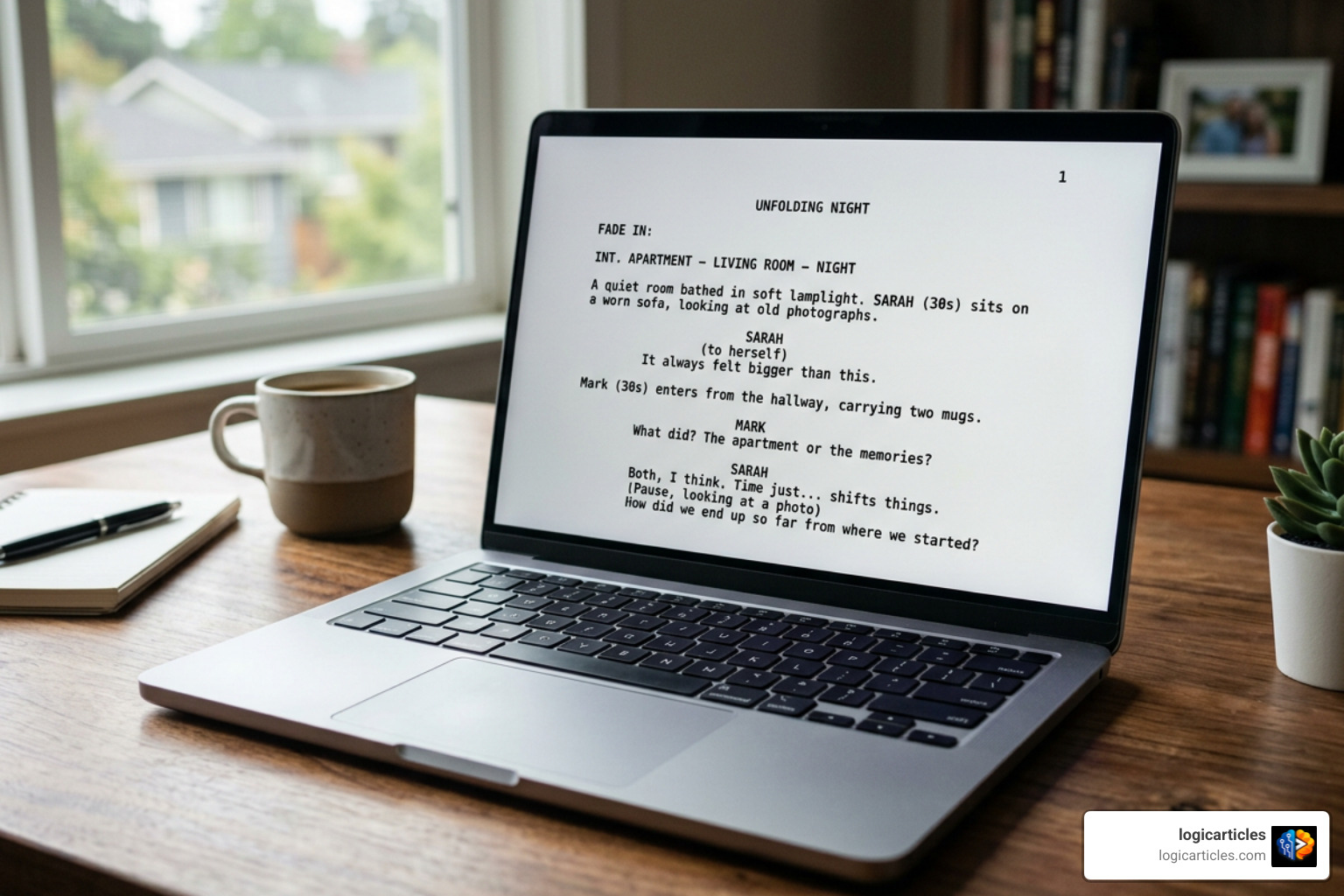
Industry-standard screenplay auto-formatting automatically handles tab stops, element cycling (like hitting Tab to jump from character name to dialogue), and page numbering. Beyond baseline formatting, modern screenwriters also require advanced workflow tools, including Writers Guild of America (WGA) standard revision tracking with color-coded pages (such as Blue, Pink, and Yellow drafts) and locked scene numbers during rewrite passes.
Screenplay Formatting vs Real-Time Collaboration
There is often a tug-of-war between traditional desktop auto-formatters and cloud-native collaborative applications. If you work solo, local auto-formatting and local data security might be all you care about. However, modern writers’ rooms often require simultaneous multi-user co-writing with live cursor tracking, embedded video chat, and continuous cloud synchronization.
For instance, platforms like Scriptio® | Screenwriting Software provide an offline-first experience using markdown-style Fountain syntax rules that automatically format elements on the fly while offering continuous background cloud sync and live collaboration for up to five simultaneous users. Finding a tool that balances automatic margin management with seamless version history prevention ensures you won’t accidentally overwrite your writing partner’s dialogue.
Pre-Production Workflows and Script Breakdowns
Writing a screenplay is only step one of the filmmaking process. Once a script is finalized, it transitions into pre-production, where directors, producers, and line producers break down scenes to estimate budgets, build shooting schedules, design storyboards, and generate daily call sheets.
If you plan to produce or direct your own script, choosing a platform like the Screenplay Writing Program | Screenwriting Format Software by StudioBinder can save hundreds of administrative hours. Integrating your script directly into down-funnel pre-production pipelines allows locked scenes to automatically populate breakdown sheets, cast lists, and shot lists without manual retyping or file converting.
Traditional Screenwriting Software vs. AI Script Writing Software
The biggest structural shift in screenwriting technology over the last few years is the rise of generative AI and natural language processing models. Traditional screenwriting software acts as a specialized, ultra-compliant typewriter. In contrast, AI script writing software promises to serve as a digital co-writer capable of evaluating story architecture, recommending scene continuations, and organizing beat sheets.
To see how these two paradigms contrast, examine the comparison table below:
| Feature | Traditional Screenwriting Tools | AI Script Writing Tools |
|---|---|---|
| Core Philosophy | Manual typing with precise layout automation | Assisted drafting, story generation, and structural analysis |
| Formatting | Strict industry standards (Courier 12pt, exact margins) | Automated conversion from prompt to industry format |
| Outlining | Static beat boards, index cards, and mind maps | Generative beat sheets, plot arc tracking, and pacing analytics |
| Context Memory | None (software treats text as basic strings) | Extended context windows (up to 200,000+ tokens) |
| Primary Audience | Studio screenwriters, production rooms, traditional filmmakers | Indie creators, solopreneurs, writers overcoming block |
Basic Autocomplete vs True Structural AI
Not every feature labeled “AI” offers real intelligence. Many legacy software vendors slap basic autocomplete onto their text editors — tools relying on decades-old pattern matching — and market it as cutting-edge artificial intelligence. In user evaluations, these autocomplete features score poorly (often rated 2 out of 5 stars for utility) because they fail to understand story architecture.
True structural AI in screenwriting utilizes expansive context windows (often 200,000+ tokens) allowing the language model to read and memorize your entire script. This enables real AI capabilities, including:
- Beat generation: Producing a multi-act beat sheet aligned with structures like Save the Cat! or The Hero’s Journey.
- Character arc tracking: Identifying narrative gaps where character motivations drift or lack dramatic tension.
- Structural pacing analysis: Visualizing scene lengths and emotional curves across Acts I, II, and III.
Tools like Laper lead this space by scoring high on structural analysis, whereas prose-heavy AI like Sudowrite excels at descriptive fiction paragraphs but struggles with screenplay layout and scene logic.
Which is the Best Tool for Script Writing First Drafts?
Can an AI draft a full, production-ready script from scratch? The quick answer is no — human voice, subtext, emotional nuances, and thematic depth remain irreplaceable. However, AI screenwriting assistants shine during the initial brainstorming and outline phase.
When evaluating which is the best tool for script writing first drafts, platforms that balance structural guidance with surgical rewrites offer the most value. For example, AI Screenwriting Software for Filmmakers | Melies offers focused, selection-aware AI passes that protect your original text while generating three alternative dialogue takes or converting basic beat outlines into structured scenes. Similarly, platforms like Squibler, used by over 20,000 writers, offer scene-by-scene drafting that maintains character consistency via dedicated story element panels.
Detailed Comparison of Leading Scriptwriting Applications

No single script writing app fits every medium. A Hollywood feature film script demands different tools than an episodic TV pilot, a multi-format stage play, a video podcast, or a high-retention YouTube video.
Industry Standard Desktop and Cloud Suites
When studio executives ask for a script, they expect an .fdx file or a flawlessly formatted PDF. Screenwriting Software | Final Draft® remains the heavy-weight champion of Hollywood, used in approximately 95% of studio film and television productions and relied upon by over 3 million writers in 100 countries.
Final Draft’s strength lies in its ecosystem: line producers, script coordinators, and assistant directors depend on its script revision system, WGA color tracking, and seamless export integration. With the launch of Final Draft Cloud alongside Final Draft 13, it bridges the gap between traditional desktop power and browser-based accessibility. However, its built-in smart suggestions are minimal compared to specialized AI assistants, making it an executive standard for output rather than an AI story generator.
Other modern alternatives include Arc Studio Pro (boasting a G2 rating of 4.7/5 stars for its clean, distraction-free environment) and WriterDuet (holding a 4.6/5 stars G2 rating and chosen by over 2 million writers for its industry-leading real-time cloud collaboration).
Which is the Best Tool for Script Writing for YouTube and Multi-Format Content?
For creators producing content outside traditional film studios, general screenwriting applications can feel overly rigid. YouTube creators, podcasters, and multi-format authors benefit from specialized software.
If you draft both screenplays and long-form fiction or digital media, Screenplay Writing Software — Mark offers an all-in-one platform featuring dual screenplay/novel modes, Courier Prime formatting, FDX exports, and multi-dimensional script analysis.
If your focus is direct video production, the Movie Script Maker | Online Screenplay Generator from StudioBinder simplifies building script outlines directly alongside shot lists. Meanwhile, niche platforms like Subscribr cater specifically to YouTube creators by analyzing audience retention pacing, while Celtx (ranked #1 for ease of use on G2) provides an accessible gateway for media students and video production teams.
Pricing, Free Trials, and Free Tier Limitations
Understanding pricing tiers, subscription models, and free plan limitations is critical before investing your time into learning a platform.
| Software | Pricing Structure | Free Tier / Trial Details | Best Suited For |
|---|---|---|---|
| Final Draft | ~$249 one-time or $9.85/mo | 5-day free trial | Professional film & TV screenwriters |
| WriterDuet | ~$9.99/mo | 3 free projects (no watermarks/page limits) | Collaborative co-writers |
| Mark | ~$12.99/mo | 14-day free trial (no credit card) | Screenplay & novel multi-format writers |
| Arc Studio Pro | ~$69/year | Generous free tier with distraction-free writing | Modern indie screenwriters |
| Celtx | ~$14.99/mo | Basic free access / trial | Film students & production teams |
| Melies | Free editor / Credit-based AI | Free core writing, formatting, import & export | Filmmakers wanting built-in storyboards |
| Scriptio | Free core / Paid Pro tier | Unlimited free writing & formatting | Offline-first markdown/Fountain writers |
Evaluating Free Plans: Watermarks, Export Limits, and Project Caps
While free scriptwriting software seems attractive, almost all free tiers impose operational constraints. When testing free software, watch out for these common limitations:
- Forced Watermarks: Some free tools stamp large branding watermarks across the header or footer of exported PDFs, rendering the draft unusable for professional submission.
- Project or Script Caps: Free plans frequently cap your account at 1 to 3 active scripts. WriterDuet, for example, allows 3 free projects without watermarks, whereas others lock your account until you upgrade.
- Export Format Lockouts: Basic accounts may restrict file exports to raw text or paginated PDFs while locking away industry-standard
.fdxor Fountain file exports behind paywalls. - Offline Access Restrictions: Web-only free plans may prevent you from accessing your scripts without an active internet connection.
Frequently Asked Questions About Script Writing Software
Can AI write a complete production-ready screenplay?
No. While modern generative tools can produce outlines, scene drafts, and dialogue ideas, AI cannot generate a complete, production-ready screenplay on its own. AI models lack true lived emotional experience, personal voice, and thematic subtlety. Scripts generated entirely by AI usually suffer from generic plot beats, predictable dialogue, and inconsistent character motivations. The best screenwriters treat AI as an assistant for overcoming writer’s block, building beat sheets, and testing alternative line polishes.
What software is used by 95% of Hollywood productions?
Final Draft is used in 95% of Hollywood film and TV productions. It has maintained its status as the undisputed industry standard for over 30 years because production managers, script coordinators, and assistant directors rely on its native .fdx file structure and production revision tracking tools.
What are the main limitations of free screenwriting tools?
The most common limitations of free screenwriting tools include project caps (limiting you to 1–3 scripts), watermarked PDF exports, missing revision tracking, restricted export file formats (such as blocking .fdx output), and disabled real-time collaboration features.
Conclusion
Determining which is the best tool for script writing ultimately comes down to your personal workflow, budget, and project goals:
- Choose Final Draft if you are submitting scripts directly to Hollywood studios, agencies, and production companies that mandate
.fdxcompliance. - Choose WriterDuet or Scriptio if you are co-writing scripts in real time with remote partners.
- Choose Melies, Laper, or Squibler if you want true AI capabilities to build story arcs, refine dialogue, and generate visual storyboards.
- Choose StudioBinder if you want an integrated pipeline that carries your script straight into pre-production call sheets and shooting schedules.
To explore more in-depth reviews and comparisons of modern software tools, check out our latest guides and analysis in the AI tools category on logicarticles.