Categorizing the Best AI Tools for Network Engineers
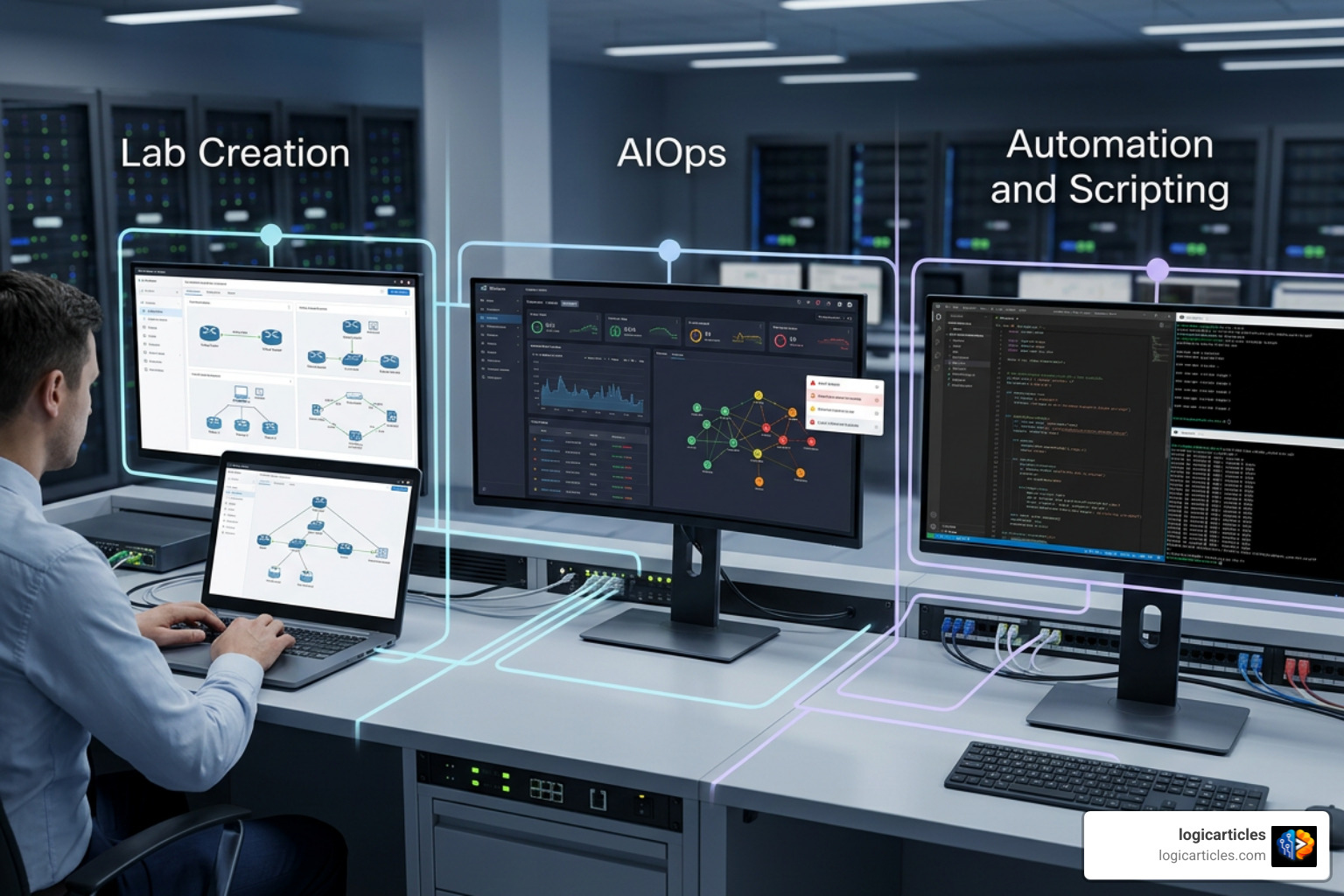
Understanding the landscape of artificial intelligence in infrastructure operations requires sorting solutions by their core operational lane. Broadly speaking, the best ai tools for network engineers fall into three primary categories: multi-vendor lab creation, production AIOps platforms, and automation coding assistants.
Best AI Tools for Network Engineers in Multi-Vendor Lab Creation
Setting up complex, multi-vendor test environments used to take days of downloading disk images, configuring hypervisors, and manually connecting virtual interfaces. Modern prompt-to-lab tools transform this workflow completely. Engineers can now describe a desired topology using natural language—such as specifying a dual-homed BGP setup across multiple hardware operating systems—and an agentic system builds it instantly.
By using containerized network operating system (NOS) images like Nokia SR Linux, Arista cEOS, Cisco IOL, and Juniper cRPD, tools like the NetPilot AI Network Emulator instantiate working topologies in about 2 minutes. Rather than relying on abstract, simulated command lines, these platforms launch authentic NOS instances. This allows engineers using platforms designed for AI for Network Engineers to interact directly with true vendor code and test syntax in safe, cloud-hosted sandboxes.
Production AIOps vs. Vendor-Specific AI Copilots
While lab generation platforms focus on pre-production staging, live network management relies on AIOps and vendor-native assistants. Enterprise AIOps platforms analyze streaming gNMI telemetry, syslog data, and SNMP metrics across complex environments to detect real-time traffic anomalies and predict performance degradation before users log tickets.
Vendor-specific AI copilots—such as Cisco AI Assistant, HPE Juniper Marvis, and Arista AVA—excel deeply within their native ecosystems. Marvis, for example, excels at identifying wireless interference and client connection issues across Mist environments, while Arista AVA simplifies telemetry searches across EOS fabrics. However, these tools face operational boundaries when traversing multi-vendor borders. A vendor-native assistant rarely has deep visibility or execution capabilities inside a competing vendor’s operating system, making independent AIOps platforms essential for heterogeneous networks.
Best AI Tools for Network Engineers for Network Automation Scripting
Drafting automation code is one of the most common daily tasks for modern engineers. AI coding assistants substantially speed up the writing of Ansible playbooks, Python scripts using Netmiko or Nornir, and Terraform manifests.
| Tool Category | Key Capabilities | Typical Validation Method | Execution Target |
|---|---|---|---|
| General LLMs (ChatGPT, Claude, Gemini) | Prompt-based playbook drafting, syntax translation, protocol explanation | Manual syntax checks, dry runs | Copy-pasting into local IDE |
| Dedicated AI Coding Tools (Cursor, GitHub Copilot) | In-line code completion, context-aware repository scanning | Linters (ansible-lint, flake8), local unit testing | Development environment |
| Specialized Agent Frameworks (NetClaw, Damira AI) | Multi-turn tool execution, intent-based network automation | Isolated lab execution, pyATS state diffing | Test sandboxes, staging networks |
While these AI utilities generate valid syntax rapidly, they lack awareness of live topology state. An AI-generated playbook might contain sound YAML syntax while simultaneously applying an IP address that creates a routing loop. Consequently, script generation tools must always be paired with rigorous pre-execution syntax verification and dry-run validation in safe lab environments.
Model Context Protocol (MCP) and Agentic Integration
A fundamental barrier to using general-purpose Large Language Models (LLMs) in networking has been their isolation from actual infrastructure context. Passing raw configuration snippets into a public chat box yields generic answers because the model lacks visibility into live routing tables, topology layouts, and organization-specific standards. Model Context Protocol (MCP) solves this problem by creating an open standard that connects LLMs directly to external systems and data sources.
MCP acts as a secure bridge, allowing AI agents to query live network metadata, source-of-truth databases, and controller APIs at runtime. Catalog guides identify dozens of production-ready MCP servers mapping directly into the network stack. Integrations like Damira AI bring specialized CCIE-level instructions and decision-tree logic into tools like Claude Desktop and VS Code. Developers can also use the FastMCP Python framework to build custom MCP servers that expose internal device APIs as structured tools for AI assistants.
Open-Source Agentic Frameworks and MCP Implementations
Beyond individual servers, full agentic frameworks leverage MCP to orchestrate complex multi-step workflows. Open-source solutions like NetClaw on GitHub pair nearly 200 operational skills with over 100 MCP integrations.
One challenge with managing extensive network toolsets in LLMs is token consumption. Feeding large tool schemas and verbose CLI outputs into a prompt window quickly degrades model performance and inflates operational costs. To overcome this, advanced frameworks use Graph Compact Format (GCF) encoding to compress network topology and state payloads by 55% to 83%. Coupled with federated agent architectures that distribute specialized tasks across dedicated sub-agents, these tools minimize context bloat while executing automated discovery, state audits, and troubleshooting pipelines.
Runnable Digital Twins vs. Passive Network Verification
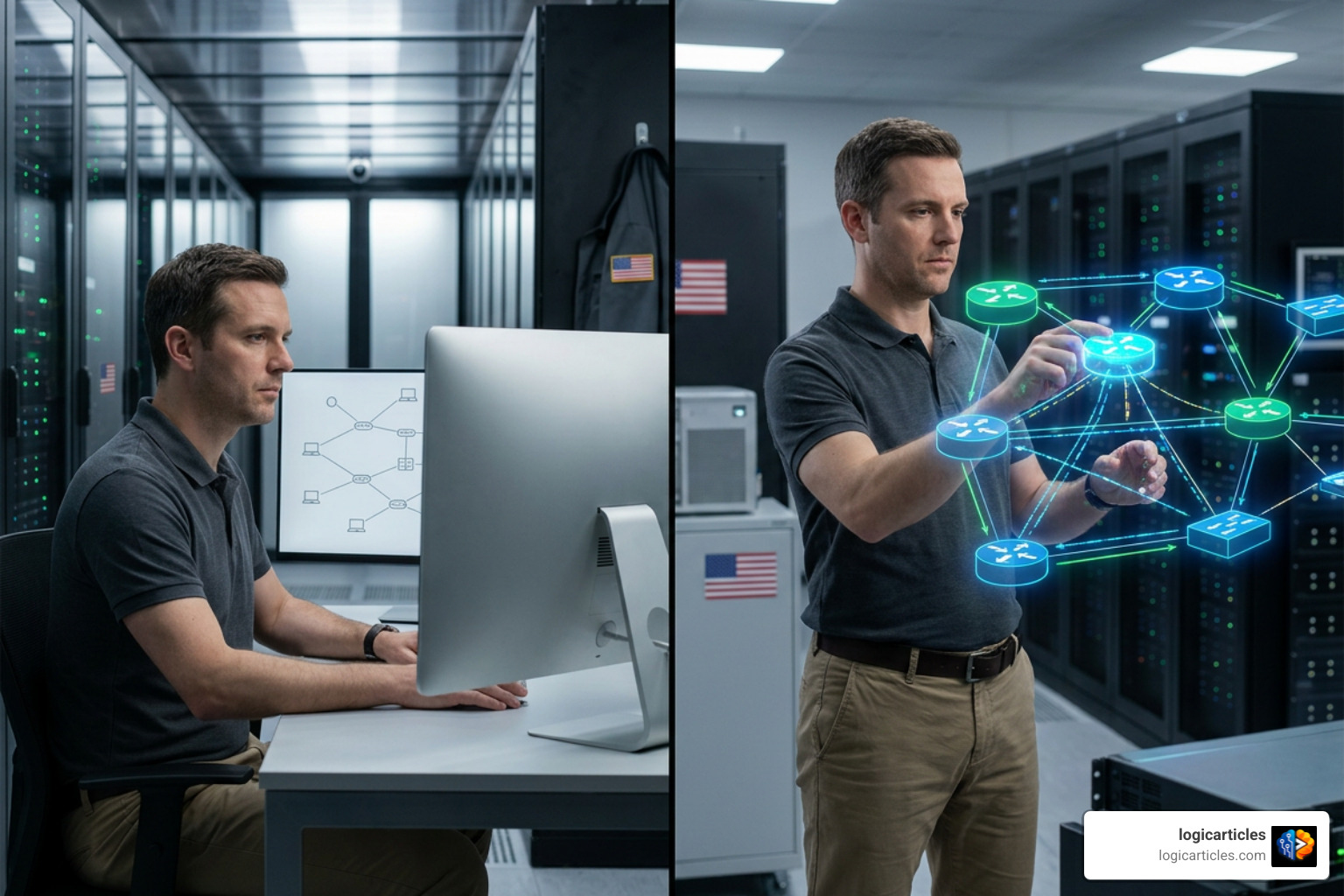
Validating changes before pushing them to live infrastructure is crucial for avoiding downtime. However, the industry uses two distinct approaches to pre-deployment modeling: passive telemetry verification tools and runnable digital twins.
Passive Telemetry Twins vs. Executable Digital Twins
Passive digital twins—such as those built by Forward Networks or open-source tools like Batfish—parse collected configurations, routing tables, and telemetry to create static mathematical models of the network. They excel at proving invariants, such as confirming whether a specific host can reach an internal database through complex ACL rules. However, because they are read-only mathematical abstractions, they cannot run live, interactive CLI commands or execute dynamic software updates.
In contrast, a Runnable Network Digital Twin from NetPilot constructs an active, executable replica using real, containerized network operating systems. Engineers can SSH directly into device command lines within the twin, execute candidate change scripts, observe real-time control plane protocol negotiation (such as BGP or OSPF convergence), and evaluate actual system response before scheduling maintenance windows.
Local-First Agentic NetOps and Intent-Based Verification
For organizations that require strictly isolated environments or operate air-gapped infrastructure, open-source local-first frameworks provide an accessible alternative. Projects like the AIMusubi NetOps framework demonstrate how local LLMs can interact with real network hardware via RESTCONF, Arista eAPI, and VyOS endpoints.
By deploying intent engines on local workstation hardware or homelabs, engineers can execute intent-based operations safely. The framework automatically captures pre-change operational state, applies candidate configurations through unified vendor adapters, performs post-change verification diffs, and triggers an automated rollback if protocol adjacencies fail to re-establish properly.
AI Tool Validation, Risk Mitigation, and Enterprise Workflows
Deploying AI in enterprise operations requires addressing significant risk factors, chief among them hallucination—where an LLM confidently outputs incorrect CLI commands or invalid routing parameters.
To mitigate these risks, enterprise integration strategies rely on strict guardrails:
- PII Masking and Sanitization: Strip passwords, SNMP community strings, private IP ranges, and proprietary hostnames locally before passing diagnostic outputs to external AI providers.
- Least-Privilege API Access: Restrict AI agent execution credentials to read-only accounts during initial analysis, utilizing approval gates for any configuration changes.
- Fail-Closed Guardrail Proxies: Implement proxy layers that intercept and evaluate AI-generated commands against organizational policy matrices before sending syntax to network devices.
- CI/CD Pipeline Integration: Embed automated syntax checks (such as
ansible-lintandpyATSoperational state checks) into version control pull requests.
Source-of-Truth Syncing and Workflow Orchestration
AI agents operate best when guided by accurate structural data. Integrating AI systems with centralized source-of-truth platforms like NetBox or Nautobot ensures that topology generation and IP allocation draw from curated, authoritative data rather than statistical guesswork.
In enterprise environments, AI tools should interface directly with IT Service Management (ITSM) software like ServiceNow or Jira. An agentic workflow can automatically generate a pre-change digital twin, capture state diffs, compile a Method of Procedure (MOP) document with a validated rollback plan, and attach these artifacts directly to a change ticket for human peer review.
Career Development and AI Upskilling for Network Engineers
The integration of artificial intelligence into network engineering changes the core skill set required for career advancement. Traditional CLI fluency remains vital, but modern engineers must complement domain expertise with data engineering and automation skills.
- API and Metadata Standards: Deepen proficiency in structured data formats including JSON, YAML, YANG models, and RESTCONF/NETCONF protocols.
- Model Context Protocol (MCP): Learn how to deploy, configure, and construct custom MCP servers using Python SDKs to expose internal tools to AI engines.
- Modern Certification Paths: Focus on updated curriculum standards like CCNA v1.1, which introduces generative AI concepts, or structured vendor training like the Cisco AI Business Practitioner (AIBIZ) and Technical Practitioner paths.
- Python Automation Libraries: Master foundational automation frameworks such as Nornir, Netmiko, and pyATS to write programmatic test suites that validate AI-suggested changes.
- Prompt Engineering and Context Curation: Develop techniques for constructing precise, context-rich prompts that supply AI models with explicit constraints, output schemas, and security boundaries.
Frequently Asked Questions about Network AI Tools
Can generative AI tools replace human network engineers?
No. Generative AI tools excel at accelerating repetitive tasks, drafting initial code, and parsing verbose log files, but they lack holistic physical context, architectural reasoning, and ultimate operational accountability. Network engineering relies on human judgment to evaluate business risk, validate safety parameters on live infrastructure, and interpret physical topology constraints that an LLM cannot observe directly.
How does Model Context Protocol (MCP) prevent LLM network hallucinations?
MCP reduces hallucinations by providing the LLM with direct access to live, structured environment data at runtime. Rather than relying solely on frozen training data to guess network states or protocol syntax, the model queries live devices, IPAM databases, or standard documents via defined tool schemas. Supplying accurate, real-time context significantly narrows the statistical probability of incorrect responses.
How do I validate AI-generated Ansible playbooks before production execution?
Always validate AI-generated playbooks through a multi-stage process: first, run local syntax linters (ansible-lint) and dry-run execution checks (--check mode); second, apply the playbook against an isolated multi-vendor sandbox or runnable digital twin; finally, execute automated post-change validation tests using pyATS or Nornir to confirm that interface statuses, routing tables, and traffic paths match expected criteria.
Conclusion
The best ai tools for network engineers enhance operational capability rather than replacing core engineering expertise. By shifting from unstructured chat interactions to context-aware, agentic workflows, engineering teams can eliminate routine setup friction, speed up root-cause analysis, and validate complex change requests before they cause outages. Combining fast AI automation with rigorous human oversight ensures that network infrastructure remains scalable, resilient, and secure. Explore more AI tool insights to stay ahead in modern network engineering.