Overview of Popular Productivity Software Categories
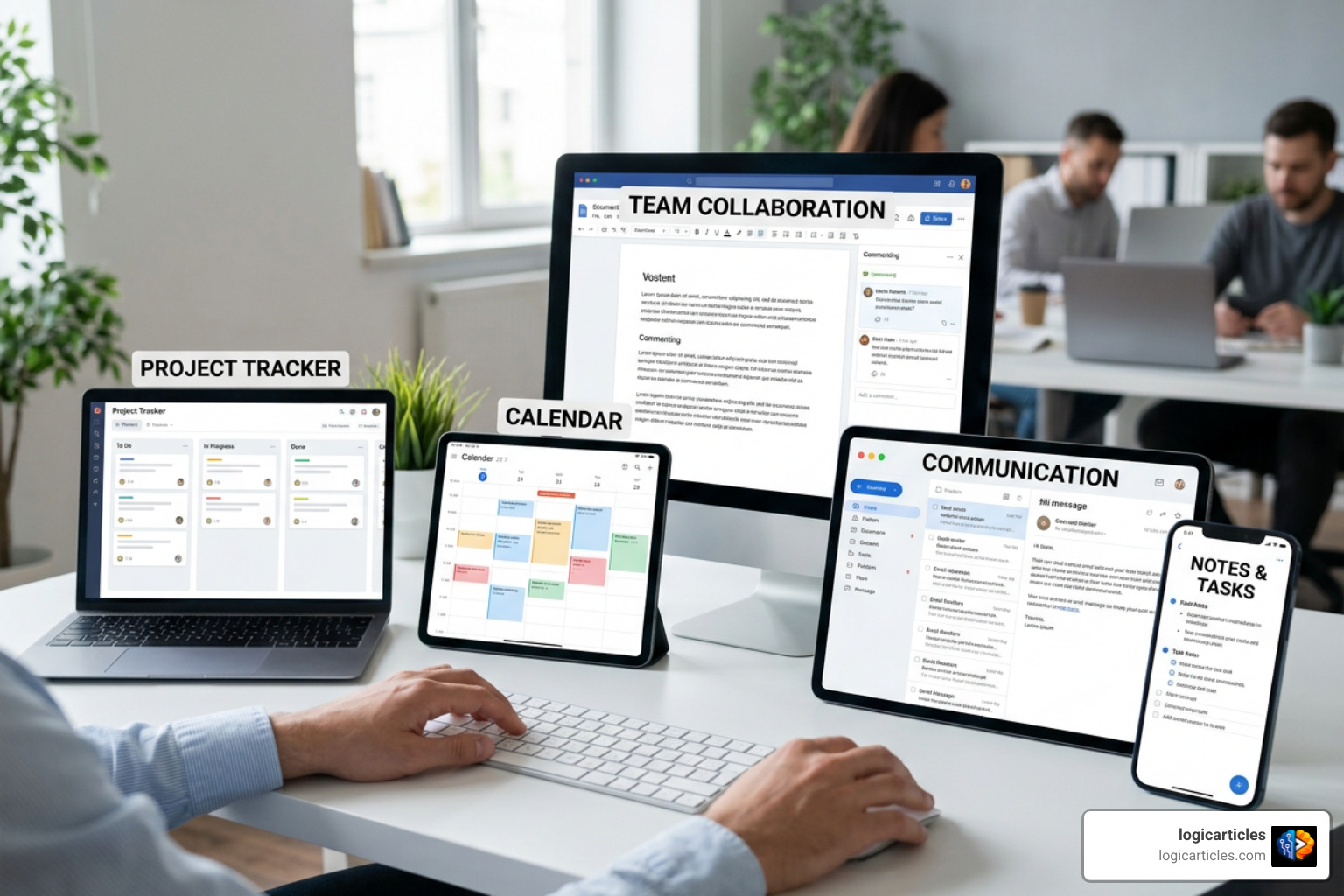
Understanding the software landscape begins with recognizing why app sprawl happens in the first place. When teams run into operational friction, their instinct is often to download a new app to fix it. Without a clear strategy, a company quickly ends up with separate apps for messaging, task management, client notes, file storage, and time tracking. According to recent industry insights on the Data reveals the most productive & distracting apps of 2025, maintaining central alignment across digital workspaces is critical, especially when employees switch between home, office, and client environments.
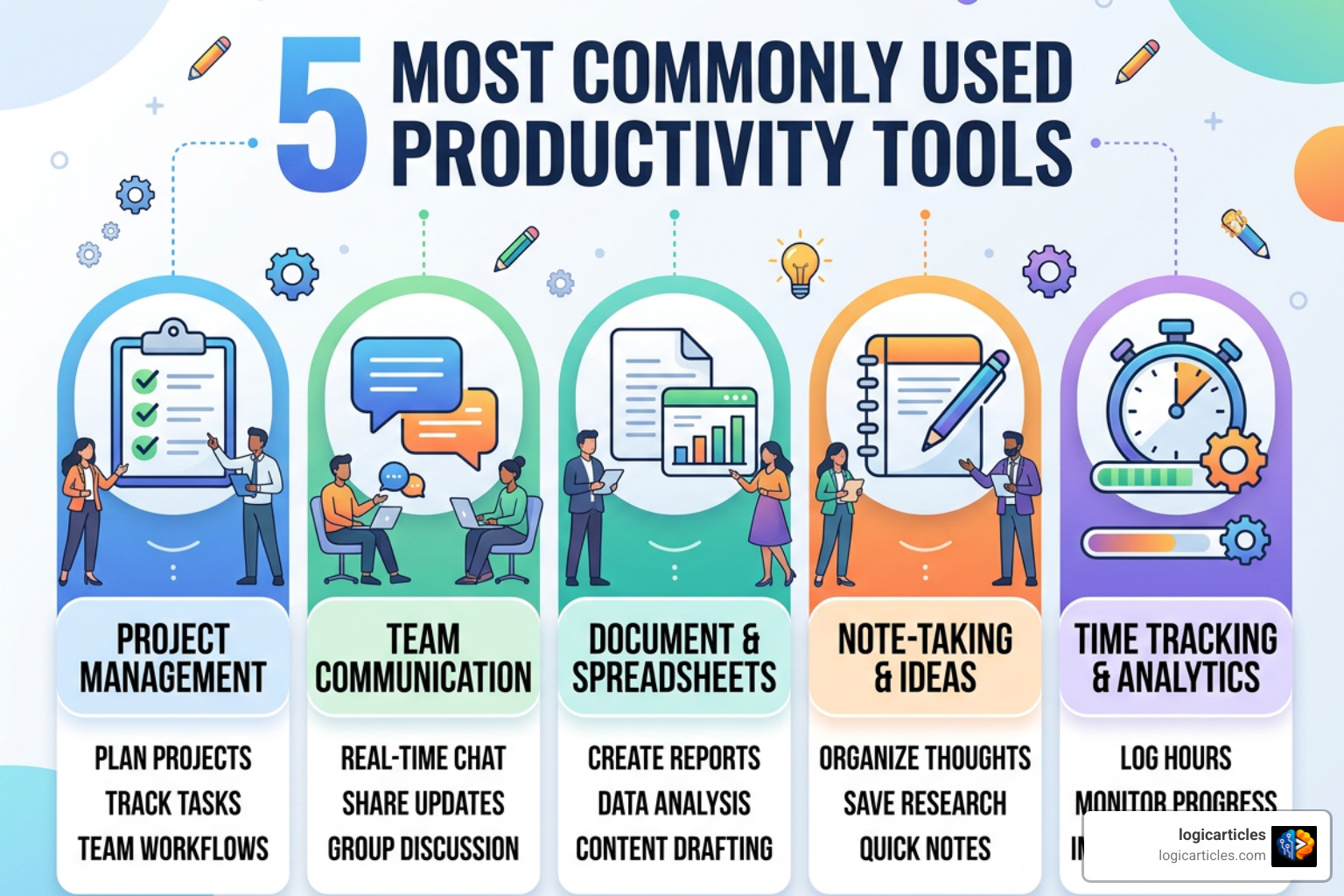
To keep a workforce aligned without creating administrative drag, top-performing organizations build their tech stack around five fundamental functional categories:
- Task and Project Management: Provides visual task visibility, tracks owner accountability, establishes milestones, and connects daily execution to project profitability.
- Asynchronous & Real-Time Communication: Separates quick, daily team chatter from project-critical documentation, preventing decisions from getting buried in traditional email chains.
- Knowledge Management & Wikis: Acts as a centralized digital “second brain” where process documentation, meeting summaries, and operational SOPs live.
- Cloud Document Creation & Storage: Enables simultaneous real-time co-authoring, file sharing, and spreadsheet analysis with client-grade permission controls.
- Resource Planning & Time Tracking: Measures actual billable effort against project budgets, protects team member capacity, and prevents burnout.
Project Management Software (ClickUp & Asana)
When project tasks live exclusively in email threads or personal notebooks, deadlines inevitably fall through the cracks. Purpose-built project management platforms provide a central source of truth for every task, deliverable, and milestone.
As highlighted in the 10 Best Productivity Tools & Apps in 2026 | ClickUp breakdown, modern project tracking extends far beyond basic to-do lists. Platforms like ClickUp and Asana offer flexible view options—including visual Kanban boards, Gantt charts, and workload views—that allow teams to organize work according to their preferences.
For professional service providers and agencies, these platforms bridge the gap between daily task execution and underlying financial health. By linking custom task fields directly to project budgets, leaders can track milestone progress, estimate client profitability, and spot scope creep before it damages project margins.
Communication and Collaboration Hubs (Slack)
Internal email is often where quick decision-making goes to die. Relying on inbox threads for day-to-day team communication creates data silos, causes version-control confusion, and delays simple approvals.
Dedicated communication hubs like Slack solve this issue by organizing conversations into dedicated, searchable channels arranged by topic, department, or client project. Teammates can post quick status updates, drop in files, conduct quick audio huddles, or tag colleagues for immediate feedback.
Furthermore, Slack’s extensive integration ecosystem allows automated system alerts—such as custom website contact form submissions, deployment updates, or project status changes—to stream directly into relevant team channels, drastically reducing manual update emails.
All-in-One Documentation and Wikis (Notion)
Without a centralized documentation platform, company knowledge gets scattered across private local drives, outdated text files, and forgotten chat messages. Notion solves this problem by combining flexible note-taking, collaborative wikis, and dynamic database structures inside a single interface.
Many organizations utilize Notion to build their internal “second brain.” Teams can draft meeting notes, build company handbooks, track hiring pipelines, and establish standard operating procedures (SOPs) using flexible content blocks. Because these documents can link directly to relational databases, a meeting note recorded today can instantly pull data from an active project record without requiring duplicate entries.
Cloud Workspace and Document Suites (Google Workspace)
A foundational cloud workspace is non-negotiable for modern operations. Google Workspace (comprising Gmail, Google Docs, Sheets, Drive, and Meet) remains an essential operational anchor for millions of businesses globally.
The platform’s strength lies in its frictionless, real-time co-authoring environment. Multiple team members can review a project proposal, edit complex financial spreadsheets, leave line-item comments, and resolve suggestions simultaneously without saving conflicting document versions. Deep integration across Google Calendar and Gmail ensures that client scheduling, team video conferencing, and cloud document permissions remain seamless across desktop and mobile devices.
Time Tracking and Resource Planning (Toggl Track)
If you don’t track where operational hours are spent, managing project scope or client profitability is nearly impossible. Dedicated time tracking tools like Toggl Track give organizations clear visibility into team utilization rates and task allocations.
Through one-click timers and intuitive browser extensions, team members can log billable and non-billable hours directly inside their project documents or web browsers. For service leaders, this real-time time tracking data provides the objective metrics needed to balance team workloads, establish accurate project estimates for future clients, and protect staff from taking on unrealistic workloads.
Comparing Free vs Paid Software Tiers
Most modern software platforms operate on a freemium model. While free tiers offer an easy way to test basic functionality, growing organizations often hit feature limitations quickly. Understanding when to upgrade prevents unexpected workflow disruptions.
| Tool Name | Free Tier Limitations | Key Upgrade Triggers | Target Team Size |
|---|---|---|---|
| ClickUp / Asana | Limited storage, basic view layouts, capped custom fields. | Advanced automation needs, custom guest permissions, Gantt chart dependencies. | 1 to 50+ users |
| Slack | 90-day message history cap, limited canvas integrations. | Access to full search archives, external guest channels (Slack Connect), SSO security. | 3 to 100+ users |
| Notion | Block caps for team workspaces, basic file upload limits. | Unlimited team members, granular workspace permissions, advanced AI capabilities. | Solopreneurs to Enterprise |
| Google Workspace | 15 GB storage per personal account, basic administrative controls. | Custom domain business email, advanced administrative security, pooled cloud storage. | 1 to Unlimited |
| Toggl Track | Up to 5 users, basic reporting exports, standard tracking features. | Detailed billable rate calculations, resource capacity planning, automated timesheet audits. | Freelancers to Growing Agencies |
Key Features of the 5 Most Commonly Used Productivity Tools
When evaluating software tiers across the 5 most commonly used productivity tools, look closely at the operational features that protect team output:
- Task Dependencies: Automatically prevents team members from starting downstream tasks until prerequisite deliverables receive formal approval.
- Custom Fields & Metadata: Allows teams to tag tasks with financial costs, client account names, priority tiers, or custom approval statuses.
- Granular Role Permissions: Enables managers to invite external clients or freelancers into specific project spaces without exposing sensitive internal data or administrative settings.
- Built-In AI Copilots: Summarizes long document threads, generates initial draft content, extracts action items from raw meeting notes, and automates routine data classification.
Evaluating the 5 Most Commonly Used Productivity Tools for Your Stack
Before adding a new subscription to your company credit card, perform a candid audit of your existing software stack. Adopting new software without assessing your existing processes often complicates workflows rather than streamlining them.
When evaluating the 5 most commonly used productivity tools, apply the 30-Day Testing Rule: introduce a candidate tool to a small focus group handling a single, contained workflow (such as managing a weekly content sprint or tracking a single client onboarding project). Evaluate the tool over a full 30-day operational cycle. If the software fails to save measurable time, reduce email volume, or improve output visibility during that window, delete it before rolling it out to your broader team.
How to Choose Among the 5 Most Commonly Used Productivity Tools
To select the right software mix for your operational requirements, score each prospective tool against four core evaluation criteria:
- Operational Fit: Does the software align naturally with how your team already works, or does it demand extensive daily administration just to stay updated?
- API & Native Connectivity: Can the platform send and receive data smoothly with your core software suite through native integrations or webhooks?
- User Interface Simplicity: Is the layout intuitive enough for non-technical team members to adopt quickly without weeks of mandatory training?
- Total Cost of Ownership (TCO): Does the per-user pricing scale sustainably as your head count grows, accounting for required add-ons and administrative costs?
How to Avoid Tool Fragmentation and Consolidate Workflows

Recent studies show that knowledge workers switch between applications nearly 1,200 times each day. This rapid app-toggling wastes roughly four hours per week just resetting attention between fragmented interfaces.
When your team relies on separate apps for task management, client notes, document drafts, team messaging, and time logging, data silos are inevitable. Team members spend more time manually copying updates between platforms than doing actual productive work. In fact, research indicates that 92% of professional services leaders believe their current tech stack falls short on data reporting, while 57% of teams spend more time assembling status reports than delivering project work.
To eliminate tool fragmentation, build a consolidated tech stack centered around a single core platform that serves as your workspace’s central source of truth. As explored in the guide to Best AI Productivity Tools 2026 for Smarter Work, software value has shifted from manual velocity to workflow compression. Connect your core applications so that an action in one tool automatically triggers updates in another:
When software integrations handle these routine background updates automatically, your team reclaims valuable focus time, eliminates duplicate data entry, and lowers overall software expenditure.
Frequently Asked Questions About Productivity Software
What are the 4 main types of productivity tools?
The four core categories of productivity tools are:
- Project Management Platforms: Apps like ClickUp or Asana that track tasks, owners, dependencies, and project milestones.
- Communication & Collaboration Hubs: Real-time messaging applications like Slack that manage team discussions and instant messaging.
- Documentation & Knowledge Bases: Centralized wikis like Notion or Google Docs used to store SOPs, notes, and organizational knowledge.
- Time & Resource Management Tools: Tracking software like Toggl Track that logs billable hours, tracks team capacity, and monitors project effort.
How many productivity tools should a team use?
Most productive teams run a compact core stack of four to six primary tools. Maintaining more than six active applications often causes workflow overlap, increases context switching, and creates data silos where critical project updates get lost. Adopting a lean stack ensures every app fulfills a distinct operational role without burdening employees with duplicate administrative work.
Are team productivity tools worth the financial investment?
Yes, selected thoughtfully, dedicated productivity software yields a clear return on investment. Research demonstrates that organizations strengthening team collaboration experience a 39% increase in overall productivity, while 87% of workers feel significantly more engaged when leveraging modern collaboration software daily. For professional services firms, centralizing work management can improve billable resource utilization by over 20%, directly protecting project profit margins and generating substantial revenue gains.
Conclusion
Building an efficient tech stack isn’t about collecting the newest applications on the market—it is about choosing a cohesive set of tools that solves your team’s specific operational bottlenecks. By consolidating your workflows around the 5 most commonly used productivity tools—a project manager, a communication hub, a knowledge wiki, a cloud document suite, and a resource tracker—you eliminate app fragmentation and empower your team to focus on meaningful work.
Take time to audit your team’s daily processes, test software using limited 30-day trials, and prioritize platforms that integrate seamlessly with your core systems. To discover more operational strategies, workflow guides, and modern workplace insights, Explore Productivity Strategies at LogicArticles to streamline your business operations today.