10 Uses of Artificial Intelligence in Daily Life With Pictures

10 uses of artificial intelligence in daily life with pictures include the apps and devices many people already use every day:
- Navigation apps that predict traffic and suggest faster routes
- Streaming services that recommend shows, films, and music
- Voice assistants that respond to spoken commands
- Banking systems that flag suspicious purchases
- Smart home devices that automate lights and temperature
- Health tools and wearables that monitor vital signs
- Customer-service chatbots that answer common questions
- Predictive text, autocorrect, and writing assistants
- Social media feeds that rank content for each user
- Shopping tools that suggest products and enable visual search
AI is not a robot that thinks and feels like a person. Most everyday AI is narrow AI: software trained to spot patterns, make predictions, or handle a specific task.
That is why it can feel invisible. One consumer survey found that only 33% of people believed they used AI, while more than 77% were using an AI-powered device or service. From the route you take to work to the card alert that protects your account, AI is already part of ordinary routines.
Understanding Artificial Intelligence Beyond Common Misconceptions
When many of us hear the phrase “artificial intelligence,” science fiction movies immediately come to mind. We think of sentient androids, self-aware supercomputers, or apocalyptic takeover scenarios. In reality, modern artificial intelligence is far more practical, helpful, and grounded.
At its core, artificial intelligence refers to computer software built to mimic human-like cognitive functions—such as learning, pattern recognition, problem-solving, and decision-making. Today, virtually all software applications we interact with fall into the category of Narrow AI (or Weak AI). Narrow AI systems are explicitly designed and trained to excel at a single specific task, whether that is spotting fraudulent transaction patterns, parsing spoken voice prompts, or calculating the fastest route through peak hour traffic. In contrast, General AI—a theoretical machine capable of matching human intellect across any domain—remains strictly conceptual.
How do these systems actually work under the hood? Modern AI relies heavily on Machine Learning (ML) and Deep Learning. Instead of engineers writing millions of static “if/then” rules by hand, machine learning models analyze massive datasets to identify complex mathematical patterns. Deep learning takes this a step further by using artificial neural networks—layered algorithmic structures loosely inspired by the biological connections in the human brain. These networks process raw sensory or digital inputs, such as images, voice recordings, or transaction logs, to output accurate predictions in real time.
Because these capabilities operate quietly behind sleek touchscreens and clean app interfaces, most of us use them continuously without giving them a second thought. Recent data underscores how fast this adoption has accelerated. A Pew Research survey revealed that 31% of Americans interact with AI multiple times every single day. Furthermore, polling from April 2026 revealed that 50% of adults had actively used an AI-powered service within the past week alone. Meanwhile, professional usage has doubled over the past two years, proving that AI literacy is rapidly becoming a standard life skill.
10 Uses of Artificial Intelligence in Daily Life with Pictures
To better understand how these systems enhance our day-to-day productivity and safety, let us take a close visual look at the top ten everyday applications.
1. Navigation and Traffic Prediction: 10 Uses of Artificial Intelligence in Daily Life with Pictures
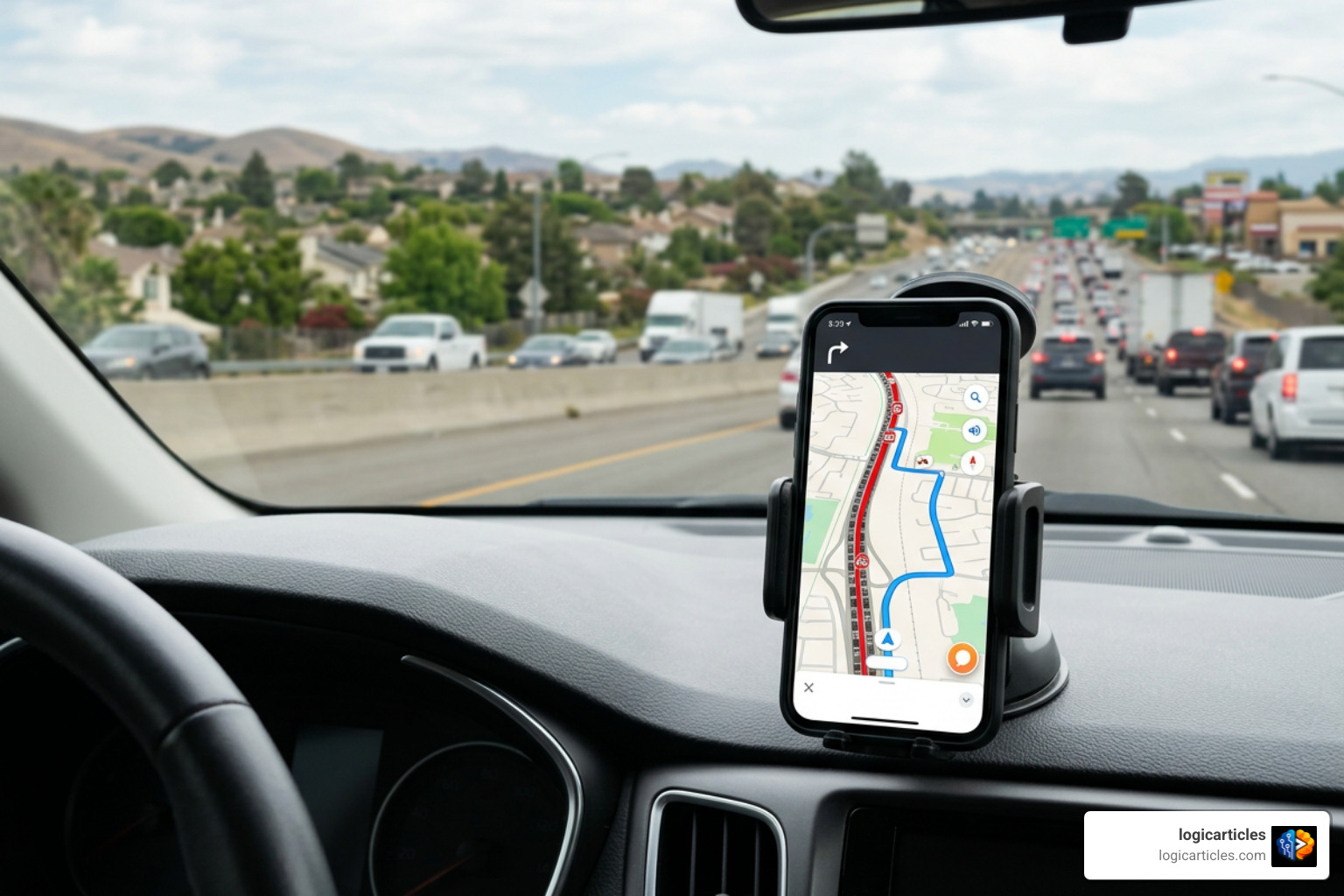
We have all experienced the relief of avoiding a sudden highway backup because our mapping app prompted us to take an unexpected exit. Modern mapping and navigation tools like Google Maps and Waze rely on deep graph neural networks to turn millions of raw data points into seamless travel instructions.
Every second, navigation platforms ingest anonymized GPS location pings from thousands of active vehicles, historical traffic speed metrics, local weather reports, municipal road construction schedules, and user-submitted accident alerts. AI algorithms continuously parse this live telemetry to identify emerging bottlenecks long before they become visible to the human eye.
Instead of treating maps as static drawings, AI treats road networks as dynamic graphs. It recalculates thousands of route combinations per second, dynamically adjusting estimated arrival times (ETAs) and offering turn-by-turn rerouting suggestions. This continuous predictive sorting saves commuters hours every month while reducing fuel consumption and emissions.
2. Streaming Recommendations and Content Personalization

When we log onto streaming platforms such as Netflix, Spotify, or YouTube after a tiring workday, we are greeted by a customized homepage that feels tailored specifically to our personal tastes. This level of customization is driven by sophisticated recommendation engines operating continuously in the background.
Recommendation engines utilize machine learning techniques known as collaborative filtering and content-based filtering. Content-based filtering categorizes media items based on metadata traits, such as genre, sub-plots, artist style, tempo, or length. Collaborative filtering, on the other hand, analyzes behavior across millions of users simultaneously. If the system notes that thousands of viewers who enjoyed a specific documentary also ended up binge-watching a particular sci-fi thriller, it automatically recommends that thriller to you.
These platforms build hyper-detailed predictive profiles using watch histories, skipped tracks, completion rates, time of day, and even device types. By removing the decision fatigue of browsing through thousands of options, AI keeps us entertained while ensuring independent creators and back-catalog films find their ideal audiences.
3. Voice Assistants and Natural Language Processing
“Hey Siri, set a timer for 15 minutes.” “Alexa, what is the weather forecast today?” “Google, call Mom on speaker.” Smart virtual voice assistants have transitioned from novel tech experiments into essential household hubs.
Turning spoken sound waves into logical digital actions requires sophisticated Natural Language Processing (NLP). When we speak to a smart device, an acoustic model converts audio frequencies into phonemes and text transcriptions within milliseconds. Next, a natural language understanding (NLU) model analyzes the sentence structure to discern intent and extract key variables (such as “timer length” or “contact name”).
Voice assistants are shifting from basic, reactive query engines into context-aware digital partners. Modern NLP systems adapt to individual vocal biomarkers, regional accents, speech cadences, and household idioms over time. Today, virtual assistants transcribe human speech, interpret intent, and route tasks to third-party software applications in under a second.
4. Financial Security and Real-Time Fraud Detection
If you have ever received an instant text alert from your bank asking you to confirm an unfamiliar transaction made in another city or country, you have experienced AI-driven fraud prevention in action.
Financial institutions process billions of electronic card transactions daily. Human security auditors could never manually review even a fraction of this volume. Instead, deep learning models analyze every swipe, tap, and online purchase in real time—typically taking under 100 milliseconds to assign a risk score before approving or declining the transaction.
AI models accomplish this by establishing a precise baseline profile of your routine spending habits. The system tracks historical transaction amounts, typical merchant categories, geographic coordinates, purchasing time windows, and device identifiers. If your physical card is suddenly charged at a luxury goods store thousands of miles away minutes after you bought a coffee down the street, the model flags the anomalous variance, instantly freezes the transaction, and sends an alert to your mobile phone.
5. Smart Home Automation: 10 Uses of Artificial Intelligence in Daily Life with Pictures
Smart home technology has evolved far beyond controlling light bulbs with a smartphone app. Today’s smart home ecosystems integrate artificial intelligence and Internet of Things (IoT) sensors to optimize home comfort, security, and power consumption automatically.
Consider intelligent thermostats. Rather than relying on rigid manual programming schedules, these devices use machine learning algorithms to learn household occupancy patterns over several weeks. By combining ambient temperature readings, humidity metrics, and movement sensor data, the thermostat learns when residents wake up, leave for work, return home, or go to sleep.
Additionally, smart home systems coordinate energy usage dynamically. They pre-heat or pre-cool living spaces during off-peak energy hours to reduce electricity bills. Research indicates that learning thermostats cut household heating and cooling expenses by an average of 10% to 15%. Similar background AI models automate smart plugs to shut off unused appliances, adjust motorized window blinds based on sunlight angles, and detect water leaks before catastrophic structural damage occurs.
6. Healthcare Diagnostics and Fitness Wearables
Artificial intelligence has made medical monitoring personally accessible through daily health wearables and medical imaging applications. Smartwatches and fitness bands continuously record photoplethysmography (PPG) optical light signals, skin temperatures, motion metrics, and electrocardiograms (ECG).
Machine learning algorithms embedded within wearable software analyze these continuous streams of biometrics to establish personal baseline metrics. When sudden irregularities occur—such as extended periods of elevated resting heart rate or irregular heart rhythms indicative of atrial fibrillation—the wearable prompts the user to rest or seek medical evaluation. Furthermore, built-in accelerometers and gyroscopes run machine learning models trained on crash and fall dynamics, allowing modern smartwatches to automatically contact emergency services if a user experiences a severe accident.
In professional clinical settings, deep learning visual algorithms analyze complex medical imaging like X-rays, CT scans, and MRIs. Predictive AI systems in hospitals are capable of detecting early-stage tumors and flagging life-threatening conditions like sepsis hours earlier than standard manual checks, giving medical professionals critical extra time to intervene.
7. AI Customer Support Chatbots and Virtual Help
We have all used customer support messaging tools on e-commerce sites, banking portals, or travel service platforms. While older customer support tools relied on frustrating, fixed decision-tree scripts, modern AI customer-service chatbots leverage advanced Large Language Models (LLMs) and sentiment analysis.
Modern conversational AI tools understand context, nuance, and user intent expressed in plain language. They can look up order tracking numbers, process item returns, update subscription billing methods, and resolve multi-step inquiries without human intervention 24/7.
When a customer expresses frustration through specific phrasing or punctuation, sentiment analysis models recognize the emotional shift and automatically route the customer conversation log to a qualified human representative. By handling up to 80% of routine customer service inquiries instantly, conversational AI dramatically reduces wait times for users while reducing operational costs for businesses.
8. Predictive Text, Autocorrect, and Writing Assistance
Whether you are typing a quick text message on a smartphone or drafting a formal business proposal on a laptop, artificial intelligence actively refines your prose as you type.
Modern smart input keyboards, autocorrect engines, and grammar assistance tools rely on transformer-based language models and probabilistic algorithms like random forests. Instead of checking typed words against a static dictionary, these systems analyze surrounding sentence context to predict the exact word you intend to type next.
As you use your device over time, local machine learning models adapt to your personal vocabulary, custom jargon, family names, and unique phrasing habits. On a broader level, writing assistants analyze sentence structures, passive voice construction, and tone metrics to suggest conciseness improvements, formatting fixes, and grammar edits. This allows us to communicate faster, clearer, and with significantly fewer typos across our personal and professional lives.
9. Social Media Algorithms and Content Discovery
Social media networks serve custom content streams to billions of daily active users. Behind every scroll, swipe, and refresh sits an aggressive algorithmic engine built to optimize feed content discovery.
Social algorithms process hundreds of signals in real time to evaluate whether a video, photo, text post, or advertisement should appear on your feed. These signals include your historical viewing duration, post likes, comments, shares, account relationships, and sound tag preferences. Machine learning models test short video clips on small sample audiences before deciding whether to push them to broader target demographics.
While these feed systems optimize for user retention and content discovery, implementing smart AI integration strategies allows individuals to train social algorithms deliberately. By intentionally saving constructive topics, unfollowing negative triggers, and filtering keyword preferences, users can turn their digital feeds into high-value hubs for news, skill learning, and professional inspiration.
10. E-Commerce Personalization and Visual Shopping
Online shopping has been transformed by background artificial intelligence that makes finding, evaluating, and purchasing products easier than ever. About two-thirds of U.S. consumers regularly interact with AI while shopping online.
One major innovation in retail is visual search. By integrating computer vision models into smartphone cameras and shopping apps, consumers can take a picture of a sweater, a piece of furniture, or an unfamiliar kitchen utensil and immediately locate identical or visually similar items for sale across thousands of online retailers.
Furthermore, e-commerce platforms utilize dynamic pricing algorithms that adjust inventory pricing based on real-time market trends, local demand, and competitor rates. Behind the scenes, real-time AI personalization engines analyze past browsing behaviors to display tailored product bundles and store recommendations. Industry data shows that real-time AI personalization models generate up to a 20% higher conversion rate than traditional static shopping displays because they connect buyers with relevant products instantly.
Trade-Offs, Privacy Risks, and Ethical Considerations of Daily AI
While artificial intelligence offers extraordinary daily convenience, speed, and safety enhancements, relying heavily on automated software introduces significant trade-offs that every modern consumer should understand.
The primary concern surrounding daily AI adoption is data privacy and collection. Modern AI systems require massive volumes of personal behavioral data to deliver personalization. Smart home sensors map our daily living hours, recommendation engines track our media preferences, and location tools log our physical routes. If device permissions are configured carelessly, personal data can be aggregated for aggressive targeted advertising or exposed through third-party data breaches.
A second trade-off involves algorithmic bias and hallucinations. Because machine learning models are trained on historical human datasets, they can perpetuate societal biases regarding gender, race, or socio-economic backgrounds in credit scoring, job recruiting, and automated moderation. Furthermore, conversational AI tools can occasionally output incorrect facts confidently (referred to as “hallucination”), underscoring why critical human verification remains vital.
Finally, there are risks regarding over-reliance and attention capture. Relying entirely on predictive algorithms for navigation, writing, and schedule management can gradually erode critical spatial thinking, memory recall, and problem-solving skills. Moreover, engagement algorithms are specifically optimized to capture human attention, making intentional digital boundaries essential for maintaining mental well-being.
| Daily AI Feature Area | Everyday Productivity & Safety Benefits | Privacy, Ethical, & Operational Risks |
|---|---|---|
| Navigation & Commuting | Avoids traffic jams, optimizes arrival times, and lowers fuel consumption. | Continuous GPS telemetry logging and potential location tracking concerns. |
| Financial & Fraud Alerts | Prevents unauthorized credit card theft and blocks suspicious transactions within milliseconds. | False-positive card declines during travel and sensitive purchase profiling. |
| Personalized Recommendations | Eliminates decision fatigue by surfacing relevant music, news, and entertainment. | Creates restrictive “filter bubbles” and captures screen time aggressively. |
| Smart Home Automation | Cuts household power consumption by 10-15% and alerts owners to environmental hazards. | Requires continuous household audio/visual sensor monitoring and device connectivity. |
| Writing & Messaging Assistants | Accelerates typing speed, corrects typos, and improves written clarity in real time. | Potential exposure of private personal text entries to cloud training servers. |
Frequently Asked Questions About Artificial Intelligence in Daily Life
How can I integrate AI into my daily routine without technical skills?
You do not need any coding or technical knowledge to use daily AI effectively. Modern consumer AI platforms interact using natural language instructions. You can start small by choosing one routine task you perform daily—such as drafting meal plans, generating a weekly grocery list based on your pantry, or summarizing long news articles—and typing plain English prompts into a conversational assistant. As you become comfortable with the outputs, you can expand into setting up automated calendar scheduling, smart home lighting scripts, or custom fitness routines.
What is the difference between passive everyday AI and active generative AI?
Passive everyday AI operates quietly in the background without needing your direct input. Examples include spam filters sorting your email inbox, fraud models checking card swipes, or recommendation engines building your streaming homepage. Active generative AI, on the other hand, requires explicit human prompts to generate brand new content—such as asking a chatbot like ChatGPT or Claude to write a cover letter, code a script, or generate custom images based on text descriptions.
Is it safe to share personal data with everyday AI applications?
For general tasks like travel itineraries, meal planning, or grammar proofreading, everyday AI usage is very safe. However, you should observe basic privacy hygiene. Never type private account passwords, full bank account numbers, tax identification codes, or sensitive medical records into public AI tools. Take time quarterly to audit app permissions on your mobile devices, opt out of optional data-sharing training settings where available, and stick to reputable software providers that use strong end-to-end data encryption.
Conclusion
Artificial intelligence is no longer a futuristic technology restricted to research laboratories or science fiction novels. It operates as a practical, invisible layer of modern assistance running quietly behind the apps, screens, and connected devices we use every single day. From navigating around unexpected commuter traffic to protecting our bank accounts from global cyber fraud, narrow AI removes daily friction and saves us valuable time.
As these predictive technologies continue to evolve, building basic AI literacy is one of the most practical steps we can take. By understanding how machine learning systems parse data, recognizing their subtle trade-offs, and maintaining intentional control over our personal data privacy, we can leverage these tools to build a more organized, creative, and efficient daily life. To keep discovering practical software tools that boost your personal productivity, Explore top AI tools across our latest guides and reviews.