Chicago’s Custom Software Development Scene: What You Need to Know Before You Hire

Custom software development in Chicago is one of the most competitive and capable markets in the United States — and for good reason.
Quick answer: Top Chicago custom software developers at a glance
| Factor | What to Expect |
|---|---|
| Hourly rates | $25–$49/hr (mid-market) to $150–$300/hr (premium) |
| MVP cost | Starting around $30,000–$60,000 |
| Enterprise projects | $150,000–$400,000+ |
| MVP timeline | 2–4 months |
| Key industries | FinTech, healthcare, logistics, manufacturing, SaaS |
| Top methodologies | Agile, Scrum, DevOps |
Chicago is home to over 35 Fortune 500 headquarters, a thriving startup ecosystem anchored by the 1871 Innovation Hub, and a deep engineering talent pool fed by world-class institutions like the University of Chicago and Northwestern University.
Unlike off-the-shelf software — think tools like Salesforce or QuickBooks that are built for the average business — custom software is built specifically for your workflows, your data, and your growth goals. That difference matters a lot when your business has unique processes that generic tools simply can’t handle.
With over 366 software development companies operating in the Chicago area (according to Clutch), choosing the right partner is the hardest part.
This guide compares the top options so you don’t have to sift through hundreds of listings yourself.
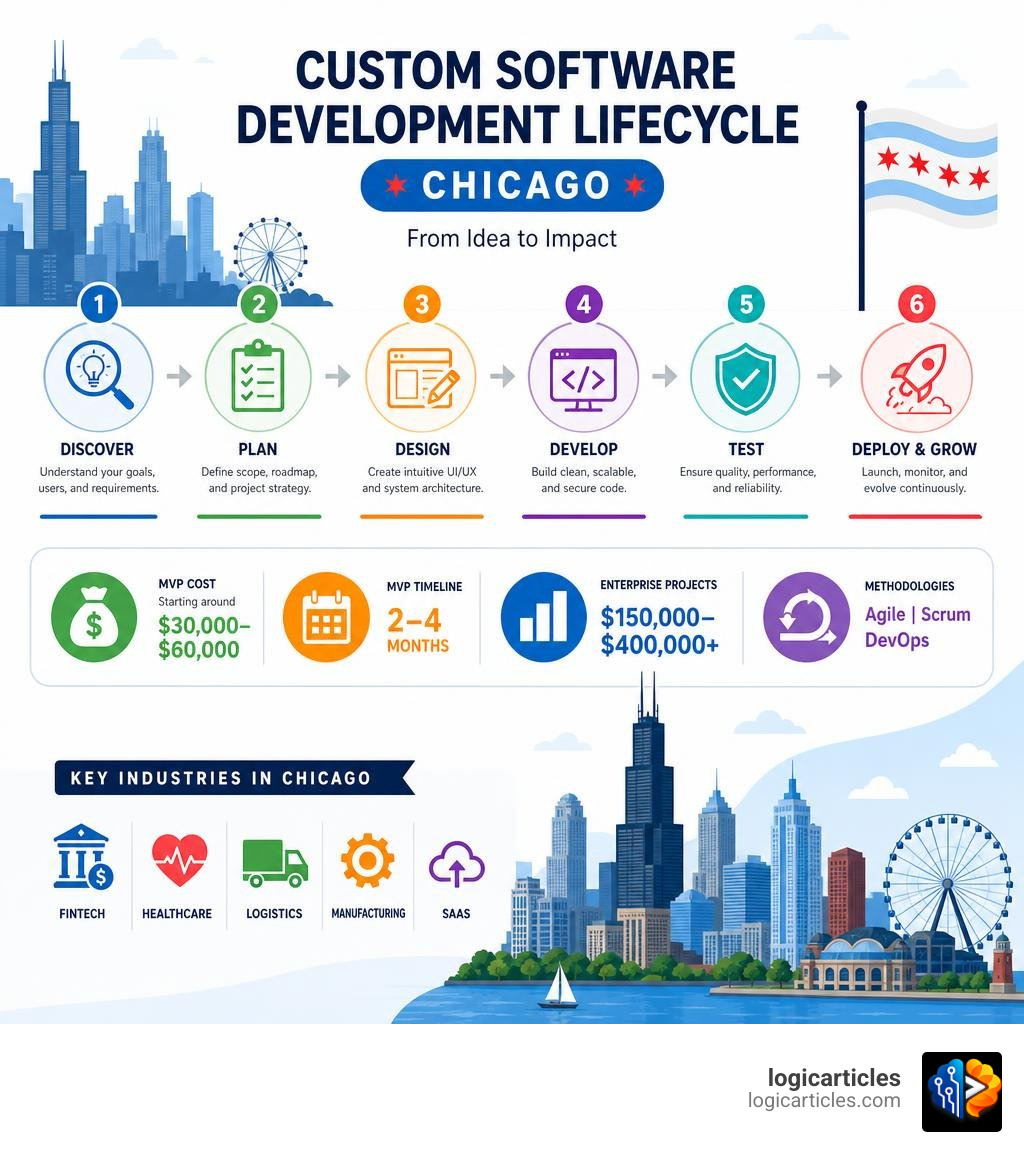
Why Choose Custom Software Development Chicago for Your Business?
When we look at the Midwest business landscape, we see a culture built on practical, ROI-focused principles. Chicago is often called “the city that works,” and that blue-collar work ethic extends directly into its digital economy. Businesses here do not just want flashy technology; they want software that solves real bottlenecks, saves hours, and pays for itself.
Opting for custom software development in Chicago means tapping into this unique local business mindset. Here is why working with a regional team makes a massive difference:
- Local Collaboration and On-Site Meetings: While remote work has its place, nothing beats sitting in a room with your development team, drawing on a physical whiteboard, and working out complex workflow logics. Working with a local Chicago firm means you can easily meet in River North, the Loop, or the West Loop to discuss your project face-to-face.
- Timezone Alignment: When your systems go down or you need a rapid pivot, you cannot afford to wait 12 hours for an offshore team to wake up. Chicago developers operate in the Central Time zone, meaning synchronous communication happens throughout your entire workday.
- Deep Midwestern Engineering Talent: Chicago is fed by world-class academic institutions. The University of Chicago and Northwestern University constantly pump highly skilled engineering, mathematics, and data science graduates into the local market. This academic depth ensures that your software is engineered with clean, scalable, and modern architectures.
To understand how to position your business for a custom build, it often helps to seek professional guidance early. Navigating the initial scoping phases is much easier when you work with experts who understand the local landscape. For a deeper dive into how specialized advisors can shape your strategy, check out our guide on Software Development Consulting In 2026.
Key Benefits of Custom Software Development Chicago
Investing in custom software is not just about avoiding monthly SaaS subscription fees. It is about building a proprietary asset for your business. When we build custom applications for our clients, we focus on five primary benefits:
- Infinite Scalability: Off-the-shelf software often charges you per user or limits your database storage. As your business grows, these licensing fees skyrocket. Custom software scales with your business without penalizing you for your success.
- Unfair Competitive Advantage: If you and all your competitors use the exact same third-party software, you are all bound by the same operational limitations. A custom application allows you to automate unique proprietary workflows that your competitors simply cannot replicate.
- Tailored Workflows: Instead of forcing your employees to adjust their daily routines to fit the rigid structure of a pre-made tool, custom software is designed around your existing, proven business processes.
- Seamless System Integration: Most businesses run on a patchwork of legacy systems, CRMs, and accounting tools. Custom middleware and APIs can bridge these gaps, allowing data to flow smoothly between your tools without manual data entry.
- Legacy System Modernization: Many established Chicago businesses—especially in manufacturing and logistics—rely on legacy desktop software built decades ago. Custom developers can systematically wrap or rebuild these legacy applications into modern, cloud-native platforms without disrupting your daily operations.
How to Choose the Right Partner for Custom Software Development Chicago
Choosing a software vendor is like choosing a business partner. It is a long-term relationship that requires trust, clear communication, and shared goals. To ensure you make the right choice, we recommend following a structured evaluation process:
- Examine Their Portfolio and Case Studies: Do not just look at pretty screenshots. Ask for hard metrics. Did their previous build reduce operational costs? Did it scale to support thousands of concurrent users? Look for experience in your specific industry.
- Request a Technical Assessment: A reputable agency should be willing to audit your current systems or review your project requirements to provide a technical roadmap. This shows they are thinking about the architecture, not just trying to win a contract.
- Establish Communication Protocols: Ask how they manage projects. Will you have a dedicated product manager? Will you receive bi-weekly working demos? If an agency cannot explain their communication cadence, expect delays and misunderstandings down the road.
- Verify Compliance and Industry Expertise: If you are in healthcare, fintech, or logistics, your software must abide by strict regulatory standards. Ensure the agency has a proven track record of shipping compliant code.
When vetting developers, it is also crucial to ensure they follow modern, secure development practices. To help you evaluate their technical standards, read our exhaustive breakdown of Web Development Best Practices 2026.
Comparing the Top Software Development Models in the Midwest
When planning a custom software project, businesses are faced with a crucial decision: where should the developers actually be located? The model you choose will dictate your project’s budget, communication style, and overall speed-to-market.
To help you visualize the trade-offs, we have put together a comparison table of the three primary development models available to Midwest businesses:
| Feature | Onshore (Local Chicago) | Nearshore (Latin America/Canada) | Offshore (Eastern Europe/Asia) |
|---|---|---|---|
| Cost | Premium ($150–$300/hr) | Moderate ($50–$90/hr) | Low ($25–$49/hr) |
| Timezone Overlap | Perfect (100% Central Time) | Excellent (80%–100% Overlap) | Poor (Night/Day Difference) |
| Legal Protection | Full US Jurisdictional Law | High (US-Governed Contracts) | Variable (Complex IP Enforcement) |
| Cultural Alignment | Perfect (Midwest Mindset) | Strong (American Business Norms) | Moderate (Requires Heavy Specs) |
| Best For | Complex enterprise builds, on-site strategy, and regulated systems | Rapid scaling, cost efficiency, and real-time agile sprints | Highly defined, repetitive coding tasks and simple MVPs |
For companies looking to balance budget constraints with real-time collaboration, a hybrid model is highly effective. You can learn more about how local oversight pairs with remote efficiency by exploring the Nearshore Custom Software Development Agency in Chicago | Hristov Development .
Local Chicago Agencies vs. Nearshore Teams
Local Chicago agencies offer unparalleled peace of mind. You can walk into their offices, meet their leadership, and easily hash out complex business logic over lunch. All contracts are bound by Illinois state law, and your intellectual property is protected by robust domestic legal frameworks.
Nearshore teams, often located in Latin America or Canada, have become incredibly popular because they offer a “best of both worlds” scenario. They operate in timezones that closely overlap with Chicago’s Central Time, allowing your in-house team to collaborate with them synchronously via Slack, Zoom, and GitHub.
Furthermore, because they operate in regions with lower overhead costs, they can deliver senior-level engineering talent at a 30% to 40% discount compared to local Chicago rates, while still utilizing US-legal entities to protect your intellectual property.
Enterprise-Grade Engineering vs. Boutique Agencies
As you search for developers, you will find a stark contrast between massive enterprise-grade engineering firms and smaller boutique agencies.
Enterprise-grade firms are built to handle massive, multi-million-dollar projects for Fortune 500 companies. They have deep benches of specialists, strict compliance departments, and the infrastructure to handle complex, high-security integrations. They excel at mitigating risk and eliminating technical debt from day one, though they come with premium price tags and longer procurement cycles.
Boutique agencies, on the other hand, are highly agile. They are excellent for startups, early-stage MVPs, and mid-market businesses that need to move fast. With a boutique team, you often work directly with senior partners, resulting in less red tape and faster pivot times.
For those seeking highly specialized, senior-led enterprise consulting without the bloated overhead of massive agencies, we recommend looking into Enterprise Software Engineering | Fortune 500 Engineer | Champlin Enterprises .
Key Industries and Technology Stacks Driving Chicago’s Tech Scene
Chicago’s economy is incredibly diverse, which means its software developers must be highly versatile. Unlike Silicon Valley, which is heavily focused on consumer tech and social media, Chicago’s tech scene is dominated by heavy-hitting B2B sectors: finance, logistics, healthcare, and manufacturing.
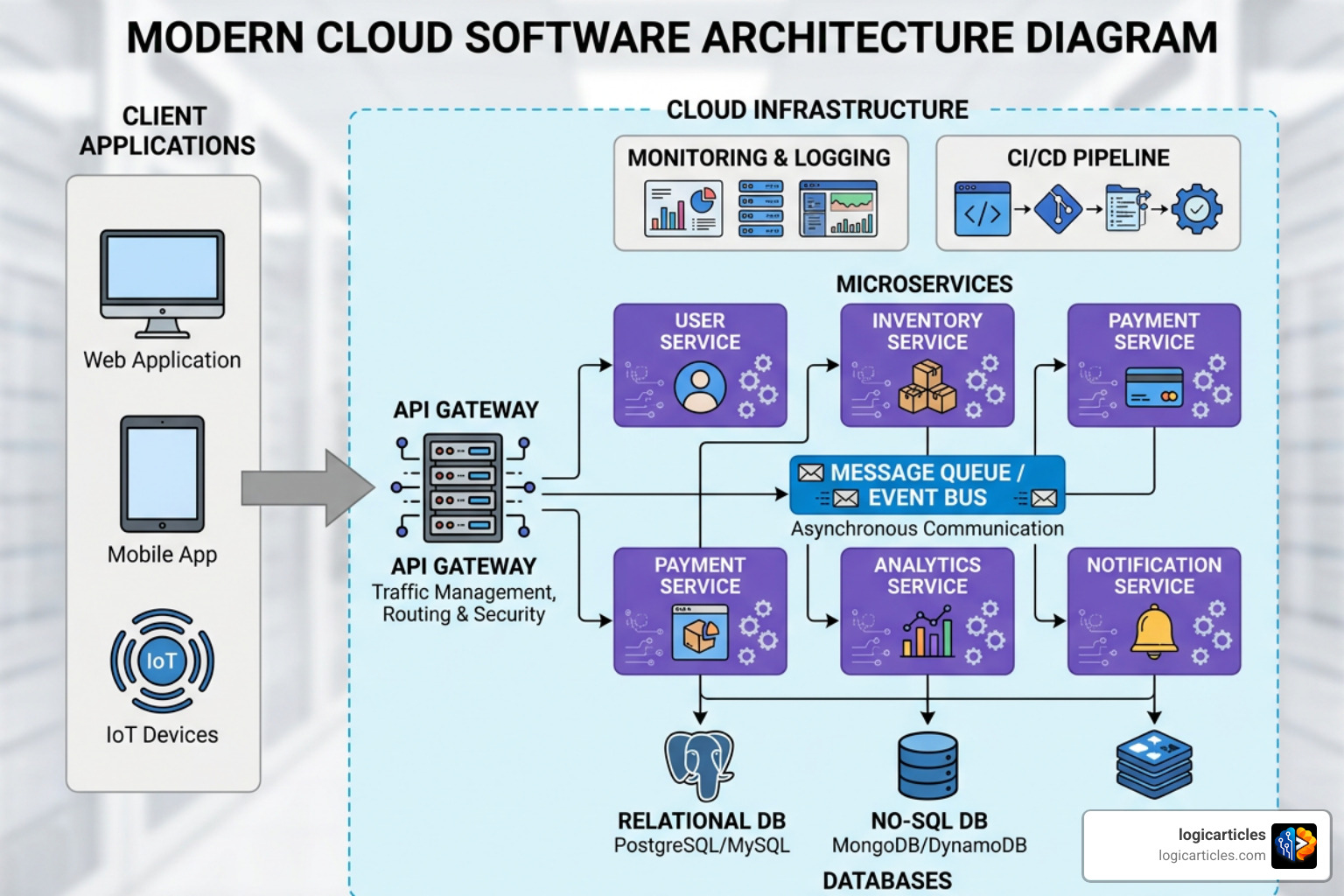
To build software that survives and thrives in these demanding industries, Chicago developers utilize robust, modern technology stacks. We see a strong preference for React, Next.js, and Angular on the frontend, paired with highly scalable backends built on Node.js, Python, Java, or .NET.
If you are planning to enter the highly competitive financial technology space, check out our curated list of the Best Fintech Software Development Company options to see who is leading the pack.
FinTech and SaaS Architecture
Chicago is a global financial powerhouse, home to the CME Group (the world’s largest derivatives exchange). This heritage has turned the city into a massive hub for FinTech and B2B SaaS innovation.
Building a successful SaaS platform in Chicago requires an architecture designed for enterprise buyers. This means implementing:
- Multi-Tenant Architecture: Ensuring complete data isolation between different corporate clients while sharing the same underlying application infrastructure.
- Robust Billing and Subscription Management: Integrating complex, metered billing systems via Stripe or custom ledger systems.
- Single Sign-On (SSO) and Enterprise Auth: Implementing SAML and OAuth 2.0 so corporate users can securely log in using their existing identity providers (like Okta or Active Directory).
To see how local SaaS experts construct these high-performance platforms, explore the specialized solutions offered by SaaS Development for FinTech in Chicago | Codazz .
Healthcare and Regulatory Compliance
Chicago sits at the nexus of the Midwest’s healthcare economy, surrounded by major hospital networks, pharmaceutical giants, and digital health startups. Building software for this sector requires navigating a minefield of local and federal regulations.
Developers must ensure absolute compliance with:
- HIPAA: Protecting Patient Health Information (PHI) through end-to-end encryption, strict access controls, and detailed audit trails.
- GDPR & CCPA: Honoring data privacy rights, user deletion requests, and strict data-sharing rules.
- BIPA (Illinois Biometric Information Privacy Act): This is a critical local regulation. Illinois has the strictest biometric privacy laws in the country. If your software uses facial recognition, fingerprint scanning, or biometric clock-ins, you must obtain written consent and provide clear data retention schedules. Negligent violations can cost $1,000 to $5,000 per violation, making compliance a primary architectural constraint from day one.
For a deeper look at how local firms embed these strict security controls into their codebases, review the services highlighted by Custom Software Development services in Chicago .
Generative AI and Emerging Tech
In 2026, generative AI is no longer a futuristic gimmick; it is a core business tool. Chicago enterprises are actively integrating Large Language Models (LLMs) and Retrieval-Augmented Generation (RAG) systems into their custom software to automate customer support, analyze complex financial contracts, and streamline logistics routing.
The key to successful AI implementation is data privacy. Businesses cannot simply feed proprietary corporate data into public AI models. Chicago developers specialize in building private, secure AI pipelines that process sensitive data locally or within secure cloud environments, ensuring your intellectual property never leaks.
To explore how local teams are building these secure, cutting-edge intelligence systems, check out the offerings from the Generative AI Development Company in Chicago – Inoxoft .
Cost Analysis and Development Process in 2026
How much does custom software development in Chicago actually cost, and how long does it take? While every project is unique, the local market has established clear pricing tiers and timelines based on complexity:

Typical Cost Breakdown for Chicago Software Projects
To help you budget for your upcoming digital product, we have broken down the typical cost structures we see in the Chicago market:
- Minimum Viable Product (MVP): $30,000–$60,000. Built over 6 to 10 weeks, an MVP focuses purely on your core value proposition. It is designed to validate your business idea with real users or secure initial funding.
- Production-Ready SaaS Platform: $60,000–$180,000. Taking 3 to 5 months to develop, this tier includes a fully polished UI/UX, multi-tenant database architectures, automated billing, and secure user authentication.
- Enterprise-Grade Platform: $150,000–$400,000+. Spanning 5 to 10 months (or more), these platforms require complex legacy integrations, SOC 2 Type II compliance readiness, high-frequency data pipelines, and advanced security protocols.
For a highly practical, transparent breakdown of project scoping and cost modeling in the Midwest, we highly recommend checking out the guide from Custom Software Development Company Chicago | Midwest Enterprise Partner .
The 5-Phase Software Development Lifecycle
A successful software build relies on a structured, iterative process. Most top-tier Chicago agencies utilize a variation of this 5-phase lifecycle:
- Discovery and Ideation: We sit down to define your business goals, user personas, and functional requirements. This phase produces a detailed technical specification document and a clear project roadmap.
- UI/UX Design: Designers create wireframes and interactive mockups in tools like Figma. You get to see and click through your application’s user interface before a single line of code is written.
- Sprint-Based Development: Developers write code in 2-week “sprints.” At the end of each sprint, you receive a working demo of the software, allowing you to provide real-time feedback and steer the development process.
- Testing and Quality Assurance (QA): Dedicated QA engineers run automated and manual tests to find bugs, assess performance bottlenecks, and verify compliance requirements.
- Deployment and Support: The software is launched to production (usually hosted on secure cloud infrastructure like AWS or Google Cloud). Post-launch, the agency provides ongoing maintenance, security updates, and feature enhancements.
Frequently Asked Questions about Chicago Software Development
How much does custom software development cost in Chicago?
A focused MVP typically costs between $30,000 and $60,000. A production-ready SaaS platform ranges from $60,000 to $180,000, while complex enterprise platforms with legacy integrations and strict compliance requirements can easily range from $150,000 to over $400,000.
How do Chicago developers ensure compliance with HIPAA and BIPA?
They achieve this by designing compliance directly into the software’s architecture from day one. For HIPAA, this involves implementing AES-256 encryption for data at rest and TLS for data in transit, along with detailed audit logs. For Illinois’s strict BIPA regulations, developers build explicit written-consent flows, automated data retention/destruction schedules, and secure, isolated databases for any biometric data.
What is the typical timeline to launch a custom software MVP?
A focused custom software MVP typically takes 2 to 4 months from kickoff to launch. Simple applications can sometimes be delivered in as little as 6 to 8 weeks, while highly complex enterprise systems can take 6 to 12 months of phased rollouts.
Conclusion
Navigating custom software development in Chicago can feel overwhelming, but it is one of the most rewarding investments your business can make. By partnering with a team that understands the practical, ROI-driven Midwest business culture, you can turn complex operational challenges into streamlined, digital competitive advantages.
Whether you are looking to build a high-frequency FinTech platform, a BIPA-compliant healthcare application, or a scalable SaaS product, Chicago’s tech ecosystem has the talent and the drive to bring your vision to life.
If you are looking to build a career in this thriving ecosystem or want to understand the academic foundations of the engineers building your systems, take a look at our guide on the Online Best Software Engineering Degree In 2026.
Ready to find the perfect software solution for your business? Explore the Best Software Solutions in our curated category to find more insights, comparisons, and expert guides tailored to your growth goals.