Why So Many People Are Ditching Google Drive and iCloud in 2026
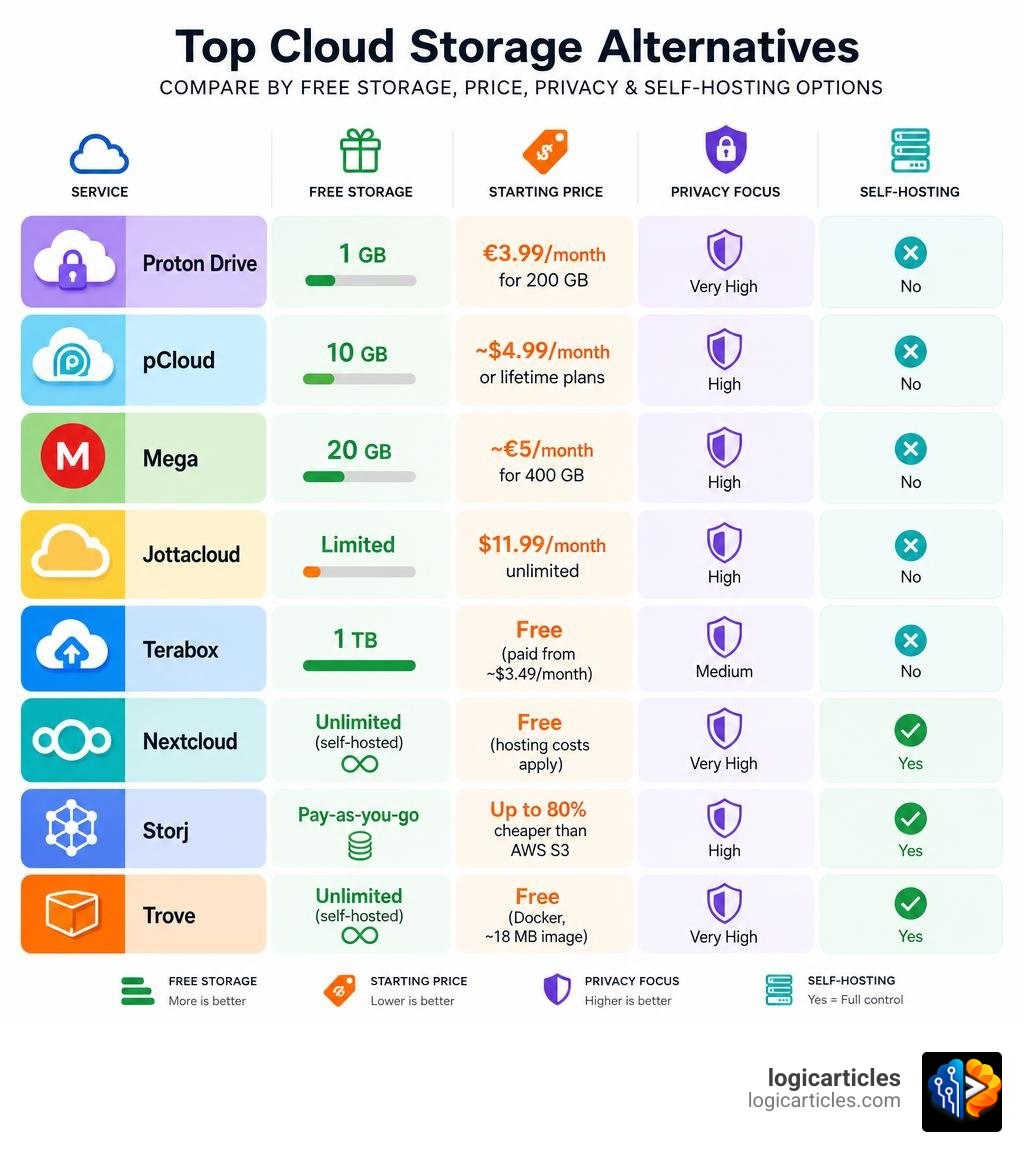
The best cloud storage alternatives to Google Drive and iCloud in 2026 include:
| Service | Best For | Free Storage | Starting Price |
|---|---|---|---|
| Proton Drive | Privacy-first users | 1 GB | €3.99/month for 200 GB |
| pCloud | Lifetime value, cross-platform | 10 GB | ~$4.99/month or lifetime plans |
| Mega | Large free storage | 20 GB | ~€5/month for 400 GB |
| Jottacloud | Unlimited storage | Limited | $11.99/month unlimited |
| Terabox | Maximum free storage | 1 TB | Free (paid from ~$3.49/month) |
| Nextcloud | Self-hosted control | Unlimited (self-hosted) | Free (hosting costs apply) |
| Storj | Cost-efficient distributed storage | Pay-as-you-go | Up to 80% cheaper than AWS S3 |
| Trove | Lightweight self-hosting | Unlimited (self-hosted) | Free (Docker, ~18 MB image) |
Think about the last time you got a notification saying your cloud storage was full. Or the moment you realized a company you don’t fully trust holds all of your personal files.
That feeling is exactly why millions of people are searching for cloud storage alternatives right now.
Google Drive, iCloud, and OneDrive are convenient. But they come with real trade-offs — limited free storage, rising subscription costs, privacy concerns, and a creeping sense that you have very little control over your own data.
The good news? The alternatives in 2026 are genuinely excellent. Whether you want ironclad privacy, a one-time lifetime payment, unlimited storage, or the ability to host everything yourself on your own server — there is a solution built for exactly that.
This guide covers all of it, from hosted services to self-hosted platforms, free tiers to enterprise tools, and everything in between.
Evaluating the Best Cloud Storage Alternatives for 2026

When we look beyond the mainstream giants, we find a rich ecosystem of platforms designed for modern data needs. But how do we separate the secure, high-performing options from the digital equivalent of a cardboard box in a rainy alley?
To find the right fit, we must look at a few critical pillars: data sovereignty, regulatory compliance (like GDPR and HIPAA), and encryption standards.
Data sovereignty dictates which country’s laws govern your files. If your data is stored in the United States, it is subject to the Patriot Act, meaning government agencies can theoretically request access. If it is stored in Switzerland or the European Union, it is shielded by much stricter privacy regulations like GDPR. For healthcare professionals or business owners, HIPAA compliance is another non-negotiable requirement that many default consumer cloud accounts fail to satisfy.
True privacy requires zero-knowledge encryption. This security standard ensures that only you hold the keys to your files. The service provider cannot read your documents, view your photos, or hand over your data to third parties because they literally do not have the technical ability to decrypt it.
If you want to understand how these security architectures fit into the broader cloud landscape, our Droven.io Cloud Computing Guide 2026 offers a deep dive into modern infrastructure trends.
Privacy-First Cloud Storage Alternatives
For those of us who believe our private files should stay private, a few standout services put security at the core of their business model.
First up is Proton Drive. Based in Switzerland, Proton benefits from some of the world’s strictest privacy laws. They offer a secure, end-to-end encrypted ecosystem that integrates beautifully if you already use Proton Mail. Proton Drive gives users 1 GB of free storage, with paid tiers starting at €3.99 per month for 200 GB and €9.99 per month for 500 GB. It is a seamless, zero-knowledge experience where even Proton itself cannot see a single byte of your data.
Another heavyweight in this category is pCloud – Secure Cloud Storage for Files, Photos & Documents . Also operating under Swiss privacy standards, pCloud has built a massive community of over 22 million users across more than 130 countries. They have maintained a stellar 99.98% uptime with over 989 billion files successfully uploaded to their secure servers.
What makes pCloud incredibly popular is its flexibility. It gives you 10 GB of storage for free, offers an optional zero-knowledge “Crypto” folder for highly sensitive documents, and allows you to choose whether your data is physically stored in European or United States data centers.
High-Performance and Distributed Cloud Storage Alternatives
If you are looking for enterprise-grade performance, massive scalability, or a way to cut infrastructure costs, traditional centralized data centers are no longer your only option. Welcome to distributed cloud storage.
The leader in this space is The fastest cloud storage and compute | Storj . Instead of relying on a few massive, carbon-heavy data warehouses owned by tech monopolies, Storj leverages a globally distributed network of independent nodes. This decentralized architecture lowers cloud storage costs by up to 80% and slashes carbon emissions by up to 83% compared to traditional centralized providers.
Storj is fully S3-compatible, meaning it integrates effortlessly as a drop-in replacement for developer workflows, backups, and media pipelines. Files uploaded to Storj are automatically split into pieces, encrypted, and distributed across the globe, ensuring high speed, incredible durability, and zero-trust security.
For teams comparing these modern distributed storage options against traditional hyperscalers, our Droven.io AWS vs Azure Comparison provides a clear breakdown of how standard cloud giants stack up.
Hosted vs. Self-Hosted Cloud Storage Solutions
One of the biggest decisions you will make when choosing cloud storage alternatives is whether to go with a hosted service or a self-hosted platform.
Hosted services (like pCloud, Mega, or Jottacloud) handle all the hardware, server maintenance, security updates, and infrastructure for you. You pay a monthly or yearly fee, download their app, and get to work. It is convenient, fast, and requires zero technical knowledge.
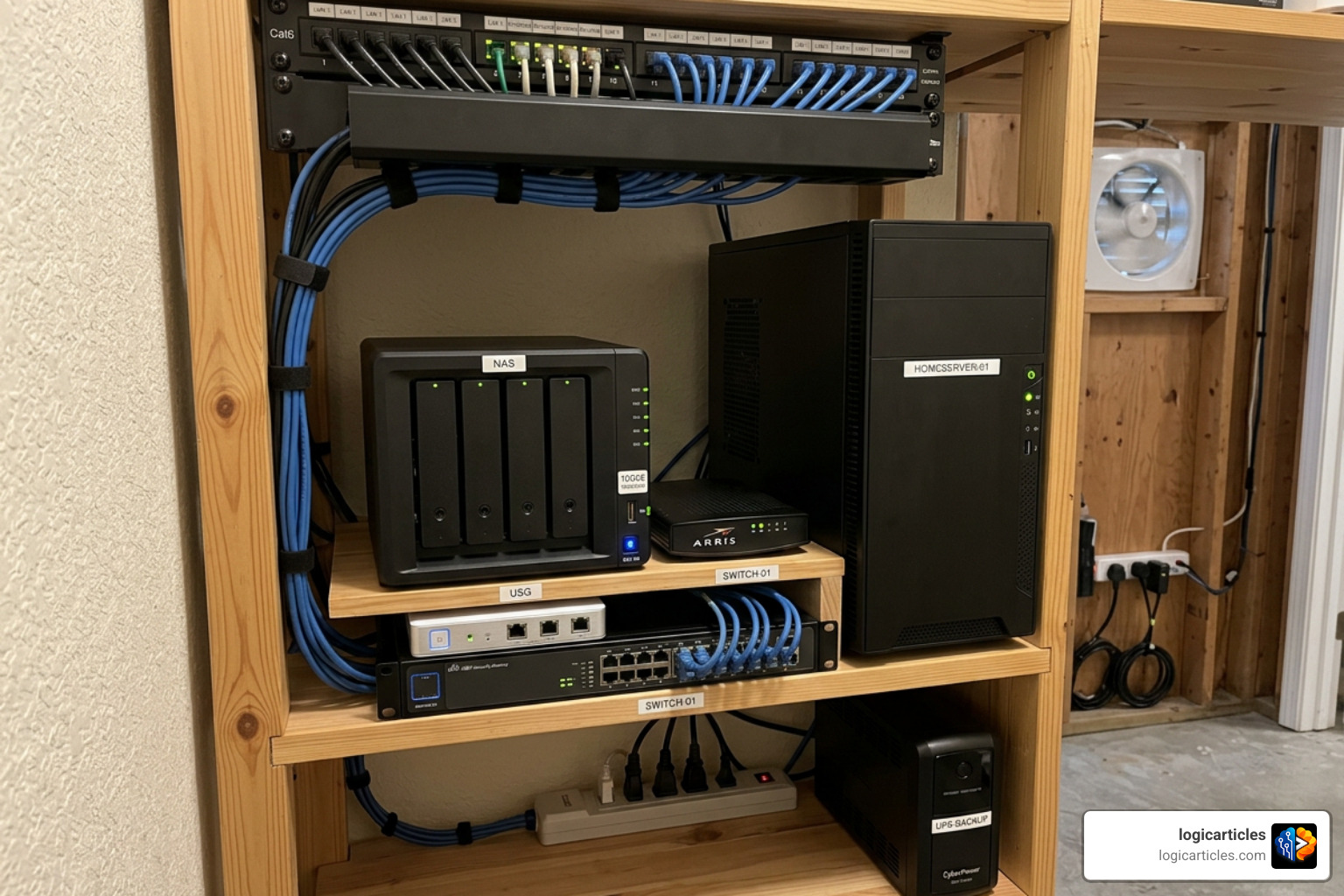
Self-hosted solutions, on the other hand, give you absolute control. You run the storage software on your own hardware—whether that is an old computer in your closet, a dedicated Network Attached Storage (NAS) device, or a rented Virtual Private Server (VPS). You own the hard drives, you control the physical location of the data, and you pay nothing in ongoing subscription fees to third-party storage giants.
However, self-hosting comes with maintenance overhead. If a hard drive fails, you have to replace it. If the software needs an update, you have to run it. You also have to think about how your storage backend—whether it is local disk storage, S3-compatible object storage, or a hybrid setup—handles features like deduplication (removing duplicate files to save space) and file versioning (keeping older versions of files so you can recover from accidental deletions).
Managing your own infrastructure can be incredibly cost-effective if done right. To keep your overall tech budget lean, check out our guide on the Best Cloud Cost Optimization Tools for 2026: Cut Cloud Bills Fast.
Lightweight Self-Hosted Platforms
If you decide to take the self-hosted route, you do not have to install bloated software suites that slow down your hardware.
For a minimalist, laser-focused experience, look at agjmills/trove . Trove is a self-hosted Google Drive alternative designed to do one thing exceptionally well: store and manage files. Written in Go, it features an incredibly lightweight Docker image size of approximately 18 MB. To put that in perspective, Nextcloud’s Docker image can easily exceed 1 GB, and Seafile sits around 200 MB. Trove supports local disk and S3-compatible backends, content-addressed deduplication, and multi-user quotas without any of the unnecessary bloat.
Another fantastic modern option is Locker | Open-Source File Storage Platform . Locker is a 100% open-source, type-safe file storage platform built on Next.js and PostgreSQL. It features multi-store replication, allowing you to mix and match storage backends (like local filesystems, AWS S3, and Cloudflare R2) with primary and replica configurations. It even includes a virtual bash shell interface, letting advanced users navigate their files using familiar command-line tools right in the web browser.
Local-First and Enterprise Open-Source Tools
For users who want a balance of local-first speed and cloud-like convenience, the open-source community has delivered some incredible tools.
First is README.md at 802d34568390712acd3ca16349eac89538776577 · spacedriveapp/spacedrive . Spacedrive is an open-source, cross-platform file manager powered by a Virtual Distributed Filesystem (VDFS) written in Rust. It treats files as first-class objects with content-aware identity using fast BLAKE3 hashing. This allows Spacedrive to index files across your phone, computer, and cloud accounts, automatically identifying duplicates and syncing files peer-to-peer without relying on a central server.
For businesses and teams, Open Source Cloud Storage Platform | Frappe Drive is a brilliant, collaboration-focused option. Built on the Frappe framework, it offers seamless S3 integration, allowing you to link AWS storage to a beautiful, user-friendly web interface in minutes. It features isolated team workspaces, real-time document editing, and tight integration with ERPNext, making it a perfect fit for growing companies.
Maximizing Value: Lifetime Plans and Unlimited Storage
If you are tired of monthly subscriptions draining your wallet, we have good news. The cloud storage market in 2026 offers highly competitive pricing models designed to give you maximum value.
| Provider | Key Value Proposition | Starting Price / Free Tier |
|---|---|---|
| Terabox | Massive free storage | 1 TB (1024 GB) completely free |
| Jottacloud | Truly unlimited storage | $11.99/month for a single user |
| pCloud | Pay once, use forever | Lifetime plans (e.g., 500 GB, 2 TB, 10 TB) |
| Mega | Excellent free privacy | 20 GB free storage |
For those on a tight budget, Terabox offers an unprecedented 1 TB (1024 GB) of cloud storage completely free without requiring credit card details. While the free tier is ad-supported, it is an unbeatable amount of space for backing up media and large archives.
On the other hand, if you have multiple terabytes of data and do not want to worry about hitting a cap, Jottacloud provides a truly unlimited cloud storage plan for a single user at a rate of $11.99 per month. It is a favorite for backing up massive media libraries and NAS systems.
For long-term savings, pCloud’s lifetime plans allow you to make a one-time payment to secure your storage forever, eliminating monthly bills entirely.
If you are running a small business and looking for ways to streamline your digital operations alongside cost-effective storage, take a look at our review of the Best Cloud POS Software in 2026.
Frequently Asked Questions about Cloud Storage
Choosing the perfect cloud setup can bring up a lot of questions. Here are the answers to the most common queries we hear from users looking to switch.
What are the best free cloud storage alternatives?
If you want to avoid paying a dime, your best options are Terabox, Mega, and pCloud. Terabox is the undisputed king of capacity, giving you 1 TB of free space out of the box. Mega is an excellent runner-up, offering 20 GB of free storage with strong, zero-knowledge encryption. pCloud provides 10 GB of highly reliable, Swiss-secured free storage that you can easily expand through referral programs.
How do self-hosted cloud storage alternatives compare to hosted services?
Self-hosted platforms (like Nextcloud, Trove, or Locker) give you 100% data ownership, custom storage limits, and zero monthly subscription fees. However, they require you to manage your own hardware, handle security updates, and configure backups. Hosted services cost money but offer absolute convenience, instant setup, and zero technical maintenance.
Which cloud storage alternatives offer the best security and privacy?
Proton Drive and pCloud are the top choices for privacy-conscious users. Both operate under strict Swiss privacy laws, offer zero-knowledge end-to-end encryption, and allow you to keep your files entirely out of reach of major tech conglomerates and advertising networks.
Conclusion
Finding the right cloud storage alternatives in 2026 does not mean you have to compromise on speed, convenience, or collaboration. Whether you choose the Swiss-backed privacy of Proton Drive, the lifetime value of pCloud, the distributed performance of Storj, or the complete control of a self-hosted Docker container like Trove, you are taking a massive step toward securing your digital sovereignty.
A hybrid strategy is often the smartest approach: keep your active, collaborative files on a secure hosted service, and back up your massive archives to a cost-efficient distributed network or a self-hosted home server.
Ready to optimize the rest of your digital workflow? Explore more productivity tools in our library to build a faster, more secure, and highly efficient workspace today!