Yes, There Are AI Checking Tools — Here’s What You Need to Know

Is there an AI checking tool? Yes — and there are many. Here are the most widely used options available right now:
| Tool | Free Tier | Claimed Accuracy | Best For |
|---|---|---|---|
| Copyleaks | Up to 25,000 characters | 99%+ | Enterprise, education |
| GPTZero | Yes | 99% | Educators, students |
| Grammarly AI Detector | Yes | 99% | Writers, professionals |
| QuillBot AI Detector | Up to 1,200 words | Not publicly stated | General use |
| ProAIChecker | Up to 5,000 words/month | 98.7% | Writers, recruiters |
These tools analyze text to estimate whether it was written by a human or generated by an AI model like ChatGPT, Claude, or Gemini.
AI-generated content has exploded. By August 2026, AI writing tools are deeply woven into how students, marketers, journalists, and professionals produce text every day. That’s useful — but it also creates real problems around authenticity, academic integrity, and editorial trust.
AI checking tools exist to help answer one simple question: did a human write this?
They don’t always get it right. No detector is 100% accurate. But the best ones give you a meaningful signal — often broken down sentence by sentence — so you can make smarter decisions about the content in front of you.
This guide explains how these tools work, which ones perform best, and how to use them responsibly.
Understanding How AI Detection Software Works
When you paste an essay or blog post into an AI checker, the software doesn’t magically “know” who typed the words. It doesn’t track keystrokes on someone else’s computer unless you’re using dedicated authorship tracking tools. Instead, AI detection platforms rely on statistical pattern recognition and machine learning algorithms trained on massive datasets containing both human writing and machine-generated prose.
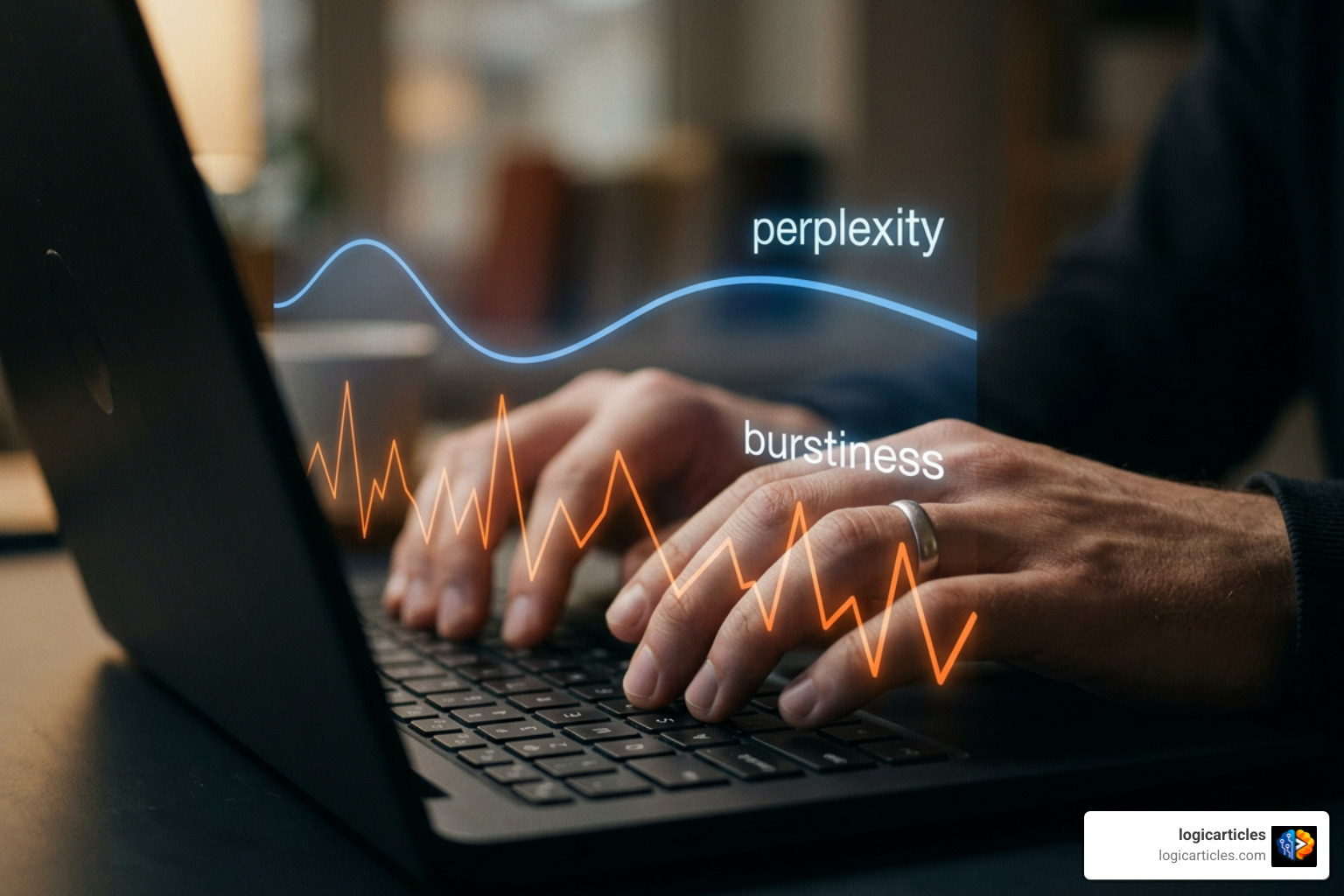
Large Language Models (LLMs) generate content by selecting words based on complex mathematical probabilities. Because of this probability engine, AI writing tends to follow smooth, statistically predictable paths. Human writing, on the other hand, is messy, erratic, and full of stylistic quirks. Detection algorithms look for these distinct mathematical footprints.
Key Mechanisms: Perplexity and Burstiness
To evaluate text, AI detectors rely primarily on two foundational concepts in natural language processing:
- Perplexity (Text Predictability): Perplexity measures how surprising or unexpected a string of words is to a language model. Because LLMs select words based on statistical likelihood, AI-written content usually has low perplexity — meaning the choice of words is highly predictable. Human writers frequently choose unexpected metaphors, unique vocabulary, or unusual phrasing, resulting in high perplexity.
- Burstiness (Structural Variation): Burstiness looks at variations in sentence structure, length, and rhythm across a piece of writing. Human beings naturally write with high burstiness. We might follow a long, intricate compound sentence filled with clauses with a quick three-word punch. AI text, by contrast, tends to exhibit low burstiness — producing sentences that are uniformly medium-length, neatly balanced, and monotonous in cadence.
When a detector evaluates text, it combines perplexity and burstiness metrics to calculate a total probability score ranging from 0% (entirely human) to 100% (entirely AI).
Is There an AI Checking Tool That Scans Multi-Layer Signals?
While basic detectors rely solely on perplexity and burstiness, modern enterprise detection systems analyze multi-layer signals to increase precision. Modern software checks for subtle stylometric markers, syllable dispersion ratios, parts-of-speech syntax, and hyphenation frequencies.
Furthermore, advanced platforms evaluate potential watermark signatures embedded directly into model outputs or check passage coherence across long-form documents. By evaluating content across multiple analytical layers simultaneously, these specialized detectors reduce guessing and provide stronger evidence of machine generation.
Is There an AI Checking Tool for Modern LLMs?
A common concern among editors and teachers is whether older detection algorithms can keep up with newly released text generators. Modern detectors regularly update their core neural networks to maintain high accuracy against frontier models.

Identifying Outputs from ChatGPT, GPT-5, Claude, and Gemini
Leading software platforms are explicitly trained on outputs generated by popular models, including ChatGPT, GPT-4, GPT-5, Anthropic’s Claude (including Claude 3.5 and 3.7 Sonnet), Google’s Gemini, DeepSeek, and Meta’s Llama. If you are searching for a robust AI Detection Platform, look for systems that frequently retrain their models on updated dataset releases.
Each LLM leaves unique stylistic signatures. For instance, certain models favor specific transitional phrases (“furthermore,” “delve,” “testament to”) or adopt over-structured paragraph headers. Detection platforms flag these specific model signatures, helping users pinpoint not just that content was machine-generated, but often which specific model architecture produced it.
Detecting Humanized and Human-Refined AI Text
Can AI detectors spot content that has been edited by a human or run through an “AI humanizer” tool? In many cases, yes.
While manual editing or paraphrasing alters surface-level wording, the underlying statistical patterns—such as uniform sentence pacing, missing personal context, and underlying syntactic structures—frequently persist. Specialized tools like a Sentence-Level AI Checker break down individual sentences to highlight residual AI fingerprints even within hybrid or heavily edited documents.
| Content Type | How AI Detectors Evaluate It | Detection Difficulty |
|---|---|---|
| Pure AI Text | High predictability, uniform sentence length | Very Easy |
| Paraphrased AI Text | Altered vocabulary, but persistent structural signatures | Moderate |
| Hybrid / AI-Refined Text | Human thoughts with polished AI syntax | Moderate to High |
| Pure Human Text | Unpredictable word choices, high variation in sentence length | Easy (Low False Positives) |
Evaluating Accuracy, False Positives, and Core Limitations
No AI detector is completely infallible, and claiming 100% flawless evaluation across all edge cases is unrealistic. Understanding accuracy rates and potential errors is critical before using these platforms in real-world scenarios.
Top-tier detection tools achieve overall accuracy scores between 95% and 99% in third-party benchmark evaluations such as RAID. For instance, platforms like Copyleaks claim over 99% accuracy with an exceptionally low false positive rate of 0.03%, while GPTZero reports a 95.7% detection rate on AI texts alongside a 1% false positive rate on human texts. Independent testing by Pangram Labs revealed that top systems successfully passed stringent validation checks across generated texts and human historical control documents.
False Positive Rates and Non-Native English Bias
A false positive occurs when an AI detector incorrectly labels genuine human writing as machine-generated. This is the single biggest risk associated with AI checking tools.
False positives happen most frequently when human text is highly structured, formulaic, or repetitive. Research shows that English as a Second Language (ESL) or non-native English writers are disproportionately flagged by basic AI detectors. Non-native speakers often employ simpler vocabulary, standardized grammatical patterns, and predictable phrase construction—qualities that low-level detection algorithms mistake for AI output. Leading platforms actively work to remove cultural and non-native bias by training their classifiers on diverse global writing datasets.
Key Limitations and Risks of Detection Reliance
Relying blindly on AI detector scores brings serious risks:
- Short Snippet Inaccuracy: Scans under 100–250 words lack sufficient statistical data, leading to skewed scores.
- Evading Detection via Heavy Rewriting: A determined writer who substantially restructures phrases can lower detection probability scores.
- Academic and Professional Misjudgments: Taking immediate disciplinary or punitive action based solely on an automated score can unfairly penalize innocent individuals.
For complex workflows involving mixed content or media uploads, utilizing a dedicated Multi-Modal AI Checker can help analyze multi-format inputs while minimizing false flags.
Key Features to Look For in Free AI Checking Tools
When choosing an AI checking tool for personal, educational, or corporate use, evaluate platforms based on the following practical criteria:
Multilingual Support and Privacy Standards
If you operate in global environments, choose tools offering multi-language detection. Software like Copyleaks supports over 30 languages, while ProAIChecker covers over 100 languages.
Equally important is data privacy. Ensure the software implements strict zero-storage policies (GDPR and SOC 2 compliance) so that your private documents, student essays, or unreleased commercial copy aren’t retained on external servers or used to train public AI models. For quick and secure checks, trying a privacy-focused Free AI Detection Tool ensures your data remains protected.
Is There an AI Checking Tool for Sentence-Level Analysis?
Avoid tools that only offer a single, overall percentage score without context. The best tools offer granular, sentence-by-sentence analysis, highlighting exact passages deemed human, mixed, or AI-generated.
Using a detailed platform like a Free AI Checker allows you to inspect flagged sentences individually. This transparency makes it easy to understand why a section was flagged—such as repetitive phrasing—so you can edit target sentences rather than rewriting an entire document from scratch.
Responsible Best Practices for Educators, Students, and Professionals
AI detectors should be used as investigative aids and editing tools, not as final, unquestionable judges. Here is how different groups can utilize AI checkers responsibly:
- For Educators: Never use an AI detection score as the sole basis for penalizing a student. Use flagged results to open constructive dialogue. Ask students to share draft histories or explain their writing process.
- For Students: Use AI checkers as a personal pre-submission gut check. If your human-written essay flags positive because of rigid structure, rephrase those sections to introduce more personal anecdotes and varied sentence length.
- For Content Publishers and Editors: Combine automated AI checks with plagiarism scanners and human editorial reviews. Establish clear team guidelines regarding acceptable AI usage for brainstorming versus final drafting.
Using AI Checkers as an Educational and Editorial Tool
Instead of creating a culture of suspicion, frame AI detection as an educational instrument that encourages authentic voice and transparent disclosure. Integrating an enterprise-ready AI Detection Engine into your workflow helps track content origin cleanly while encouraging responsible writing habits.
Frequently Asked Questions
Do AI checkers support non-English languages?
Yes, many modern AI checkers support multi-language detection. Top platforms cover languages such as Spanish, French, German, Portuguese, and dozens more by training their classifiers on multilingual LLM datasets.
Can AI detectors spot text modified by AI paraphrasers?
Yes. While basic synonym swapping alters surface words, advanced detection tools analyze deeper structural syntax, syllable distribution, and stylometric patterns that paraphrasers usually leave behind.
What is a normal false positive rate for AI checkers?
Industry-standard false positive rates among top-tier detectors range between 0.03% and 1%. However, false positive rates can spike higher on short text samples or writing by non-native English speakers.
Conclusion
So, is there an AI checking tool? Absolutely. Modern software provides remarkably accurate insights into whether a piece of content was crafted by a human or generated by an AI model. From sentence-by-sentence highlights to multi-model tracking, these tools give content managers, educators, and writers the clarity needed to navigate an AI-driven world.
At logicarticles, we believe technology works best when paired with human judgment. Use AI detectors as a helpful guide to preserve originality, improve clarity, and maintain trust in your written work. Want to learn more about optimizing your digital workflow? Feel free to Explore More AI Tools in our comprehensive resource library.