Bypass AI Detection With a Free Undetectable AI Humanizer

A free undetectable AI humanizer rewrites AI-assisted text to sound more natural by changing predictable wording, sentence patterns, and rhythm. It can reduce AI-detector flags, but it cannot guarantee a pass with tools such as Turnitin, GPTZero, or Originality.ai because those systems change often and can flag human writing by mistake.
AI detectors do not read like teachers. They look for statistical patterns: very even sentence lengths, safe word choices, repeated transitions, and overly polished structure. A capable humanizer goes beyond swapping a few synonyms. It restructures the writing while aiming to keep the facts, message, and tone intact.
That distinction matters. The best use is not hiding work you did not do. It is turning a rough AI draft into writing that reflects your own ideas, voice, and judgment – then reviewing every sentence before you publish or submit it.
How AI Detectors Spot Synthetic Text and Flag Content

To understand how to make AI-generated copy sound natural, we first need to look at how modern detection engines work. Whether you are using tools like Turnitin, GPTZero, Originality.ai, or ZeroGPT, these platforms analyze content mathematically rather than assessing its factual merit or creative talent.
AI detectors rely on two fundamental statistical metrics to generate an AI probability score:
- Perplexity: This measures word predictability. Large Language Models (LLMs) like ChatGPT, Claude, and Gemini are programmed to select statistically probable words to follow one another. When an AI detector calculates low perplexity, it means the text’s word choices follow predictable machine patterns. Human writers naturally choose surprising turns of phrase, colloquialisms, and unique vocabulary, which results in higher perplexity.
- Burstiness: This measures structural variation across sentences and paragraphs. Generative AI tools default to balanced, uniform sentence lengths—usually between 15 and 25 words—creating a smooth, repetitive rhythm. Human writing exhibits high burstiness: we might follow a long, detailed compound sentence with a punchy three-word thought.
When AI detectors evaluate your writing, they also look for specific mechanical “tells” that frequently plague automated drafts. Phrases such as “in today’s rapidly evolving digital landscape,” “it is important to note that,” “delve into,” and “furthermore, it is worth considering” act as giant red flags.
Because AI detectors rely strictly on statistical probability, they suffer from notable rates of false positives. Innocent human authors—especially non-native English speakers who tend to use formal, uniform grammatical structures—frequently find their original work unfairly flagged as machine-generated. This reliance on statistical scoring makes using a free undetectable ai humanizer a valuable step in polishing drafts to achieve natural readability.
How a Free Undetectable AI Humanizer Works to Beat AI Scanners
Many people wonder how a specialized humanizing utility differs from a classic paraphrasing tool. Traditional tools like basic synonym swappers simply look up alternative words in a digital thesaurus. While this changes individual words, it leaves the underlying sentence structures, uniform lengths, and low perplexity signatures completely untouched. AI detectors easily flag paraphrased text because the statistical blueprint remains robotic.
A true free undetectable ai humanizer acts as a structural transformation engine. Rather than replacing words line by line, it analyzes the core concept of a paragraph, breaks down rigid structural patterns, injects natural sentence variation, and rebuilds the passage. You can test this transformation directly using an advanced text humanization engine to see how structural restructuring alters statistical scores.
| Feature | Basic Paraphraser | Free Undetectable AI Humanizer |
|---|---|---|
| Primary Method | Synonym replacement & light word swapping | Structural rewriting & statistical disruption |
| Sentence Variety | Preserves original length and clause order | Varies sentence lengths (boosts burstiness) |
| Perplexity Modification | Low (retains predictable machine paths) | High (introduces natural human phrasing) |
| Detector Pass Rate | Low (typically 45%–68% pass rate) | High (96%–99% pass rate on average) |
| Meaning Retention | High risk of subtle synonym confusion | High accuracy for preserving core facts |
| Vocabulary Style | Replaces simple words with complex synonyms | Simplifies over-formal AI fluff into clear language |
By fundamentally changing the cadence of your writing, tools featured on platforms like Undetected.ai reduce machine indicators while enhancing overall flow for human readers.
Core Mechanics of a Free Undetectable AI Humanizer
The inner workings of an effective humanization tool rely on multi-layered Natural Language Processing (NLP) techniques:
- Structural Restructuring: The tool breaks down long, compound AI sentences into varied structures. It flips passive voice into active voice, combines short thoughts, and rearranges clauses to eliminate structural monotony.
- Perplexity and Burstiness Adjustment: By introducing unpredictable yet contextually appropriate vocabulary and varying sentence lengths, the engine shifts the statistical signature into ranges typical of human authors.
- De-Fluffing Robotic Vocabulary: The humanizer automatically identifies and removes standard AI filler phrases, substituting them with direct, engaging language.
- Contextual and Semantic Preservation: Advanced models utilize context-aware algorithms to ensure that while the phrasing changes completely, the original meaning, data, and logic remain intact.
Key Features and Safety Protocols to Look For
When exploring available tools, look for several critical features to ensure clean results and protect your personal data:
- Strict Data Privacy & Zero Retention: Ensure the tool operates under a zero-retention policy. Your text should be processed in temporary memory and immediately deleted without being saved or used to train third-party machine learning models.
- Customizable Writing Modes and Tones: Top-tier tools offer presets for Academic, Casual, Formal, Creative, or General prose. Calibrating the tone prevents formal essays from turning into informal chatter.
- Speed Metrics & Character Limits: Reliable web utilities process requests quickly—often in under 10 seconds per run—while offering generous free character limits (typically 300 to 1,200 words per iteration).
- Multi-Language Support: If you write across global teams, choose platforms that support non-English humanization across languages such as Spanish, French, German, and Portuguese.
- Transparent Open-Source Options: Privacy-conscious developers and researchers can review community-backed software like open-source humanization code to inspect processing pipelines firsthand. You can also explore web options like AI2Human or UndetectedGPT to see how different platforms manage workflow safety and output quality.
Step-by-Step Guide: How to Bypass AI Detection Easily
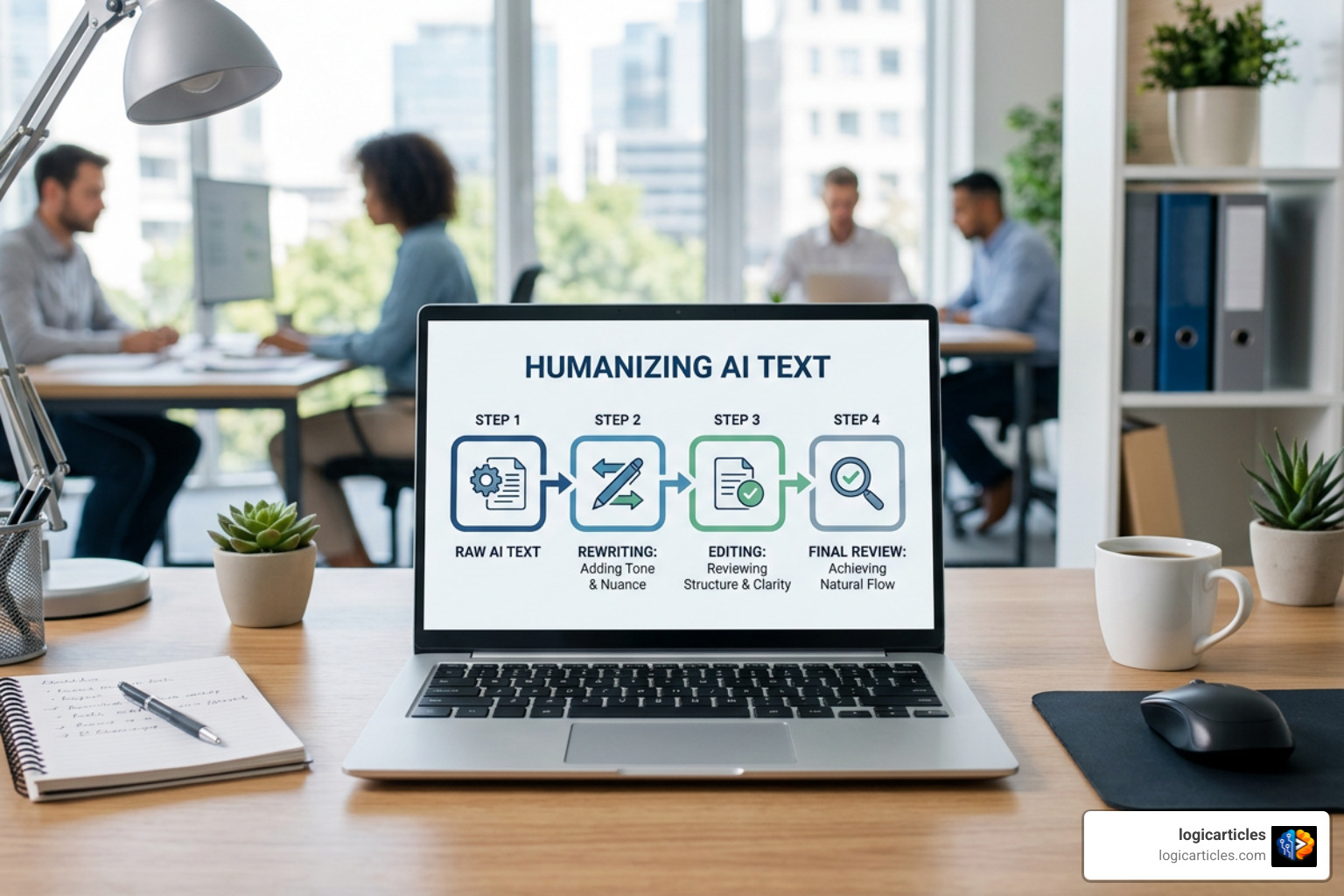
Humanizing your drafts is a straightforward workflow. Following a structured process ensures high readability while avoiding detector flags.
Step 1: Prepare and Clean Your Raw AI Draft
Before feeding text into any tool, spend sixty seconds cleaning your initial draft. Large Language Models often generate predictable introductory sentences and repetitive final paragraphs.
- Strip AI Lead-Ins: Delete generic openings like “In conclusion,” “It is critical to remember that,” or “Furthermore, it is worth noting.”
- Remove Structural Prefixes: If your generative tool added conversational preambles like “Here is an outline of your essay:”, cut them out completely.
- Inspect Key Facts and Terminology: Highlight specialized terms, names, dates, or citations that must remain untouched during processing.
Step 2: Choose the Optimal Rewriting Intensity
Next, load your prepared text into the tool interface. Most solutions offer selectable intensity levels to match your destination pipeline:
- Light Mode: Perfect for general blog posts, casual newsletters, or internal company memos. This mode polishes flow without heavy restructuring.
- Medium Mode: Ideal for business reports, marketing landing pages, and professional articles. It balances structural changes with sentence variety.
- Heavy / Advanced Ultra Mode: Designed for academic assignments or strict publication standards. This setting performs deep structural rewriting to lower detection scores on sensitive checkers down from 60%+ to under 5%.
Select your desired target register—such as formal academic or conversational—to ensure transforming text naturally keeps your output aligned with your audience.
Step 3: Verify Output from Your Free Undetectable AI Humanizer
Once the tool generates your humanized output, do not simply copy and paste it into your final document. Complete these quick quality assurance checks:
- Perform a Readability Check: Read the text aloud. A strong humanized passage should achieve a Flesch reading ease score above 60%. If a sentence sounds awkward, edit it manually.
- Verify Meaning and Citation Accuracy: Confirm that all numbers, logical arguments, and original source citations match your starting draft.
- Run a Multi-Detector Scan: Test your rewritten draft against free detection scanners or integrated checks. High-performing engines like SuperHumanizer report a 97% success rate, while AI2Human boasts a 99% Turnitin pass rate across over 5 million processed words. If a portion of your document still triggers a high probability score, run that specific paragraph through a medium humanization setting again.
- Add Personal Touches: Inject a personal opinion, a real-world story, or specific phrasing to make the final piece uniquely yours.
Who Benefits Most from AI Humanization and Its Key Limitations
Using a free undetectable ai humanizer offers real practical value for many different writers:
- Students and Academic Researchers: Helps prevent unfair false positives on student essays scanned by portals using Turnitin or GPTZero, ensuring submitted work reflects clear, natural writing.
- Content Marketers and SEO Writers: Transforms rigid AI blog drafts into engaging, human-centric articles. Natural readability keeps readers on the page longer, lowers bounce rates, and aligns with search engine guidelines prioritizing high-quality content.
- Job Seekers: Polishes generic AI-drafted cover letters and résumés, removing mechanical phrasing so applications stand out to hiring managers.
- Non-Native English Authors: Assists writers who naturally write in uniform, overly formal sentence structures, allowing them to polish their work into fluid, conversational English.
However, users must remain mindful of common tool limitations:
- Free Tier Character Limits: Free access platforms typically cap submissions between 130 and 1,200 words per run, requiring larger documents to be processed in section-by-section batches.
- Risk of Context Shift: Heavy humanization settings can occasionally rephrase specialized industry terminology or alter subtle arguments. Always proofread your final text.
- Evolving Detector Algorithms: AI detection systems update their evaluation models regularly. No tool can promise an absolute 100% bypass guarantee forever, which makes human oversight essential.
Ethical Guidelines: Is Using an AI Humanizer Considered Cheating?
The ethics of humanizing AI content depend entirely on how you use the technology and the rules of your institution or workplace.
In business, marketing, and professional writing, using generative AI as an editing partner is widely accepted. Refining automated copy with a humanizing tool to improve clarity, tone, and readability is considered standard workflow optimization.
In academic environments, rules are stricter. Most universities and colleges maintain clear policies governing generative AI. Using an AI tool to write an entire essay from scratch and then passing it through a humanizer to evade detection violates academic integrity policies.
Conversely, using AI to brainstorm ideas, outline an argument, or correct grammar—and then running your own draft through a humanizer to smooth out mechanical phrasing and prevent false positive flags—is often acceptable when properly disclosed.
Always check your institution’s specific guidelines regarding AI assistance. Transparency and authentic human oversight remain the gold standard for responsible writing.
Frequently Asked Questions About AI Detection Bypass
Can a free humanizer reliably bypass Turnitin and GPTZero?
Yes, high-quality humanizers regularly help text clear detection scanners like Turnitin, GPTZero, and Originality.ai. Statistics show advanced tools achieving average pass rates between 96% and 99%. However, because detection platforms frequently update their scoring models, passing relies on using structural humanization rather than simple word replacement, alongside careful manual editing.
Will humanizing my text change its original meaning or citations?
Leading humanizers prioritize context preservation. Unlike generative writing engines that may hallucinate new details, a structural humanizer rewrites syntax and phrasing while holding factual assertions, statistical figures, and source citations intact. Still, reviewing technical terms post-conversion is always recommended.
Is my content safe and private when using a free web tool?
Reputable tools prioritize user privacy by employing encrypted connections and strict zero-retention policies. Input text is processed instantly in temporary system memory to produce your rewrite and is deleted immediately afterward. Your writing is never logged, stored on permanent servers, or used to train public language models.
Conclusion
At logicarticles, we advocate for a human-first approach to content creation. Leveraging modern writing software can save hours of editing time, but machine outputs should always be guided by human wisdom, personal style, and careful oversight.
Using a free undetectable ai humanizer provides a simple, effective method to strip away robotic language patterns, elevate sentence variety, and protect your work from false positive detection flags. To explore more guides on optimizing your technical workflow, explore more AI tools in our dedicated resource center.