Why the Best Construction Financial Management Software Is a Game-Changer in 2026

Finding the best construction financial management software can be the difference between a profitable year and a costly one. Construction finances are far more complex than most industries — you’re tracking costs across dozens of active jobs, managing subcontractors, handling retainage, and chasing payments that can take 90+ days to arrive.
Here are the top construction financial management platforms in 2026:
| Software | Best For | Deployment |
|---|---|---|
| Sage 300 CRE | Mid-to-large contractors | Cloud / On-premise |
| FOUNDATION | Contractors of all sizes | Cloud / On-premise |
| CMiC | Mid-size to enterprise | Cloud |
| Trimble Viewpoint | Heavy civil & large firms | Cloud / On-premise |
| Jonas Enterprise | Multi-jurisdiction enterprise | Cloud / On-premise |
| Acumatica Construction | Growing cloud-first teams | Cloud-native |
| Sage 100 Contractor | Midsize contractors | Cloud / On-premise |
| Procore Financial Mgmt | Field-connected financials | Cloud |
General accounting tools like QuickBooks weren’t built for construction. They don’t understand job costing, progress billing, or work-in-progress (WIP) reporting. When contractors try to force a generic tool to do construction-specific work, things fall through the cracks — and projects bleed money silently.
The construction industry has a well-known cash flow problem. 40% of payments still happen offline. The average invoice takes over 90 days to get paid. In 2023, nearly three-quarters of contractors reported paying for materials out of their own pocket while waiting on clients.
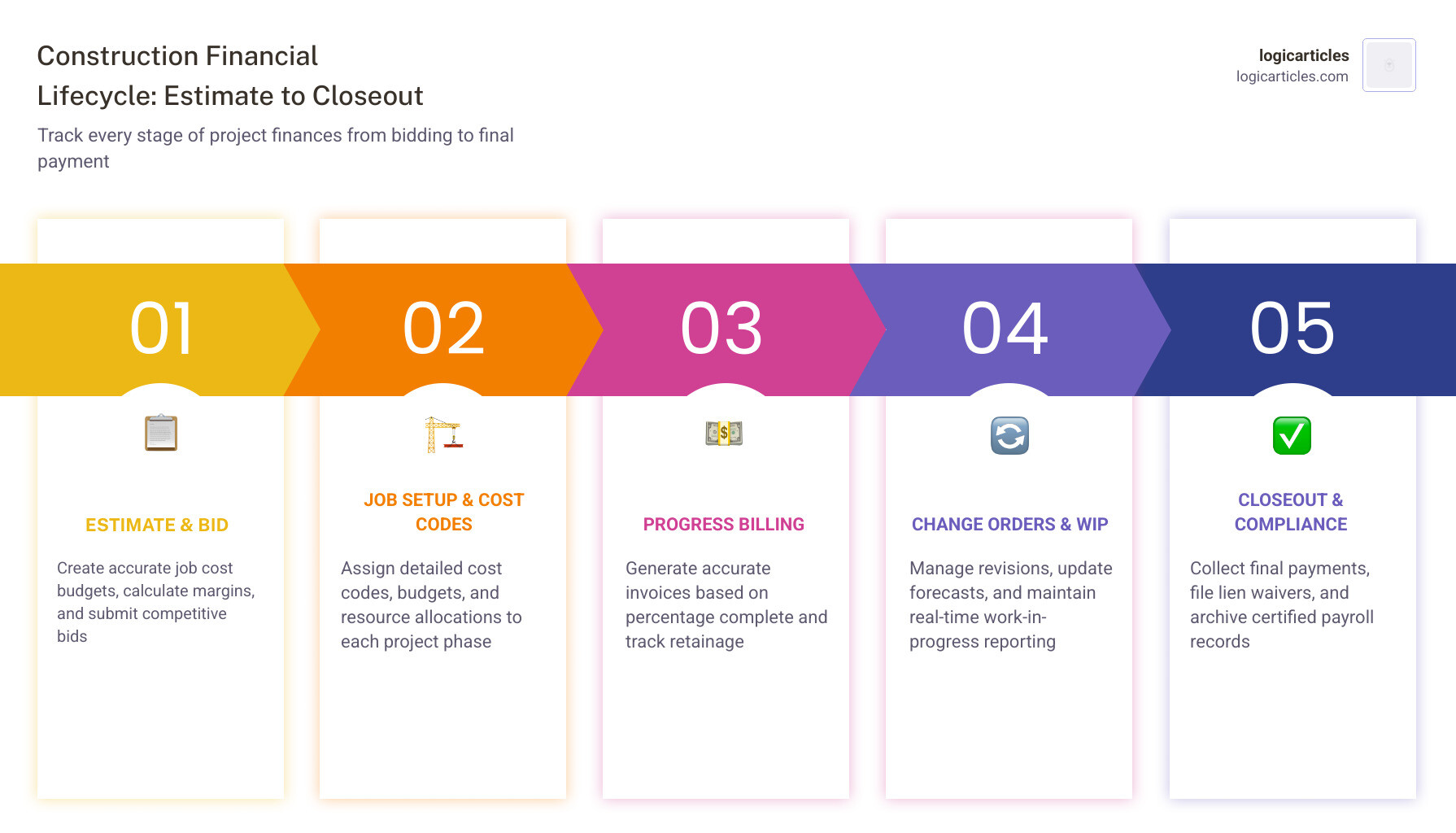
Specialized construction financial software exists to solve exactly these problems — connecting estimates, job costs, payroll, billing, and compliance in one place.
This guide breaks down everything you need to choose the right platform for your business.
Construction Accounting vs. General Financial Software
We often get asked: “Can’t I just use the same software my local bakery uses?” The short answer is yes, but you’ll likely regret it by your third change order. General accounting software is designed to track transactions by period; the BEST construction financial management software is designed to track transactions by project.
Job Costing and Revenue Recognition
In a standard business, you buy an item and sell it. In construction, you are “manufacturing” a building over months or years. Construction-specific tools handle job costing by tracking every dollar, hour, and quantity against specific cost codes. This allows for sophisticated revenue recognition, where you recognize income based on the percentage of completion rather than just when a check clears.
Retainage and WIP Reporting
Try explaining “retainage” (the 5-10% of payment held back until the job is done) to a generic software, and it will likely throw an error. Specialized platforms like Sage US automate these holdbacks. Furthermore, they generate Work-in-Progress (WIP) reports, which are essential for bonding and bank requirements. These reports show if you are overbilled or underbilled, preventing “profit fade” before it ruins your margins.
Specialized Payroll and Compliance
Construction payroll is a beast. You might have one employee working on three different jobs in two different states with three different union pay scales—all in one week. General software simply can’t handle the complexity of certified payroll or the specific regulatory compliance required for government-funded projects. Construction & Financial Management Software | Beam and other specialized tools bridge this gap by automating these industry-specific workflows.
Essential Features of the BEST construction financial management software
When we evaluate the top platforms in 2026, several “must-have” features separate the leaders from the laggards. If a software doesn’t offer these, it’s just a glorified spreadsheet.
- Progress Billing: The ability to generate AIA-style (G702/G703) invoices based on percentage of completion.
- Change Order Management: Every change in scope should automatically update the budget, the contract, and the project’s bottom line.
- Subcontractor Management: Tracking insurance certificates (COIs), lien waivers, and payment status for every sub on the job.
- Equipment Tracking: Managing depreciation, usage hours, and maintenance costs for your fleet.
- Field-to-Office Integration: Ensuring that a foreman’s daily log in the field updates the financial dashboard in the office instantly.

Advanced Job Costing in the BEST construction financial management software
The heart of any construction firm is the job cost. The CMiC Construction Accounting Software | Job Costing module is a prime example of how modern systems unify data. Instead of waiting for the end of the month to see if you’re over budget, real-time data allows you to track labor productivity and unit costs daily. If your crew is burning through hours faster than the estimate allowed, the software flags it immediately, giving you a chance to course-correct before the profit disappears.
Automated Compliance and the BEST construction financial management software
Compliance is where most contractors lose sleep. Managing lien waivers can be a full-time job. Platforms like Built have revolutionized this by automating the exchange of lien waivers for payments. This ensures that no money leaves your account until the proper legal releases are signed. In 2026, AI-driven automation also handles COI tracking, alerting you the moment a subcontractor’s insurance expires, thus protecting your business from massive liability.
Leading Construction Financial Platforms for 2026
The market in 2026 is divided between legacy powerhouses that have modernized for the cloud and “best-of-breed” solutions that focus on specific niches.
| Provider | Key Strength | Market Share / Trust Stat |
|---|---|---|
| Sage | Industry Standard | 48% of ENR Top Contractors use Sage |
| FOUNDATION | Customer Service | Trusted by 43,000+ professionals |
| Trimble | Heavy Construction | Serving the industry since 1978 |
| Deltek | Specialty Trades | 6,000+ loyal contractor customers |
The Heavy Hitters
Sage US remains a dominant force. With over 50 years of experience (stemming from the Timberline legacy), they offer Sage 300 CRE for large enterprises and Sage 100 Contractor for the mid-market. Their new cloud-native option, Sage Intacct Construction, is widely considered one of the most robust financial engines available.
FOUNDATION Software is another stalwart, having started in 1985. We’ve found that contractors love FOUNDATION because it was built specifically for the “back office” of a construction company, with a heavy emphasis on complex payroll and real-time job costing.
CMiC and Trimble Viewpoint are the go-to choices for massive, multi-state enterprises. CMiC uses a single-database architecture, meaning there are no “syncs” or “integrations” between accounting and project management—the data is simply the same for everyone, everywhere.
The Cloud-Native Revolution
Acumatica Construction Edition has gained significant ground by 2026. Its unique consumption-based pricing model doesn’t penalize you for adding users, making it ideal for growing firms. It is built on a modern API-first architecture, allowing it to “talk” to almost any other software you use.
Strategic Factors for Selecting Your Software
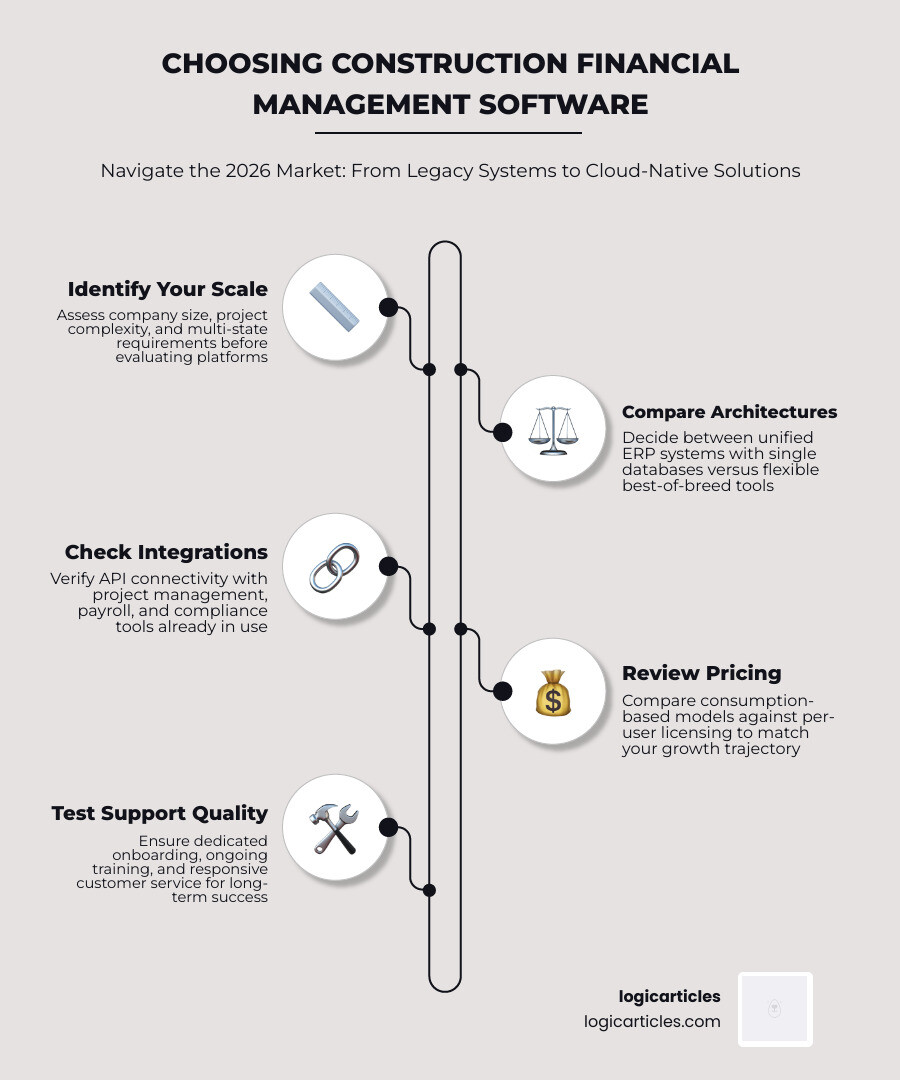
Choosing the BEST construction financial management software isn’t just about features; it’s about the “fit.” We recommend looking at these three pillars before signing a contract.
Company Size and Complexity
A $5 million residential remodeler has very different needs than a $500 million heavy civil contractor. Small to mid-sized firms might find success with platforms like Beam or KonstructIQ, which focus on ease of use and quick implementation. Larger firms need the deep audit trails and multi-entity capabilities of a full ERP (Enterprise Resource Planning) system.
Deployment: Cloud vs. On-Premise
In 2026, the “cloud vs. on-premise” debate is mostly over—the cloud has won. However, some firms still prefer on-premise for total data control. Cloud-native solutions offer better mobile accessibility and lower IT overhead, which is why 53% of the BD&C Giants trust Sage’s cloud-enabled offerings.
The Integration Ecosystem
Your financial software shouldn’t be an island. It needs to connect to your estimating tools, your project management software (like Procore), and your time-tracking apps. When looking for the Best Deals, consider the total cost of ownership, including the cost of building or maintaining these integrations. A “closed” system that doesn’t allow data to flow freely will eventually create “data silos” that lead to errors.
Frequently Asked Questions about Construction Finance
How does construction software handle certified payroll?
Certified payroll is a requirement for many public works projects, requiring you to submit weekly reports (like the WH-347) to prove you’re paying prevailing wages. The BEST construction financial management software automates this by pulling data directly from timecards, applying the correct Davis-Bacon Act wage scales, and generating the necessary filings with a single click. This eliminates the manual entry that often leads to audits and fines.
What is the typical cost of construction ERP systems?
Pricing varies wildly. Some platforms, like FOUNDATION, typically start around $500 per month. Others, like Sage 100 Contractor, might start at $115 per user per month. Enterprise-grade systems often require a custom quote based on your annual construction volume. Beyond the subscription, you must factor in implementation fees, which can sometimes equal the first year’s software cost, and ongoing maintenance or support fees.
Can I integrate my financial software with project management tools?
Yes, and you should! A two-way sync between your financial software and a platform like Procore ensures that when a Project Manager approves a change order in the field, it instantly appears as a “pending” item in the accounting office. This eliminates double data entry and ensures that your “Estimated Cost at Completion” is always accurate.
Conclusion
At logicarticles, we’ve seen that the most successful contractors aren’t always the ones with the best hammers—they’re the ones with the best data. Transitioning to the BEST construction financial management software is a strategic investment that protects your profit margins and stabilizes your cash flow.
Whether you choose the legacy power of Sage, the user-friendly nature of FOUNDATION, or the modern cloud architecture of Acumatica, the goal remains the same: real-time visibility. When you can see a budget overrun happening in week two of a project instead of month six, you have the power to stay profitable.
For more insights on the Tools that are shaping the industry in 2026, explore our other guides. Ready to take the next step? Most of these vendors offer live demos—we highly recommend seeing the software in action with your own data before making a final choice.
3 thoughts on “8 Best Construction Financial Management Software in 2026”