Why the Droven IO AWS vs Azure Comparison Matters in 2026

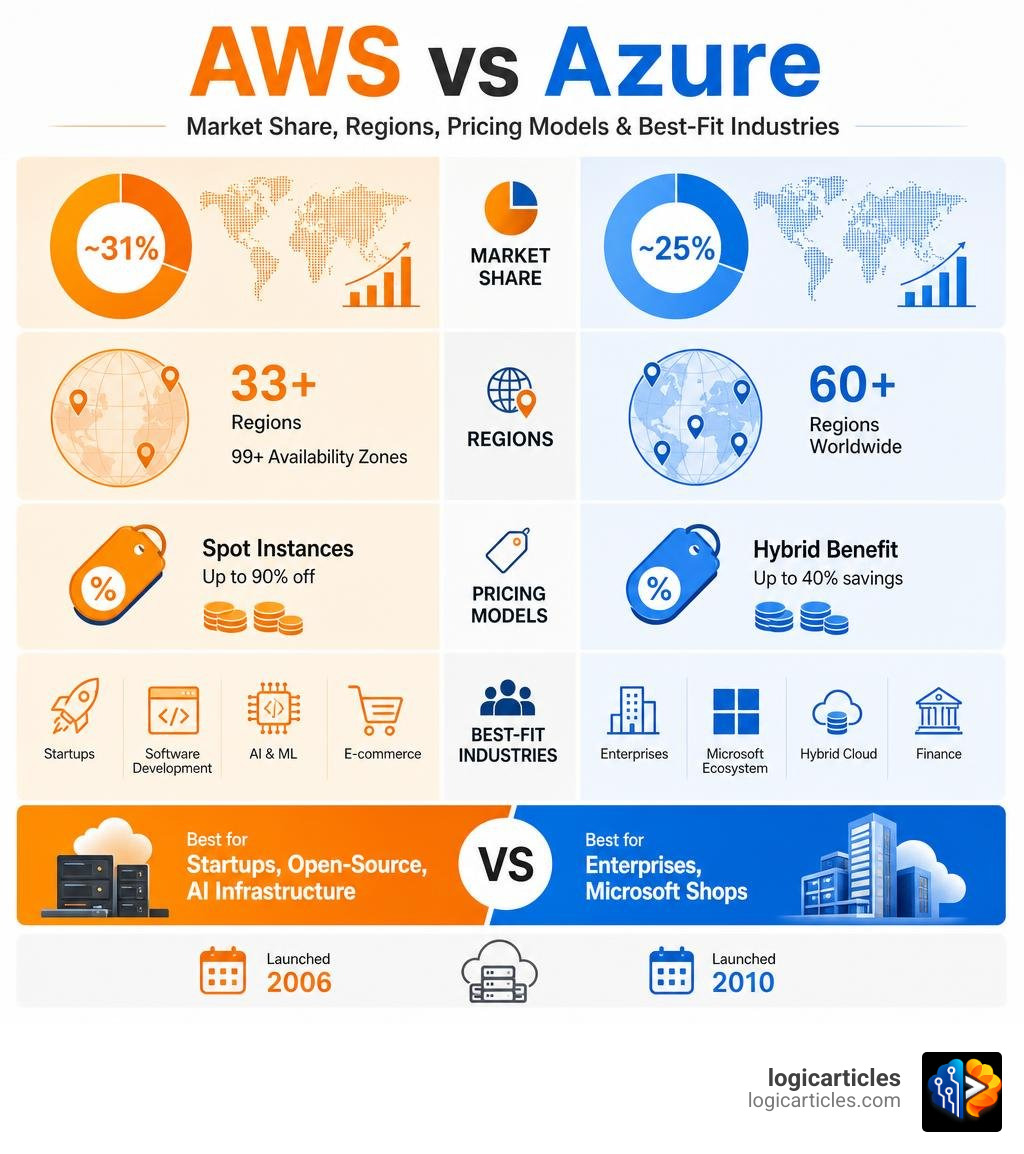
The droven io aws vs azure comparison has become one of the most searched topics for businesses, developers, and freelancers trying to make smarter cloud decisions in 2026. With AWS holding roughly 31% of the global cloud market and Azure close behind at 25%, choosing the wrong platform can cost you real money — and real time.
Here’s a quick answer to what most people want to know:
| Factor | AWS | Azure |
|---|---|---|
| Best for | Startups, open-source, AI infra | Enterprises, Microsoft shops |
| Global regions | 33+ regions, 99+ Availability Zones | 60+ regions worldwide |
| AI/ML | SageMaker, Bedrock, Rekognition | Azure ML, OpenAI integration |
| Hybrid cloud | AWS Outposts | Azure Arc, Azure Stack |
| Pricing edge | Spot Instances (up to 90% off) | Hybrid Benefit (up to 40% savings) |
| Market share | ~31% | ~25% |
| Launched | 2006 | 2010 |
Droven.io sits on top of both platforms as a DevOps and automation layer — it helps teams deploy, monitor, and optimize workloads across AWS and Azure from a single interface.
Not long ago, cloud computing was something only large enterprise IT teams could afford to think about. Today, it’s the foundation of nearly every digital business, freelance career, and online income stream. A single industrial equipment company automated over 1,000 invoices a year using cloud-based AI tools — saving 300 hours of labor. That’s the kind of practical impact this choice can have.
This guide breaks down every major difference between AWS and Azure so you can make a confident, informed decision — whether you’re a startup founder, an enterprise architect, or a developer building your first cloud project.
Understanding the Droven IO AWS vs Azure Comparison
Choosing a cloud provider is no longer just about picking a place to dump your databases. In 2026, the modern cloud strategy is shifting rapidly toward multi-cloud architectures. Businesses want the freedom to run their core applications where they perform best, without being locked into a single ecosystem. This is exactly where the droven io aws vs azure comparison comes into play.
What is Droven.io and How Does It Bridge Cloud Platforms?
Droven.io is a cloud-native DevOps automation and orchestration platform designed to simplify infrastructure management. It is not a replacement for AWS or Azure; rather, it acts as an intelligent control plane that sits on top of them.
For teams struggling with complex deployments, Droven.io offers several core capabilities:
- Automated CI/CD Pipelines: Its pipeline intelligence layer can automatically skip redundant build steps, reducing runtime by up to 40% in real-world tests.
- Infrastructure as Code (IaC) Support: Droven.io has a built-in linting engine that catches configuration errors before they hit production.
- Real-Time Monitoring & Alerts: It utilizes ML-based anomaly detection to filter out background noise, so your on-call engineers only wake up for real emergencies.
- Container Orchestration: It features native Kubernetes integration to manage containerized workloads seamlessly.
By serving as a centralized orchestration layer, Droven.io makes it possible for developers to build, run, and scale applications on AWS, Azure, or both simultaneously. If you want to dive deeper into how users rate this tool, check out our comprehensive breakdown of Droven Io Reviews 2026.
Why Use a Droven IO AWS vs Azure Comparison for Multi-Cloud Orchestration?
Why do we need a tool like Droven.io to manage our cloud platforms? The reality of 2026 is that multi-cloud setups are becoming the default standard. According to the Droven IO AWS vs Azure: Which Cloud Platform Wins in 2026? (Your Simple Guide) – techdoaction.com , using a dual-cloud strategy helps companies avoid vendor lock-in, mitigate global outages, and optimize regional latency.
However, managing two different cloud portals is an administrative headache. Your team has to master both AWS CloudFormation and Azure ARM templates, deal with distinct identity management protocols, and reconcile separate bills.
Droven.io solves this by offering a unified dashboard. You can deploy an API to AWS in North America for raw performance, while hosting your database on Azure in Europe to comply with local regulations. It balances workloads automatically, enabling smarter resource optimization and ensuring your digital infrastructure remains highly resilient. For a broader overview of how this fits into your long-term roadmap, take a look at the Droven IO: Powering Smart Digital Innovation guide.
AWS vs Azure: Core Services, AI Capabilities, and Hybrid Infrastructure in 2026
To understand how Droven.io orchestrates these environments, we must first look at how AWS and Azure stack up head-to-head across their core technical offerings.
| Service Category | Amazon Web Services (AWS) | Microsoft Azure |
|---|---|---|
| Compute | Amazon EC2, AWS Lambda, ECS, EKS | Azure Virtual Machines, Azure Functions, AKS |
| Storage | Amazon S3, Amazon EBS, Amazon Glacier | Azure Blob Storage, Azure Files, Archive Storage |
| Databases | Amazon RDS, Aurora, DynamoDB, Redshift | Azure SQL Database, Cosmos DB, Synapse Analytics |
| AI & Machine Learning | Amazon Bedrock, SageMaker, Rekognition | Azure OpenAI Service, Azure ML, Cognitive Services |
| Hybrid Cloud | AWS Outposts | Azure Arc, Azure Stack |
| DevOps Tools | CodePipeline, CodeDeploy, CloudFormation | Azure DevOps, GitHub Enterprise, Azure Bicep |
Compute, Storage, and DevOps Feature Face-Off
When it comes to raw compute, AWS EC2 remains the industry gold standard for customization, offering a massive variety of instance types, including energy-efficient ARM-based Graviton chips. Azure Virtual Machines, however, have closed the gap significantly by offering highly optimized instances specifically tailored for enterprise Windows Server environments.
In the storage arena, Amazon S3 (Simple Storage Service) is incredibly popular for its durability, granular lifecycle policies, and vast ecosystem of third-party integrations. Microsoft’s Azure Blob Storage is equally reliable, but it holds a distinct advantage for teams already using Microsoft’s productivity suite, as it integrates natively with Office 365 and local active directories.
From a DevOps perspective, AWS provides a highly customizable, open-source-friendly toolchain (CodePipeline, CodeBuild). Azure, on the other hand, leverages its acquisition of GitHub to offer Azure DevOps and GitHub Actions, which many development teams find much easier to adopt out of the box. According to the Droven.io Review 2026: Features, Pricing, and DevOps Benefits , using Droven.io on top of these pipelines allows teams to consolidate their deployments and reduce overall cycle times by 30% to 50%.
AI/ML Ecosystems: Amazon Bedrock vs Azure OpenAI
AI is the most fiercely contested battleground of 2026. AWS approaches AI with Amazon Bedrock and Amazon SageMaker. Bedrock provides a serverless API experience that allows you to choose from multiple foundational models (such as Anthropic Claude, Meta Llama, and Amazon Titan), giving developers immense flexibility to build generative AI applications without being tied to a single model provider.
Azure takes a different route through its close partnership with OpenAI. The Azure OpenAI Service gives businesses direct, enterprise-grade access to GPT-4o and other cutting-edge OpenAI models, backed by Microsoft’s strict compliance and security guardrails. For developers who want to learn more about the broader landscape, you can explore the latest Droven Io Machine Learning Trends 2026 to see how these models are reshaping modern software.
Hybrid Cloud Leadership: AWS Outposts vs Azure Arc
For organizations that cannot move entirely to the public cloud due to strict regulatory requirements, hybrid cloud support is vital.
- Azure Arc is widely considered the market leader in this category. It allows you to manage on-premise servers, edge devices, and even AWS resources directly from the Azure Portal, bringing cloud-native management practices to your local data centers.
- AWS Outposts delivers physical AWS hardware directly to your on-premise facility, extending native AWS APIs, infrastructure, and tools to your local environment. While highly powerful, it requires a significant hardware investment compared to Azure’s software-defined hybrid approach.
As highlighted in the AWS vs Azure 2026: Which Cloud Provider is Best for You? – The Ethical Hacker , Azure’s hybrid capabilities make it the preferred option for highly regulated sectors like healthcare, finance, and government.
Pricing Models, Cost Optimization, and Earning Opportunities in 2026
Managing cloud spend is one of the biggest challenges businesses face. Without proper guardrails, a minor configuration error can result in a massive surprise bill.

Navigating the Pricing Puzzle: Spot Instances and Hybrid Benefits
Both AWS and Azure utilize a pay-as-you-go model, but they offer distinct cost-saving programs that cater to different business profiles:
- AWS Spot Instances: AWS allows you to bid on unused compute capacity for up to 90% off standard on-demand rates. This is ideal for fault-tolerant workloads, batch processing, and testing environments.
- Azure Hybrid Benefit: If your company already owns Windows Server or SQL Server licenses, Azure allows you to repurpose those licenses in the cloud, saving up to 40% compared to standard rates.
- Savings Plans & Reserved Instances: Both platforms allow you to commit to 1- or 3-year terms in exchange for steep discounts (often up to 72%).
By using Droven.io’s cost-optimization features, businesses can automatically identify idle servers and schedule automatic shutdowns for non-critical resources during off-hours, routinely saving 20% to 35% on their monthly bills. For a complete guide on cloud budgeting and architecture, refer to our Droven Io Cloud Computing Guide 2026.
Career Paths: Freelancing and Remote Work Opportunities in 2026
The cloud boom has created incredible opportunities for IT professionals. In the United States, freelance cloud engineers and architects command impressive rates, typically earning between $75 and $150 per hour depending on their certifications and experience.
If you are looking to break into the industry or boost your income, here are a few actionable tips:
- Get Certified: Start with foundational certifications like the AWS Cloud Practitioner or Azure Fundamentals. From there, aim for Associate and Professional Solutions Architect badges.
- Build a Portfolio: Don’t just study theory. Build real projects using the free tiers of AWS and Azure, and document your work on GitHub.
- Learn Multi-Cloud: Engineers who understand both platforms and can manage them using tools like Droven.io are in high demand, often earning up to 40% more than single-cloud specialists.
For a deeper look into the educational paths and career opportunities available this year, you can check out the Droven.io Cloud Computing Guide: Complete 2026 Guide .
Industry Fit: Choosing the Right Platform for Your Business Needs
There is no single “winner” in the droven io aws vs azure comparison. The best platform depends entirely on your industry, your existing tech stack, and your business goals.

When to Choose AWS: Startups and Open-Source Flexibility
AWS was built by developers, for developers. It is the ideal platform for:
- SaaS Startups: The sheer volume of specialized services and the ease of scaling globally make AWS the default choice for young, agile companies.
- Open-Source Tech Stacks: If your team relies heavily on Linux, Python, Kubernetes, and open-source databases, AWS provides a more natural, flexible environment.
- High-Scale Media & Gaming: Companies requiring massive data pipelines, low-latency content delivery, and heavy compute scaling (like streaming services) benefit from AWS’s highly mature global infrastructure.
When to Choose Azure: Enterprise Integration and Regulated Industries
Azure is the natural evolution for established enterprises. You should choose Azure if:
- You are a Microsoft Shop: If your company already runs on Windows, SQL Server, Active Directory, and Office 365, Azure integrates seamlessly with your existing workflows.
- You Operate in a Highly Regulated Industry: Azure’s extensive compliance certifications and superior hybrid cloud tooling make it the safest choice for healthcare IT, financial services, and government contracts.
- You Need Turnkey Enterprise AI: Organizations that want to deploy advanced AI agents quickly using pre-built Microsoft Copilot systems find Azure’s ecosystem incredibly streamlined.
Security is a major factor in this decision. For the latest updates on how both platforms protect enterprise workloads, read our guide on Droven Io Cybersecurity Updates.
Leveraging Droven IO AI Automation Tools for Cloud Optimization
In 2026, manual cloud management is becoming obsolete. Smart companies are leveraging AI automation to handle routine operational tasks.
Maximizing Efficiency with a Droven IO AWS vs Azure Comparison
Droven.io provides powerful automation capabilities that sit on top of your cloud infrastructure. By integrating Droven Io Ai Automation Tools, businesses can automate complex multi-step workflows.
For example, an industrial equipment manufacturer used Droven.io’s automation tools to process over 1,000 invoices annually. The system automatically ingests incoming invoices, uses machine learning to extract key financial data, verifies the information against internal databases hosted on AWS, and updates the enterprise resource planning (ERP) system running on Azure. This single automation saved 300 hours of manual labor per year and eliminated human data-entry errors.
Future Cloud and AI Trends in the USA Market
As we look toward the future, several emerging technologies are poised to redefine cloud computing in the United States:
- Agentic AI: AI systems that can plan, reason, and execute multi-step workflows without constant human supervision are being integrated directly into cloud pipelines.
- Quantum Computing: Both AWS (via Amazon Braket) and Azure (via Azure Quantum) are expanding their quantum-computing-as-a-service offerings.
- 6G Networks: The rollout of early 6G technologies is enabling ultra-low-latency edge computing, bridging the gap between local devices and centralized cloud servers.
To stay ahead of these rapid developments, check out our analysis of the Droven Io Best Ai Startups In Usa 2026 to see who is leading the next wave of digital innovation. You can also read more about this in the Droven IO AWS Vs Azure Comparison: Which Cloud Platform Is Better For Modern Businesses In 2026? analysis.
Frequently Asked Questions about Cloud Platforms in 2026
Can I use Droven.io with both AWS and Azure at the same time?
Yes, absolutely. Droven.io is built specifically for multi-cloud and hybrid environments. From its unified dashboard, you can deploy applications, manage databases, and orchestrate pipelines across both AWS and Azure simultaneously without needing to log into separate cloud portals.
Which cloud platform is easier for beginners to learn in 2026?
AWS is generally considered easier for beginners to learn because of its massive community, extensive documentation, and the sheer volume of free online tutorials. However, if you already have experience with Windows Server, Active Directory, or .NET development, you will find Azure’s portal and ecosystem highly intuitive.
How much money can businesses save using Droven.io for cloud orchestration?
On average, businesses save between 20% and 35% on their cloud bills after adopting Droven.io. These savings are achieved through automated resource right-sizing, scheduling idle servers to shut down when not in use, and using predictive scaling to prevent over-provisioning.
Conclusion
There is no single winner in the droven io aws vs azure comparison. AWS remains the undisputed champion of developer freedom, startup scalability, and open-source flexibility. Azure, meanwhile, is the premier choice for enterprise integration, hybrid cloud setups, and organizations deeply embedded in the Microsoft ecosystem.
By leveraging an orchestration platform like Droven.io, you don’t have to choose just one. You can build a highly resilient, cost-effective multi-cloud strategy that utilizes the unique strengths of both platforms to drive digital resilience for your business.
Ready to explore the latest tools shaping the future of technology? Browse our extensive LogicArticles AI Tools Category to find the perfect solutions for your business workflows today!