Why the “Zaubee vs” Debate Matters for Your Business Listing

Zaubee vs legitimate business directories is a comparison that more and more business owners are making — often after discovering their company is already listed on Zaubee without their permission.
Here’s a quick answer for anyone who needs it fast:
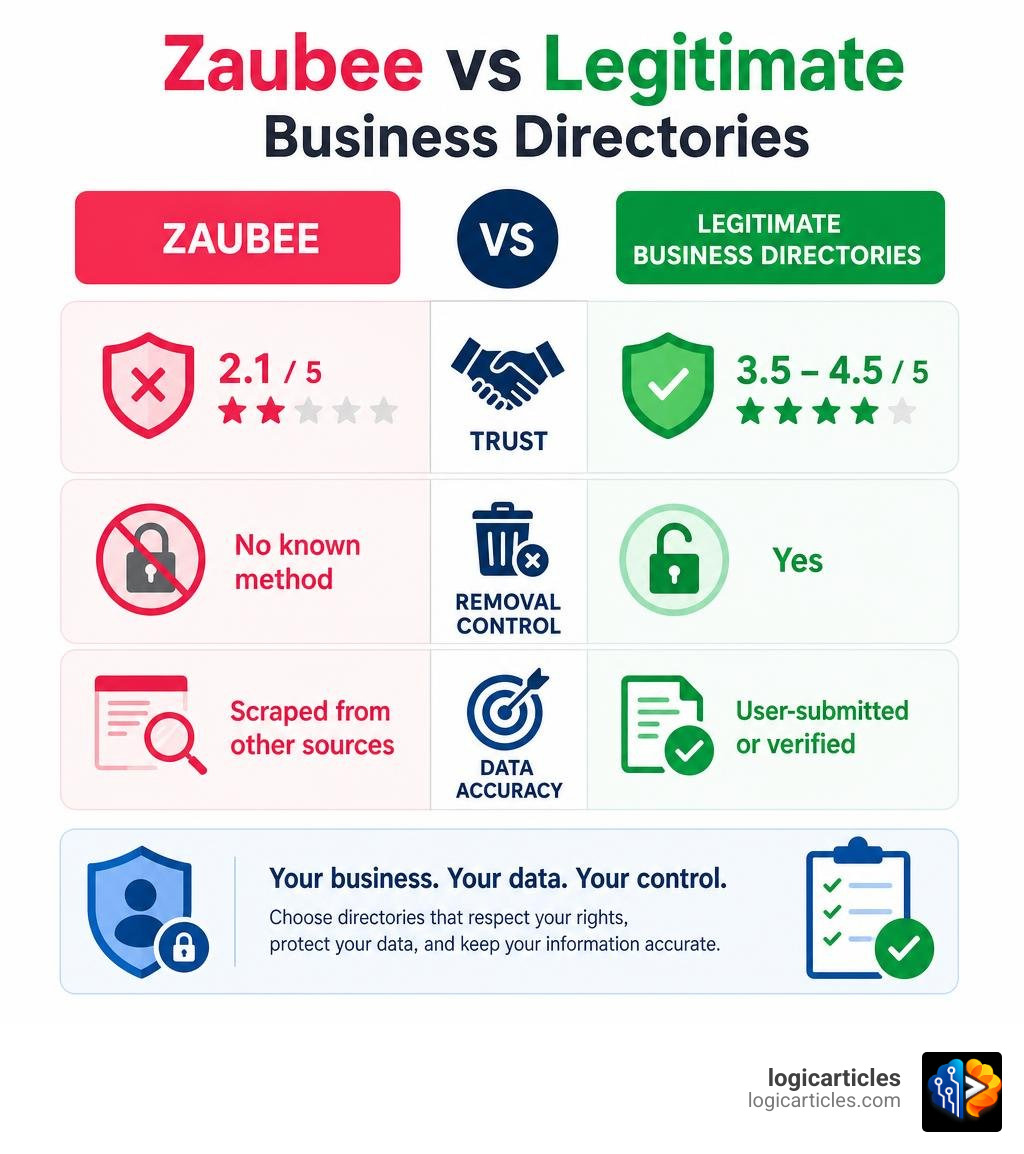
| Zaubee | Legitimate Directories (e.g., 11880.com) | |
|---|---|---|
| TrustScore | 2.1 / 5 (Trustpilot) | Typically 3.5–4.5 / 5 |
| 1-star reviews | 84% | Rare |
| Can you add your own listing? | No known method | Yes |
| Can you remove your listing? | No known method | Yes |
| Data source | Scraped from other sources | User-submitted or verified |
| GDPR opt-out | Unclear / difficult | Standard process |
Zaubee is a global online business directory. It collects and displays information about local businesses, restaurants, hotels, and other locations — mostly across the United States. The catch? Most businesses never agreed to be listed there.
Business owners regularly report finding their information on Zaubee with wrong titles, incorrect photos, and outdated contact details — all scraped from other sources. And when they try to remove it? There’s no clear way to do that either.
With a Moz Domain Authority of 33 and a Trustpilot rating of just 2.1 out of 5 — driven by 84% one-star reviews — Zaubee raises serious questions about data privacy, accuracy, and business owner rights.
This guide walks you through everything you need to know about Zaubee, how it compares to trusted alternatives, and what you can actually do about it.
What is Zaubee and How Does It Work?

At first glance, Zaubee.com looks like any other standard local business directory. It features categories for dining, shopping, hospitality, and professional services across various cities. However, unlike legitimate platforms where business owners actively create an account to boost their local SEO, Zaubee operates primarily as an automated data-scraping operation.
Instead of waiting for you to submit your business details, Zaubee uses automated web crawlers to scrape public registries, social media profiles, and other online directories. This harvested data is then compiled into automatically generated profile pages.
Because the data is gathered programmatically without human oversight, the listings are frequently riddled with errors. Business owners often discover that their profiles feature outdated phone numbers, incorrect physical addresses, or completely unrelated photos scraped from random corners of the web.
Even from a technical perspective, Zaubee’s structure is highly unconventional. Web developers looking into the site’s architecture have noted that many internal links, such as restaurant detail page anchors, use non-functional # values in their href attributes. This forces scrapers to use highly customized XPath workarounds just to navigate the site. If the site’s own backend structure is this messy, it is no surprise that the data displayed to customers is equally disorganized.
Despite these clear quality issues, Zaubee has managed to secure a Moz Domain Authority of 33 out of 100. This moderate domain authority allows its scraped pages to rank surprisingly well in hyper-local Google search results. According to industry data, about 33% of relevant managed businesses currently have an automatically generated, unverified profile on Zaubee.
Zaubee vs Legitimate Business Directories: Trust and Accuracy
When evaluating Zaubee vs established, legitimate directories like Germany’s 11880.com or enterprise SEO platforms like BrightEdge, the difference in user trust is night and day.
Legitimate directories prioritize data accuracy and user verification. They provide clear, self-service portals where business owners can easily add, edit, or delete their listings. In contrast, Zaubee has built a reputation centered on frustration. On Trustpilot, Zaubee holds a poor TrustScore of 2.1 out of 5 stars based on 19 total reviews. A staggering 84% of these reviews are 1-star ratings, with only 16% coming in at 5 stars (often from unverified accounts).
The primary complaints from business owners center on:
- Unauthorized Listings: Profiles created without the owner’s knowledge or consent.
- Inaccurate Information: Incorrect business hours, wrong phone numbers, and outdated addresses that actively turn potential customers away.
- Incorrect Photos: Random, scraped images that have nothing to do with the actual business.
- No Customer Support: A complete lack of responsive communication channels to address these errors.
To put this lack of control into perspective, think about how we evaluate other business tools. When you choose a critical business service, you expect transparency, support, and reliability. For example, in our analytical comparison of Chargebee vs Zuora: Which One to Pick in 2026?, we emphasize how enterprise-grade billing platforms must offer clear data portability, robust compliance, and predictable implementation.
Similarly, when evaluating recruitment tools like in our guide on Hirebee vs Reczee Detailed comparison features, price, or choosing e-signature platforms in our breakdown of DocuSign vs Signbee: API Comparison, Pricing, and Code Examples (2026), the focus is always on user control, data security, and seamless integration.
Unfortunately, directories like Zaubee offer none of these protections. Instead of giving you a clear dashboard to manage your digital presence, they lock your business data behind a wall of automated scraping, leaving you with little to no recourse when things go wrong.
Data Privacy, GDPR, and the Challenges of Information Removal

For businesses operating in regions governed by strict privacy laws, such as the European Union’s General Data Protection Regulation (GDPR) or the California Consumer Privacy Act (CCPA), Zaubee’s practices raise serious legal red flags.
Under GDPR, businesses and individuals have the “right to be forgotten.” This means directories must provide a clear, easily accessible, and free method for users to opt out and have their personal and commercial data permanently deleted.
Zaubee, however, makes the removal process incredibly difficult. There is no automated “Delete Listing” button. Instead, business owners are forced to navigate a complex, manual management process. Because there is no known, reliable self-listing or self-removal method on the site, many owners find themselves stuck in a loop of ignored support emails.
If you are trying to figure out how to handle your presence on this platform, you can read our detailed walkthrough on Zaubee Add Business In 2026 to understand your current options for claiming or managing these listings.
This lack of control stands in stark contrast to modern software development standards. For instance, when comparing advanced development platforms like we do in Pokee vs v0: AI Agent Platform vs AI UI Generator, developers expect isolated workspaces, persistent memory, and absolute control over their data and deployments. In the directory space, platforms like Zaubee deny business owners this fundamental control, operating instead as passive data brokers that exploit public data for their own ad revenue.
Why Low-Trust Directories Rank on Google and How to Protect Your Brand
You might wonder: If Zaubee is so poorly rated, why does it keep showing up on the first page of Google?
The answer lies in how search engine optimization (SEO) algorithms treat structured data. Google’s crawlers love well-organized directory sites because they contain clear schemas, localized keywords, and thousands of interconnected pages. Even with a mediocre Moz Domain Authority of 33, Zaubee’s massive catalog of scraped pages allows it to match highly specific, long-tail local search queries (e.g., “plumbers in [small town name]”).
This poses a major brand protection risk. If a potential customer searches for your business and finds an inaccurate Zaubee listing before finding your official website, you could lose that lead forever.
To protect your brand and secure your online presence, we recommend the following steps:
- Set Up Google Alerts: Monitor your business name regularly to see where new listings appear.
- Claim Verified Profiles: Build strong profiles on trusted directories like Google Business Profile, Yelp, and Bing Places. This pushes low-quality scraper sites further down the search results.
- Use Trusted API Integrations: When managing your digital assets, always rely on platforms that offer clean, secure data sharing.
Just as developers look for simple, secure, and direct APIs—such as when they Compare E-Signature APIs — Signbee to avoid bloated enterprise setups—you should look for directory management tools that sync your data securely without leaving room for third-party scraping.
Furthermore, if you are looking to build secure, automated communication channels for your own brand, utilizing advanced tools like Intelligent Conversations for Your Applications ensures that your customer interactions remain private, accurate, and completely under your control.
Frequently Asked Questions About Zaubee
How does Zaubee vs legitimate directories handle data removal?
Legitimate directories provide straightforward, automated opt-out forms or dashboard settings that allow you to delete your profile instantly. Zaubee, on the other hand, has no reliable, automated removal process. Business owners often have to submit manual opt-out requests through third-party data privacy tools or try to contact the site administrators directly, which frequently results in ignored requests.
What are the key differences in user trust when comparing Zaubee vs established platforms?
Established directories maintain high trust by verifying business owners through phone calls, mail, or official business documents. They hold strong Trustpilot scores and active customer service teams. Zaubee has a TrustScore of 2.1 out of 5, with 84% of its reviews being 1-star ratings. This low score is a direct result of unauthorized data harvesting, inaccurate listings, and a total lack of support for business owners.
Is there a safe way to add or claim a business listing?
While some platforms allow you to “claim” a scraped listing to correct the data, doing so on low-trust directories can sometimes validate your contact details for further marketing outreach. It is generally safer to focus your energy on high-authority, verified directories (like Google Business Profile) and use reliable digital presence managers to keep your public data consistent across the web.
Conclusion
Navigating online directories can feel like a game of whack-a-mole. While platforms like Zaubee can cause headaches with their unauthorized listings and outdated information, understanding how they operate is the first step toward reclaiming control of your brand’s digital footprint.
At logicarticles, we are dedicated to helping you protect your online reputation, navigate complex data privacy landscapes, and make informed decisions about the software and directories you interact with.
To discover more secure, efficient, and innovative ways to manage your business workflows and digital presence, explore our comprehensive guides on the latest AI Tools on LogicArticles.