Is There a Free AI That Can Summarize Research Papers?

The short answer is yes: is there a free AI that can summarize research papers? Absolutely. Dedicated tools now allow researchers, graduate students, clinical analysts, and industry professionals to ingest full-length academic documents and extract digestible key findings within seconds. Over 900,000 users have summarized more than 2,200,000 papers since March 2023, reflecting a fundamental shift in how literature reviews, meta-analyses, and background research are conducted across higher education and research R&D departments.
Traditional skim-reading and manual annotation can easily take anywhere from 15 minutes to an hour per study, especially when dealing with complex mathematical proofs, dense methodology sections, or intricate multi-column layouts. Leveraging an automated summarizer cuts that review process down to roughly 5 minutes per paper. Modern platforms like the AI Text Summarizer – Best Free Summarizing Tool | Paperpal utilize specialized natural language processing (NLP) to convert dense scientific articles into clear, actionable bullet points, plain language summaries, and structured study highlights.
Understanding how free access operates across these platforms helps researchers maximize their daily output without incurring subscription costs. Free plans generally operate under a few predictable parameters:
- Usage Caps & Daily Quotas: Some tools offer unlimited free use for short text submissions up to 600 words per run, while others provide 3 free paper summaries per day or a monthly allotment of 10 to 30 free full-document summaries upon registering a free account.
- Trial Tiers & Student Access: Certain platforms offer generous temporary full access, such as 7-day free trials supporting up to 30,000 words summarized, or extended free semesters for verified university email addresses.
- File Size & Page Limits: Free tiers often support documents ranging from 25MB up to 50MB, accommodating 100 to 200 pages (~200,000 characters) per ingestion, which is more than enough for long-form review papers and monographic studies.
For open-source enthusiasts, developers, and privacy-focused institutions, open repositories on GitHub—such as vikas-kashyap97/ai-research-summarizer or Mountchicken/Resophy—allow users to host free, localized summary engines tailored to specific document types, specialized mathematical notation, and custom API integrations without relying on third-party cloud services.
Key Features to Look For in a Free Academic Summarizer
When evaluating free tools, selecting an option built explicitly for scholarly material yields significantly better results than basic text-condensing software. Generic summarizers rely heavily on basic word frequency and statistical sentence ranking, frequently missing subtle context shifts, experimental boundary conditions, sample biases, and nuanced citation structures.
Essential features to look for in a robust scholarly summarizer include:
- Structured Breakdowns: Academic articles follow standard scientific structures (Introduction, Methods, Results, Discussion—commonly referred to as the IMRAD framework). A capable summarizer breaks content down into these exact sections rather than generating an unstructured block of generic text.
- Multi-Language Support & Translation: Scholarly findings are published worldwide. Platforms like the Paper Summarizer – Summarize Research Papers Instantly can translate and condense research across 50 to 60+ languages, enabling cross-border literature synthesis and allowing researchers to digest non-English journals instantly.
- Flexible File Format Ingestion: Look for engines that accept direct PDF uploads, DOCX files, TXT files, and direct links via DOI identifiers, arXiv handles, J-STAGE IDs, or direct web URLs like the Free Article & URL Summarizer with AI — cc.com.ai.
- Data Privacy & Intellectual Property Controls: Privacy is critical, especially when reviewing unpublished preprints, grant applications, or proprietary technical reports. Reliable tools process files transiently in memory, enforce strict TLS encryption in transit, delete uploaded files automatically after user sessions end, and explicitly guarantee that private user data is never harvested to train public foundational models.
Is There a Free AI That Can Summarize Research Papers with Complex Data?
Extracting quantitative data accurately from scientific literature requires specialized capabilities beyond standard prose processing. Purpose-built research tools deploy specialized document parsing engines that parse visual components, mathematical blocks, and tabular structures.
- Statistical Metrics & P-Values: Purpose-built tools isolate sample sizes (n values), confidence intervals (CI), effect sizes, standard deviations, and exact p-values embedded deep within dense results sections.
- Study Populations & Experimental Parameters: AI tools can isolate target demographic parameters, quantitative control groups, dosage limits, and specific experimental protocols directly from methodology sections.
- Figure, Graph, & Chart Interpretation: Advanced document processing pipelines read visual elements, data tables, and diagrams, mapping tabular data directly back into the primary narrative summary.
Is There a Free AI That Can Summarize Research Papers with Citations?
Yes. Dedicated tools like Free AI Paper Summarizer | Kenkyu.ai incorporate interactive inline citation chips directly into generated summaries.
Instead of making generalized claims or sweeping statements, these specialized platforms connect every generated sentence directly to its corresponding source passage in the uploaded PDF. Clicking an inline citation expands the original source paragraph in a side-by-side viewer, allowing you to audit statements against the raw text immediately. This strict retrieval-augmented grounding virtually eliminates AI hallucinations, ensures factual accountability, and preserves high academic integrity.
Free AI Summarizers vs. General-Purpose Chatbots
Many researchers wonder if specialized tools are necessary when general-purpose conversational chatbots like ChatGPT, Claude, or Gemini exist. While general chatbots excel at creative writing and general brainstorming, they exhibit clear functional limitations when handling complex multi-page academic literature.
General large language models (LLMs) often silently truncate documents that exceed hidden token window limits—frequently cutting off crucial discussion or methodology text after 20 to 30 pages—and are prone to inventing plausibly sounding but entirely non-existent bibliographic references. In contrast, dedicated academic summarization platforms offer full-document ingestion, structured IMRAD extraction, and verifiable source mapping built directly into the reading interface.
| Feature / Capability | Purpose-Built Academic Summarizers | General-Purpose AI Chatbots |
|---|---|---|
| Document Ingestion Limits | Handles 50MB+ files / 100-500 pages (~200k-1M chars) without truncation | Truncates long documents silently after ~30 pages |
| Citation Verifiability | Includes interactive inline citations linked to source passages | Prone to generating hallucinated or missing citations |
| Structured Output | Automatically organizes summaries into IMRAD sections | Generates unstructured text unless explicitly prompted |
| Data Extraction | Pulls metrics, p-values, study populations, and table data | Struggles with complex statistical tables and embedded charts |
| Privacy Protections | Memory-only session processing with auto-deletion | May retain user inputs for model training unless opted out |
When conducting serious literature synthesis, relying on purpose-built tools ensures that critical methodological details, statistical edge cases, and original reference attributions remain intact throughout your research workflow.
Frequently Asked Questions About Paper Summarizers
How accurate are AI-generated paper summaries?
Modern academic summarization tools built on domain-specific natural language processing models achieve up to 95% comprehension and context accuracy on standard peer-reviewed literature. However, AI summaries are best utilized as an accelerated triaging mechanism—rapidly scanning 30 to 50 papers to identify the top 5 essential studies that warrant deep, line-by-line reading. Researchers should always manually verify key quantitative metrics, experimental boundary conditions, and direct quotes against the original primary document before citing them in formal publications or systematic literature reviews.
Can free AI tools handle multi-page PDFs and unpublished preprints?
Yes. Free tiers typically support document uploads ranging from 25MB up to 50MB, which comfortably covers 50 to 100+ pages of dense, multi-column academic text, complete with embedded high-resolution figures. For unpublished manuscripts, working preprints, or confidential technical drafts, always verify that the chosen platform uses session-based memory processing, encrypts transfers via SSL/TLS, and automatically purges uploaded files after 24 hours without storing or training on your proprietary scientific research.
Do free paper summarizers preserve original citations and references?
Specialized academic summarizers preserve citation structures by mapping every key summary claim back to exact line items and paragraph offsets in the source PDF. This trace-back capability ensures that when you copy an insight into your literature matrix or reference management software (such as Zotero, Mendeley, or EndNote), you retain the exact background citation and page number needed for proper academic attribution.
Conclusion
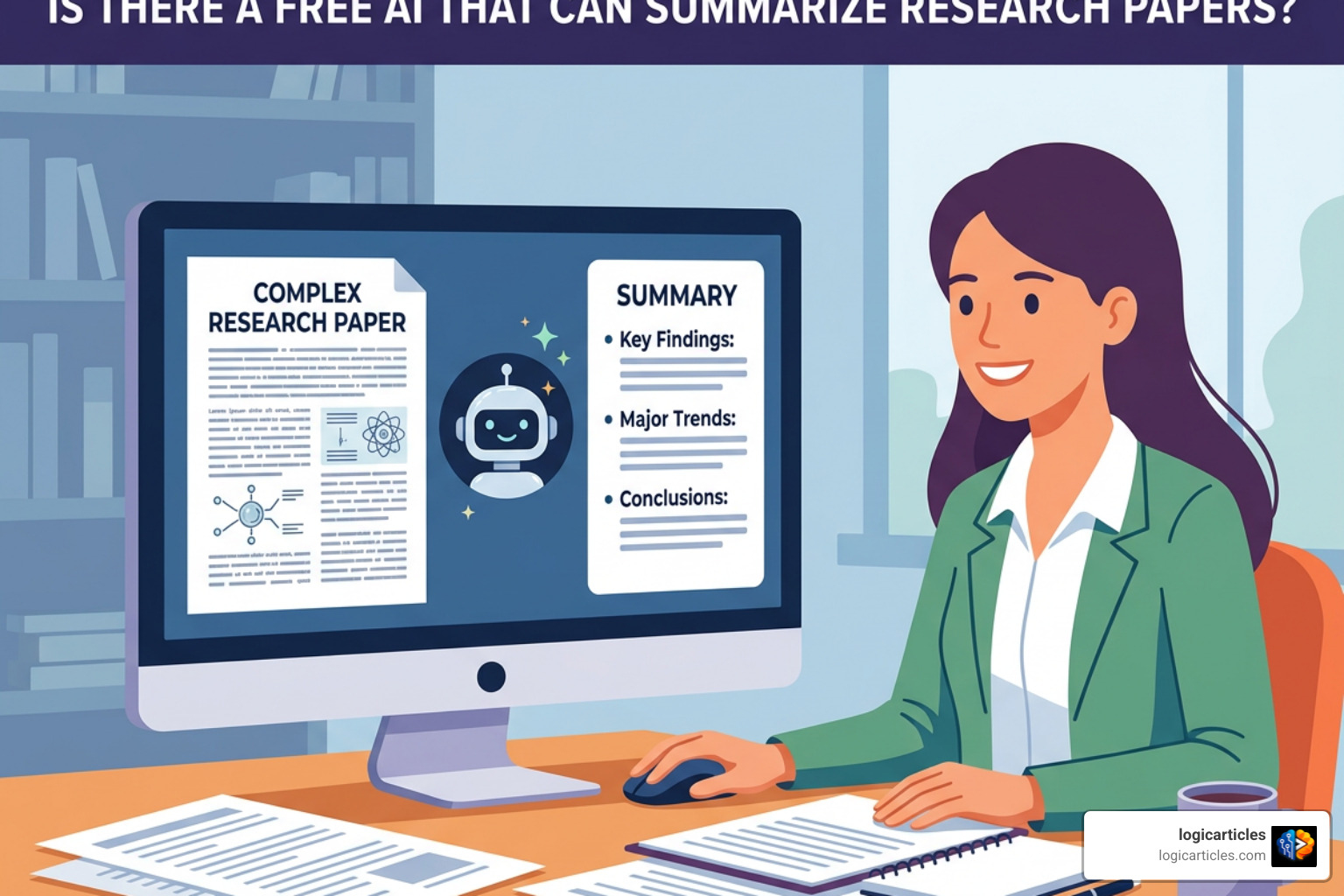
So, is there a free AI that can summarize research papers? Yes, and incorporating these specialized tools into your scholarly workflow can fundamentally transform how quickly you discover, evaluate, and digest academic literature. By converting dense multi-page PDFs into cited, structured summaries, free paper summarizers empower researchers to screen massive volumes of research in a tiny fraction of the time previously required.
To maintain the highest level of rigor in your work, treat AI summaries as an intelligent screening and filtering layer rather than a complete substitute for full-text reading. Use instant summaries to quickly organize comprehensive literature review matrices, tag key methodologies, and compile background reference lists, but always double-check primary data and core findings against the source document before publishing your conclusions.
Ready to optimize your academic workflow with cutting-edge technology? Explore More AI Tools at logicarticles to discover software, guides, and practical insights built to make your research smarter and faster.