Why Choosing the Right Family Law Software Matters

Finding the best family law software for your practice can mean the difference between a firm that runs smoothly and one buried in paperwork. Family law cases — divorces, custody disputes, child support, adoption — are emotionally complex and administratively demanding. Missing a deadline or miscalculating support figures can have serious consequences for your clients.
Here’s a quick look at the top family law software options available right now:
| Software | Best For | Starting Price |
|---|---|---|
| Victoria AI | AI-native, all-50-states coverage | $299/month per attorney |
| Smokeball | Automatic time tracking | $29/user/month |
| MyCase | All-in-one practice management | Contact for pricing |
| Family Law Software | Financial analysis & court forms | Free 2-week trial |
| Divorcepath | Canadian firms | Contact for pricing |
| CARET Legal | Workflow automation | Contact for pricing |
| CosmoLex | Canadian firms, split billing | Contact for pricing |
| CaseQube | AI + Salesforce integration | Contact for pricing |
| Neos | AI document handling | Contact for pricing |
| Deliberately.ai | Document management & intake | Contact for pricing |
Family law attorneys don’t just need legal software — they need tools built for the unique demands of family practice. Generic practice management platforms often lack critical features like child support calculators, financial affidavit generators, pension valuation tools, and state-specific court forms.
The good news: a growing number of purpose-built platforms now handle everything from client intake to complex financial projections — and many are adding AI to do it faster.
This guide compares the leading options so you can find the right fit for your firm’s size, budget, and practice focus.
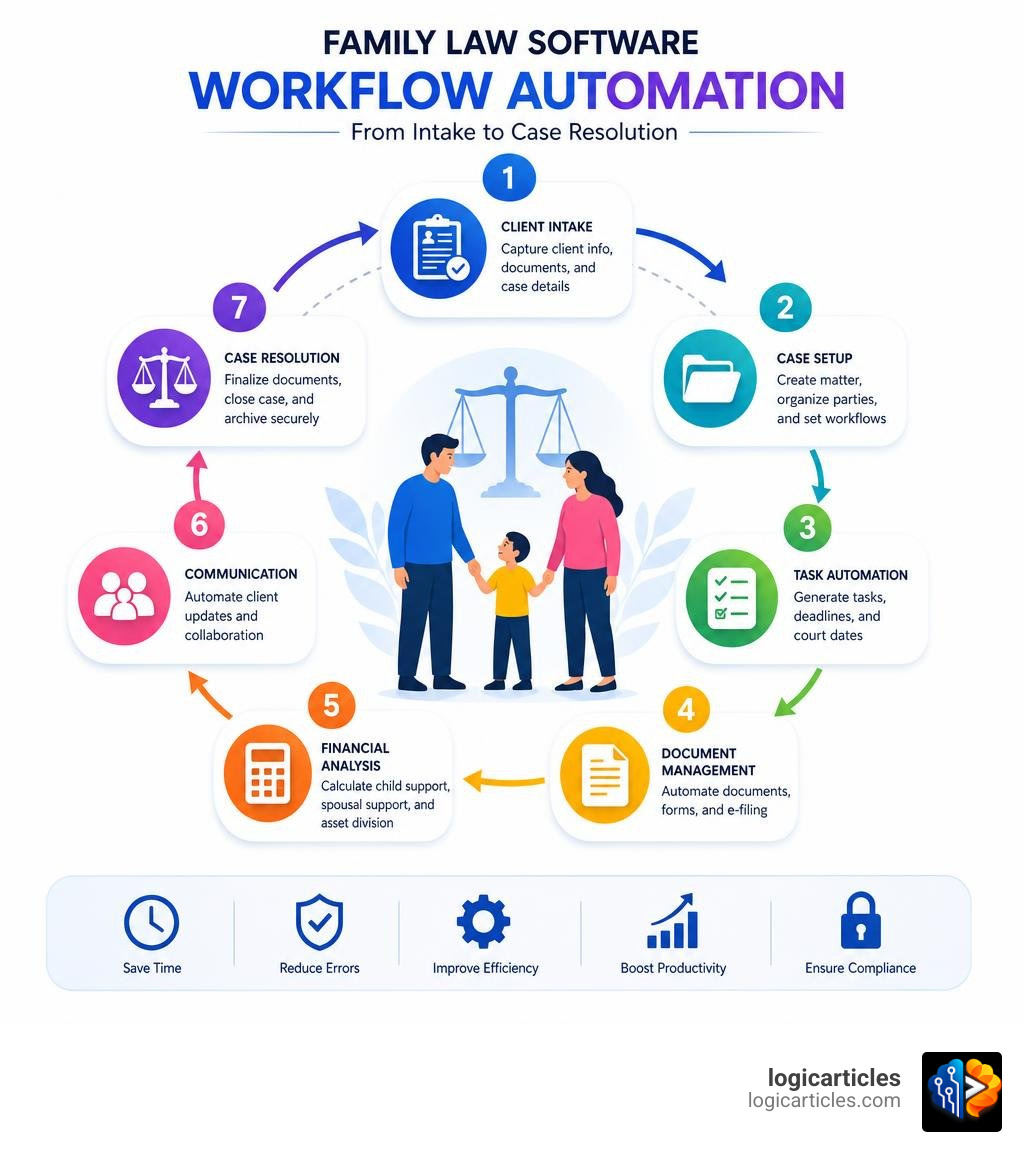
Why Specialized Tools Outperform General Legal Practice Management
While general legal practice management systems are great for organizing files and tracking billable hours, they often fall flat when faced with the highly specific, emotionally charged, and mathematically intensive nature of family law.
In a typical divorce case, you aren’t just tracking tasks and filing pleadings. You are calculating child support across multiple scenarios, dividing complex marital assets, projecting the long-term tax implications of spousal support, and valuing defined benefit pensions. Using a general practice management tool for these tasks is like trying to perform surgery with a Swiss Army knife—it has a lot of tools, but none of them are exactly right for the job.
Specialized family law tools are designed from the ground up to handle these distinct workflows. For example, instead of manually copying financial data from tax returns into a spreadsheet, specialized software can automatically extract that data, run the necessary state-specific guidelines, and instantly show you how a change in custody percentages affects child support.
Furthermore, general tools often lack advanced task allocation features. To keep your team on track with the intricate steps of custody disputes or adoption filings, you can explore Best Task Management Software in 2026 Tested to see how modern project tools keep workflows moving. But when it comes to legal-specific calculations, specialized family law platforms remain unmatched.
Key Features to Look For in the BEST family law software
When evaluating the best family law software for your practice, you should look for features that directly reduce your administrative burden and minimize the risk of human error. The ideal platform should seamlessly bridge the gap between case organization, financial calculations, and client communication.
Here are the non-negotiable features you should prioritize:
- State-Specific Court Forms & Financial Affidavits: The software must automatically generate and populate local court forms, income declarations, and asset disclosures.
- Dynamic Client Intake: Portals that allow clients to securely input their own financial history, saving your paralegals hours of manual data entry.
- Split Billing & Flexible Invoicing: Family law often involves complex fee arrangements, such as splitting a single invoice between two parties or managing third-party payments.
- Rule-Based Calendaring: Automated court deadline calculations based on local jurisdictional rules to ensure you never miss a critical filing.
| Feature | Specialized Family Law Software | Generic Legal Software |
|---|---|---|
| State Support Calculators | Built-in (all 50 states or specific regions) | None (requires external tools) |
| Pension Valuation | Advanced actuarial tables included | None |
| Split Billing Support | Yes (split fees between parties) | Rare / Requires complex workarounds |
| AI Guided Intake | Tailored to divorce & custody details | Generic contact forms |
AI-Powered Document Automation and Case Management
In 2026, artificial intelligence is no longer a futuristic luxury—it is a core component of efficient legal practice. The leading family law platforms now leverage AI agents to automate the most tedious parts of case management.
Instead of spending half your day chasing down clients for missing tax documents, modern tools use intelligent intake systems to guide clients through the upload process step-by-step. Once uploaded, the AI automatically extracts income figures, identifies financial gaps, and flags discrepancies.
For firms looking to revolutionize their document handling, adopting AI Family Law Case Management Software | AI Divorce Software for Lawyers | Divorce.law is a game-changer. These AI-native systems can generate complete, court-ready 50-state petitions, parenting plans, and discovery responses in a fraction of the time it takes to draft them manually.
Advanced Financial Calculations and Asset Division
At its core, divorce law is financial law. Dividing marital property, determining spousal support, and calculating child support require absolute mathematical accuracy. A minor error in asset valuation can lead to a malpractice claim or an unfair settlement for your client.
The best family law software solutions offer highly sophisticated financial engines. They don’t just add up assets; they calculate the after-tax value of property division, run multi-year cash flow projections, and handle complex defined benefit pension valuations using integrated mortality tables.
Managing these high-stakes financial calculations is very similar to managing wealth at an enterprise level. To understand how specialized systems handle complex accounting and asset structures, you can read more about the Best Family Office Accounting Software to see how high-level financial tools maintain accuracy and transparency.
Top Family Law Software Solutions Compared
To help you find the perfect match, let’s break down the top family law platforms on the market into distinct categories based on their primary strengths.

Best family law software for Financial Analysis and Court Forms
If your primary pain point is preparing financial affidavits, calculating support arrears, and generating long-term financial projections, you need a tool with an incredibly robust calculation engine.
- Family Law Software: This platform is widely considered the gold standard by courts and divorce professionals across North America. Founded in 1996, it specializes in deep financial analysis. It offers spousal and child support calculators for over 20 states, after-tax property division modeling, and defined benefit pension valuations. It also allows you to project a client’s net worth and cash flow up to 50 years into the future. You can explore their features directly via Software for Divorce Professionals – Family Law Software .
- CaseQube: Built on the powerful Salesforce platform, CaseQube is an excellent choice for firms that want a modular, secure, and highly customizable cloud solution. It combines case paths for custody and divorce with built-in financial tools and retainer billing. To see how they bring legal and financial tools together, check out Family Law Software Cloud | Law Case Management Software for Attorneys .
Best family law software for AI-Driven Workflows and Document Management
For firms looking to leverage cutting-edge technology to eliminate administrative clutter, AI-driven platforms offer unmatched efficiency.
- Deliberately.ai: This platform introduces “Client Intelligence” to the legal space. Instead of acting as a simple storage folder, it uses semantic search, optical character recognition (OCR), and entity extraction to automatically organize, tag, and summarize scattered client documents. It also features guided AI intake to reduce back-and-forth emails. Discover how this tool turns chaotic communication into clear insights at AI for Family Law | Legal Document Management Software .
- Victoria AI: As an AI-native operating system designed exclusively for divorce practices, Victoria AI features specialized AI agents that assist with legal research, case strategy, financial analysis, and document drafting. It is fully compliant with state bar ethics rules and covers child support calculations for all 50 states.
Best for All-in-One Practice Management and Billing
If you want a single software platform to run your entire practice—handling everything from your trust accounting to your client portal and time tracking—these all-in-one solutions are your best bet.
- CosmoLex: This cloud-based platform is highly popular for its built-in, compliant legal accounting system. Unlike other tools that require a separate integration with general accounting software, CosmoLex handles trust accounting and complex split billing natively. It is highly optimized for Canadian and US practices alike. Learn more at Efficient Family Law Software for Your Practice | CosmoLex Canada .
- Divorcepath: Particularly outstanding for Canadian family law firms, Divorcepath offers a fully connected, modern workflow. It features guidelines-based child and spousal support calculations for all Canadian provinces and territories, AI-powered tax document extraction, and seamless integration with Clio. Learn how they help firms transition from legacy systems at Family Law Firm Software – Divorcepath .
Security, Compliance, and Implementation Challenges
Because family law cases involve highly sensitive personal details—such as social security numbers, tax returns, mental health records, and custody schedules—security is paramount. When choosing software, you must ensure it complies with ABA Model Rules 1.1 (Competence) and 1.6 (Confidentiality).
Look for platforms that offer:
- SOC 2 Certification: Ensures the platform’s infrastructure meets strict security and privacy standards.
- End-to-End Encryption: Protects client data both while it is stored (at rest) and while it is being sent (in transit).
- Role-Based Access Controls: Allows you to restrict access to sensitive custody or financial documents to only the specific staff members working on the case.

The biggest challenge most firms face isn’t finding the right software, but successfully implementing it. Data migration—moving your existing client files, contacts, and active cases from old systems—can be daunting. Additionally, getting your staff to adopt new workflows requires structured training.
To help your team navigate this transition and store internal training guides, standard operating procedures, and software manuals, we recommend setting up a centralized internal knowledge base. You can find the best tools for this by reading our guide on the Best Knowledge Base Software in 2026.
Frequently Asked Questions About Family Law Software
What is the difference between general legal software and specialized family law software?
General legal software focuses on generic workflows, basic time tracking, and document storage. Specialized family law software includes built-in financial calculators (for child support, spousal support, and pension valuations), state-specific court forms, and features like split billing, which are essential for divorce and custody proceedings.
How does AI improve efficiency in family law practices?
AI improves efficiency by automating administrative tasks. It can automatically extract financial data from uploaded tax returns and pay stubs, summarize lengthy case files, draft initial parenting plans, and guide clients through the intake process without requiring manual oversight from your staff.
Is cloud-based family law software secure enough for sensitive client data?
Yes, provided you choose a reputable provider. The leading cloud-based family law platforms use bank-grade AES-256 encryption, multi-factor authentication (MFA), and SOC 2 certified data centers, making them highly secure and compliant with state bar ethics rules.
Conclusion
Upgrading to the best family law software is one of the most impactful decisions you can make for your firm’s future. By automating repetitive administrative tasks, streamlining financial calculations, and utilizing AI-driven document management, you can protect your firm from costly errors and spend more time advocating for your clients.
At logicarticles, we track the latest trends in legal technology to help you make informed software decisions. Did you know that 1 in every 100 people who use our tool see a 3x ROI? By matching your firm with the right specialized software, you can unlock incredible efficiency and accelerate your practice’s growth.
Ready to explore more technology guides to optimize your business operations? Explore more software reviews on our platform today!