What a Software Escrow Agreement Actually Does (And Why It Matters)
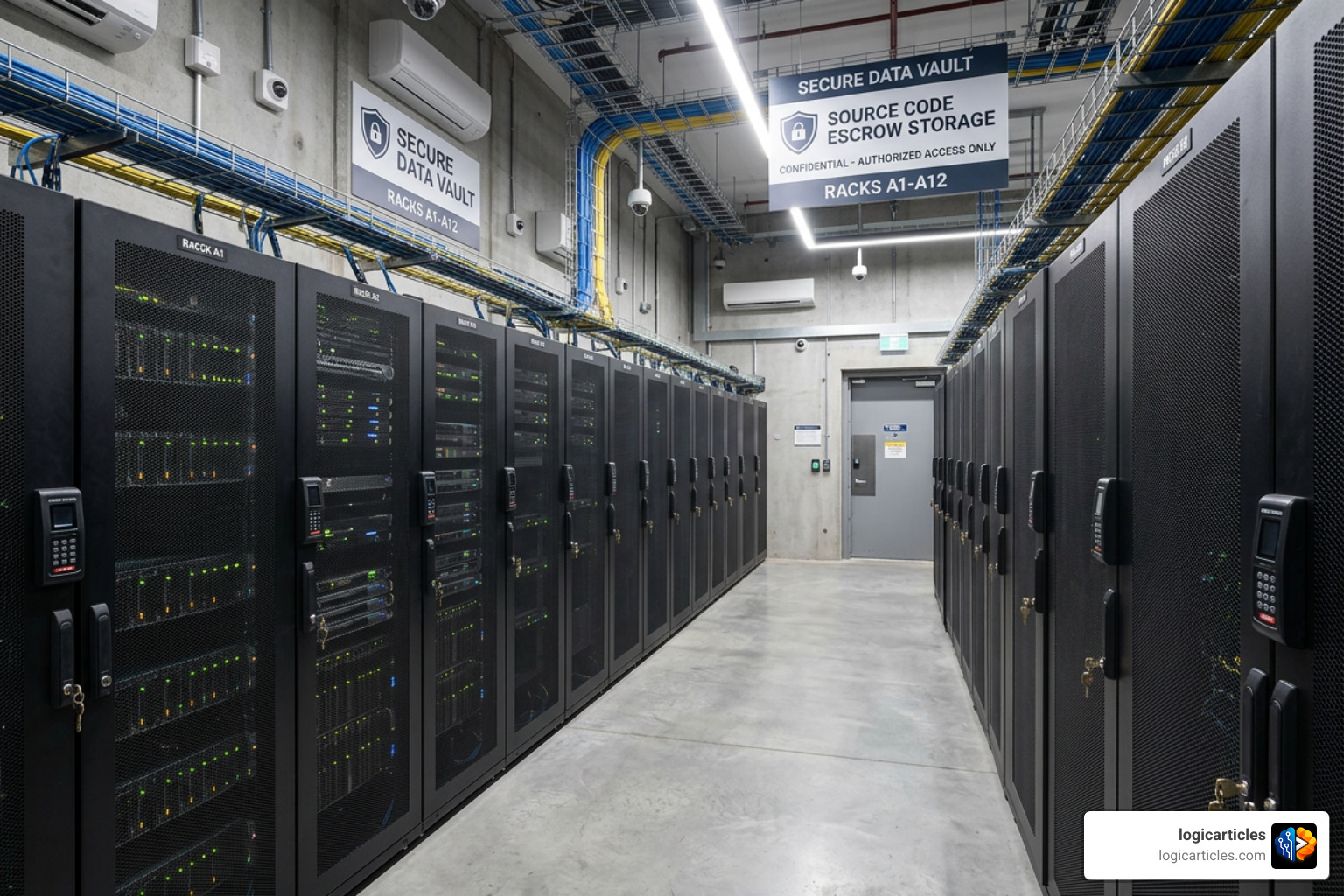
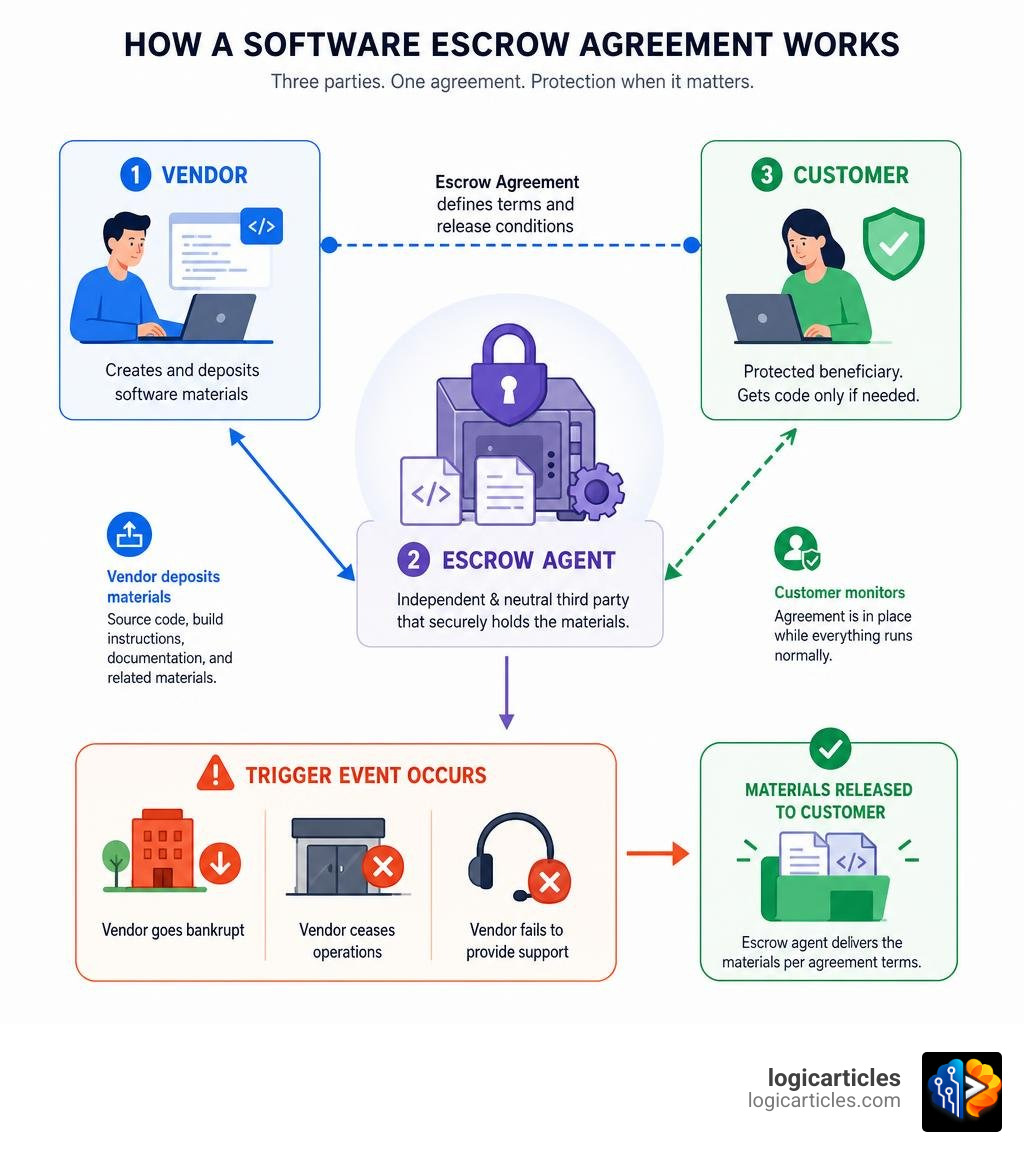
A software escrow agreement is a three-party contract where a software vendor deposits their source code with a neutral third party — and that code is only released to the customer if something goes wrong.
Here’s the quick version:
- Who’s involved: The software vendor (depositor), the customer (beneficiary), and an independent escrow agent
- What gets stored: Source code, build instructions, documentation, and related materials
- When it’s released: Only when a trigger event occurs — like the vendor going bankrupt, ceasing operations, or failing to provide support
- Why it exists: To protect businesses that depend on software they don’t own or control
Software escrow has been around for roughly forty years. Yet many businesses — even those that run entirely on third-party software — have never heard of it, or aren’t sure when they need it.
That’s a real problem. Think about it: 99% of businesses now use at least one SaaS solution. Many rely on software that would grind their operations to a halt if the vendor disappeared tomorrow. Without an escrow arrangement, that risk has no safety net.
This guide breaks down exactly how software escrow agreements work, what they cover, and when you need one.
What is a Software Escrow Agreement?
To understand a software escrow agreement, we first have to look at how software licensing works. When we license commercial software, we rarely buy the actual intellectual property (IP) or the underlying “recipe” of the program—known as the source code. Instead, we purchase a license to run the compiled, ready-to-use version (the object code).
The software vendor retains exclusive rights to the source code to protect their proprietary IP. However, this creates a major vulnerability for us as the customer. If that software is a business-critical application—meaning our daily operations completely depend on it—we are entirely at the mercy of the vendor to keep it running, fix bugs, and provide security patches.
This is where a Software Source Code Escrow Agreement | Practical Law comes into play. It acts as an insurance policy. By placing a copy of the source code and maintenance documentation into a secure, neutral vault, the vendor protects their IP from public exposure, while we secure a legal pathway to access that code if the vendor can no longer fulfill their obligations.
The Three Parties in a Tripartite Software Escrow Agreement
A standard, robust software escrow arrangement is structured as a tripartite (three-party) agreement. Each party has distinct legal obligations:
- The Depositor (The Software Vendor): The developer or vendor who owns the intellectual property. They are obligated to periodically upload and update the source code and related technical materials in the escrow environment.
- The Beneficiary (The Customer/Licensee): The business or enterprise using the software. They gain the peace of mind that they can access the source code if the vendor defaults.
- The Escrow Agent (The Neutral Third Party): An independent, specialized service provider. The agent’s job is to securely store the deposited materials, verify their completeness, and manage the release process according to strict contractual terms.
Bipartite vs. Tripartite Escrow Structures
Not all escrow arrangements are created equal. Depending on the level of control and security required, businesses typically choose between three structural approaches:
- The Access Clause: This is a simple clause embedded directly within a standard software license agreement. It outlines the conditions under which a vendor should hand over the source code. However, because it does not bind an independent escrow agent, it offers very weak protection. If the vendor goes bankrupt, there is no third party holding the code to hand it over to you.
- Bipartite Escrow Agreement: A standalone contract between just two parties—the vendor and the customer. While it allows the customer to monitor deposit schedules more closely than a basic access clause, it still lacks a neutral custodian. If a dispute arises, getting the code can turn into a legal nightmare.
- Tripartite Escrow Agreement: The gold standard of software escrow. By actively involving a professional escrow agent as a contracting party, both vendor and customer are protected by clear, legally binding protocols for storage, verification, and release.
| Feature / Metric | Access Clause | Bipartite Agreement | Tripartite Agreement |
|---|---|---|---|
| Parties Involved | Vendor & Customer | Vendor & Customer | Vendor, Customer, & Escrow Agent |
| Neutral Custody | No | No | Yes |
| Level of Security | Low | Moderate | High |
| Independent Verification | No | No | Yes (Optional Service) |
| Enforceability in Bankruptcy | Weak | Moderate | Very Strong |
Key Components and Deposited Materials
For a software escrow agreement to be effective, we must ensure that the materials held in escrow are actually useful. If a worst-case scenario occurs and the escrow agent hands us a digital folder, we need to be able to compile, run, and maintain the software. Simply depositing outdated, unorganized files is a recipe for disaster.

What Goes Into a Software Escrow Agreement Deposit?
A complete deposit should contain everything a reasonably skilled technical professional would need to rebuild and maintain the application from scratch. When setting up a Software Source Code Escrow Agreement , we recommend defining the “Deposit Materials” in a detailed technical annex. This typically includes:
- The Source Code: The human-readable programming code across all modules, including update versions and patches.
- Build Instructions and Scripts: Step-by-step guides, compilation scripts, and configuration files required to transform the raw source code into a functioning application.
- Technical Documentation: Architecture diagrams, database schemas, API documentation, and maintenance manuals.
- Third-Party Libraries and Dependencies: Clear listings (or direct copies) of any proprietary third-party tools, libraries, or open-source components integrated into the software.
- Development Environment Specifications: Details on the exact compilers, operating systems, and hardware configurations used by the developer’s team.
Verification Levels and Testing Procedures
How do we know the vendor actually deposited the correct files? This is one of the most common pitfalls in software escrow. Without verification, we might receive an empty folder or uncompilable files during a crisis. Escrow agents offer different levels of verification to prevent this:
- Level 1 (Inventory Check): The escrow agent performs a basic check to confirm that the files exist, are not corrupted, and match the file names listed in the deposit form.
- Level 2 (Technical Verification): An expert reviews the structure of the deposit, checking for completeness of documentation, database schemas, and external dependencies.
- Level 3 (Full Build and Run Test): The gold standard of verification. The escrow agent (or an independent specialist) recreates the development environment, compiles the source code, and runs the application to prove that it matches the licensed software. While Level 3 verification costs more (typically ranging from $3,000 to $8,000 per test), it is the only way to guarantee the deposit is 100% usable.
Release Conditions: When is the Escrow Triggered?
The core of any software escrow agreement is the list of “release conditions” (or trigger events). These are the specific, objective occurrences that legally authorize the escrow agent to release the deposited materials to the beneficiary.
To draft these effectively, we look at templates like the Source Code Escrow Agreement — California – California | Free PDF & Word Template to see how experienced legal professionals structure these clauses. The goal is to make these triggers as objective as possible to avoid lengthy delays when a crisis hits.
Bankruptcy and Insolvency Protections
The most common reason companies request a software escrow agreement is to protect themselves against vendor bankruptcy, liquidation, or sudden cessation of business.
In the United States, software escrow agreements serve as critical supplementary agreements protected under Title 11 USC Section 365(n) of the Bankruptcy Code. If a software vendor files for bankruptcy, the court-appointed trustee might attempt to reject the software license. Section 365(n) protects us by allowing licensees to retain their intellectual property rights—including accessing the source code stored in escrow—even if the vendor rejects the contract.
This level of protection is vital for highly specialized sectors. For instance, when managing custom Insurance Software Development, a sudden vendor collapse without an escrow release could freeze claims processing and regulatory compliance overnight.
Dispute Resolution and Contrary Instructions
What happens if we request a release, but the vendor claims they aren’t in default?
To prevent premature or fraudulent releases, standard agreements include a Contrary Instructions clause. The typical process works like this:
- The Demand: We submit a written release request to the escrow agent, citing a specific trigger event (e.g., the vendor failed to fix a critical bug within the agreed SLA).
- The Notice: The escrow agent immediately notifies the vendor and provides a set window (usually 10 to 30 business days) for them to respond.
- The Objection: If the vendor believes they are not in default, they submit “Contrary Instructions” denying the claim.
- Arbitration: Once contrary instructions are received, the escrow agent halts the release. The dispute is then sent to rapid, binding arbitration to resolve the matter legally without exposing the source code prematurely.
This process is highly critical in complex settings like EMR Software Development in 2026, where patient care and strict medical privacy laws mean that any dispute over system access must be resolved with absolute legal precision.
On-Premise vs. SaaS Escrow in 2026
The software landscape has shifted dramatically over the last several years. As of June 2026, the way we deploy, manage, and secure software looks very different than it did a decade ago. Consequently, software escrow has had to evolve from physical vaults to dynamic cloud integrations.

When we look at modern Software Stack Management in 2026, we must distinguish between traditional on-premise escrow and modern SaaS continuity escrow.
Traditional On-Premise Escrow
In a traditional on-premise model, the software runs locally on our own servers. If the vendor disappears, the application doesn’t stop working immediately. It will keep running, but we won’t get any more updates, security patches, or bug fixes.
For these legacy systems—often categorized under core What is Productivity Software?—traditional escrow works perfectly. The escrow agent holds the physical or static digital source code, and if a release event occurs, we compile that code to maintain our local deployment.
Modern SaaS and Cloud Continuity Escrow
SaaS applications present a much tougher challenge. Since 99% of businesses currently use SaaS and 85% of firm software is SaaS-based, we cannot simply rely on static source code. If a SaaS provider goes bankrupt or suffers a catastrophic financial default, their hosting servers (AWS, Azure, Google Cloud) will be shut down for non-payment. Having the raw source code on a hard drive won’t help us if we don’t have the active databases, cloud configurations, or live hosting infrastructure to run it.
To keep up with Web Development Best Practices 2026, modern SaaS escrow includes:
- Automated Git Deposits: Continuous, encrypted syncing of active code repositories directly into the escrow storage.
- Hosting Access Credentials: Secure storage of cloud configuration scripts (like Terraform or Kubernetes files) and access credentials.
- Financial Continuity Provisions: Agreements where the escrow agent is authorized to pay the hosting provider (e.g., AWS) directly for up to 90 days to keep the servers running while we migrate our data.
Frequently Asked Questions about Software Escrow
Setting up a software escrow agreement often brings up practical questions about logistics, costs, and legalities. Utilizing resources like a Software Escrow Agreement Template | Free Word Download can help clarify these standard terms, but here are the answers to the most common questions we encounter.
What happens if the agreement is terminated without a release event?
If the software license naturally expires, or if the agreement is terminated by mutual consent without any trigger events occurring, the escrow agent will return all deposited materials to the software vendor. Alternatively, the agreement may dictate that the escrowed files must be securely destroyed. Confidentiality provisions and trade secret protections always survive the termination of the agreement.
Who typically pays for software escrow fees?
This is entirely negotiable. In many enterprise deals, the customer (beneficiary) pays the annual maintenance and setup fees because they are the ones requesting the protection. However, if a vendor uses escrow as a selling point to win larger corporate contracts, they may absorb the cost. Annual fees for a standard single-beneficiary tripartite escrow typically range from $1,000 to $5,000, with additional costs for technical verification.
Is a software escrow agreement legally required?
There is no general, overarching law that mandates software escrow. However, sector-specific regulators effectively require it for risk management. For example, US banking regulators (OCC, FDIC) expect banks to have escrow agreements for core banking technology. Similarly, strict healthcare standards and federal procurement rules often make software escrow a non-negotiable requirement for critical systems.
Conclusion
At logicarticles, we believe that proactive risk management is the cornerstone of sustainable growth. As businesses rely more heavily than ever on third-party digital infrastructure, safeguarding your software investments is no longer optional.
A software escrow agreement bridges the gap between protecting a vendor’s valuable intellectual property and securing a customer’s business continuity. By setting up clear tripartite agreements, defining comprehensive deposit materials, and establishing objective release triggers, you ensure that your business remains resilient—no matter what happens to your software vendors.
Ready to optimize your business tools and secure your digital workflow? Explore Productivity Software Solutions to learn more about selecting and managing the best applications for your business stack.