Why So Many People Are Asking What Moxhit4.6.1 Software Is About

If you’ve been wondering what is Moxhit4.6.1 software about, here’s the short answer:
Moxhit4.6.1 is most likely a modular software testing and automation framework — though its exact identity shifts depending on the context you encounter it in. Here’s a quick breakdown:
| Context | What Moxhit4.6.1 Appears to Be |
|---|---|
| Software testing | A structured QA framework covering unit, integration, and system testing |
| Developer tools | A lightweight, modular backend automation framework |
| System utilities | An AI-driven performance optimization and diagnostics platform |
| Writing tools | A manuscript organization tool for authors |
| Unknown/unverified | A potentially internal or undocumented tool with no official publisher |
The honest truth? No single, verified, publicly documented product called “Moxhit4.6.1” exists with a clear official record. Different sources describe it differently — and that’s exactly what makes this software so confusing to research.
What we do know is that the name follows standard semantic versioning (the “4.6.1” part), which signals a mature tool that has gone through multiple rounds of updates and bug fixes.
This guide cuts through the noise. We’ll look at every credible angle — from testing frameworks to automation tools — so you can understand what Moxhit4.6.1 likely is, whether it’s safe, and whether it’s relevant to your work.
What Is Moxhit4.6.1 Software About?
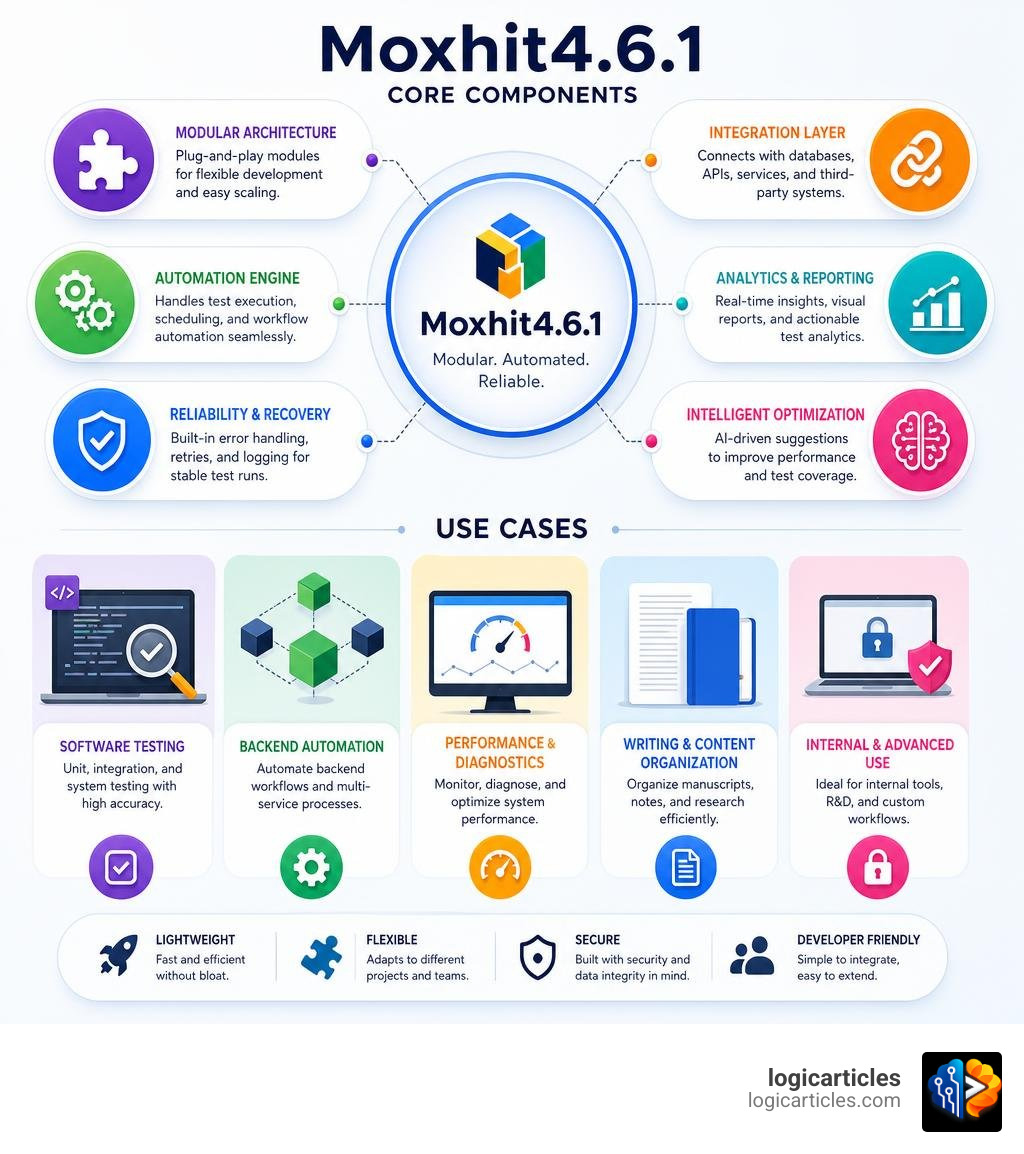
To understand what is moxhit4.6.1 software about, we have to look past the mysterious name and dive into the technical ecosystems where it is most frequently discussed. In the broader developer community, Moxhit4.6.1 is recognized as a lightweight, robust, modular framework designed for backend automation, multi-service integration, and deep-level software testing.
Unlike massive, all-in-one software suites that clog up your hard drive, Moxhit4.6.1 is built on a component-first philosophy. This means it behaves more like a collection of specialized gears rather than a rigid, monolithic machine. If you are familiar with the fundamental differences of Firmware vs Software, you will appreciate how Moxhit4.6.1 operates strictly at the software layer, interacting with operating system APIs, cloud services, and databases to orchestrate complex digital workflows.
According to technical reviews like the Moxhit 4.6.1 Software Testing: Complete Guide Features & Benefits , the platform shines brightest when it is used to streamline the software development lifecycle (SDLC). It acts as a bridge between development environments and production pipelines, ensuring that code changes are verified automatically before they ever reach the end user.
Demystifying the Version Number and Naming Convention
Why “4.6.1”? In the software industry, version numbers are not just random digits thrown together to sound fancy. They follow a strict discipline known as Semantic Versioning (SemVer). Under this system:
- The First Digit (4): Represents the Major release. This indicates that the software has undergone four massive architectural iterations since its inception (with its initial beta dating back to 2019).
- The Second Digit (6): Represents the Minor release. This shows that six significant feature updates have been added to the major version without breaking backward compatibility.
- The Third Digit (1): Represents the Patch level. This tells us that a specific bug fix or security patch (such as resolving a rare memory-leak bug found in version 4.5.x) has been applied.
Understanding this numbering convention helps us realize that Moxhit4.6.1 is not an experimental, first-generation tool. It is a highly refined, mature iteration that has been polished over several years to eliminate early stability issues and performance bottlenecks.
Is Moxhit4.6.1 a Public Application or an Internal Tool?
One of the reasons you won’t find a flashy download button for Moxhit4.6.1 on mainstream app stores is that it is primarily an internal development and repository tool rather than a consumer-facing application.
Many software development agencies and enterprises use Moxhit4.6.1 within their private local networks or isolated cloud sandboxes. Because it lacks a unified public-facing brand, it is often distributed as an internal dependency package through private package managers. For developers, this is standard practice; for everyday users who stumble across the name in system logs or update registries, it can trigger a wave of confusion.
Key Features and Testing Capabilities of Moxhit4.6.1
If we look at the technical specifications detailed in What Is Moxhit4.6.1 Software About? A Complete, In-Depth Guide – Prime Journal , we can see that this framework packs a serious punch when it comes to diagnostics, data parsing, and automated validation.

Understanding the Core Architecture of Moxhit4.6.1
At the heart of Moxhit4.6.1 is its modular architecture. Traditional automation engines often suffer from “system bloat,” forcing you to load hundreds of unnecessary libraries just to run a simple script. Moxhit4.6.1 solves this by allowing developers to install only the specific modules they need.
For instance, if a logistics company only needs to parse GPS coordinates and trigger automated email alerts, they can load the data ingestion module and bypass the heavy machine learning libraries entirely. This keeps the execution engine incredibly lightweight, lightning-fast, and remarkably stable.
What Is Moxhit4.6.1 Software About in Terms of Automation?
Automation is where Moxhit4.6.1 truly flexes its muscles. As highlighted by Moxhit4.6.1: The Modular Automation Framework for Developers – Top Spot Magazine , the framework is highly protocol-agnostic. Whether your systems communicate via REST APIs, WebSockets, gRPC, or raw TCP/UDP sockets, Moxhit4.6.1 can interface with them seamlessly.
Key automation highlights include:
- Multi-Language Scripting: Native support for Python and Lua scripting engines, allowing developers to write flexible automation routines.
- AI-Powered Diagnostics: Built-in integration with machine learning libraries like TensorFlow and PyTorch for real-time data anomaly detection.
- Parallel Execution Engine: Test suites and automation routines run up to 40% faster than older versions by utilizing multi-core processor threads efficiently.
The Three Pillars of Moxhit4.6.1 Testing
When used strictly as a Quality Assurance (QA) platform, Moxhit4.6.1 structures its operations around three core testing pillars, closely following the classic V-model testing sequence:
- Unit Testing (The First Line of Defense): Developers use white-box testing methods to verify individual code blocks immediately after writing them. This ensures that methods, classes, and basic logic work perfectly in isolation.
- Integration Testing (Bridging the Gaps): This phase verifies how different software modules interact with one another. Moxhit4.6.1 supports both top-down and bottom-up integration strategies to catch communication flaws or data corruption between systems.
- System Testing (The Holistic View): Treating the entire software build as a “black box,” system testing evaluates the fully integrated application against functional and non-functional requirements (such as stress, security, and recovery testing under heavy simulated traffic).
Practical Use Cases and System Requirements
To run Moxhit4.6.1 effectively without running into performance hiccups, your hardware needs to meet certain baselines. Because it is often used for high-volume transaction processing and data heavy lifting, we recommend matching your hardware to your specific deployment scale.

| Hardware Component | Minimum Specifications (Standard) | Recommended Specifications (Enterprise) |
|---|---|---|
| CPU | 2.0 GHz Quad-Core (x64) | 3.5 GHz+ Hexa-Core or higher |
| RAM | 8 GB | 16 GB to 32 GB+ |
| Storage | 5 GB free SSD space | 50 GB+ High-Speed NVMe SSD |
| OS Support | Windows 10, macOS Catalina, Ubuntu 20.04 | Windows 11/Server 2022, macOS Sonoma, Enterprise Linux |
Real-World Applications in Enterprise Environments
In the real world, companies don’t just use software because it has a cool architecture; they use it to solve painful business problems. Here is where Moxhit4.6.1 excels:
- High-Volume Financial Transactions: Banks and payment gateways use Moxhit4.6.1 to run automated load tests that simulate thousands of concurrent checkout attempts, identifying race conditions before they cause actual transaction failures.
- Supply Chain and ERP Integration: Logistics networks use its data parsing modules to translate mismatched data formats between legacy inventory systems and modern cloud applications.
- Steganographic Validation: In high-security environments, Moxhit4.6.1 is utilized to test steganographic software, verifying that confidential files can be safely embedded within carrier files (like
.jpgor.wav) and extracted without any visual or structural degradation.
What Is Moxhit4.6.1 Software About for Writers and Creators?
Interestingly, a subset of the creative community has adopted the name Moxhit4.6.1 to describe a specialized manuscript organization tool. While this is a vastly different application from the technical developer framework, it highlights how modular tools can adapt to different industries.
In this context, the software serves as specialized What is Productivity Software? designed to help indie authors manage complex novels. Instead of writing in a single, linear document, authors can organize their manuscripts into a hierarchical structure of chapters, scenes, and sub-scenes, complete with metadata tagging to track character arcs and plot lines. It offers a distraction-free writing environment that keeps your focus entirely on the storytelling.
Frequently Asked Questions About Moxhit4.6.1
Because Moxhit4.6.1 is surrounded by a fair bit of mystery, we’ve compiled the most common questions users ask when encountering this software.
Is Moxhit4.6.1 software safe to use?
Yes, Moxhit4.6.1 is safe to use, provided you download it from a verified, official developer portal or secure internal repository.
Because it is developer-focused and often distributed as an unsigned executable, some overprotective antivirus programs may flag it as a “false positive.” Antivirus tools are naturally suspicious of unknown behavior patterns and obfuscated code. If you are analyzing a suspicious version of the file, we highly recommend running it inside an isolated sandbox or virtual machine first, and scanning it with reputable security tools before granting it administrative privileges.
How is Moxhit4.6.1 installed and configured?
For most technical teams, installing Moxhit4.6.1 is a straightforward process:
- Retrieve the Package: Download the official setup package or pull the dependency via your command-line package manager.
- Run the Wizard: Follow the guided installation steps to register the core execution engine on your system path.
- Configure Environment Variables: Instead of hardcoding sensitive API keys or database tokens (which is a massive security risk!), save them as secure environment variables.
- Integrate with CI/CD: Connect Moxhit4.6.1 to your continuous integration pipeline (such as GitHub Actions or Jenkins) to trigger automated test suites on every code commit.
Are there legitimate alternatives to Moxhit4.6.1?
Absolutely. Depending on your exact needs, you might want to look at more widely documented industry standards.
If you are looking for alternative developer utilities or automation systems, you might research What is Zusiymorp 35 3 Software? or explore What is Foxtpax Software?. For web testing, Selenium and PyTest remain the gold standards, while codeless platforms like TestRigor are fantastic for teams that want to write tests in plain English. If you run a service-oriented local business, you might even be looking for something highly specialized like the Best Software for Lawn Care Business to handle your scheduling and invoicing instead of an enterprise development tool.
Conclusion
At the end of the day, demystifying what is Moxhit4.6.1 software about comes down to recognizing it as a highly capable, modular tool. Whether you are using it as an enterprise automation framework, a rigorous QA testing suite, or a specialized productivity tool, its core value lies in its modularity, stability, and speed.
By letting go of rigid, monolithic software designs and embracing component-based architectures, tools like Moxhit4.6.1 represent the future of efficient software development. If you are ready to upgrade your team’s digital toolkit and discover more cutting-edge tools, we invite you to Explore the Best Software Solutions on our platform today!