Why Real Estate Development Software Is Changing How Projects Get Built
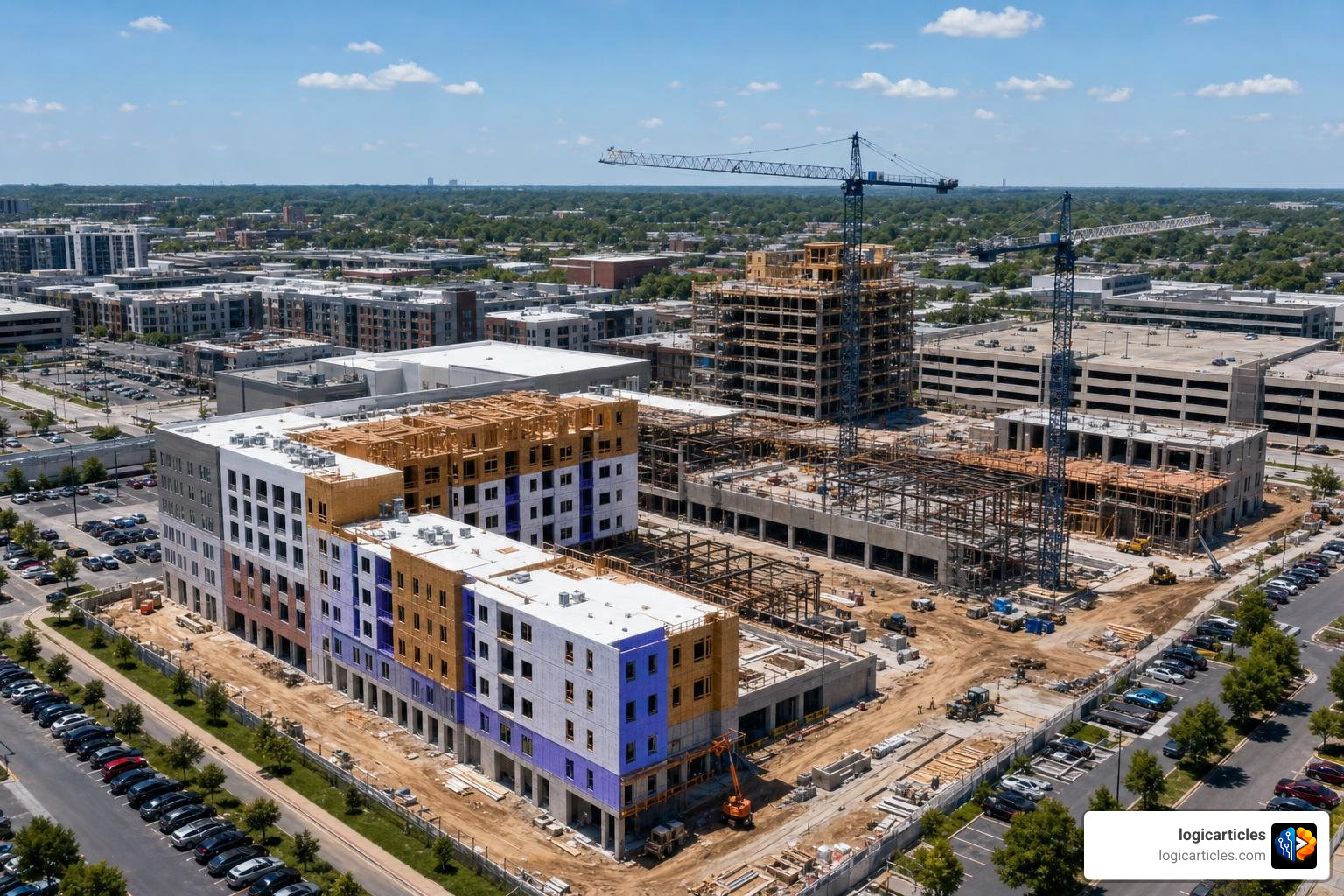
Real estate development software is a category of digital platforms built to manage the full lifecycle of a development project — from land acquisition and feasibility through construction, financing, and stabilization.
If you’re evaluating your options quickly, here’s what you need to know:
| What It Does | Why It Matters |
|---|---|
| Centralizes project budgets, schedules, and documents | Replaces scattered spreadsheets and email threads |
| Tracks costs, draw requests, and change orders in real time | Reduces cost overruns and billing disputes |
| Manages deal pipelines from site selection to close | Speeds up decision-making and due diligence |
| Generates investor and lender-ready reports | Improves stakeholder confidence and alignment |
| Supports the full lifecycle: acquisition → construction → stabilization | Eliminates the need for multiple disconnected tools |
Most development teams still run their projects on a mix of spreadsheets, email, and messaging apps. It works — until it doesn’t.
As project complexity grows, that approach creates real risk. Budgets live in different files. Updates happen in email threads no one can find later. Invoices get disputed. Cost overruns go undetected until it’s too late.
The numbers tell the story: firms using purpose-built development platforms have reported up to 66% fewer cost overruns and 80% less manual administrative work. Some job managers report saving 2.5 hours per person per day just from better real-time communication and approvals.
This guide breaks down what real estate development software actually does, which categories exist, how leading platforms compare, and how to choose the right one for your team and project size.
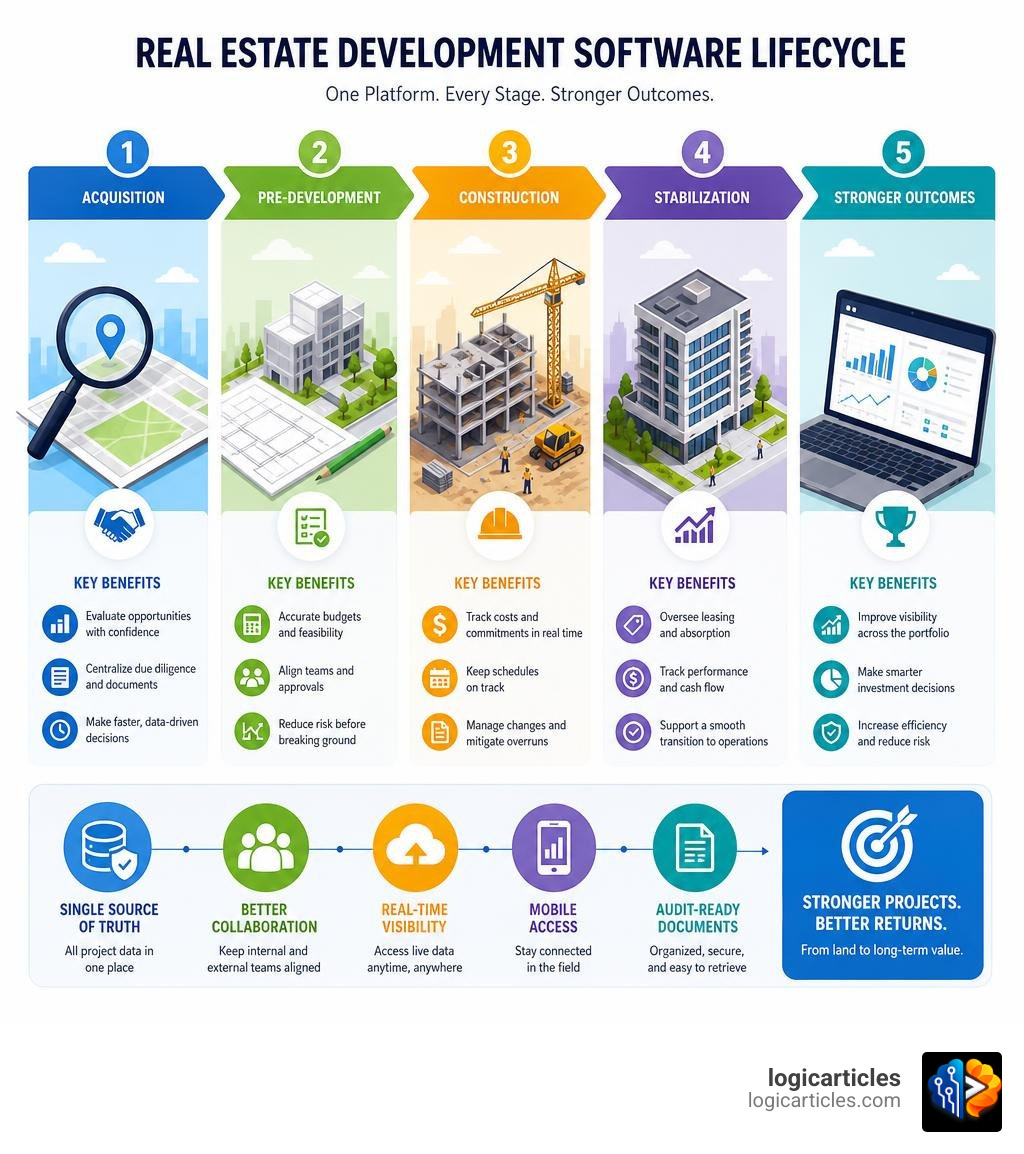
What is Real Estate Development Software and Why It Matters

At its core, real estate development software acts as the single source of truth for a developer’s entire portfolio. Unlike generic business software, these tools are built around the unique financial and operational realities of building physical assets. Development is fundamentally a leverage and capital deployment game where visibility directly impacts decision speed, funding costs, and risk exposure.
Without a unified platform, critical project data is locked in siloed spreadsheets, creating massive blind spots. Implementing specialized software allows us to mitigate entitlement risks, manage volatile material prices, and coordinate complex capital stacks. Once a project is built and leased, the data flows smoothly into the next phase of the property lifecycle, which you can manage using the Best Real Estate Portfolio Management Software In 2026.
Core Functions of Real Estate Development Software
Modern development platforms support the project from the first spark of an idea to the day the keys are handed over:
- Deal Modeling & Feasibility: Instantly run pro formas, evaluate different zoning scenarios, and calculate residual land value to determine if a deal actually pencils.
- Due Diligence: Track environmental reports, site surveys, and title documents in a centralized checklist.
- Pre-Development & Entitlements: Monitor permitting timelines, design revisions, and utility approvals before breaking ground.
- Construction Tracking: Keep tabs on commitments, actual costs, anticipated costs, and payment histories in real time.
- Stabilization Monitoring: Track lease-up velocities, capital expenditures, and operational transition metrics.
How It Differs from Generic CRM and Project Management Tools
Many teams make the mistake of trying to force generic CRMs, spreadsheets, or general project management tools to run their developments. While these generic tools are great for basic task tracking, they simply aren’t built to handle the complex financial structures of commercial real estate.
Generic tools do not understand the concept of a multi-tiered capital stack, nor do they support automated draw package generation. They cannot differentiate between hard costs (the physical construction materials and labor) and soft costs (architectural fees, engineering, permits, and legal expenses).
Furthermore, real estate development software integrates specialized zoning intelligence and spatial mapping capabilities directly into your workflows. While a general tool can help you assign a task, it won’t help you calculate your debt-to-equity ratio or forecast interest rate sensitivities. If you want to see how general tools stack up for basic office work, check out our guide on the Best Task Management Software In 2026 Tested.
Key Features and Capabilities to Look For

When evaluating real estate development software, it is easy to get lost in a sea of features. To ensure your team actually uses the platform, look for solutions that offer robust workflow automation, strict document control, and seamless real-time project tracking solutions.
A great developer platform should automatically ingest and categorize invoices and contracts using AI, standardizing your cost data across your entire portfolio. It should also feature built-in approval workflows so that when a general contractor submits a change order, it is automatically routed to the correct project manager, lender, and investor for sign-off.
Financial Controls in Real Estate Development Software
The lifeblood of any development project is its budget. Real estate development software provides continuous financial oversight by replacing manual spreadsheets with automated cost-tracking engines.
The software excels at managing:
- Budget Tracking: Comparing planned versus actual spending in real time so you can spot potential overruns before they happen.
- Draw Requests: Compiling bank draw packages—which used to take weeks of manual spreadsheet work—in a matter of minutes.
- Change Order Management: Tracking pending, approved, and rejected change orders to see their exact impact on your contingency funds.
- Financial Forecasting: Integrating actuals directly from your accounting system to automatically update your work-in-progress (WIP) and cash flow projections.
To learn more about construction-specific financial systems, read our review of the Best Construction Financial Management Software.
Feasibility and Deal Pipeline Management
Before you lay a single brick, you need to know if a project is viable. Advanced automated feasibility platforms let you draw a site using real parcel data and instantly generate zoning-compliant designs.
By setting custom parameters like floor area ratios (FAR), building heights, and parking requirements, developers can generate multiple design options in seconds. This allows us to calculate conceptual cost estimates and residual land value early on, filtering out bad deals in hours rather than weeks. To keep your pipeline organized from the start, utilizing Real Estate Deal Management Software | Pipeline Tracking for CRE Developers | Acreus can bridge the gap between initial sourcing and underwriting.
Comparing Software Categories and Functional Profiles
Not all real estate development software is built for the same user. Depending on your organization’s size, asset class focus, and project delivery model, you will need a specific type of platform.
| Software Category | Target Audience | Core Strength | Key Limitation |
|---|---|---|---|
| Financial-Centric | Institutional developers, finance directors, capital allocators | Advanced pro forma modeling, automated draw packages, investor reporting | Lacks detailed jobsite coordination and field tools |
| Project-Centric | Development managers, owner’s representatives, construction managers | Field-to-office communication, site documentation, task scheduling | Lighter on deep equity/JV financial modeling |
| All-in-One Platforms | Mid-to-large scale developers managing the entire lifecycle | End-to-end integration from acquisition to post-delivery | Steeper learning curve and higher implementation costs |
| Specialized Tools | Land developers, homebuilders, feasibility engineers | Patented workflows (e.g., anti-monotony, site-solver maps) | Narrow focus on specific phases or asset classes |
Choosing the right category ensures you don’t overpay for features you don’t need, or worse, end up with a tool that doesn’t solve your core problems. For a deeper look at managing the physical construction phase, explore the Best Construction Manager Software.
Financial and Pro Forma Focused Solutions
These platforms are designed to protect the capital stack. They excel at scenario analysis, allowing developers to model complex joint venture (JV) equity splits, debt structures, and interest rate sensitivities.
By using AI-powered financial modeling tools, developers can fill out simple guided forms to instantly generate investor-grade business plans, pitch decks, and dynamic pro formas. This is incredibly helpful for raising capital quickly without spending tens of thousands of dollars on external financial consultants.
Project and Jobsite Management Solutions
Once construction begins, the focus shifts from financial modeling to field execution. Jobsite management solutions prioritize real-time communication, subcontractor collaboration, and robust site documentation.
Firms using mobile-first jobsite tools have seen a 100%+ increase in site documentation (photos and videos) within weeks of implementation. This documentation is critical for resolving customer disputes, proving work completion, and maintaining an audit-ready history of the build.
For homebuilders and master-planned community developers, keeping track of lot inventory and architectural approvals requires unique tools. Using The XO® – Community Development Software | Cecilian Partners can help streamline lot management and automate the architectural review process through patented compliance engines.
Choosing the Right Real Estate Development Software
Selecting the right software is a major strategic decision that will impact your team’s daily operations for years to come. To make an informed choice, we must evaluate platforms based on their ease of use, integration capabilities, and overall return on investment.
Many developers find success by transitioning to all-in-one developer platforms that centralize plans, budgets, bids, and subcontractor communications in a single interface. This eliminates tool fragmentation and ensures that everyone—from the architect to the accountant—is working from the same data.
Key Evaluation Criteria for Developers
When demoing different platforms, keep these four critical criteria in mind:
- Integration Depth: Does the software integrate seamlessly with your existing accounting systems, ERPs, and document storage tools?
- Scalability: Can the platform handle your current pipeline as well as your projected growth over the next five years?
- Security and Compliance: Does the vendor hold SOC 2 certification or other enterprise-grade security credentials?
- Onboarding and Support: What kind of training and data migration assistance does the software company provide?
Common Pricing Models and Implementation Timelines
Pricing for real estate development software varies widely depending on the complexity of your operations. The most common pricing models include:
- Per-Project Pricing: Flat monthly fees per active project (often starting around $150/month for professional cost-control tools).
- Per-User Licensing: Monthly fees per user (typically ranging from $39 to $200+ per user, per month).
- Enterprise Tier Agreements: Annual flat-rate contracts based on your total portfolio volume or annual construction value.
Implementation and onboarding typically take anywhere from 10 to 14 weeks. During this period, the software vendor should assist with data translation, API connections, cleaning historical data, and training your team and external partners.
Frequently Asked Questions about Real Estate Development Software
How does real estate development software reduce project risk?
Real estate development software reduces risk by providing real-time financial visibility across your entire portfolio. By automating the tracking of change orders, commitments, and actual expenditures, the platform flags potential cost overruns before they impact your contingency funds. This continuous oversight allows developers to make proactive adjustments, leading to highly predictable project outcomes and significantly fewer surprises during lender audits.
Can small-to-medium developers benefit from these platforms?
Absolutely. Small-to-medium developers often have leaner teams, meaning every hour saved has a massive impact on the bottom line. SME-focused development software eliminates manual spreadsheet entry, saving employees up to 40% of their administrative time. It also ensures that all change orders and extra tasks are tracked and billed accurately, preventing cash flow issues and reducing customer invoice disputes to virtually zero.
How does it integrate with existing accounting systems?
Most modern development platforms feature built-in integrations with major accounting systems and ERPs like Sage, QuickBooks, and other leading financial suites. This integration eliminates double data entry by automatically syncing invoices, payments, and contract actuals between your project management dashboard and your general ledger.
Once your development project transitions into an operating asset, you can continue managing your tenants and rental cash flows using the Best Commercial Property Management Software. Alternatively, if you focus on residential assets, check out our guides on the Best Rental Property Software and the Best Condo Management Software. For operational maintenance post-delivery, utilizing the Best Cmms Software For 2026 ensures your physical assets remain in peak condition.
Conclusion
The real estate development industry has reached a digital turning point. Relying on fragmented spreadsheets, scattered emails, and disconnected point solutions is no longer a viable way to build in a competitive market. By adopting purpose-built real estate development software, developers can gain total financial control, automate tedious administrative tasks, and build deeper trust with investors and lenders.
Whether you are a small developer looking to scale your operations or an enterprise firm managing a billion-dollar pipeline, the right software will serve as the engine for your strategic growth.
Ready to streamline your development operations and boost your team’s efficiency? Explore productivity solutions on logicarticles to find more tools that can help transform your business workflows today.