What the id Software Xbox Layoffs Statement Actually Says

The id Software Xbox layoffs statement from Microsoft has been one of the most-discussed corporate responses in gaming since the cuts landed in July 2026 — on the same day the studio shipped a major DOOM: The Dark Ages expansion.
Here is the short version of what you need to know:
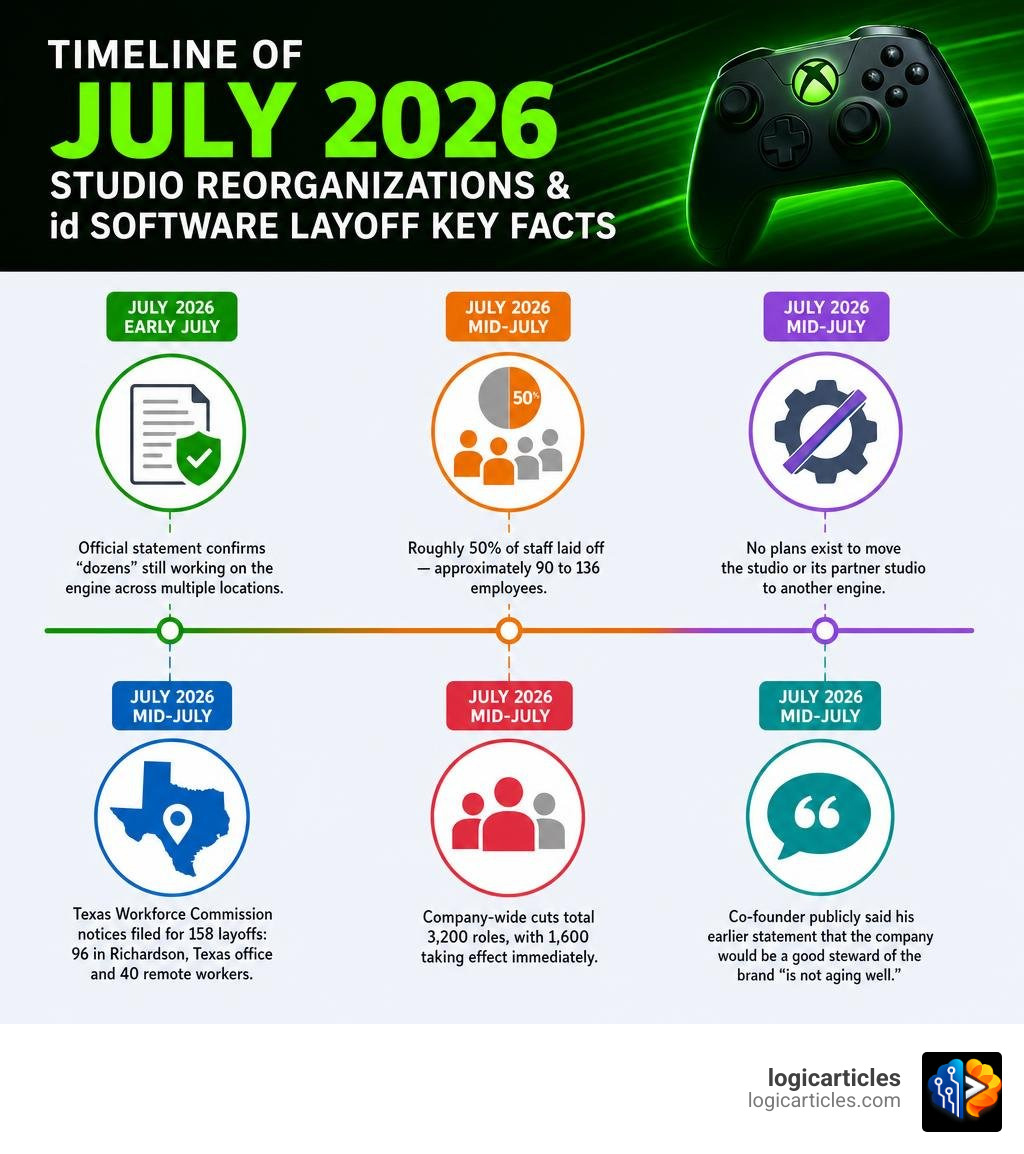
- Xbox’s official statement confirmed that “dozens” of people across multiple locations are still working on the id Tech engine, pushing back on rumors that only a single developer remained.
- Roughly 50% of id Software’s staff — approximately 90 to 136 employees — were laid off as part of Xbox’s broader restructuring.
- No plans exist (as of July 2026) to move id Software or MachineGames to Unreal Engine.
- ZeniMax Media filed Texas Workforce Commission notices covering 158 layoffs in the state, including 96 at the Richardson, Texas office and 40 remote workers.
- Xbox is cutting 3,200 roles across its video game division in total, with 1,600 taking effect immediately.
- John Carmack, co-founder of id Software, publicly said his earlier statement that “Microsoft will probably be a good steward of the brand” was not aging well.
The cuts hit the QA department and core programming teams especially hard, raising real questions about the studio’s ability to maintain its historically high technical standards.
Analyzing the Official id Software Xbox Layoffs Statement
When news first broke that id Software was losing half of its staff, panic rippled through the gaming community. Rumors quickly spread on social media that the legendary id Tech engine team had been reduced to a skeleton crew of just one person in Texas.
To address the growing anxiety, Xbox issued a brief but direct statement to clarify the situation. According to reports, Microsoft labeled these rumors “inaccurate” and clarified that “dozens of people” continue to actively develop and support the id Tech engine across multiple studio locations.
While this statement was designed to calm nervous investors and developers, it also highlighted a massive transition period. The restructuring has left many wondering how the studio will balance future engine development with the demands of its current game roadmap. We can see how these deep organizational changes are sending shockwaves through the community in the detailed breakdown by Xbox Layoffs Devastate Id Software, Obsidian, and IOI | GAMES.GG .

What the id Software Xbox Layoffs Statement Reveals About id Tech 8
The proprietary id Tech engine is widely regarded as one of the most optimized, high-performance engines in the entire video game industry. With the release of DOOM: The Dark Ages, id Software showcased the power of id Tech 8, delivering incredible visual fidelity and blistering frame rates.
Xbox’s statement made it clear that id Tech is not being abandoned. Instead, the responsibility for maintaining and advancing the engine is being distributed globally. While the Dallas (Richardson) headquarters saw major staff reductions, the Frankfurt, Germany office remains heavily focused on the core engineering of the engine.
As analyzed in the report from id Software Layoffs Cut Studio Staff in Half Amid Xbox Restructure << Windows Tips :: Gadget Hacks , distributing engine support across different time zones and offices presents its own set of challenges. When a studio loses half of its staff, institutional knowledge built over decades doesn’t easily transfer to other teams. This shift raises questions about how quickly id Software can roll out engine updates and support other Bethesda studios using the technology.
Industry Rumors vs. the Official id Software Xbox Layoffs Statement
In the absence of clear communication, the gaming industry is always quick to fill in the blanks. When the layoffs hit, rumors swirled that Microsoft was planning to retire id Tech entirely and transition both id Software and MachineGames to Epic Games’ Unreal Engine.
The official id software xbox layoffs statement directly refutes this idea. Ditching a highly optimized engine that is perfectly tailored for , first-person shooters would be incredibly expensive and counterproductive. For games like Indiana Jones and the Great Circle and the DOOM series, id Tech’s unique rendering pipeline is a core part of their identity.
However, the contrast between Xbox’s optimistic statement and the reality on the ground has kept fans and journalists skeptical. As detailed by Fallout over Xbox Layoffs Grows, as Finger-Pointing Begins and id Software Sees Half Its Staff Cut , the loss of engineering talent makes it difficult to see how future iterations of the engine can keep pace with competitors without a major reinvestment from Microsoft.
The Scale of the Cuts: How Many Employees Were Affected?
The sheer volume of the cuts at id Software has shocked even industry veterans. While Microsoft initially framed the layoffs as a standard corporate realignment, public regulatory filings soon revealed the true scale of the damage.
According to official filings with the Texas Workforce Commission, ZeniMax Media (the parent company of id Software and Bethesda) laid off a total of 158 employees in Texas. Of those, 136 positions were directly tied to id Software. This represents roughly 50% of the studio’s entire workforce, effectively halving the size of the legendary developer overnight.
To put these numbers into perspective, let’s look at how these layoffs compare to other major Xbox studios affected during this same July 2026 restructuring wave:
| Studio | Pre-Layoff Staff Size | Estimated Layoffs | Percentage of Workforce Cut | Key Areas Affected |
|---|---|---|---|---|
| id Software | ~200 – 250 | 136 | ~50% | QA, Core Programming, Engineering |
| Obsidian Entertainment | ~285 | 60 – 70 | ~25% | Art, Design, Narrative, QA |
| IO Interactive (Istanbul) | N/A | Full Studio Closure | 100% | Entire Development Team |
These statistics, which are also explored in XBOX Layoffs See 136 People Let Go At ID Software – Insider Gaming , show that while several studios felt the sting of the “big reset,” id Software was hit with surgical precision, losing a massive portion of its core operational strength.
Richardson Office and Remote Worker Redundancies
The physical impact of the layoffs was split between id Software’s physical headquarters in Richardson, Texas, and its network of remote developers. The Texas Workforce Commission filings confirmed that 96 employees working directly out of the Richardson office were let go, alongside 40 remote workers who reported to the Texas branch.
Losing 136 talented individuals is a massive blow to the local game development scene in Texas. Many of these remote and in-office workers had spent years building the tight-knit culture that id Software is famous for. According to reports from 50% of Staff Cut from id Software, per Reports | DayOne , this sudden reduction has left remaining employees stretched thin as they try to pick up the pieces of ongoing projects.
Impact on QA and Core Programming Teams
While a 50% cut across any company is devastating, the specific departments targeted at id Software have raised serious red flags. Internal reports indicate that the Quality Assurance (QA) department was almost entirely dismantled, and the core programming and engineering teams were heavily gutted.
Losing core engineering staff is incredibly risky for a studio like id Software. These are the programmers who write the low-level code that allows DOOM to run at incredibly high frame rates on a wide variety of hardware. As discussed by Xbox Layoffs Hit Obsidian and Id Software Teams Hard , cutting these highly specialized roles means that future projects may suffer from longer development cycles, slower bug-fixing pipelines, and potential performance issues at launch.
John Carmack’s Reaction to the Microsoft Restructuring
The layoffs at id Software did not go unnoticed by the studio’s legendary co-founder, John Carmack. Known as the mastermind behind the original 3D engines that powered Wolfenstein 3D, DOOM, and Quake, Carmack’s opinions still carry immense weight in the gaming industry.
Following the news of the massive staff cuts, Carmack took to social media to express his disappointment. He specifically referenced his previous comments from when Microsoft first acquired ZeniMax Media, where he had expressed optimism about the tech giant’s ownership.
Carmack bluntly stated:
“My ‘Microsoft will probably be a good steward of the brand’ statement isn’t aging well.”
This public display of regret resonated deeply with fans and industry professionals alike. Carmack’s criticisms of corporate ownership highlight several key issues:
- Loss of Long-Term Vision: Corporate parent companies often prioritize short-term quarterly margins over the decades-long cultivation of creative talent.
- Dismantling Legacy Tech Teams: Cutting core programmers ignores the immense value of having a highly specialized, in-house engine team.
- The Pitfalls of Constant Reorganization: Repeatedly tearing down and rebuilding studios disrupts creative momentum and destroys institutional knowledge.
Carmack’s reaction serves as a sobering reminder of the tension between creative game development and corporate financial management.
Broader Context: Xbox’s Franchise-First Strategy and Restructuring
To understand why Microsoft made such drastic cuts at id Software, we have to look at the bigger picture of Xbox’s business strategy in July 2026. Under the leadership of Xbox CEO Asha Sharma, the company embarked on a massive organizational overhaul designed to streamline operations and improve profit margins.
The restructuring resulted in the elimination of 3,200 roles across the gaming division, alongside a dramatic flattening of corporate management layers from 14 down to ideally three to five layers.

As part of this “big reset,” Microsoft is pivoting to a strict “franchise-first” model. Instead of funding a wide variety of experimental projects across dozens of individual studios, the company is focusing its resources on its most valuable, established intellectual properties. For Bethesda, this means concentrating almost exclusively on five core franchises:
- Fallout
- The Elder Scrolls
- DOOM
- Quake
- Wolfenstein
While DOOM and Quake are safe under this strategy, the actual studios making them are being forced to operate with much smaller, leaner teams. By cutting id Software’s staff in half, Microsoft hopes to reduce overhead costs while relying on cross-studio collaboration and outsourcing to get future projects over the finish line.
Frequently Asked Questions About the id Software Layoffs
Will id Software transition to Unreal Engine?
No. Despite widespread rumors that id Software and MachineGames would abandon their proprietary engine, the official statement from Xbox confirmed that dozens of developers across multiple locations are still actively working on and supporting the id Tech engine. There are currently no plans to transition these studios to Unreal Engine.
How do the layoffs affect DOOM: The Dark Ages DLC?
While the layoffs occurred on the same day the latest DOOM: The Dark Ages expansion was released, the long-term roadmap for future DLC and live-service updates remains uncertain. With the QA department and core programming teams heavily impacted, fans should expect potentially longer development cycles and slower patch rollouts for upcoming content.
How many total roles were cut across Xbox?
As part of the July 2026 restructuring wave led by CEO Asha Sharma, Xbox is eliminating a total of 3,200 roles across its video game division. The first wave of 1,600 cuts began immediately, with the remaining reductions scheduled to roll out through the end of the fiscal year.
Conclusion
The massive layoffs at id Software mark a major turning point for one of the most respected names in video game history. While the official id software xbox layoffs statement attempts to reassure fans that the id Tech engine has a bright, multi-location future, the reality of losing half of the studio’s staff cannot be ignored. As Microsoft pushes forward with its franchise-first strategy, the gaming world will be watching closely to see if a downsized id Software can still deliver the technical masterpieces they are famous for.
Navigating professional shifts and organizational restructures can be incredibly challenging, whether you are in the gaming industry or any other field. If you are looking for ways to streamline your own workflows, manage projects more efficiently, and keep your team aligned during times of change, explore our curated productivity resources from logicarticles. We offer practical guides and strategies to help you stay ahead of the curve and maintain high standards, no matter what challenges come your way.