What Is SolarWinds Software? A Clear Answer for IT Teams
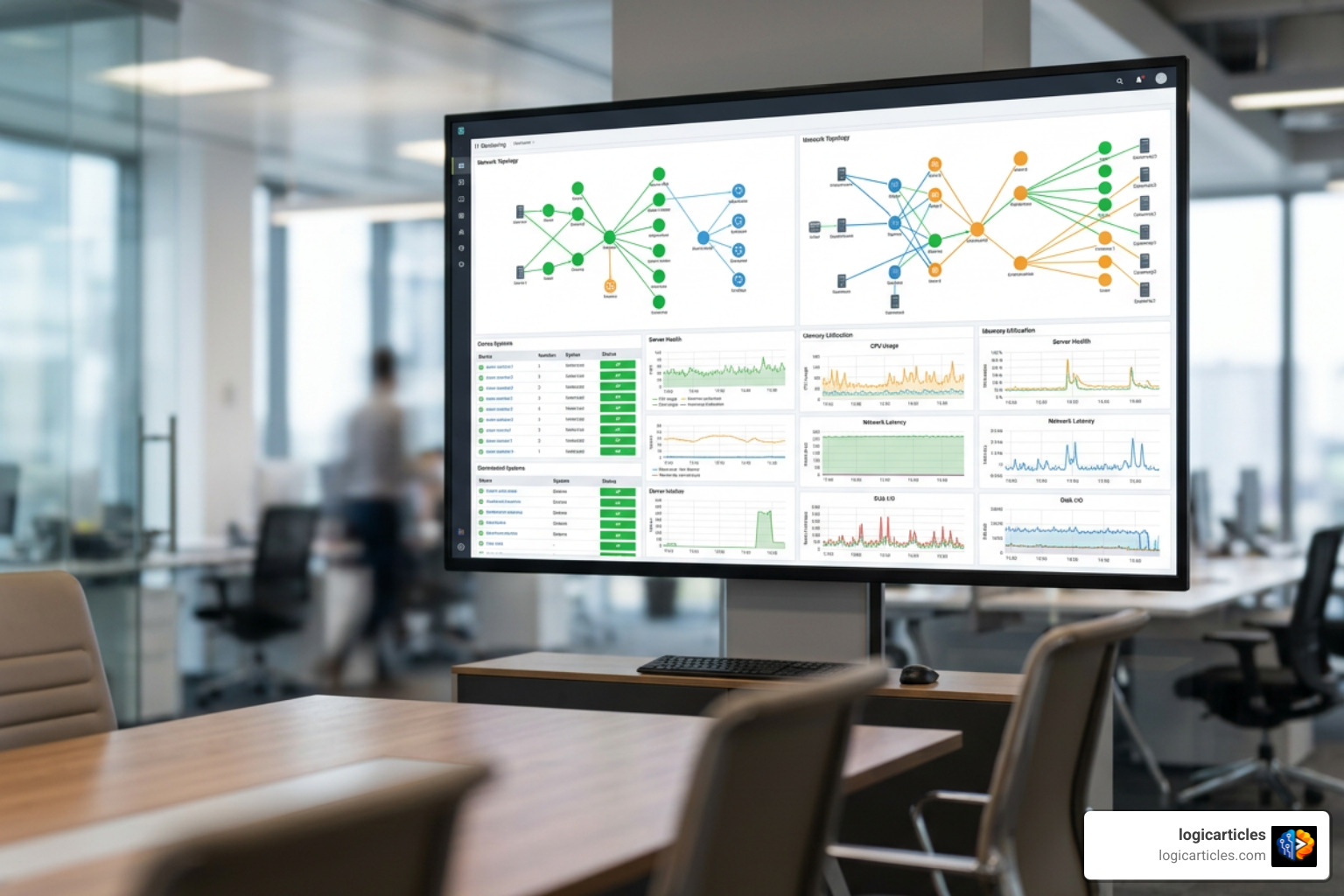
What is SolarWinds software? It is an enterprise IT management platform that helps organizations monitor, manage, and troubleshoot their networks, servers, databases, and applications — all from a unified interface.
Here is a quick summary:
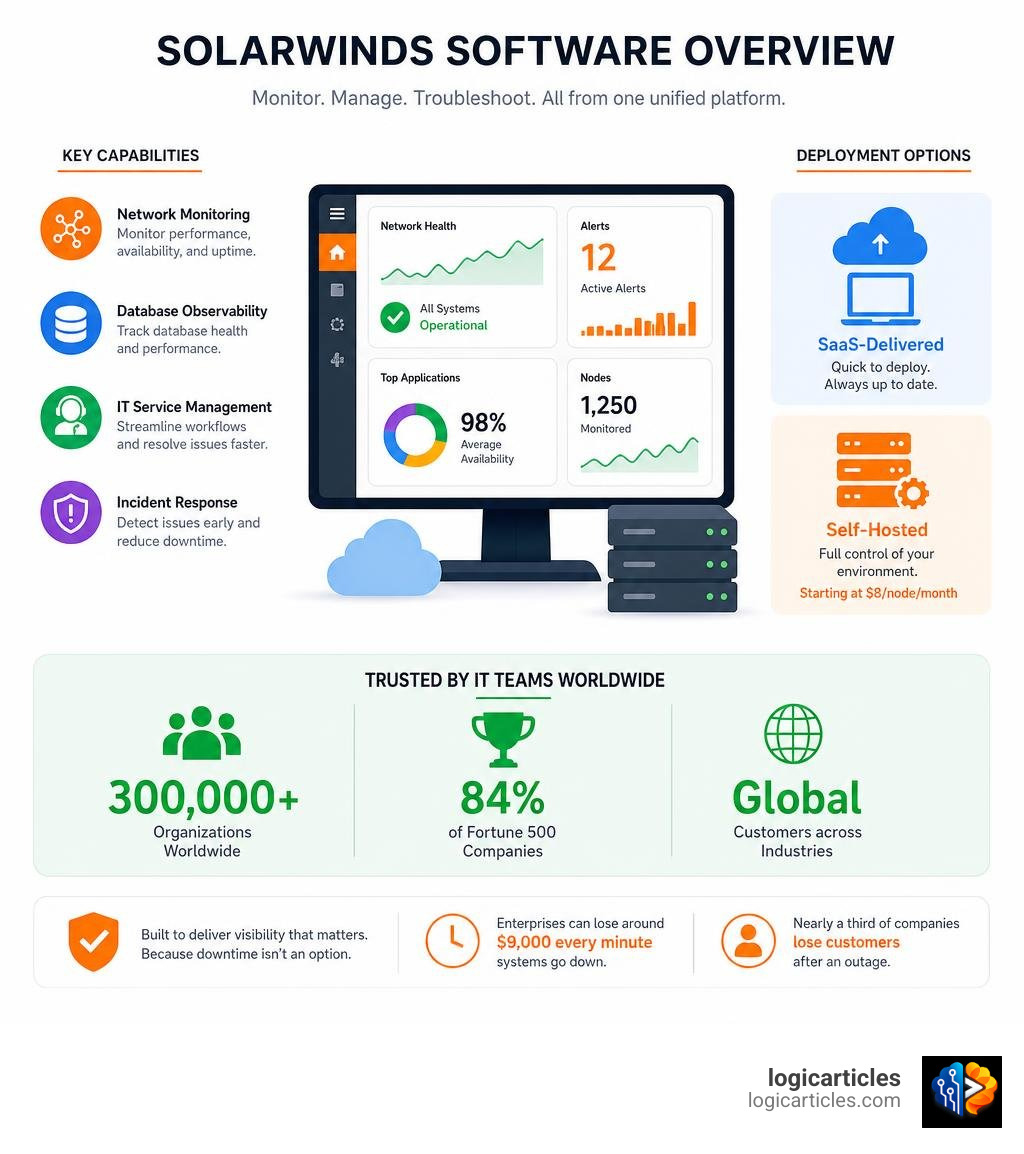
- What it does: Monitors IT infrastructure (networks, servers, databases, apps) across on-premises, cloud, and hybrid environments
- Who uses it: IT administrators, network engineers, and enterprise IT teams — including 84% of Fortune 500 companies
- Core capabilities: Network monitoring, database observability, IT service management (ITSM), and incident response
- Deployment options: Self-hosted (starting at $8/node/month) or SaaS-delivered
- Customer base: Over 300,000 organizations worldwide
SolarWinds has been a dominant name in IT infrastructure management since 1999. Today, it positions itself as an AI-powered observability platform — but its roots are in practical, no-nonsense network monitoring tools built for IT professionals who needed visibility fast.
The stakes are real. Enterprises can lose around $9,000 every minute systems go down, and nearly a third of companies lose customers after an outage. SolarWinds was built to prevent exactly that.
It is also a company with a complex story. In late 2020, Microsoft’s president described the breach of SolarWinds’ Orion platform as “the largest and most sophisticated attack the world has ever seen.” Understanding what SolarWinds does means understanding both its power and its history.
This guide covers all of it — the platform, the products, the security legacy, and whether it is the right fit for your organization.
What Is SolarWinds Software and How Does It Work?
To understand what is solarwinds software at a technical level, we have to look under the hood of its core collection architecture. SolarWinds does not just sit on a server and guess what is happening across your network; it uses a highly structured system of polling engines, database layers, and optional software agents to gather real-time telemetry.
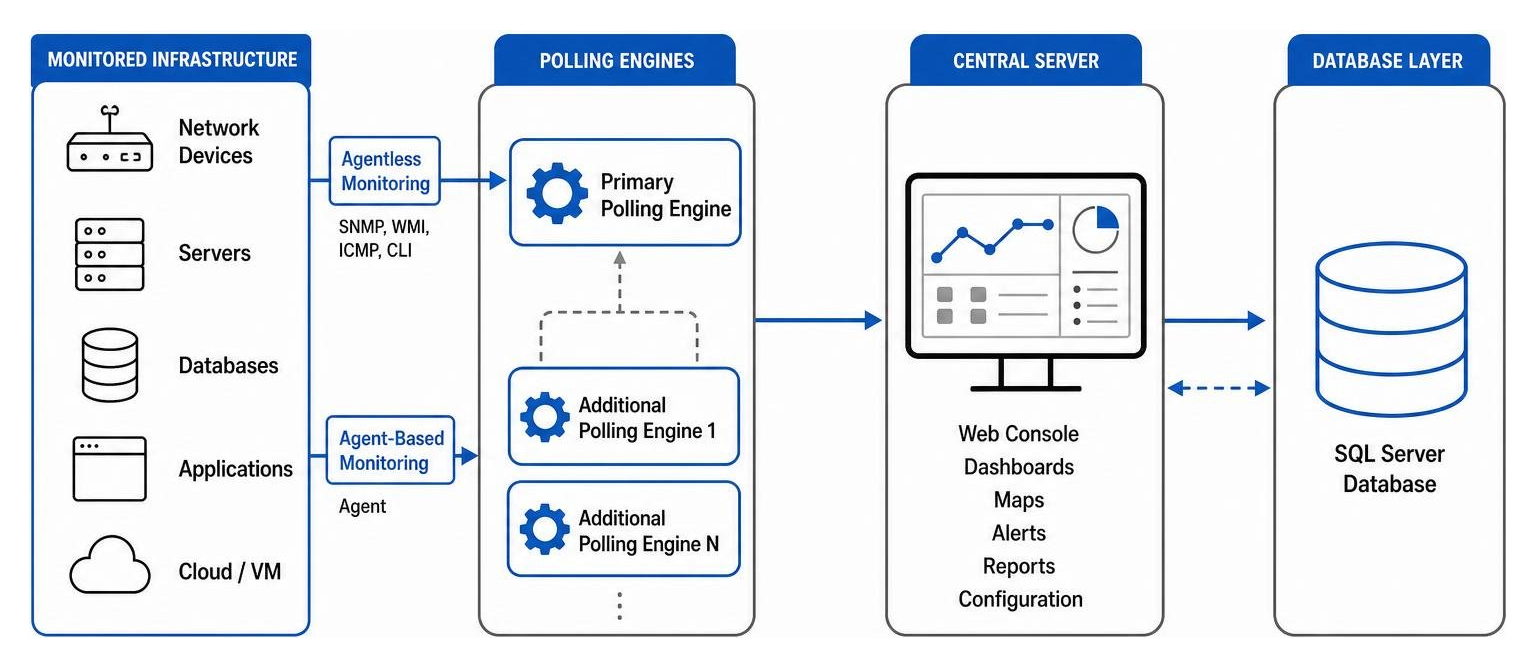
At its foundation, the platform relies on three primary components:
- The Central Server: This is the brain of your SolarWinds deployment. It hosts the web console where we view dashboards, construct maps, configure alerts, and generate reports.
- Polling Engines: The muscle of the operation. The primary polling engine (and any Additional Polling Engines, or APEs, deployed to scale out the system) actively queries your infrastructure. It uses standard protocols like SNMP (Simple Network Management Protocol), WMI (Windows Management Instrumentation), ICMP (ping), and CLI scripting to check the health of routers, switches, virtual machines, and physical servers.
- The Database Layer: Every metric, transaction, and log collected by the polling engines is written to a Microsoft SQL Server database. Because of this, the performance of your SolarWinds environment is heavily tied to the health of your SQL instance. It is worth noting that while SolarWinds offers High Availability (HA) configurations to protect its application servers, this HA does not cover the SQL database itself, which requires its own separate database clustering or Always On availability groups.
When it comes to gathering data from target systems, we have two primary options:
- Agentless Monitoring: The polling engine queries devices remotely using standard network protocols. This is highly popular because it requires zero software installation on target servers. If a switch speaks SNMP, SolarWinds can monitor it out of the box.
- Agent-Based Monitoring: For highly secure zones, DMZs, or cloud instances where remote ports cannot be opened, we install a small SolarWinds agent directly on the target operating system (Windows or Linux). This agent streams real-time health metrics back to the polling engine over a single secure port.
All of these components historically came together under what was known as the Orion Platform. Today, that architecture has evolved into the unified SolarWinds Platform. This modern foundation consolidates your various monitoring modules into a single web interface, giving us a cohesive view of our entire infrastructure instead of forcing us to jump between separate, siloed tools.
Core Capabilities and Product Portfolio
The modern SolarWinds portfolio is incredibly broad. Over the years, the company expanded its footprint far beyond simple network pings. It achieved this growth through aggressive internal development and strategic acquisitions, buying up popular tools like Pingdom, Loggly, and Papertrail to build out a complete observability suite.
To help us understand the landscape, let us look at the primary ways we can deploy and utilize SolarWinds Products:
| Capability / Feature | SolarWinds Observability Self-Hosted | SolarWinds Observability SaaS |
|---|---|---|
| Primary Deployment | On-premises or private cloud VMs | Fully managed cloud SaaS |
| Best For | Strict compliance, legacy infrastructure, hybrid IT | Cloud-native applications, microservices, Kubernetes |
| Licensing Model | Node-based / perpetual or subscription | Usage-based / subscription |
| Target Systems | Physical servers, virtual hosts, local networks | Containers, microservices, cloud APIs, serverless |
| AIOps Integration | Machine learning-based Root Cause Assist | Native cloud-native anomaly detection |
This division highlights how SolarWinds transitioned to meet the demands of modern DevOps and cloud engineers. Whether you are running a traditional data center full of rack servers or spinning up ephemeral Kubernetes clusters in the public cloud, there is a deployment model tailored to your environment.
Answering What Is SolarWinds Software for Network and Systems Monitoring
If you ask any veteran network engineer what is solarwinds software, they will likely point you directly to their core infrastructure monitoring modules. These are the classic, battle-tested tools that built the company’s reputation.
We can break down these core systems management and monitoring tools into a few essential products:
- Network Performance Monitor (NPM): The flagship product. NPM tracks device uptime, packet loss, latency, and interface bandwidth utilization. It features “NetPath,” a visual traceroute tool that maps out the exact network path your traffic takes across the internet or your internal WAN, pinpointing exactly where a bottleneck is occurring.
- Server & Application Monitor (SAM): SAM extends visibility into your operating systems and applications. It can monitor over 1,200 applications out of the box using pre-built templates. Whether you need to track Active Directory health, IIS web server pools, or custom Linux daemons, SAM gives you the tools to do so.
- Virtualization Manager (VMAN): For virtualized environments running VMware vSphere, Microsoft Hyper-V, or Nutanix, VMAN helps optimize host resources. It identifies VM sprawl, recommends rightsizing for over-allocated RAM and CPU, and helps troubleshoot storage I/O bottlenecks.
- Storage Resource Monitor (SRM): SRM gives us deep visibility into physical storage arrays (SAN and NAS) from vendors like Dell, HPE, and NetApp. It helps prevent unexpected storage exhaustion by mapping file systems directly to physical disks.
By combining these modules under the Systems Management Software umbrella, IT teams can correlate a slow-loading application with a failing virtual host or a saturated network switch port in a matter of seconds.
Explaining What Is SolarWinds Software for Database and Service Management
Beyond physical and virtual hardware, SolarWinds offers dedicated solutions to keep software applications and business workflows running smoothly. Two of the most critical pillars here are database tuning and IT service management (ITSM).
Database Observability and Query Optimization
Applications are only as fast as the databases supporting them. When a user experiences a slow interface, the culprit is often a poorly indexed table or an inefficient query. SolarWinds addresses this with specialized database performance tools:
- Database Performance Analyzer (DPA): DPA uses “Response Time Analysis” to measure the exact time a database query takes to execute and highlights what it was waiting on (such as CPU, memory, or disk I/O). It supports SQL Server, Oracle, MySQL, and PostgreSQL.
- SQL Sentry: Designed for deep-dive SQL Server database performance tuning, SQL Sentry helps database administrators (DBAs) visualize query plans, find deadlocks, and optimize resource allocation.
- Database Performance Monitor (DPM): A SaaS-delivered database observability tool optimized for open-source and cloud-native databases.
IT Service Management (ITSM) and Incident Response
Monitoring tools are only helpful if we can act on the alerts they generate. SolarWinds closes this loop by integrating observability with ITSM via SolarWinds Service Desk.
This platform aligns with ITIL best practices to automate incident routing, manage asset inventories (CMDB), and track service-level agreements (SLAs). When NPM or SAM detects a critical server failure, it can automatically generate a ticket in the Service Desk, assign it to the correct infrastructure team, and attach relevant system logs to accelerate resolution.
These integrations are a key reason why organizations rely on SolarWinds Solutions to streamline their entire operational workflow.
The Evolution of SolarWinds: History, Ownership, and Security
To truly understand what SolarWinds is today, we have to look at its history, its financial shifts, and the security challenges that reshaped the entire software industry.
Founded in 1999 in Tulsa, Oklahoma, SolarWinds established itself by creating simple, affordable tools for network administrators. It grew rapidly, moving its headquarters to Austin, Texas, and expanding its catalog through acquisitions.
Over the years, the company’s financial structure underwent major changes:
- 2016: SolarWinds was taken private in a $4.5 billion deal led by private equity firms Silver Lake and Thoma Bravo.
- 2018: The company returned to the public market with an IPO.
- 2021: SolarWinds completed a corporate restructuring, spinning off its managed service provider (MSP) software business into a separate public company called N-able, Inc.
- 2025: SolarWinds returned to private ownership once again, acquired by private equity firm Turn/River Capital for $4.4 billion (at $18.50 per share).
Despite its commercial success, the name SolarWinds remains permanently linked to one of the most sophisticated cyber espionage campaigns in history.
The SUNBURST and SUPERNOVA Attacks
In December 2020, security researchers discovered that nation-state hackers (later attributed to the Russian APT29 group) had compromised SolarWinds’ software build pipeline.
The attackers injected a highly sophisticated backdoor, dubbed SUNBURST, directly into legitimate, digitally signed updates for the Orion Platform (specifically versions 2019.4 through 2020.2.1).
Because these updates were trusted and signed, approximately 18,000 public and private sector customers downloaded them. The attackers then used this backdoor to gain unauthorized access to high-value networks, including several US federal government agencies and major cybersecurity firms.
Around the same time, a separate, unsigned web shell exploit called SUPERNOVA was discovered on some customer systems, implemented by a completely different threat actor.
The security fallout was massive. It highlighted industry-wide vulnerabilities in software supply chains and exposed past internal security lapses, such as a public GitHub repository that had leaked credentials with the weak password "solarwinds123". SolarWinds settled a class-action lawsuit related to the incident for $26 million in November 2022.
Rebuilding with “Secure by Design”
In response to the breach, SolarWinds hired top-tier security experts and launched its Secure by Design initiative. This project completely rebuilt the company’s software development lifecycle.
Today, SolarWinds uses a next-generation build system that compiles software in isolated, parallel environments. This ensures that code cannot be silently modified during the compilation process, setting a new standard for supply chain security.
For a detailed look at the company’s corporate timeline and historical milestones, you can explore the SolarWinds History page.
Key Benefits and Deployment Options
If you are considering implementing SolarWinds within your organization, it is important to weigh the practical benefits against the operational demands of the platform.

The Pros: Why Organizations Choose SolarWinds
- Unified Visibility: By consolidating tool sprawl, we can view our networks, servers, databases, and applications in a single pane of glass.
- Significant MTTR Reductions: Real-world case studies prove the platform’s effectiveness. For example, Pine Labs is on track to reduce its mean time to resolution (MTTR) by 60-70% by eliminating tool sprawl. Similarly, a large enterprise technology company reduced its incident resolution time by 50% using SolarWinds Hybrid Cloud Observability.
- Extensive Template Library: Out-of-the-box templates allow IT teams to start monitoring complex enterprise applications (like SAP or Microsoft Exchange) in minutes.
- Strong Public Sector Alignment: SolarWinds is deeply integrated into government, higher education, and defense sectors, meaning its tools are built to align with strict compliance standards like CMMC and Zero Trust frameworks.
The Cons: Potential Challenges
- Complexity and Learning Curve: The platform is incredibly powerful, but new administrators often find the interface crowded and complex. It requires dedicated training to configure and maintain effectively.
- SQL Database Dependency: Because the self-hosted platform writes heavily to a Microsoft SQL Server, you must budget for a robust, high-performance database cluster to avoid performance bottlenecks.
- Licensing Cost at Scale: While entry-level pricing is accessible (for example, self-hosted observability starts at $8 per node, per month), large-scale deployments with thousands of nodes and additional polling engines can quickly become a significant capital expense.
Frequently Asked Questions about SolarWinds
Who typically uses SolarWinds software?
The primary users of SolarWinds are network administrators, systems engineers, database administrators (DBAs), and IT directors. Because of its scalability, it is highly favored by large enterprise organizations (including 84% of the Fortune 500) as well as public sector entities, federal agencies, and educational institutions that manage complex, hybrid IT environments.
What is the difference between SolarWinds and N-able?
Historically, SolarWinds operated an MSP (Managed Service Provider) division that sold cloud-based security, backup, and automation tools to IT service providers. In July 2021, SolarWinds spun off this business into an entirely independent, publicly traded company called N-able, Inc.
Today, SolarWinds focuses strictly on corporate enterprise IT organizations, while N-able independently supports MSPs.
How does SolarWinds use AI in its platform?
SolarWinds has embraced “AIOps” and what it calls Agentic AI by Design. This approach uses machine learning to automate tedious troubleshooting tasks.
Key AI features include Root Cause Assist, which correlates anomalies across your network to pinpoint the exact source of an outage, and AI Query Advisor in database tools, which automatically suggests optimization strategies for slow-running database queries.
Conclusion
At its core, SolarWinds is a comprehensive, powerhouse platform built to solve the most painful problem in IT: unexpected downtime. By bringing networks, servers, databases, and service desks together under a single umbrella, we can eliminate tool sprawl, run highly efficient operations, and resolve critical incidents before they impact our customers.
While its historical security challenges changed the way the industry views supply chain security, the company’s aggressive “Secure by Design” rebuilding effort has turned it into a model for secure software development.
If you are looking to optimize your IT infrastructure, streamline your service desk, or automate complex deployment workflows, SolarWinds remains one of the most capable tools on the market. To learn more about how modern software and automation can transform your business workflows, Explore AI Tools on our platform today!