Why Console TheGameArchives Matters for Retro Gamers in 2026
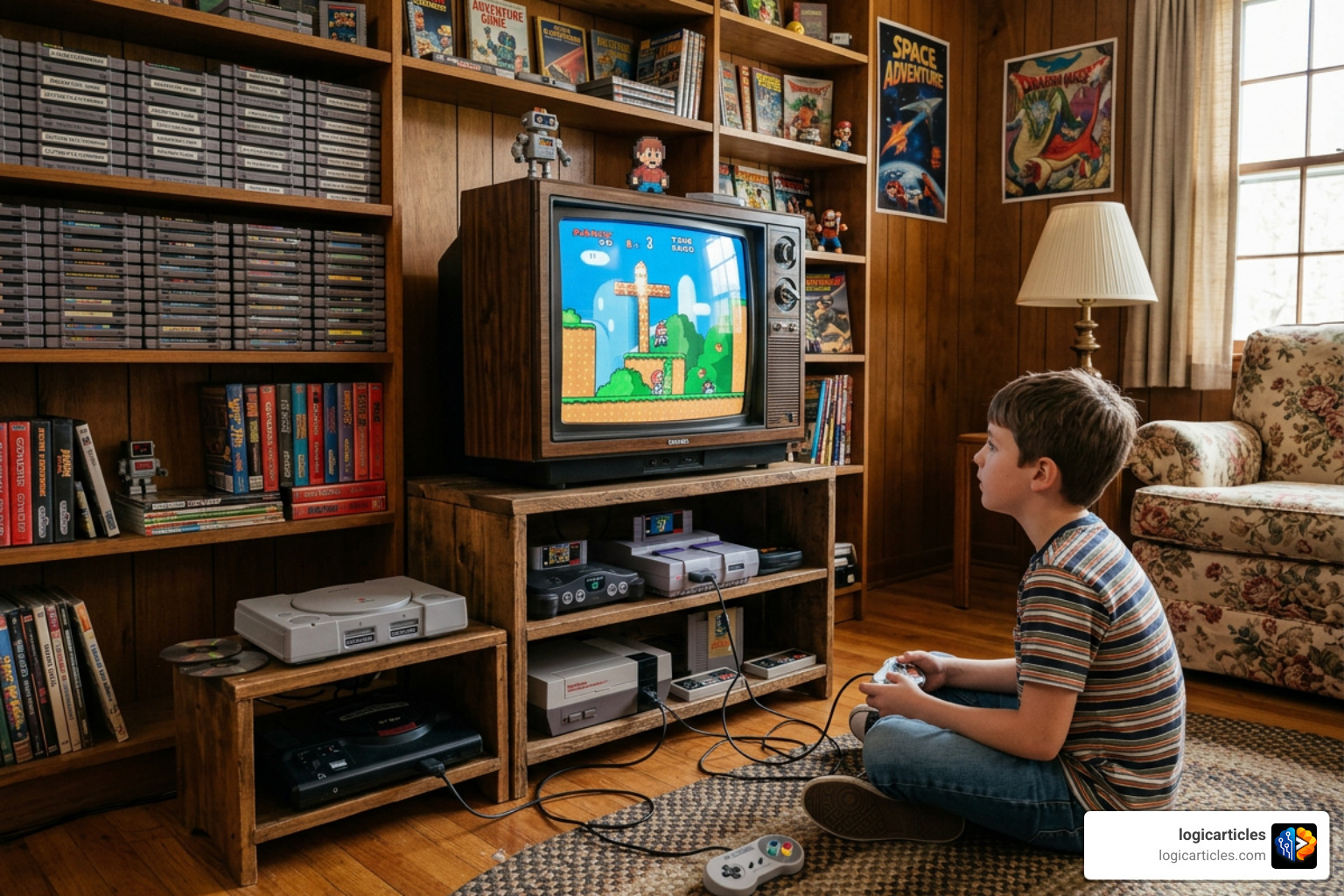
Console TheGameArchives is a software-based digital platform that lets you browse, organize, and play classic video games from dozens of historical systems — no physical hardware required.
Quick answer for what you’re looking for:
- What it is: A digital archive and emulation platform for retro console games
- What you need: A computer or compatible device with a modern browser
- Does it replace a physical console? Yes, for most classic titles
- Is it legal? It depends on how you source your game files — more on that below
- Who is it for? Retro gamers, historians, developers, and curious newcomers alike
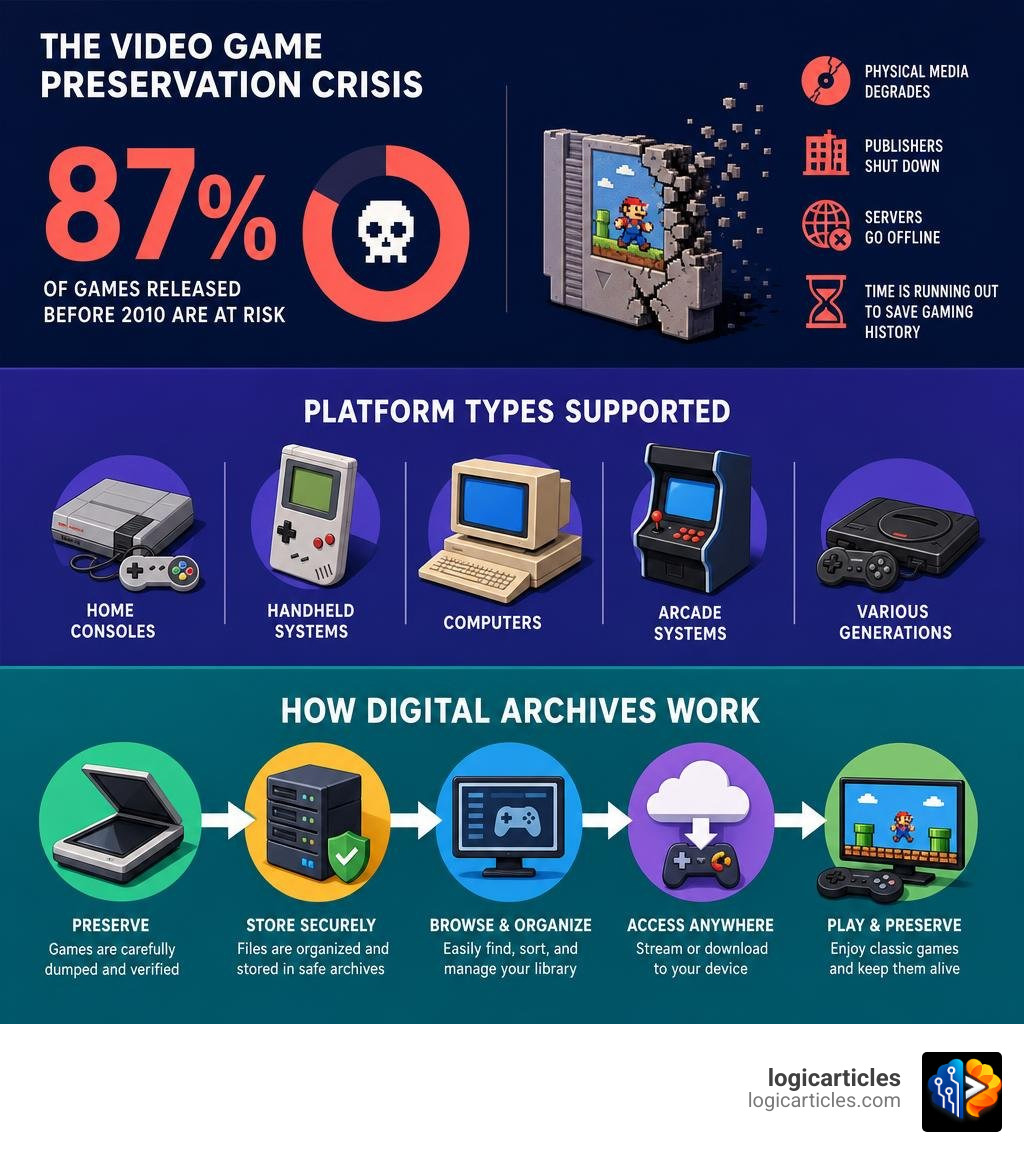
Here’s why this matters right now: 87% of video games released before 2010 are already lost or at risk of disappearing due to poor preservation practices. Physical media degrades. Publishers shut down. Servers go offline. The window to save gaming history is closing fast.
The name causes confusion for a lot of people. Many expect TheGameArchives Console to be a new piece of hardware — like a mini retro box you plug into your TV. It isn’t. It’s a digital preservation ecosystem that runs on your existing devices.
This guide explains exactly how it works, what systems it supports, how to set it up safely, and what the legal landscape looks like in 2026.
Understanding the console thegamearchives
To truly understand what the console thegamearchives is, we have to look at the intersection of emulation technology and historical preservation. Rather than being a physical box sits under your television like a PlayStation 5 or an Xbox Series X, it is a highly integrated, software-based digital archiving system. Think of it as a virtual museum where the exhibits aren’t just behind glass — they are fully playable.
At its core, this platform acts as a unified portal. Instead of requiring you to download dozens of individual emulators, configure complex command-line interfaces, and hunt down obscure system files, the platform bundles these elements into a user-friendly environment. For many classic titles, it even offers browser-based gaming. This means you can boot up an 8-bit or 16-bit classic directly inside Chrome, Firefox, or Safari with a single click.
By bridging the gap between raw emulator files and the everyday gamer, it serves as a crucial tool for history preservation. When we look back at the history of gaming, we see a trail of abandoned platforms. The first programmable console using swappable ROM cartridges was the Fairchild Channel F in 1976. Since then, hundreds of consoles have come and gone. Without centralized digital archives, the software that defined these generations would simply fade into obscurity.
If you are looking for a deep dive into the core concepts and the philosophy behind this setup, check out TheGameArchives Console: Fully Explained to clear up any lingering hardware misconceptions.
Supported Systems and Game Organization
One of the most impressive feats of the console thegamearchives is how it manages massive libraries of games. If you have ever tried to organize a digital collection of retro files, you know it can quickly turn into a chaotic mess of poorly named files, missing cover art, and broken directories.
The platform tackles this through rigorous metadata standardization. It categorizes games systematically by:
- Console Generation: From early arcade systems and 8-bit home consoles to complex 64-bit systems and handheld devices.
- Release Year & Region: Clearly distinguishing between regional variants (such as a game released in Japan in 2005 versus its global release in 2006) to prevent version conflicts.
- Genre & Developer: Making it incredibly easy to filter your library when you are in the mood for a niche 90s platformer or a classic turn-based RPG.
This level of organization relies heavily on verification databases like Redump and No-Intro, which track hundreds of thousands of verified game files using unique digital signatures. To keep this massive digital library running smoothly, the platform receives continuous updates. These updates focus on metadata cleanup, directory optimization, and fixing broken links. For a closer look at how these background improvements keep the system running, read the latest details on Tgarchiveconsole Updates By Thegamearchives – returnalgirl.com.
Is the console thegamearchives Legal and Safe?
Whenever we talk about emulation and digital archiving, the elephant in the room is always the legal question. Is using the console thegamearchives legal?
The short answer is: Emulation software itself is entirely legal. Writing software that mimics older hardware does not violate copyright law. However, the legal boundaries shift when it comes to the games themselves (the ROMs or ISOs).
Downloading copyrighted game files from the internet without owning the original media is generally considered a violation of copyright laws in most jurisdictions. To stay on the right side of the law, the safest and most ethical approach is ROM dumping — using specialized hardware to extract the game data from physical cartridges or discs that you legally own.
Security is another major concern. The internet is full of sketchy retro sites that bundle classic games with intrusive ads, malware, or unwanted executable files. The platform prioritizes safety by utilizing automated file verification. Every file uploaded to trusted repositories is checked against known SHA-256 hashes to guarantee that the game file is authentic, uncorrupted, and free from malicious code.
For a comprehensive breakdown of safety protocols and how to navigate these files securely, refer to TheGameArchives Console Setup Guide: Everything You Need to Know – CLICKRADAR.
Technical Specifications and Setup Guide
While many casual titles can be played directly inside your web browser, getting the absolute best experience out of the console thegamearchives involves setting up a local front-end interface on your computer.
First, let’s look at the basic system requirements to run a local setup smoothly:
- CPU: Dual-core 2.0 GHz processor (minimum); quad-core or higher recommended for 3D-era systems.
- RAM: 4 GB (minimum); 8 GB to 16 GB LPDDR memory recommended for modern operating systems and multitasking.
- Storage: At least 50 GB of free space (minimum) on a solid-state drive (SSD) to store your system files and a curated selection of games.
- Graphics: GPU supporting OpenGL 3.0 or higher for video enhancements and shaders.
- Connectivity: Wi-Fi 6 or Gigabit Ethernet for scraping metadata and using cloud sync features.
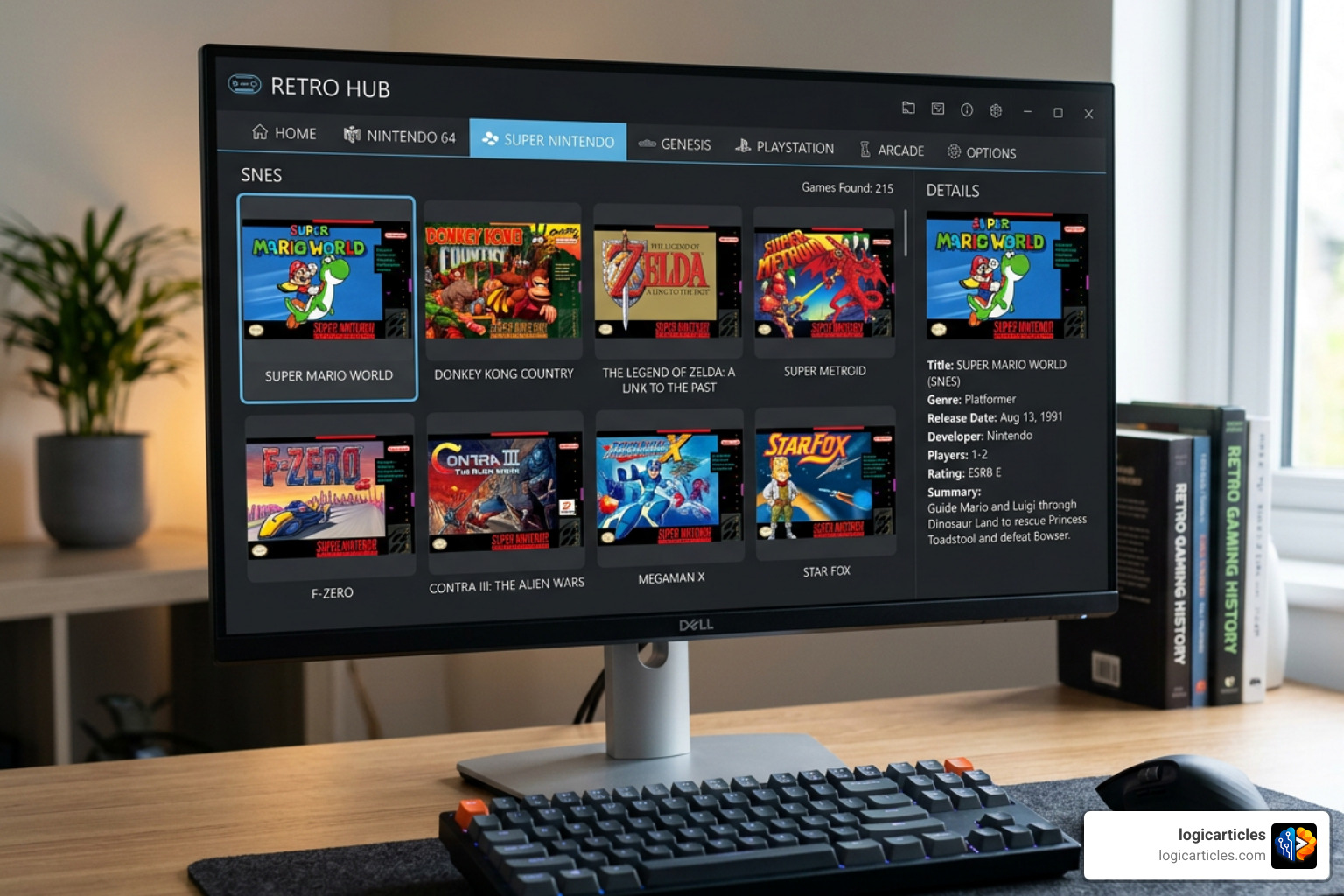
Once your system meets these specifications, you can configure a front-end interface. Popular front-ends like RetroArch, LaunchBox, or EmulationStation act as the visual “wrapper” for your collection. They scan your directories, match your games with beautiful cover art, and assign the correct emulator (often referred to as a “core”) to each platform automatically.
How to Set Up the console thegamearchives
Setting up your digital console doesn’t have to be intimidating. We have broken down the process into a few clear, actionable steps:
- Download and Extract: Download the front-end software from a verified source. Extract the files to a dedicated folder on your hard drive. Tip: Avoid extracting files directly into restricted system folders like “Program Files” on Windows, as this can cause permission errors when saving games.
- Organize Your Directories: Create separate folders for each console generation (e.g.,
/ROMs/NES,/ROMs/SegaGenesis,/ROMs/PlayStation). Keep your file names clean and avoid renaming files arbitrarily, as this can confuse the scrapers. - Configure Your Controllers: Connect your favorite gamepad (such as a USB retro controller or a modern Bluetooth controller). Map the physical buttons to the virtual layout in the settings menu.
- Enable Metadata Scraping: Run the built-in scraper tool. This automatically searches online databases to download box art, release dates, and descriptions for your games, turning your simple list of files into an interactive digital library.
For troubleshooting tips and advanced configuration methods, you can read more at Thegamearchives Tips and Tricks Tgarchiveconsole.
Performance Optimization and Features
Once your setup is up and running, you can take advantage of modern software features that far surpass what was possible on original retro hardware.
For starters, you can apply visual filters like CRT-Royale. This shader replicates the unique phosphors, scanlines, and shadow mask characteristics of a 1990s Sony Trinitron television, giving 2D pixel art the soft, warm look it was originally designed to have. You should also enable V-Sync (Vertical Sync) in your video settings to eliminate screen tearing, though you may want to disable it if you are playing on a high-refresh-rate 144Hz monitor to reduce input latency.
Other incredible modern features include:
- The Rewind Buffer: Did you just miss a crucial jump in a notoriously difficult platformer? Instead of restarting the level, you can hold down a hotkey to rewind gameplay by 30 to 90 seconds and try again.
- Netplay: This feature lets you play classic local-multiplayer games online with friends across the world, syncing your emulator states in real-time.
To see how these visual tweaks and emulation tools fit into the broader landscape of modern applications, check out our roundup of the Best Gaming Software In 2026.
Comparing Digital Archives to Physical Hardware
When deciding how to enjoy classic games, players generally choose between three paths: original physical hardware, dedicated emulation devices, or digital archiving platforms like the console thegamearchives.
Original consoles offer the highest level of authenticity, but they come with massive physical and financial costs. When adjusted for inflation, historical console release prices generally followed a downward trend — starting at an equivalent of US$800–1,000 in early generations and settling around US$500–600 for modern systems. However, buying rare legacy games on the secondary market in 2026 can cost hundreds or even thousands of dollars per title.
Here is how these options stack up side-by-side:
| Feature | Physical Retro Consoles | Dedicated Emulation Handhelds | TheGameArchives Digital Ecosystem |
|---|---|---|---|
| Cost | Extremely High (Hardware + Rare Media) | Moderate ($100–$300) | Free to Low (Uses existing PC/Browser) |
| Space Required | High (Shelves for consoles, CRT TV, cartridges) | Very Low (Pocket-sized device) | None (Entirely digital storage) |
| Setup Complexity | Low (Plug and play) | Moderate (Firmware flashing required) | Low to Moderate (Simple browser or front-end) |
| Visual Quality | Limited to original output (or costly mods) | Upscaled on small screen | Up to 4K upscaling & advanced shaders |
| Game Library Limit | Limited by physical collection | Limited by MicroSD card size | Virtually unlimited via cloud and network drives |
Benefits and Limitations of Digital Archiving
Digital archiving completely changes how we interact with gaming history, but like any technology, it has its own unique strengths and weaknesses.
The Benefits:
- Universal Save States: You can save your progress at any exact microsecond of gameplay, creating backup points before tough boss fights.
- Cloud Syncing: Start a game on your desktop computer at home, sync your save file to the cloud, and pick up exactly where you left off on your phone or laptop during your commute.
- Physical Space Savings: Instead of filling an entire room with plastic cartridges and dust-collecting wires, you can fit thousands of games onto a single high-speed SSD.
The Limitations:
- Licensing Restrictions: Because of copyright laws, digital archives cannot always host every game ever made. Some obscure or heavily licensed titles remain difficult to find legally.
- Compatibility Gaps: While popular systems are emulated perfectly, highly complex or obscure consoles (such as the Sega Saturn or experimental arcade boards) may still experience minor audio desyncs or graphical bugs.
To explore the hardware architecture and modular operating systems that power these high-end emulation setups, read TheGameArchives Console – Overview, Features, and Technical Breakdown.
Frequently Asked Questions
Do I need a physical console to use TheGameArchives?
No, you do not need any physical retro consoles or specialized gaming hardware. The system is designed to run entirely on your existing devices, such as a desktop computer, laptop, or even a compatible mobile device. Many of the lighter, classic games can be played directly inside a standard web browser without installing any extra software.
How do updates to the archive work?
Updates to the platform focus on maintaining the integrity of the archive. This includes standardizing metadata, merging duplicate entries, and verifying files against clean databases to ensure they are uncorrupted. These updates are designed to improve search accuracy and system stability, rather than deleting older games. To learn more about how these continuous library improvements are managed, check out Tgarchiveconsole Updates By Thegamearchives.
Can I play multiplayer games online?
Yes! By using the platform’s netplay features, you can connect with other players online to play classic multiplayer games that were originally limited to local split-screen or same-screen play. You will just need to make sure both you and your friend are using the same version of the game file and have your controllers configured properly before starting the session.
Conclusion
At logicarticles, we believe that video games are more than just temporary entertainment — they are vital cultural artifacts, historical records, and creative works. With 87% of classic games at risk of being lost forever, platforms like the console thegamearchives play a heroic role in keeping our digital heritage alive. They ensure that future generations can experience the groundbreaking designs, stories, and mechanics that paved the way for the massive gaming industry we enjoy today.
Whether you are a seasoned retro enthusiast looking to streamline your massive collection or a curious newcomer eager to explore the history of interactive media, setting up a digital archive is an incredibly rewarding journey.
Ready to discover more cutting-edge digital tools and tech trends shaping our world in 2026? Explore AI Tools on our platform today to stay ahead of the curve!