Why Comparing Accounting Software Solutions for Risk Management Matters
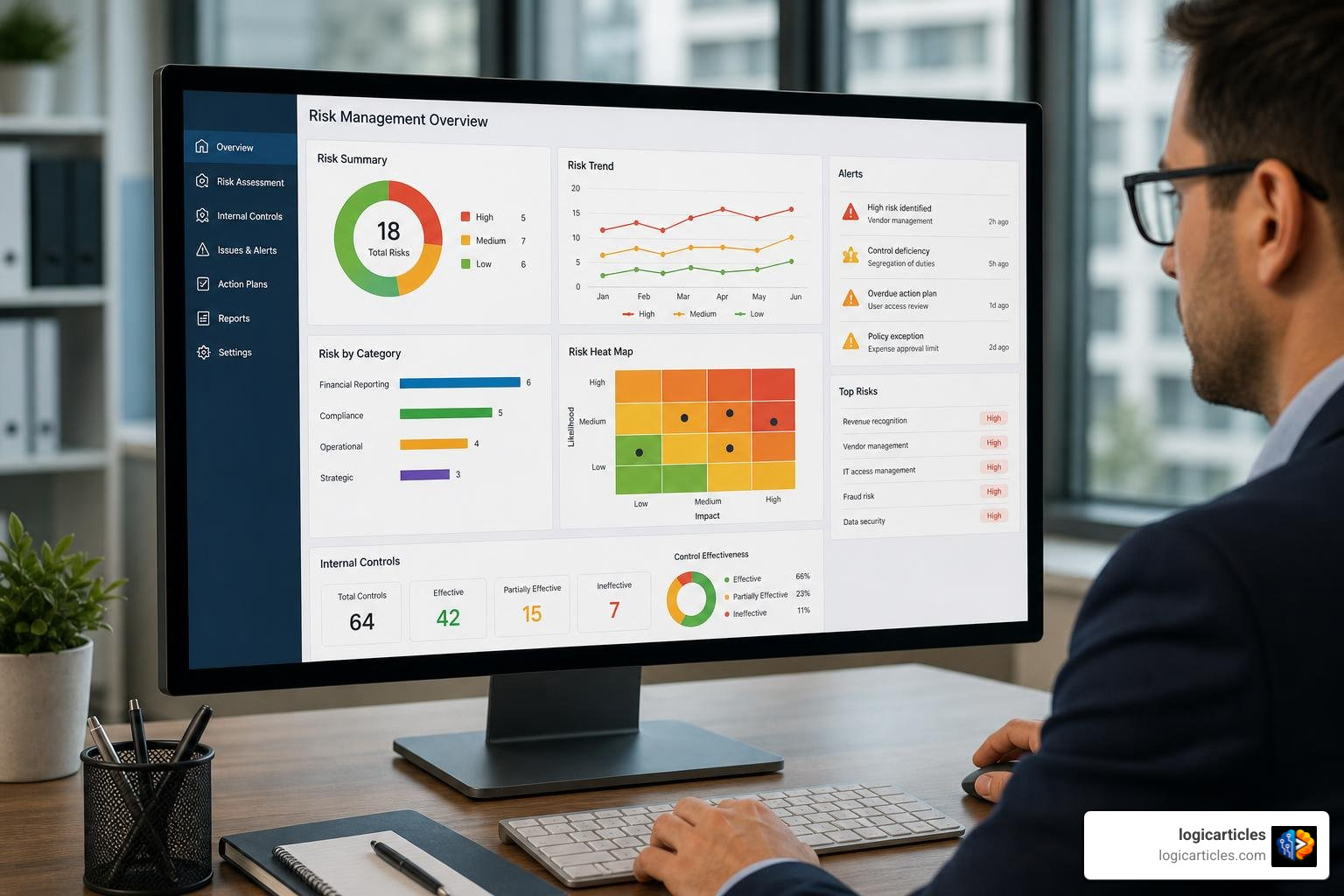
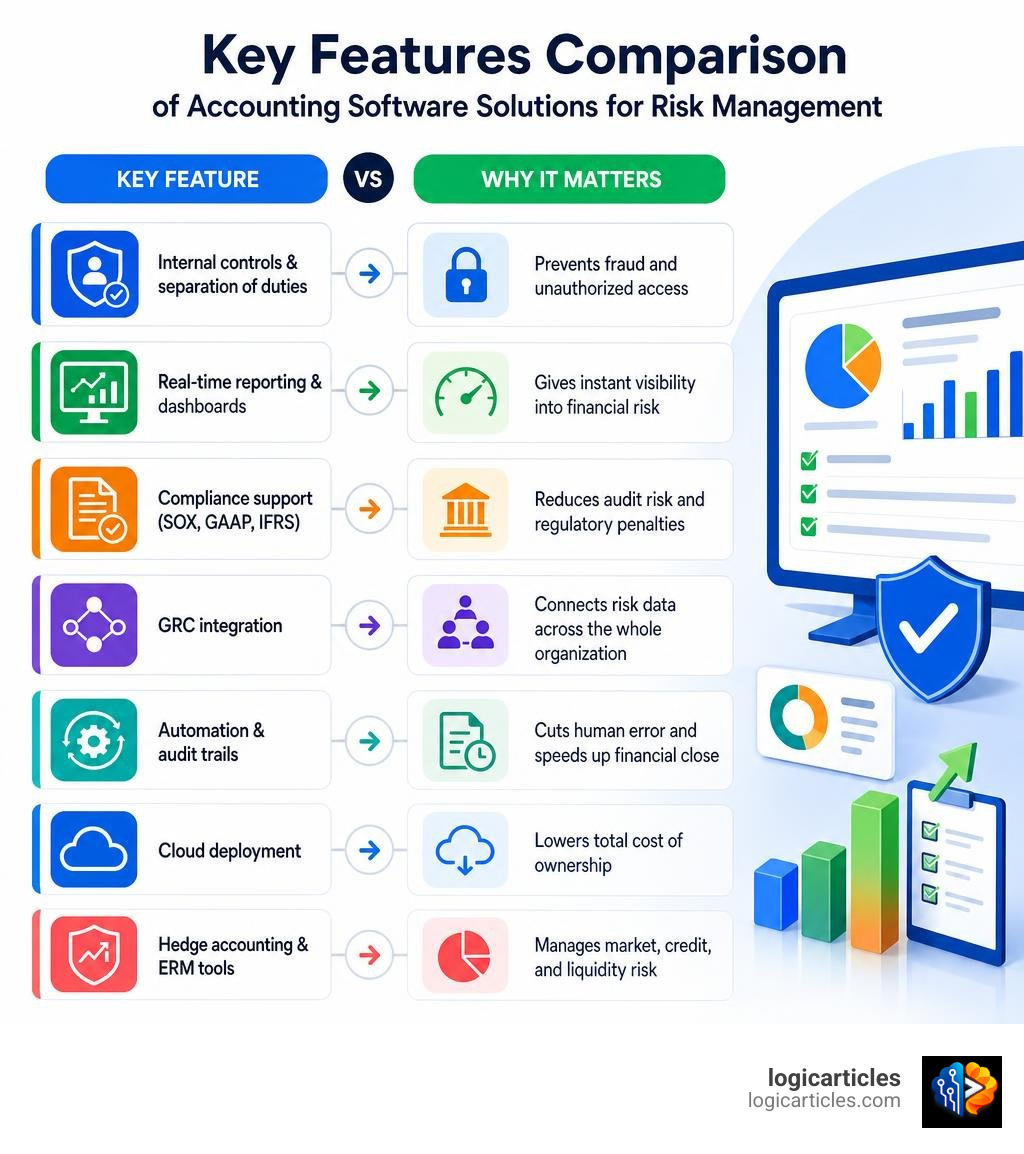
The best accounting software solutions for risk management help organizations identify financial threats, enforce internal controls, and stay compliant — all in one place. Here’s a quick comparison of what to look for:
| Feature | Why It Matters |
|---|---|
| Internal controls & separation of duties | Prevents fraud and unauthorized access |
| Real-time reporting & dashboards | Gives instant visibility into financial risk |
| Compliance support (SOX, GAAP, IFRS) | Reduces audit risk and regulatory penalties |
| GRC integration | Connects risk data across the whole organization |
| Automation & audit trails | Cuts human error and speeds up financial close |
| Cloud deployment | Lowers total cost of ownership by up to 52% |
| Hedge accounting & ERM tools | Manages market, credit, and liquidity risk |
Most organizations start managing financial risk with spreadsheets. It works — until it doesn’t.
The problem is that spreadsheets break down fast. Data lives in silos. Controls are inconsistent. One wrong formula can distort an entire risk report. As one common experience in the industry goes: teams spend more time compiling risk evidence than actually acting on it.
Modern accounting software changes that equation. It centralizes financial data, automates repetitive controls work, and surfaces risk signals in real time — so your team can focus on decisions, not data wrangling.
But not all accounting software handles risk the same way. Some tools focus on compliance automation. Others specialize in hedge accounting, credit risk, or enterprise-wide GRC integration. Choosing the wrong one means paying for features you don’t need — or missing the ones you do.
This guide breaks down exactly what to compare, so you can match the right tool to your risk management needs.
The Role of Accounting Software Solutions for Risk Management
When we think of accounting software, we often picture tax forms, invoices, and basic balance sheets. But in 2026, the best accounting software solutions for risk management act as the primary nervous system for your business’s financial health. They don’t just record what happened; they actively protect your assets and flag issues before they turn into catastrophes.
At its core, financial risk management is about visibility. If you cannot see your cash flow, pending liabilities, or operational bottlenecks in real time, you are essentially driving a car without a speedometer or fuel gauge. By centralizing all transactions into a single source of truth, modern financial software gives CFOs, treasurers, and risk officers immediate access to the accurate data they need to make strategic decisions.
Beyond simple visibility, these systems establish a digital perimeter of defense. They enforce standardized internal controls, automate multi-tier approval workflows, and monitor anomalies continuously. Instead of waiting for an annual audit to find out that someone bypassed payment guidelines, the software prevents the unauthorized transaction from happening in the first place.
Selecting a platform that balances these preventive features with daily operational ease can be tricky. To make sure you focus on the right criteria for your organization’s size, check out our guide on How to Choose the Right Accounting Software for Your Business.
How Automation in Accounting Software Solutions for Risk Management Reduces Human Error
Let’s face it: humans are great at creative strategy, but we are notoriously bad at repetitive data entry. Copying numbers from an invoice into an Excel sheet at 4:30 PM on a Friday is a recipe for a costly typo.
By automating transaction matching, bank reconciliations, and journal entries, modern accounting platforms drastically cut down on these manual slip-ups. This isn’t just a minor convenience; it is a major strategic advantage. For example, audit automation software has helped firms achieve 30% to 50% efficiency gains, which more than doubled their engagement capacity. Other risk and compliance practices have grown their capacity fivefold in less than six months by trading legacy spreadsheets for automated assurance workflows.
Furthermore, automation generates an unalterable, comprehensive audit trail. Every time a transaction is created, modified, or approved, the software logs who did it, when, and from where. This continuous oversight means that if an anomaly occurs, you can trace its path in seconds rather than spending days digging through email chains and physical folders. If you’re running a smaller operation and want to leverage these automated safeguards without enterprise-level complexity, explore the Best AI Accounting Software for Small Businesses.
Key Features to Look For in Accounting Software Solutions for Risk Management
When evaluating different platforms, it’s easy to get distracted by flashy graphics. However, a truly risk-aware financial system must have several non-negotiable features:
- Separation of Duties (SoD): The system must allow you to split critical workflows so that the person who approves a payment is never the same person who initiates it. This is your number-one defense against internal fraud.
- Role-Based Access Control (RBAC): This ensures that employees can only view or edit the data necessary for their specific jobs. A junior designer doesn’t need to see payroll records, and a warehouse manager shouldn’t be able to edit bank details.
- Multi-Dimensional Analysis: Instead of relying on a flat chart of accounts that requires manual spreadsheets to decode, look for systems that offer dimensional reporting. For instance, platforms like Sage Intacct use multiple dimensions to track transactions by location, department, project, and class automatically.
- Continuous Monitoring and Alerts: The software should send instant notifications when specific risk thresholds are breached, such as when a vendor invoice exceeds a set limit or when a bank account balance drops below a critical level.
For leadership teams trying to coordinate these features to drive corporate strategy, having the right administrative toolkit is essential. Learn more about optimizing your executive dashboard with our review of the Best CFO Software Tools for Small Business.
Integrating Accounting with Governance, Risk, and Compliance (GRC)
No department is an island, and that is especially true for finance. To build a resilient organization, your accounting data must integrate seamlessly with your broader Governance, Risk, and Compliance (GRC) strategy.
Historically, risk registers lived in a compliance officer’s database, while financial ledgers sat in the accounting department. This siloed approach is dangerous because it prevents leaders from seeing how operational risks impact financial capital. When you integrate your financial ledger with a GRC platform, you bridge this gap.

By linking financial transactions directly to risk registers, compliance frameworks, and vendor profiles, you create a unified context. If a key supplier experiences a cybersecurity breach, the system immediately flags all pending purchase orders and payments associated with that vendor. This level of connectivity ensures that risk management is proactive, collaborative, and tied directly to real-world financial impact. To understand how to build a unified GRC repository across your enterprise, explore the insights offered in the Risk Universe for Comprehensive Risk Management | Uniqus.
Supporting Internal Controls and Regulatory Compliance (SOX, GAAP, IFRS)
For public companies and regulated industries, compliance is not optional. Regulatory bodies require strict adherence to frameworks like the Sarbanes-Oxley Act (SOX), Generally Accepted Accounting Principles (GAAP), and International Financial Reporting Standards (IFRS).
Modern accounting software acts as your primary engine for compliance. It does this by hardcoding regulatory rules directly into your daily workflows. For example, to comply with SOX, you must prove that your financial reporting is accurate and that your internal controls are working. The software automatically tests these controls, logs the results, and prepares audit-ready documentation.
This structured approach is particularly helpful when dealing with complex accounting standards, such as lease accounting or revenue recognition. Instead of manually calculating lease liabilities on spreadsheets, specialized tools automate compliance from start to finish. If your organization is struggling to manage these complex calculations, check out our breakdown of the Best ASC 842 Lease Accounting Software Solutions.
Cloud-Based Accounting and Real-Time Risk Visibility
The debate between on-premises and cloud-based accounting software is officially over. In 2026, the cloud is the standard for any risk-conscious organization.
First, let’s talk about the total cost of ownership (TCO). Organizations that use cloud accounting software experience a total cost of ownership that is up to 52% less than on-premises customers. This is because the cloud shifts the massive operational burden of maintaining servers, installing security patches, and managing disaster recovery from your internal IT staff to the software vendor.
Second, the cloud provides unparalleled real-time visibility. With an on-premises system, executives often have to wait for end-of-month processing to see financial reports. In contrast, cloud systems provide real-time dashboards accessible from anywhere. If a sudden market shift occurs, you can run scenario simulations and stress-test your liquidity instantly. For a deeper look at how modern, robust platforms handle these real-time challenges, read our review of Busy Accounting Software 2026.
Managing Specialized Financial Risks: Hedge Accounting, Market, and Credit Risk

As organizations grow, they face complex financial exposures that go far beyond basic bookkeeping. Volatile currency exchange rates, fluctuating commodity prices, and counterparty credit defaults can quickly erode profit margins.
To mitigate these threats, advanced financial teams rely on specialized tools that integrate directly with their core general ledger. This is where balance sheet management software becomes indispensable. It allows risk teams to run complex what-if scenarios, model interest rate sensitivities, and manage liquidity buffers dynamically. Rather than outsourcing these crucial evaluations, bringing these capabilities in-house ensures that leadership truly “knows and owns” their numbers. To see how enterprise-level institutions manage these complex calculations, explore the Balance Sheet Management Risk Software Tool.
Hedge Accounting and Financial Risk Mitigation
Hedge accounting is a specialized financial practice used to reduce the volatility of financial statements caused by derivative instruments. However, complying with standards like ASC 815 and IFRS 9 requires strict documentation, prospective and retrospective effectiveness testing, and precise regression analysis.
Without dedicated software, managing these hedges is incredibly tedious. Advanced accounting software solutions for risk management automate the entire hedge lifecycle. They handle:
- Hedge Designation: Formally linking the derivative instrument to the underlying asset or forecasted transaction.
- Effectiveness Testing: Running mathematical models to prove the hedge is working as intended.
- Journal Entry Generation: Automatically creating the complex accounting entries required to reflect the hedge on the balance sheet and income statement.
By automating these steps, treasury teams can confidently mitigate currency, interest rate, and commodity risks without risking compliance failures. To learn more about how specialized systems track complex financial instruments, read our guide on Investment Accounting Software.
Enterprise Risk Management (ERM) and Market/Credit Risk
At the enterprise level, risk management must expand to cover market risk (the risk of losses due to market movements) and credit risk (the risk of counterparty default).
To handle this, advanced risk suites utilize distributed calculation engines that can run millions of positions through complex interest rate and market scenarios in minutes. These platforms often leverage Monte Carlo simulations—calculating risk figures across more than 10 million scenario simulations—to provide a clear, quantitative view of your Value at Risk (VaR).
Rather than relying on subjective, qualitative heatmaps (like a simple 5×5 grid), quantitative ERM software calculates exactly how much capital you stand to lose under various stress conditions. This enables CFOs and CROs to optimize their capital buffers, allocate assets dynamically, and satisfy stringent regulatory requirements. To explore how global financial institutions deploy these scalable risk engines, check out the Enterprise Risk Management Software for Market & Credit Risk.
Evaluating the ROI of Risk-Aware Accounting Software
Investing in comprehensive accounting software solutions for risk management is a strategic decision. To justify the cost to your board or executive team, you need to look at the concrete Return on Investment (ROI).
While it is easy to measure the direct cost of software licenses, the true value of risk-aware accounting software lies in what it prevents (such as fraud, compliance penalties, and operational downtime) and what it unlocks (such as staff efficiency and faster decision-making).
| Metric | Manual Risk Tracking (Spreadsheets) | Automated Risk Accounting Software |
|---|---|---|
| Time to Financial Close | 15+ calendar days | Under 9 calendar days |
| Audit Preparation Time | Weeks of manual data gathering | Instant access via centralized portals |
| Control Monitoring | Periodic/Manual (prone to gaps) | Continuous/Automated (real-time alerts) |
| Total Cost of Ownership | High internal IT maintenance costs | Up to 52% lower TCO (Cloud-native) |
| Risk Assessment Method | Qualitative (subjective heatmaps) | Quantitative (Monte Carlo / VaR) |
Industry-Specific Risk Management Solutions
Every industry faces its own unique set of risks, which means a one-size-fits-all accounting tool rarely works.
For example, nonprofits must manage strict grant tracking and donor-restricted funds to maintain their tax-exempt status. If they mismanage these allocations, they face severe legal and financial penalties. You can find specialized tools built for these challenges in our guide to the Best Nonprofit Financial Management Software.
In the investment and insurance sectors, managing liquidity, solvency, and complex capital requirements is the top priority. These firms need platforms that combine portfolio tracking with real-time compliance monitoring. To compare specialized tools in these fields, explore our resources on Insurance Investment Accounting Software and Real Estate Investment Accounting Software.
Similarly, multi-generational wealth managers and family offices need to balance complex tax compliance with strict privacy and asset protection controls. If you are managing wealth across multiple entities, check out our curated list of the Best Family Office Accounting Software.
Frequently Asked Questions about Accounting and Risk Software
What is the role of accounting software in enterprise risk management?
Accounting software serves as the single source of truth for all financial data within an enterprise risk management (ERM) framework. By centralizing transactional records, enforcing internal controls (like separation of duties), and automating audit trails, it prevents internal fraud, ensures regulatory compliance, and provides the real-time visibility needed to mitigate financial risks.
How does cloud accounting software lower the total cost of ownership?
Cloud accounting software reduces the total cost of ownership (TCO) by up to 52% compared to traditional on-premises systems. It achieves this by shifting the costs of physical server maintenance, hardware upgrades, cybersecurity monitoring, and disaster recovery from your internal IT team to the software vendor.
Why is quantitative risk management better than qualitative methods?
Quantitative risk management uses mathematical models (such as Monte Carlo simulations and Value at Risk) to calculate the exact financial impact of risks in dollars and cents. This is far superior to qualitative methods (like subjective 5×5 color-coded heatmaps) because it allows organizations to mathematically aggregate risks across different departments, compare the cost of mitigation against the value of protection, and make data-driven capital allocation decisions.
Conclusion
In 2026, managing financial risk is no longer just about playing defense. It is a strategic opportunity. By moving away from disconnected spreadsheets and adopting modern, unified accounting software solutions for risk management, your organization can automate tedious compliance tasks, eliminate human error, and gain the real-time visibility needed to make bold, data-driven decisions.
Choosing the right software infrastructure is a critical investment in your company’s resilience and future growth. To learn more about how to optimize your operations and scale your business with the right digital toolkits, explore our curated resources on productivity software solutions.