Before You Borrow Against Your Home, Read This

What is the downside of a home equity loan? It’s a fair question — and the answer matters a lot before you sign anything.
Here are the key downsides at a glance:
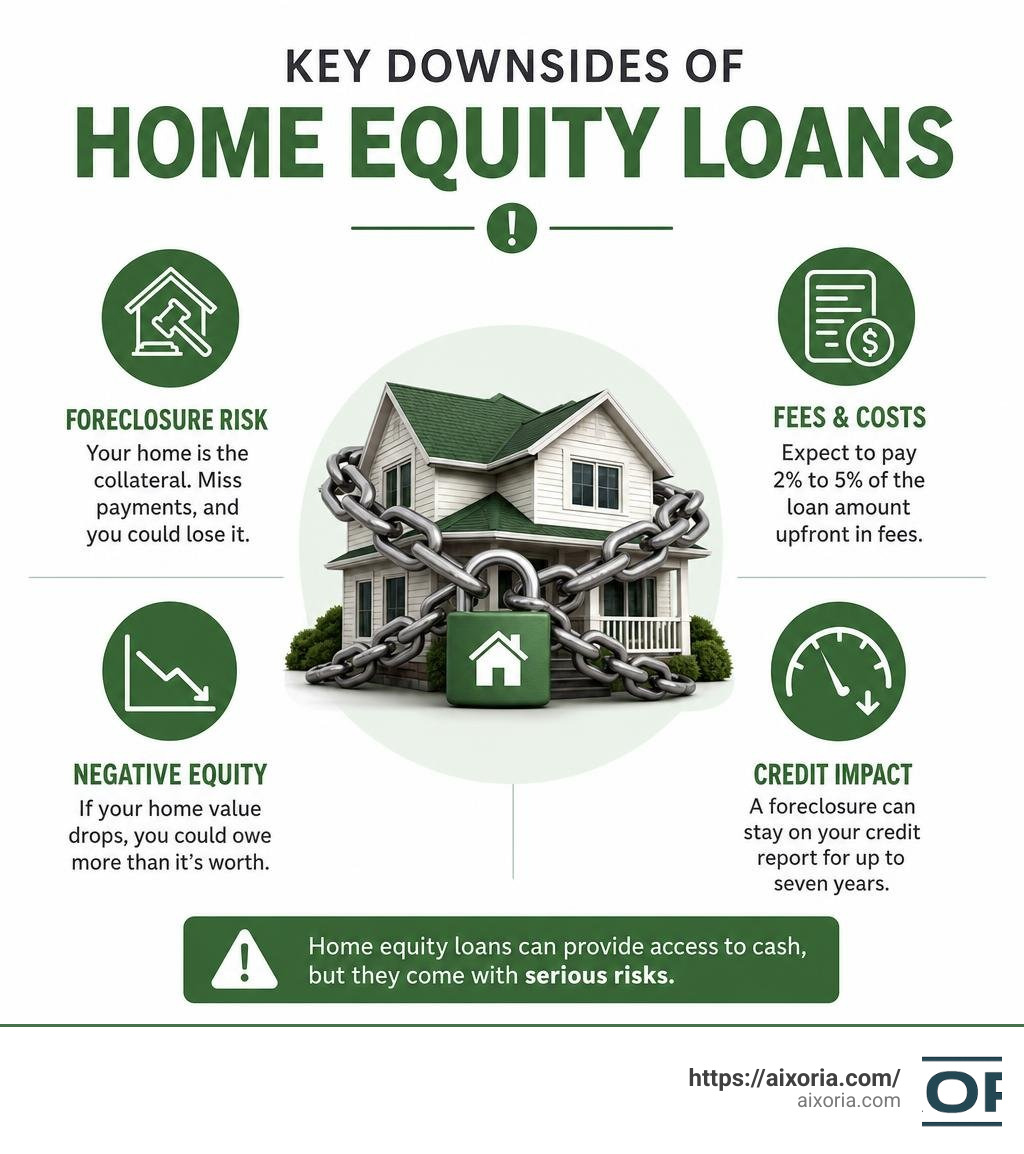
- Foreclosure risk — Your home is the collateral. Miss payments, and you could lose it.
- Closing costs — Expect to pay 2% to 5% of the loan amount upfront in fees.
- Negative equity — If your home value drops, you could owe more than it’s worth.
- Credit score damage — A foreclosure can stay on your credit report for up to seven years.
- Immediate interest — You pay interest on the full lump sum from day one, even if you don’t need all the money yet.
- Qualification barriers — Most lenders require a FICO score of at least 660.
- Limited flexibility — Unlike a HELOC, you can’t borrow only what you need when you need it.
The average homeowner sits on about $203,000 of accessible equity. That’s real money — and it’s tempting to tap into it. Home equity loans offer lower rates than credit cards or personal loans, and they come with fixed, predictable payments.
But they also turn your home into a liability if things go wrong.
This guide breaks down every major risk so you can decide whether a home equity loan is the right move for your situation — or whether a safer option exists.
What Is the Downside of a Home Equity Loan?
At its core, a home equity loan is a second mortgage. You are taking out a second, completely separate loan on top of your primary mortgage, using your home’s equity as collateral. While it can feel like you are magically converting your brick-and-mortar walls into cold, hard cash, you are actually taking on a substantial second debt load.
When we look at the big picture, the fundamental answer to “What is the downside of a home equity loan?” is that you are leveraging your most valuable financial asset. If you struggle to balance your budget, adding another fixed monthly payment to your plate can quickly lead to financial instability.

Before jumping in, we must look at the structural hazards of these products. As explored in Home equity loan risks: Is borrowing against your property always wise? – AOL, tapping your home’s equity is a serious commitment that requires stable income and a highly disciplined approach to debt. If you are already struggling with cash flow, adding a second mortgage can push your household budget to the breaking point.
Foreclosure Risk: Can You Lose Your Home?
The absolute biggest risk of a home equity loan is foreclosure. Unlike credit cards or personal loans, which are unsecured debts, a home equity loan is a secured debt.
What does “secured” mean in this context? It means you have signed a legal agreement stating that if you default on your payments, the lender has the right to seize your home, sell it, and use the proceeds to pay off the debt.
If you experience a sudden job loss, medical emergency, or drop in income in 2026, you cannot simply stop paying your home equity loan without consequences. The lender can initiate foreclosure proceedings.
Furthermore, a foreclosure is catastrophic for your credit score. According to credit bureau guidelines, a foreclosure can remain on your credit reports for up to seven years, making it incredibly difficult to qualify for another mortgage, car loan, or even rent a new apartment. To understand how these risks compound, you can read more about the specific structural dangers in What Are the Risks of Taking Out a Home Equity Loan?.
The Danger of an Underwater Mortgage
Another major downside is the risk of ending up with an “underwater” or “upside-down” mortgage. This happens when your combined mortgage balance and home equity loan balance exceed the actual market value of your home.
Let’s look at how this happens. Imagine your home is valued at $400,000, and you owe $250,000 on your primary mortgage. You decide to take out a $100,000 home equity loan to fund a major project, bringing your total debt secured by the home to $350,000.
If the local housing market experiences a sudden downturn and your home’s value drops to $320,000, you are now underwater by $30,000.
This presents several severe problems:
- Selling Obstacles: You cannot sell your home unless you have the cash to pay off the remaining $30,000 difference to your lenders at closing.
- Refinancing Blocks: You will be unable to refinance your primary mortgage to take advantage of lower interest rates because your loan-to-value (LTV) ratio is too high.
- Immobility: You are effectively locked into your home, unable to move for a new job or family reasons.
Financial Costs: Interest Rates, Fees, and Closing Costs
A home equity loan is not cheap to set up. Many homeowners mistakenly believe that because they already paid closing costs on their primary mortgage, a second mortgage will be cheap or free to acquire. This is a costly misconception.
When analyzing the Pros and Cons of Home Equity Loans, we must account for the significant upfront costs that eat into the cash you actually receive.

How Home Equity Loan Interest Rates Compare to Other Options
While home equity loans generally feature lower interest rates than credit cards, they are typically more expensive than primary mortgages. Because they are “second” mortgages, they represent higher risk to lenders. If you default and your home is foreclosed, the primary mortgage lender gets paid first from the sale proceeds. The home equity lender only gets what is left over. To compensate for this risk, lenders charge higher interest rates.
As we look at the rate environment in 2026, home equity loan rates generally range from 7.97% for 5-year terms to 8.16% for 10-year terms.
While these rates are vastly superior to credit card interest rates (which frequently soar past 20%) and personal loans (which often sit above 12%), they still represent a significant interest burden over a 15-to-30-year repayment term.
As noted in Home equity loan pros and cons to know for 2026 – CBS News, locking into a fixed home equity loan rate during an unpredictable rate climate can be a double-edged sword. If interest rates drop significantly in the future, you will be stuck paying your higher fixed rate unless you pay thousands of dollars to refinance the loan.
The Burden of Closing Costs and Fees
Getting a home equity loan requires going through a mini-mortgage process. This means you have to pay typical closing costs, which generally range from 2% to 5% of the total loan amount.
If you take out a $100,000 home equity loan, you could easily pay between $2,000 and $5,000 in upfront fees. These fees typically include:
- Home Appraisal Fee: Lenders require a professional appraisal to verify your home’s current market value.
- Origination Fees: Fees charged by the lender to process your application.
- Title Search Fees: To ensure there are no other liens against your property.
- Credit Report Fees and Documentation Charges.
Some lenders may offer “no-closing-cost” home equity loans, but beware: lenders are not charities. They will simply roll those costs into a higher interest rate, meaning you will pay far more over the life of the loan.
Comparing Home Equity Loans vs. HELOCs
When looking to tap into your home’s value, you will inevitably compare home equity loans to Home Equity Lines of Credit (HELOCs). While both use your home as collateral, their structures are completely different.
| Feature | Home Equity Loan | HELOC |
|---|---|---|
| Payout Structure | Lump-sum payment | Revolving line of credit |
| Interest Rate Type | Fixed rate | Variable rate (usually) |
| Monthly Payments | Predictable, equal installments | Variable payments |
| Access to Funds | One-time access | Continuous access during draw period |
| Immediate Interest | Yes, on the entire balance | No, only on what you draw |
What is the downside of a home equity loan compared to a HELOC?
The primary downside of a home equity loan compared to a HELOC is its lack of flexibility. With a home equity loan, you receive your money in one large, upfront lump sum.
According to What Is a Home Equity Loan? | LendingTree, this means you begin paying interest on the entire amount immediately.
If you are planning a multi-stage home renovation project that will take a year to complete, a home equity loan forces you to pay interest on the full amount from day one, even if you only need to pay the contractor in small installments.
With a HELOC, you only draw what you need, when you need it, and you only pay interest on the active balance.
Repayment Terms and Potential Payment Shocks
Home equity loans feature long repayment terms, typically ranging from 5 to 30 years. While a longer term lowers your monthly payment, it dramatically increases the total interest you pay over the life of the loan.
Furthermore, we have seen a massive surge in home equity borrowing recently. Home equity line of credit balances ballooned by $9 billion in Q2 2025 to a collective $411 billion.
Many borrowers who chose HELOCs over home equity loans during this boom are now facing “payment shock.” HELOCs often feature a 10-year “draw period” where you are only required to make interest payments. Once that draw period ends, the loan enters the repayment period, and you must begin paying both principal and interest. This can cause monthly payments to double or triple overnight.
While a home equity loan avoids this specific variable-rate payment shock by locking in a fixed rate from the start, it still saddles you with an immediate, permanent increase in your monthly housing costs for up to three decades.
Credit and Tax Implications of Tapping Your Equity
Taking out a second mortgage has long-term consequences for your credit health and tax situation. It is vital to understand these structural realities before moving forward.
We can look to Pros And Cons Of A Home Equity Loan | Quicken Loans to understand how these loans impact your broader financial landscape.
How a Home Equity Loan Affects Your Credit Score
Applying for and taking out a home equity loan will affect your credit score in several ways:
- Hard Inquiries: When you apply, the lender will perform a hard credit check, which temporarily dips your score by a few points.
- Increased Debt Load: Your credit score is heavily influenced by your debt-to-income (DTI) ratio and overall debt levels. Adding a massive new debt balance can lower your score.
- Strict Qualification Requirements: Lenders are cautious with second mortgages. Most require a FICO score of at least 660, a DTI ratio below 43%, and at least 15% to 20% equity remaining in the home after the loan is issued. If your credit is borderline, you may only qualify for exorbitant interest rates.
Tax Implications and Deductibility Disadvantages
Many people assume that home equity loan interest is always tax-deductible. This is no longer true.
Under current IRS guidelines, you can only deduct the interest on a home equity loan if the funds are used specifically to “buy, build, or substantially improve” the home that secures the loan.
If you use the cash to consolidate credit card debt, pay for college tuition, or buy a car, the interest is not tax-deductible.
Even if you do use the funds for qualifying home improvements, you must itemize your deductions on your tax return to claim the benefit, which may not make sense for everyone under current tax laws. Always consult a qualified tax professional before assuming you will receive a tax break.
When a Home Equity Loan Is Not the Best Choice
Because of the high stakes involved in leveraging your home, there are many situations where a home equity loan is simply the wrong tool for the job.
What is the downside of a home equity loan for discretionary spending?
Using a home equity loan for discretionary spending — like funding a dream vacation, buying a luxury car, or paying for a wedding — is highly risky.
When you use home equity for these purchases, you are swapping unsecured, short-term lifestyle expenses for long-term, secured debt. If you cannot pay off a credit card you used for a vacation, your credit score takes a hit, but you keep your house. If you cannot pay off the home equity loan you used for that same vacation, you could find yourself facing foreclosure.
Furthermore, spending your home’s equity on depreciating assets like cars or vacations erodes your household wealth. You are actively reducing your net worth to fund temporary lifestyle inflation.
Safer Alternatives to Borrowing Against Your Home
If you need access to cash but want to avoid the risks of a home equity loan, consider these alternatives:
- Emergency Fund: The safest alternative to debt is a fully funded emergency fund. Building up three to six months of living expenses takes time, but it carries zero interest and zero foreclosure risk.
- Personal Loans: While personal loans have higher interest rates than home equity loans, they are unsecured. Your home is not on the line if you fall on hard times.
- Federal Student Loans: If you are looking to fund higher education, federal student loans offer lower interest rates, income-driven repayment plans, and loan forgiveness options that home equity loans cannot match.
- Cash-Out Refinance: If current market interest rates are lower than your existing mortgage rate, a cash-out refinance allows you to replace your current mortgage with a new, larger mortgage, pocketing the difference in cash.
Frequently Asked Questions about Home Equity Downsides
Can you lose your home if you default on a home equity loan?
Yes. A home equity loan is a second mortgage that uses your home as collateral. If you fail to make your monthly payments, the lender has the legal right to foreclose on your property to recover the unpaid balance.
What happens if your home value decreases after taking a home equity loan?
If property values drop, you risk falling into “negative equity” (being underwater). This means you owe more on your combined mortgages than the home is worth, making it extremely difficult to sell your home or refinance your mortgage without paying the difference out of pocket.
What are the typical fees and closing costs associated with home equity loans?
Home equity loan closing costs typically range from 2% to 5% of the total loan amount. These fees include home appraisal costs, lender origination fees, title search fees, and credit check charges.
Conclusion
Understanding the answer to “What is the downside of a home equity loan?” is the first step toward making smart, informed financial decisions. While tapping into your home’s equity can provide a powerful source of low-interest funding for wealth-building projects like home renovations, it also introduces serious structural risks — including foreclosure, negative equity, and significant upfront closing costs.
Before you leverage your home, we encourage you to carefully assess your budget, evaluate your job security, and compare all available borrowing options.
For more actionable guides on personal finance, economic updates, and cutting-edge tech trends, Stay updated on the latest financial and AI trends with Aixoria.