Why So Many People Are Looking for Cheaper Spotify Alternatives in 2026

If you’re hunting for the best cheaper Spotify alternatives, here’s a quick answer:
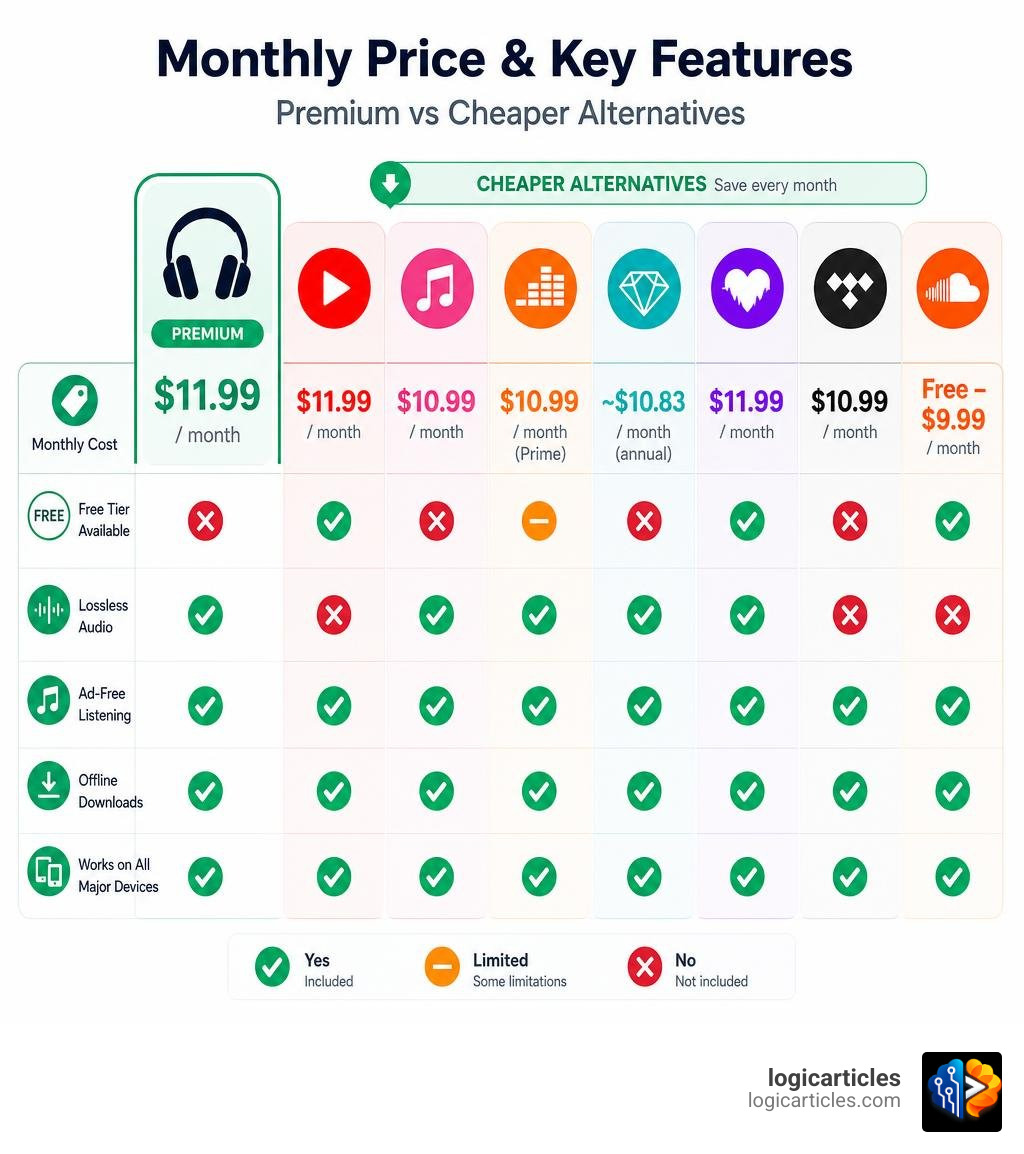
| Service | Monthly Price | Free Tier | Lossless Audio |
|---|---|---|---|
| YouTube Music | $11.99 | Yes (ads) | No |
| Apple Music | $10.99 | No | Yes (no extra cost) |
| Amazon Music | $10.99 (Prime) | Limited | Yes (no extra cost) |
| Qobuz | ~$10.83 (annual) | No | Yes (no extra cost) |
| Deezer | $11.99 | Yes (ads) | Yes (paid tier) |
| Tidal | $10.99 | No | Yes (no extra cost) |
| SoundCloud | Free–$9.99 | Yes (ads) | No |
Spotify Premium costs $11.99/month. Every service above can save you money, depending on how you subscribe.
Spotify is the biggest music streaming platform on the planet, with over 700 million users worldwide. But bigger doesn’t always mean better — or cheaper.
In 2026, a lot of listeners are hitting a wall. The price keeps creeping up. The free tier is loaded with ads and shuffle-only restrictions. And artists? Many earn less than half a cent per stream.
It’s not just audiophiles who are frustrated. Everyday listeners are asking a simple question: “Am I getting real value here?”
The good news is that strong alternatives exist — some cheaper by the month, some cheaper by the year, and some completely free. A few even pay artists significantly more per stream than Spotify does.
This guide breaks down every major option clearly, so you can find the right fit for your budget, your ears, and your values.
Evaluating the Best Cheaper Spotify Alternatives in 2026
When we evaluate the best cheaper Spotify alternatives, we have to look past the basic sticker price. True value is a mix of catalog size, streaming quality, platform compatibility, and how much of your hard-earned money actually makes it to the musicians you love.
If you want a quick birds-eye view of how these options rank overall, you can check out our comprehensive guide on the 9 Best Spotify Alternatives in 2026 Ranked.
To find a service that is genuinely cheaper than Spotify Premium ($11.99/month), we have to look at three main avenues:
- Direct Price Cuts: Services that cost $10.99/month or less (like Apple Music, Tidal, or Amazon Music for Prime members).
- Annual Plan Discounts: Services that let you pay upfront for a year to lower the monthly average (like Qobuz).
- Robust Free Tiers: Platforms that let you stream on-demand without paying a single dime, even if you have to sit through a few ads.
Why Users Seek the Best Cheaper Spotify Alternatives
It is no secret that subscription fatigue is real. In 2026, we are all paying for multiple video platforms, cloud storage, work software, and delivery services. Shaving even $1 to $2 off your monthly music bill adds up.
But cost isn’t the only driver. Many music fans are leaving Spotify for other reasons:
- The Lossless Audio Delay: Despite years of promises, Spotify has been incredibly slow to roll out true lossless, high-fidelity audio to its standard plans. Meanwhile, almost every competitor offers CD-quality or high-res audio at no extra charge.
- Fair Artist Compensation: Spotify famously pays artists a fraction of a cent per stream. If you want your subscription money to actually support the indie bands you listen to, Spotify is one of the worst platforms you can use.
- Frustrating Free Tiers: Spotify’s free mobile app forces you into shuffle-only mode, limits your skips, and blasts you with repetitive ads.
Let’s explore the commercial platforms that solve these issues while keeping your wallet happy.
Top Commercial Services as the Best Cheaper Spotify Alternatives
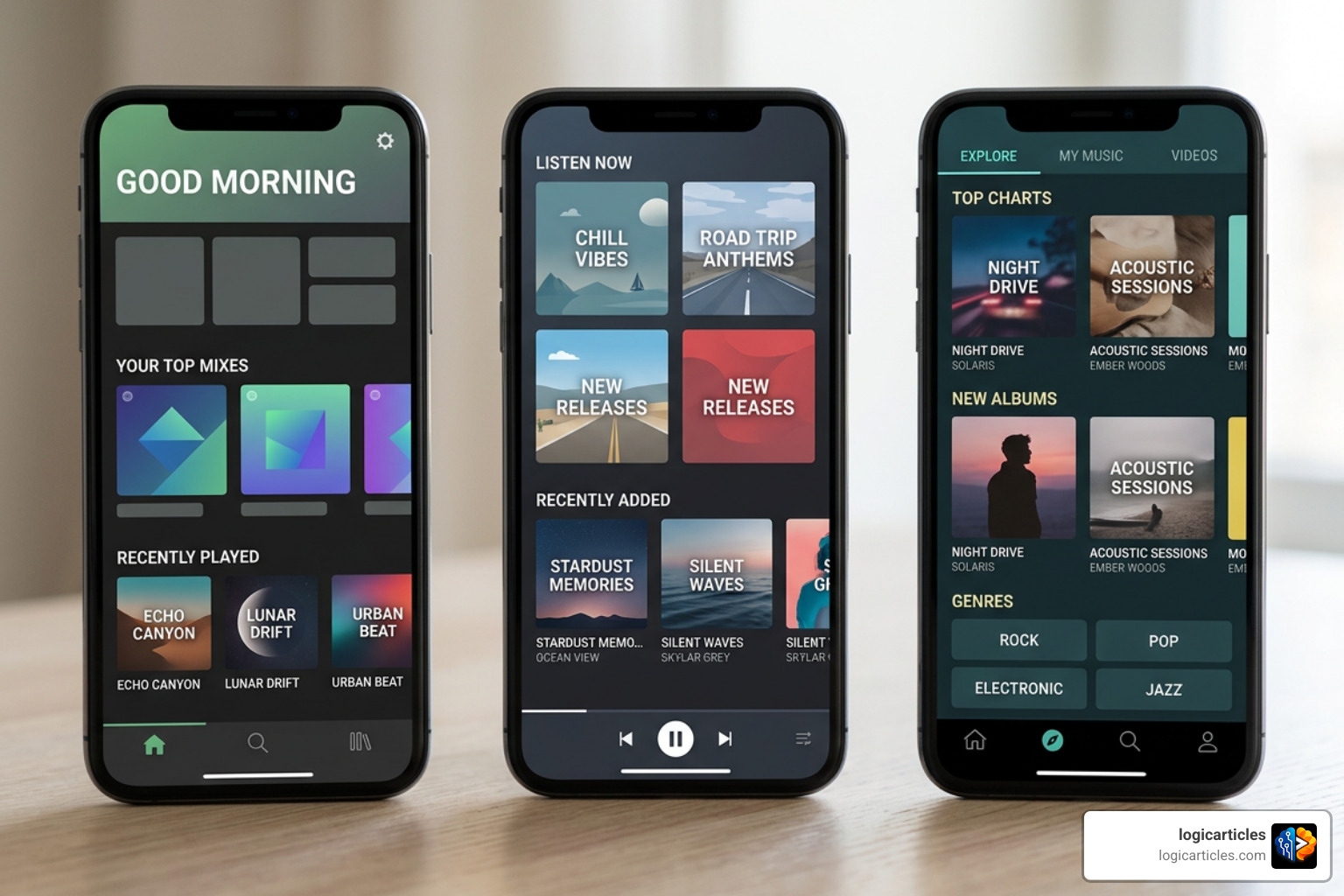
If you want a polished, reliable app with a massive music library, these mainstream platforms are the closest direct replacements for Spotify.
1. Tidal ($10.99/month)
Tidal used to be a premium-priced niche service for audiophiles, but its recent pricing restructure makes it one of the absolute best values on the market. At $10.99/month, it is a full dollar cheaper than Spotify Premium.
- The Good: You get full access to high-res FLAC audio (up to 24-bit, 192 kHz) and spatial audio (Dolby Atmos) without paying an extra cent. Even better, Tidal is legendary for its artist payouts, paying roughly $0.013 per stream—more than triple Spotify’s rate.
- The Bad: Its social features and algorithmic recommendations aren’t quite as hyper-personalized as Spotify’s.
2. Apple Music ($10.99/month)
For anyone deep in the Apple ecosystem, Apple Music is a no-brainer. It matches Tidal’s $10.99 price point and offers seamless integration with iOS, Apple Watch, and CarPlay.
- The Good: A massive library of over 100 million songs, full lossless audio (ALAC), spatial audio, and excellent live radio stations.
- The Bad: There is no free tier, and the Android and Windows apps, while vastly improved, still don’t feel quite as smooth as the native iOS experience.
3. Amazon Music Unlimited ($10.99/month for Prime Members)
If you already pay for an Amazon Prime subscription, Amazon Music Unlimited is a fantastic way to save. Prime members can get the service for just $10.99/month, and it frequently goes on sale.
- The Good: Full access to high-definition (HD) and Ultra HD tracks at no extra cost, plus seamless integration with Alexa-enabled smart speakers.
- The Bad: The user interface can feel a bit cluttered and ad-heavy for Amazon’s other physical products.
4. Qobuz (~$10.83/month via Annual Plan)
Qobuz is the ultimate platform for serious music collectors and audiophiles. While its month-to-month Studio Solo plan is $12.99, signing up for their annual plan at $129.99 drops the average cost to just $10.83/month—making it cheaper than Spotify Premium.
- The Good: The highest-quality streaming catalog available, featuring bit-perfect high-res audio. It also lets you purchase and permanently download DRM-free albums. Artist payouts are also incredibly high, averaging €0.018 per stream.
- The Bad: It lacks dynamic, algorithm-driven playlists and has virtually no podcast or video content.
5. SoundCloud (Free to $9.99/month)
SoundCloud is a completely different beast. With over 200 million tracks, it has a larger library than Spotify, Apple Music, and Amazon combined—mostly because anyone can upload their own music, remixes, and podcasts.
- The Good: The absolute best platform for discovering underground electronic music, indie rap, and bedroom pop. The basic tier is free, and their premium SoundCloud Go+ plan is only $9.99/month.
- The Bad: Audio quality tops out at 256kbps AAC for premium users, and you won’t find every mainstream release in their catalog.
6. Deezer ($11.99/month)
While Deezer matches Spotify’s price for its individual plan, it deserves a mention for its unique features, like the ability to upload up to 2,000 of your own MP3 files to stream anywhere, and its built-in “Flow” recommendation engine.
Specialized and Emerging Alternatives
If you are willing to look slightly outside the mainstream, there are several exciting, highly specialized platforms shaking up the industry in 2026:
- Regional Pioneers: If you live in or travel through Eastern Europe or Central Asia, Zvuk: HiFi music, podcasts – Apps on Google Play offers an impressive 75-million-song library, offline downloads, and high-fidelity audio with great regional integration.
- The Fair-Pay Champion: For those who want their money to go directly to the people making the music, Lissen | Fan Music Streaming That Pays the Artists You Actually Play is a game-changer. It uses a “fan-centric” royalty model. Instead of pooling all subscription fees and distributing them based on total market share, Lissen divides your monthly fee only among the specific artists you actually listened to that month.
- The Ultimate iOS Freebie: If you are an iPhone user who wants premium features without the premium price, Trending Music — Free Music Videos, Lyrics & Offline Playback on iPhone is an incredible option. It offers full on-demand song selection, synced lyrics, offline playback, and music videos for every song entirely for free (supported by occasional ads), with an optional premium upgrade of just $5.99/month.
Open-Source and Self-Hosted Music Streaming Solutions
What if you want to escape corporate ecosystems altogether? If you are tired of monthly bills, changing licensing agreements that make your favorite albums disappear, and algorithmic feeds, the open-source community has some incredible free alternatives.
These options generally fall into two categories: Free and Open-Source Software (FOSS) clients that pull music from public APIs, and self-hosted servers where you stream your own digital music collection.
- The Social & AI Powerhouse: itslokeshx/SoulSync is an outstanding, completely free, open-source platform. It features an AI playlist generator, offline downloads, and “SoulLink” for real-time synchronized listening sessions with friends. The developers have optimized this platform beautifully; using Redis caching, they improved search latency from 1.2 seconds down to a blistering 45 milliseconds (a 96% improvement) and reduced dashboard load times to just 95ms. It currently serves over 150 active users who have streamed thousands of songs entirely subscription-free.
- The Browser-Based Player: If you want a clean, Spotify-style web player, Harish-Srinivas-07/hivefyweb is a brilliant project built on Next.js. It uses local storage for offline caching and provides a beautiful, ad-free interface for streaming multi-language music.
- The YouTube Music Client: For those who want the massive catalog of YouTube Music without the ads or background playback restrictions, Metadon-svg/SimpMusic is a fantastic cross-platform FOSS client. It supports Spotify Canvas, synced lyrics from LRCLIB, and even features built-in SponsorBlock to skip non-music segments in videos automatically.
How to Seamlessly Transfer Playlists Between Services
The single biggest thing keeping people locked into Spotify is their library. The thought of manually rebuilding years of curated playlists, liked songs, and album saves on a new platform is enough to make anyone just pay the $11.99 and sigh.
Fortunately, you don’t have to do any manual labor. Several excellent, highly automated tools can migrate your entire music library in a matter of minutes:
- Soundiiz: A web-based powerhouse that supports almost every music service in existence. You simply log into your Spotify account, log into your new service, select the playlists you want to move, and let Soundiiz do the rest. The free tier lets you transfer one playlist at a time (up to 200 tracks), while the premium plan unlocks batch transfers.
- Tune My Music: Another incredibly fast web tool. It has a very simple, wizard-style interface that makes it incredibly easy to move your library to Apple Music, Tidal, Amazon, or YouTube Music.
- FreeYourMusic: If you prefer a native app, FreeYourMusic offers desktop and mobile applications that handle massive library migrations with ease.
Just like finding the Best Free Alternatives to Photoshop in 2026 Tested can save you hundreds of dollars on creative software, taking ten minutes to transfer your music playlists to a cheaper service is one of the easiest ways to optimize your monthly digital budget.
Frequently Asked Questions About Spotify Alternatives
Which Spotify alternative pays artists the most?
If supporting musicians is your primary goal, Qobuz and Tidal are the clear winners among mainstream services. Qobuz pays approximately €0.018 per stream, while Tidal pays around $0.013 per stream—both of which are more than triple Spotify’s average rate.
For the ultimate ethical streaming experience, Lissen uses a fan-centric royalty model that ensures 100% of your subscription’s royalty pool goes directly to the artists you actually listen to, rather than being pooled and handed to major-label pop stars.
Can I stream high-resolution lossless audio for cheaper than Spotify?
Yes! In fact, almost every major competitor offers high-resolution lossless audio for cheaper than Spotify Premium. Apple Music ($10.99/month), Tidal ($10.99/month), and Amazon Music Unlimited ($10.99/month for Prime members) all include full, high-res lossless streaming (up to 24-bit/192 kHz FLAC or ALAC) in their standard plans at no extra charge.
If you choose an annual plan with Qobuz, you can get pristine, bit-perfect high-res audio for an average of just $10.83/month.
Are there completely free music apps with offline playback?
Yes, though they come with different trade-offs. Trending Music offers free offline downloads, synced lyrics, and full on-demand playback on iOS, supported by ads.
If you prefer an ad-free, open-source approach, platforms like SoulSync and SimpMusic allow you to stream and download music for offline use entirely for free by leveraging public APIs and open-source hosting.
Conclusion
Finding the best cheaper Spotify alternatives in 2026 doesn’t mean you have to compromise on audio quality, library size, or user experience. Whether you want to save a dollar a month with Apple Music or Tidal, drop your average cost to $10.83 with Qobuz’s annual plan, or go completely free with open-source tools like SoulSync, there is a perfect option for your budget.
If you are looking to audit more of your digital expenses or find the absolute best tools for your devices, head over to our Best Software Category to see our latest tested recommendations.
And if you are a business owner looking to create high-quality, engaging content like this for your own brand, check out the Best Content Writing Agency in 2026 to see how we can help you scale your organic traffic.