Why Choosing the Right Reputation Management Tools Matters
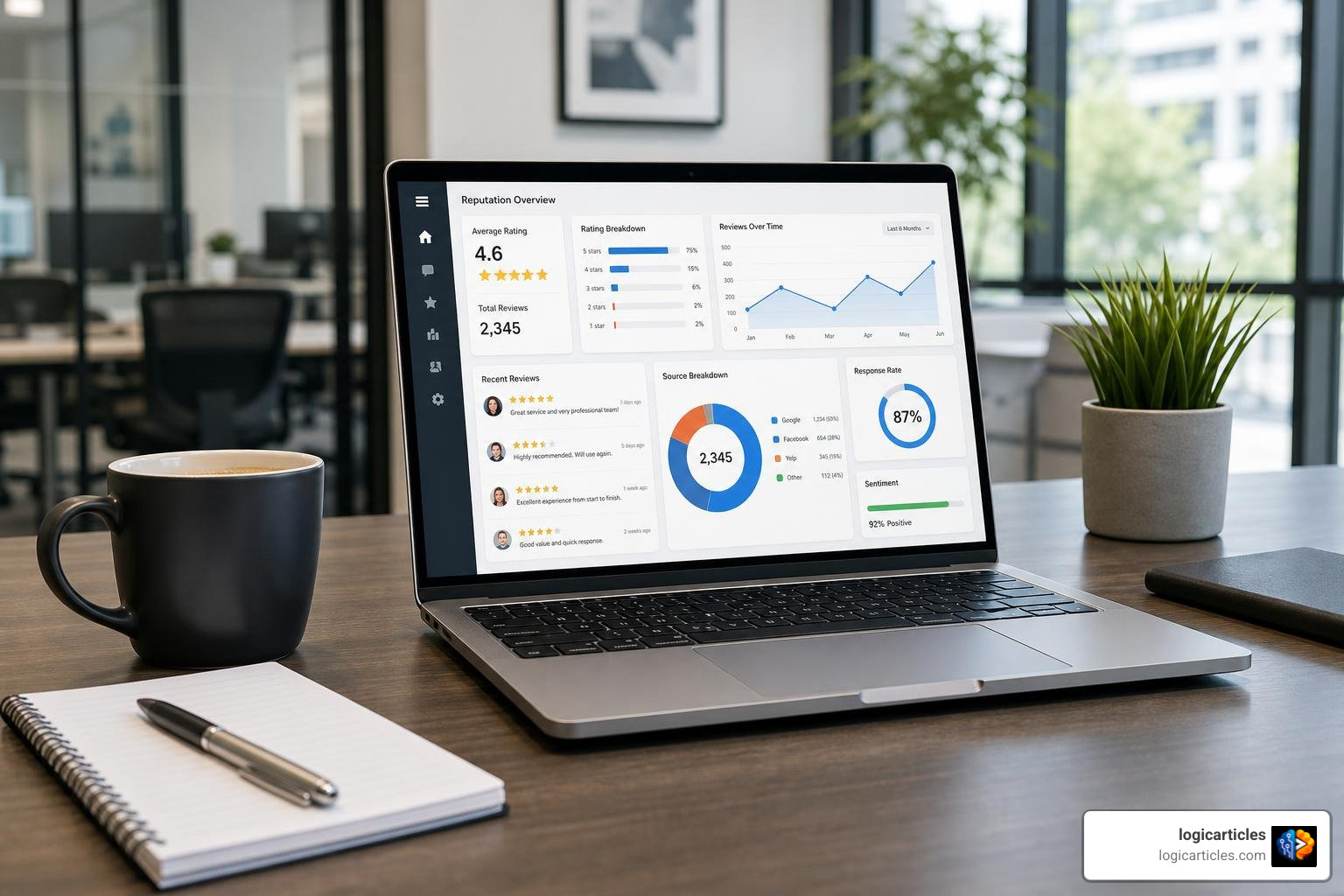
reputation management tools are software platforms that help businesses monitor, respond to, and improve their online reviews, brand mentions, and customer feedback across multiple channels.
Here are the most widely used options and what they’re best for:
| Tool | Best For | Starting Price |
|---|---|---|
| Birdeye | Agencies, multi-location brands | Custom pricing |
| GatherUp | Agencies, local businesses | $99/month |
| BrightLocal | Local SEO, review monitoring | $29/month |
| Reputation.com | Enterprise, healthcare, automotive | Custom pricing |
| Grade.us | White-label agency use | $110/seat/month |
| AppFollow | Mobile app teams | $55/month |
| Brand24 | Social listening, PR monitoring | $199/month |
| RightResponse AI | Budget-friendly AI responses | $10/location/month |
| Whitespark | Review generation, local SEO | $79/month |
| Reptor | AI search + media monitoring | Custom pricing |
Your online reputation is being shaped right now — on Google, inside ChatGPT answers, across review sites, and even in podcast episodes you’ve never heard.
And the stakes are real. 48% of hotel guests say online reviews are the main factor in choosing where to stay. Research shows that even a small jump in star rating — from 4.2 to 4.6, for example — can translate into measurable revenue gains per location.
But picking the wrong tool is costly. Some platforms are built for mobile app teams managing App Store reviews. Others are designed for hotel chains syncing with property management systems. Agencies need white-label dashboards and per-client pricing. Healthcare providers need HIPAA-compliant workflows.
There is no one-size-fits-all answer. This guide breaks down exactly what to look for — and which tool fits which situation.
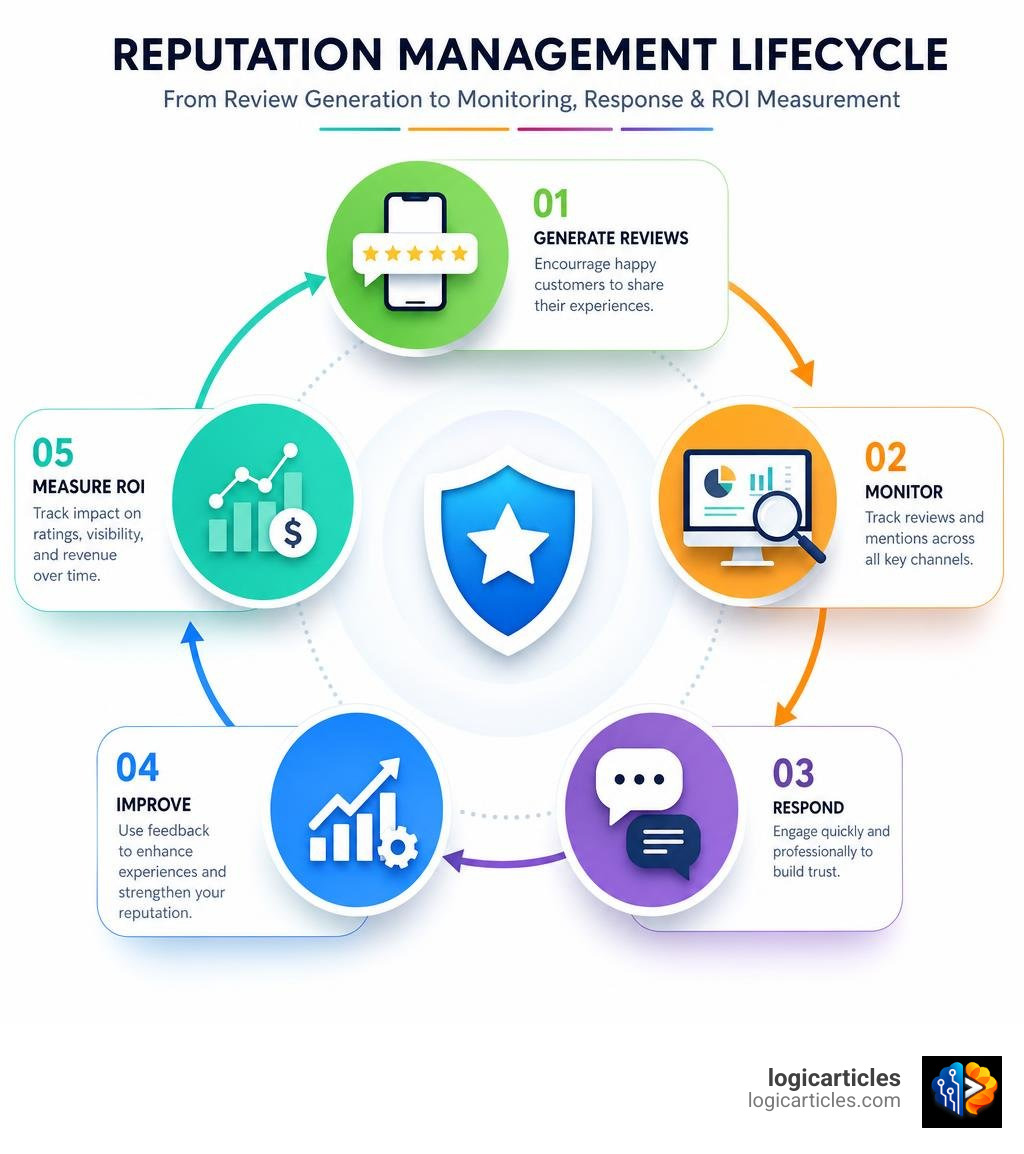
Core Features of Multi-Location Reputation Management Tools
When we manage a brand that spans dozens or hundreds of physical locations, the complexity of review tracking grows exponentially. Logging into individual Google Business Profiles or Yelp accounts is a recipe for operational burnout. To scale efficiently, multi-location brands require a unified command center that streamlines review ingestion, response workflows, and local search performance.
An enterprise-grade platform must centralize all location data while offering granular control. For example, using a specialized Reputation Management Software suite allows brands to monitor local listings, track citations, and gather fresh feedback across 80+ sites from a single dashboard. This level of centralization ensures that no local branch falls into a “search engine black hole.”
Essential Workflows for Multi-Location Brands
Managing a large-scale footprint requires clear roles and permissions. We cannot have a junior associate at a local branch accidentally replying to a sensitive corporate review, nor do we want corporate executives bogged down by daily, routine feedback. Successful multi-location workflows rely on:
- Role-Based Permissions: Corporate teams can set brand guidelines, pre-approve response templates, and monitor overall performance, while local store managers handle day-to-day responses.
- Automated Escalation Logic: If a negative review (e.g., 1 or 2 stars) is received, the system should automatically route it to a regional manager or customer service specialist for immediate service recovery.
- Location-Based Reporting: Regional managers need to compare performance metrics across districts to identify which locations are driving growth and which ones require operational support.
This is especially critical in industries with tight regional competition. For instance, selecting the Best Restaurant Reputation Management Software involves finding tools that allow franchise owners to respond to local food-delivery reviews while keeping the parent brand’s voice perfectly intact.
Critical Integrations for Automating Review Workflows
The most common reason review generation campaigns fail is friction. If your staff has to manually export customer lists from a Point of Sale (POS) system and upload them to a review tool, it simply won’t happen consistently. Automation is the bridge between a transaction and a 5-star review.
Critical integrations to look for include:
- CRM and POS Integrations: Automatically trigger a review request via email or SMS the moment a contract is signed, a patient is checked out, or a table’s bill is paid.
- Social Media APIs: Pull in direct messages, comments, and brand mentions from platforms like Facebook, Instagram, and X (formerly Twitter) so your customer care team can respond in real-time.
- Automated SMS Gateways: SMS review requests boast significantly higher open and conversion rates than email. Platforms like the Reputation Builder Platform allow businesses to send automated text prompts that link directly to top-tier review sites, boosting review volume quickly.
The Role of AI and Sentiment Analysis in Modern Brand Monitoring
We are long past the era of manually reading every single online comment to understand public perception. Modern reputation management relies on Natural Language Processing (NLP) to read between the lines, analyze emotion, and categorize feedback at scale.

AI-powered sentiment analysis does not just look for keywords like “good” or “bad.” It evaluates the context of sentences, helping brands understand why customers are happy or frustrated. If a restaurant chain receives 500 reviews in a weekend, the AI can instantly flag that “wait times” are a recurring negative trend in Chicago, while “food quality” is receiving perfect marks in Houston.
Leveraging AI-Powered Sentiment Analysis in Reputation Management Tools
AI has transformed response management from a time-consuming chore into an automated, highly efficient workflow. Leading tools leverage generative AI to draft personalized, context-aware replies with a single tap.
Instead of relying on dry, generic templates that customers can spot from a mile away, tools like AI-Powered Reputation Monitoring can draft unique responses that incorporate specific details from the customer’s review. Furthermore, sophisticated AI tools can pull in pre-loaded “business facts”—such as operating hours, parking availability, or seasonal promotions—and weave them directly into the response, turning a simple review reply into a subtle marketing opportunity.
Monitoring Modern Blind Spots Beyond Traditional Reviews
If you are only monitoring Google, Yelp, and Facebook, you are missing a massive portion of the conversation. Today, consumer opinions are shaped in spaces that traditional crawlers struggle to index.
We must keep an eye on these critical modern blind spots:
- AI Search Engines: When users ask ChatGPT, Google Gemini, or Perplexity for “the best dental clinic near me” or “reputable software development agencies,” what does the LLM say? Generative Engine Optimization (GEO) is the new frontier of reputation management.
- Google Autocomplete: When potential clients type your brand name into a search bar, autocomplete modifiers like “scam,” “lawsuit,” or “complaints” can decimate conversion rates before a user even lands on your site.
- Wikipedia and Knowledge Panels: Wikipedia edits feed directly into Google’s Knowledge Graph, voice assistants, and AI answers. Monitoring unauthorized edits is crucial for brand protection.
- Unindexed Audio (Podcasts): Brand mentions in podcasts do not naturally show up in standard text searches. Advanced brand monitoring tools like the All-in-One AI SEO Software scan audio transcripts, news outlets, and niche forums to catch negative spikes before they escalate into full-blown PR crises.
Comparing Platforms: App Stores vs. Local and Hospitality Businesses
Not all reviews are created equal. A mobile app developer has completely different reputational needs than a boutique hotel owner or a local plumbing service. Understanding these differences is key to avoiding software that does not align with your business model.
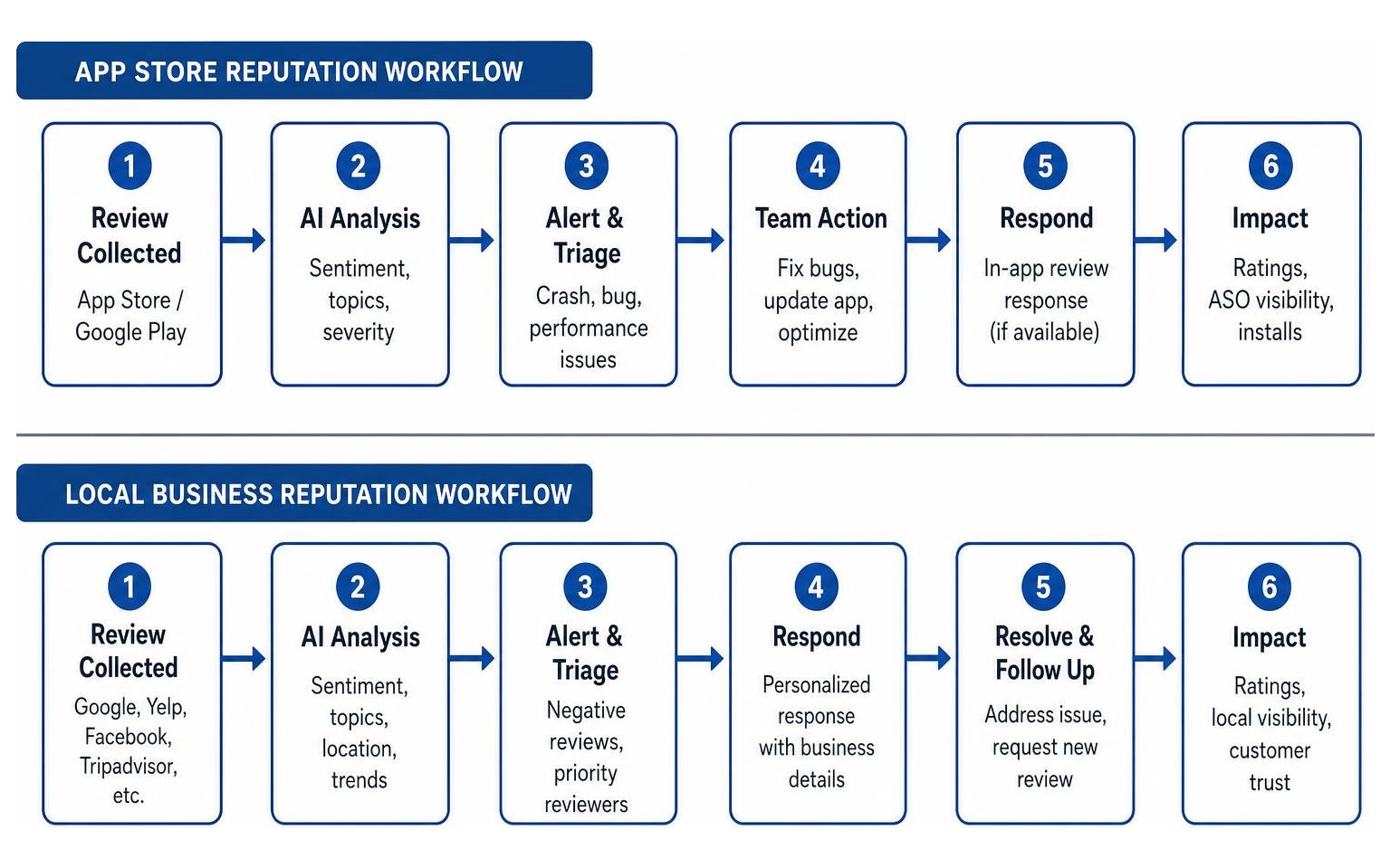
App Store Reputation Management Tools vs. Local Business Software
For mobile app teams, reviews on the iOS App Store and Google Play Store directly impact search visibility, App Store Optimization (ASO), and conversion rates.
- Uninstall Rates and Bug Tracking: App store reputation tools focus heavily on technical feedback. If a user leaves a 1-star review saying “App crashes on Android 14,” the development team needs real-time alerts to deploy a hotfix before uninstall rates skyrocket.
- Version Tracking: App reviews change dynamically with every new update. App-focused platforms allow teams to filter feedback by app version, helping them measure whether a recent release resolved user complaints or introduced new bugs.
- In-App Prompts: Rather than sending post-purchase emails, app tools integrate directly via SDKs to trigger native rating prompts when a user completes a positive action (e.g., leveling up in a game or completing a successful transaction).
Hospitality and Hotel Reputation Management Systems
In the hospitality sector, reputation management is not just a marketing effort—it is an operational KPI that directly influences pricing power and room occupancy.
- OTA Visibility: Hotels must aggregate reviews from major Online Travel Agencies (OTAs) like Booking.com, Expedia, and TripAdvisor alongside standard search engines.
- Property Management System (PMS) Integration: True hotel reputation software integrates with the property’s PMS (like Opera or Cloudbeds). This allows the system to match guest reviews with their actual stay details (room type, check-in date, staff interactions), converting unstructured feedback into actionable operational data.
- Department-Level Accountability: If a guest complains about a dirty bathroom on TripAdvisor, the platform should automatically convert that feedback into a maintenance or housekeeping ticket, closing the loop on service recovery.
Agency Scaling: White-Label Solutions and Pricing Models
For digital marketing and PR agencies, reputation management is a highly lucrative recurring service. However, managing dozens of client accounts without the right infrastructure can lead to operational gridlock.
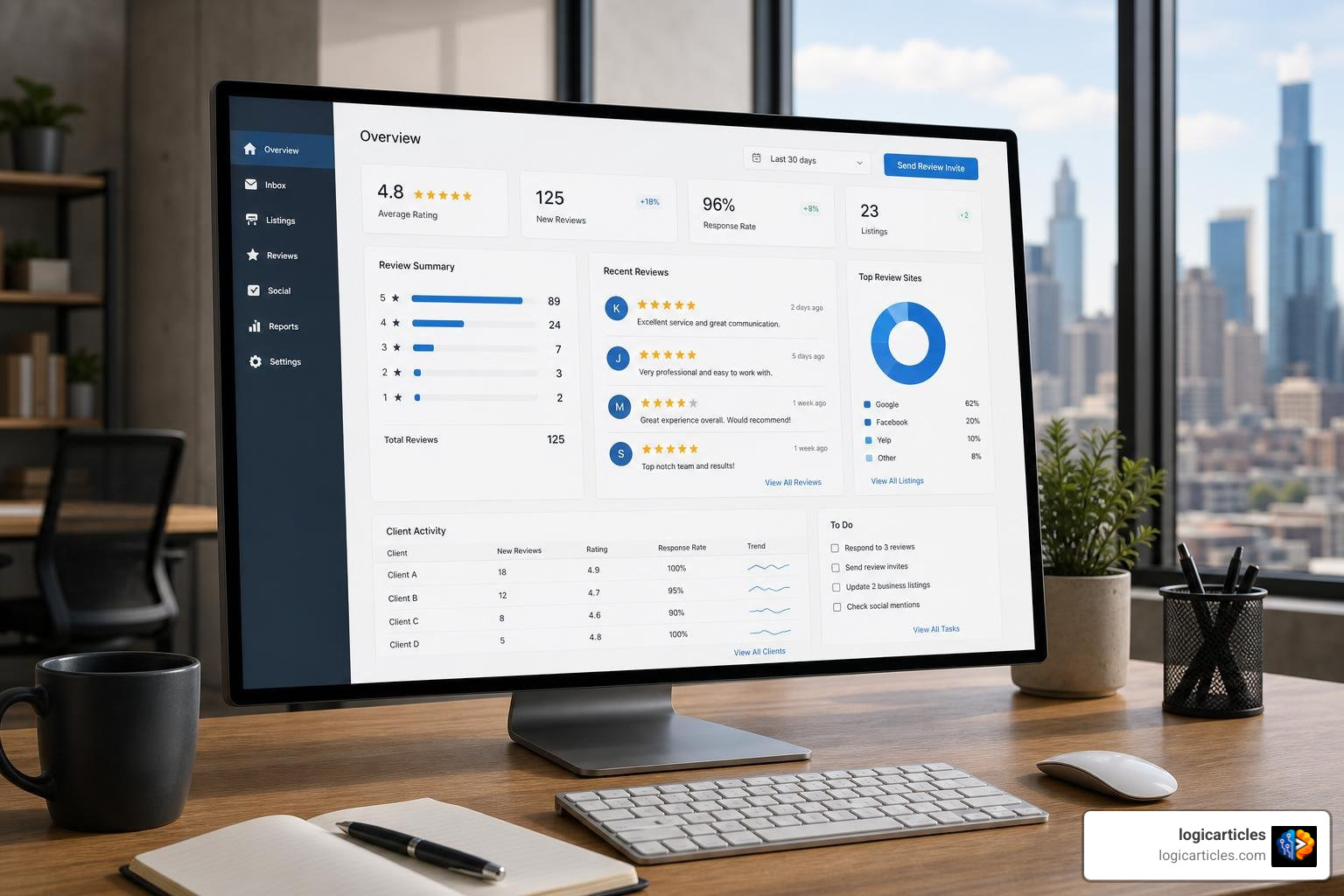
Evaluating White-Label Platforms for Agency Growth
To build long-term client retention, agencies must present a cohesive, professional brand. White-label reputation management software allows agencies to rebrand third-party platforms as their own proprietary technology.
When evaluating white-label options, we look for:
- Custom Domains and Portals: Clients log into a dashboard hosted on your agency’s domain (e.g.,
reputation.youragency.com) with your logo, brand colors, and favicon. - Branded Automated Reporting: Schedule beautifully designed PDF reports that highlight key metrics like review velocity, average star ratings, and Net Promoter Scores (NPS), automatically emailed to clients with your agency’s branding.
- Smooth Client Onboarding: Agencies need a streamlined way to transition new clients onto the platform. Platforms designed specifically as White Label Reputation Management Software for Agencies make it simple to import client data, set up custom review request templates, and establish multi-tenant dashboards with zero friction.
Comparing Pricing Models: Per-Location, Per-Seat, and Per-Client
Choosing the wrong pricing model can quickly eat into an agency’s profit margins. Reputation tools typically charge using one of three structures:
- Per-Location Pricing: Ideal for brands with physical storefronts. This model charges a flat rate (ranging from $15 to $300+ per month) for each physical location. It offers high predictability but can become expensive for massive franchises.
- Per-Seat Pricing: Best for internal corporate teams or agencies with a fixed number of users. You pay for the number of administrative accounts accessing the dashboard, regardless of how many locations or clients are being monitored.
- Tiered or Per-Client Pricing: Many agency-focused platforms offer bulk pricing tiers. For example, you might pay a flat monthly rate for up to 50 clients, allowing you to control your margins as you onboard new accounts.
Additionally, be sure to pay close attention to SMS credit systems. Sending text messages for review generation incurs carrier costs. Some platforms include a generous allocation of SMS credits in their plans, while others charge overage fees or utilize country-specific multipliers (e.g., sending a text to the UK may cost double the credits of a text sent to the US or Canada).
Compliance, Governance, and Measuring Reputation ROI
As online reviews have grown to influence billions of dollars in consumer spending, regulatory bodies and search engines have cracked down on manipulative practices. Selecting a reputation management tool is not just about features; it is about protecting your business from legal and platform-level penalties.
Navigating Legal and Compliance Risks in Review Generation
When setting up review campaigns, compliance with FTC guidelines, platform terms of service, and industry-specific regulations is paramount.
- Review Gating Risks: Review gating is the practice of pre-screening customers (e.g., asking “Were you happy with your service?” via a private survey) and only sending happy customers to public review sites like Google, while routing unhappy customers to a private feedback form. This violates Google’s Terms of Service and FTC guidelines. Platforms like Reputation Management Software help brands build compliant, open feedback loops that encourage unbiased customer input.
- HIPAA Compliance in Healthcare: Healthcare providers must handle patient feedback with extreme care. Responding to a medical review in a way that confirms a patient received a specific treatment or visited a particular clinic can violate HIPAA laws. Healthcare-specific reputation tools provide secure, role-based approval workflows and pre-approved, HIPAA-compliant response templates to protect patient privacy.
- Unbiased Feedback and Platform Penalties: Incentivizing reviews (offering discounts, free products, or gift cards in exchange for positive feedback) is strictly prohibited by most major review sites and can lead to public warning badges on your listings or complete account suspension.
Measuring the Tangible ROI of Reputation Software
Investing in reputation management software should yield clear, measurable business outcomes. Leading platforms move beyond basic vanity metrics to track tangible financial impact:
- Star Rating Increases: Moving an overall rating from a 4.2 to a 4.6 significantly improves consumer trust and conversion rates.
- Net Promoter Score (NPS) Improvements: Consistently collecting and acting on customer feedback can drive substantial NPS gains. For instance, insurance agencies utilizing structured feedback loops have seen their NPS rise by up to 24 points.
- Review Velocity and Local Pack Visibility: Consistently acquiring fresh reviews (as 74% of consumers only care about reviews written in the last three months) signals to search engines that your business is active, directly boosting your visibility in local search results.
- Direct Revenue Value: Property management firms and multi-location retail brands have successfully tied reputation improvements directly to revenue, driving average location value increases of over $108,000 per property by converting resident and guest trust into a powerful growth engine.
Frequently Asked Questions about Reputation Management Tools
How do reputation management tools improve local SEO?
Reputation management software directly impacts local search engine optimization by accelerating three critical review signals: volume, velocity, and diversity.
Search engines prioritize active, highly-rated businesses in local search results (the “Local Pack”). By automating review requests via email and SMS, these tools ensure a steady stream of fresh, positive feedback. Furthermore, embedding interactive review widgets on your website adds dynamic, keyword-rich user-generated content to your pages, which search engines crawl and reward with higher rankings.
What is review gating and why is it risky?
Review gating is the practice of filtering out unhappy customers before they can leave a public review. Typically, a business will send an email asking the customer to rate their experience on a scale of 1 to 10. If the customer selects a high score, they are prompted to leave a Google review. If they select a low score, they are directed to a private contact form.
This is highly risky because it directly violates Google’s guidelines and FTC consumer protection laws. If caught, search engines can penalize your business by removing all your reviews, suspending your business listings, or placing a highly visible warning badge on your profile that permanently damages consumer trust.
How does AI search engine monitoring work?
AI search engine monitoring—often referred to as Generative Engine Optimization (GEO)—tracks how Large Language Models (LLMs) like ChatGPT, Claude, Google Gemini, and Perplexity perceive and recommend your brand.
Because these AI search engines do not rely on traditional keyword matching, reputation tools scan the underlying data sources that LLMs use to train and generate answers (such as high-authority blogs, Wikipedia, news articles, and structured review sites). The software analyzes these sources to assess your brand’s sentiment, discoverability, and answer quality, providing you with strategic recommendations on how to improve your brand’s visibility in AI-generated search results.
Conclusion
In 2026, managing your online reputation is no longer a passive, reactive task. It is an active, revenue-driving strategy that spans search engines, social media, app stores, and AI search engines.
Whether you are a multi-location brand looking to centralize operations, an agency aiming to scale with white-label solutions, or a local business striving to turn customer trust into a growth engine, choosing the right reputation management tools is the foundation of your success. By automating your workflows, leveraging AI-powered sentiment analysis, and maintaining strict compliance, you can protect your brand, outpace your competition, and drive measurable revenue growth.
Ready to supercharge your brand’s digital presence and explore the cutting edge of modern growth? Check out our curated list of resources in the AI Tools Category to discover how the latest automated technologies can scale your business today.