Why Droven.io Machine Learning Trends Matter in 2026

Droven.io machine learning trends are reshaping how businesses, developers, and professionals think about AI — moving the conversation from “what can AI do?” to “how do we make it work in production?”
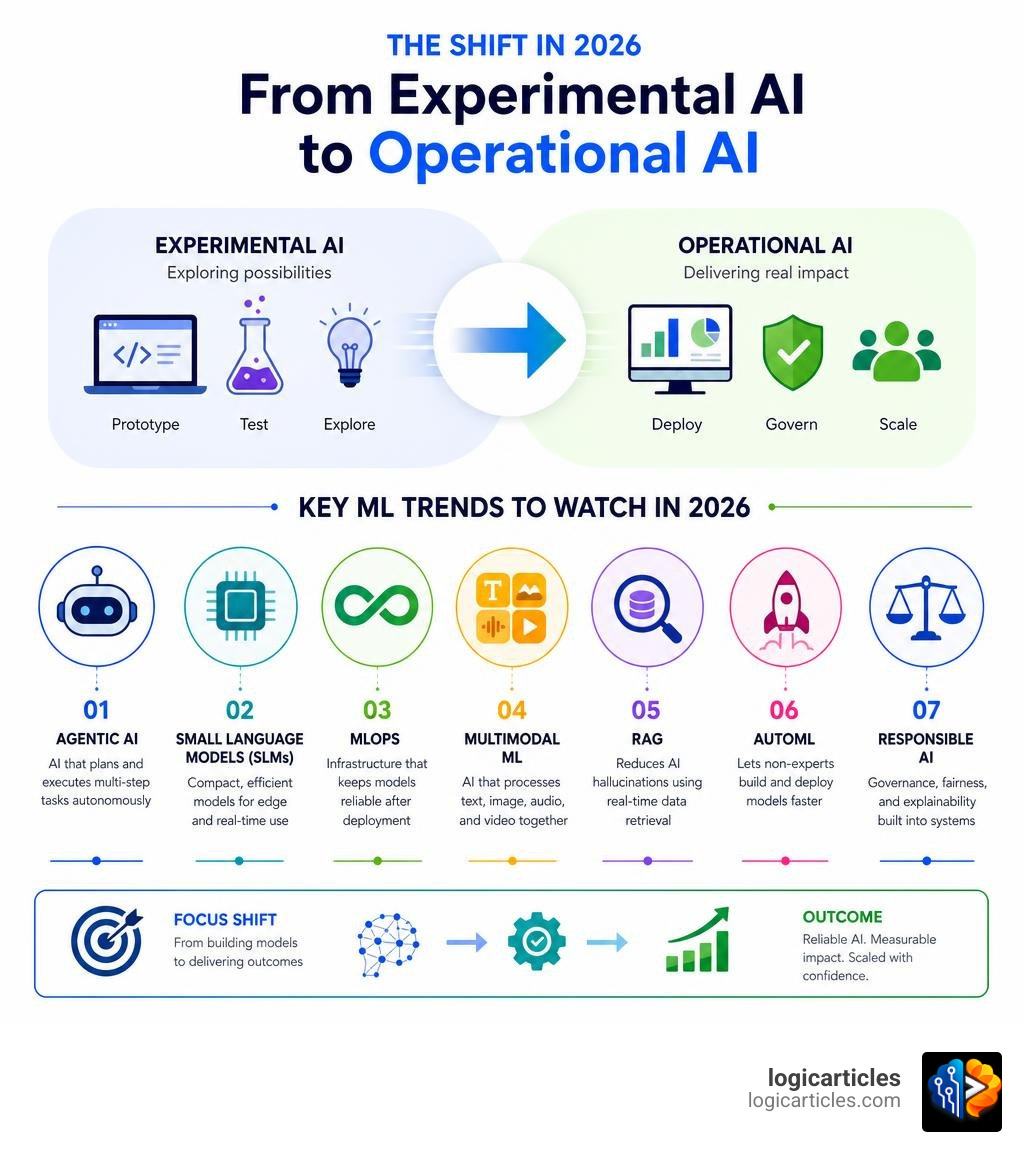
Here are the top trends at a glance:
| Trend | What It Means |
|---|---|
| Agentic AI | AI that plans and executes multi-step tasks autonomously |
| Small Language Models (SLMs) | Compact, efficient models for edge and real-time use |
| MLOps | Infrastructure that keeps models reliable after deployment |
| Multimodal ML | AI that processes text, image, audio, and video together |
| Retrieval-Augmented Generation (RAG) | Reduces AI hallucinations using real-time data retrieval |
| AutoML | Lets non-experts build and deploy models faster |
| Responsible AI | Governance, fairness, and explainability built into systems |
A few years ago, machine learning was mostly reserved for large research teams and Fortune 500 companies. In 2026, that has changed completely.
Over 60% of ML practitioners now rely on AutoML tools. Demand for MLOps engineers has grown by more than 60% in the past 18 months. And AI agents — systems that don’t just generate content but actually act — are already running in production at 57% of enterprises.
This isn’t just a technology story. It’s a strategy story.
The shift is from experimental to operational. From building models to governing them. From chasing the biggest AI to deploying the most efficient one.
Core Droven.io Machine Learning Trends Shaping 2026
As we navigate the mid-point of 2026, the artificial intelligence landscape has matured. We are no longer easily dazzled by simple chatbots that regurgitate text. Today, organizations demand systems that solve complex problems, maintain high accuracy, and operate within reasonable budgets.
According to the comprehensive Droven.io Machine Learning Trends 2026 | Full Guide, the primary theme of this year is the convergence of raw predictive power with real-world execution.
We see this play out across four pillars:
- Agentic AI: Autonomous systems capable of planning, executing, and self-correcting across multiple software tools.
- Small Language Models (SLMs): Highly optimized, domain-specific models that run locally or on edge devices.
- Multimodal Machine Learning: Systems that simultaneously process text, audio, video, and sensory data to build a richer understanding of context.
- Retrieval-Augmented Generation (RAG): The standard architectural approach to keeping LLMs grounded in enterprise facts, completely bypassing the need for constant, expensive retraining.
This evolution is fundamentally changing how we build software. Instead of writing rigid, rule-based code, developers are orchestrating smart, adaptable workflows that learn from continuous feedback loops.
How Agentic AI Redefines Droven.io Machine Learning Trends
For a long time, generative AI was treated as a passive assistant. You asked a question, and it wrote an answer. If you wanted to do something with that answer, you had to copy-paste it into another system yourself.
In 2026, we have entered the era of Agentic AI.
As highlighted in the Droven IO Future of AI: Trends, Automation & Growth 2026, agentic systems are designed for autonomous workflows and multi-step execution. Instead of waiting for step-by-step instructions, an AI agent is given a high-level goal. It then:
- Breaks the goal down into logical sub-tasks.
- Calls external APIs to retrieve real-time data.
- Executes actions across third-party software (like updating a CRM or sending an invoice).
- Monitors its own progress and self-corrects if an error occurs.

This represents a major leap in decision intelligence. For example, a modern logistics agent doesn’t just predict supply chain delays; it actively emails vendors, compares shipping rates, and updates inventory databases to mitigate those delays before a human even steps in.
Small Language Models and Efficient Edge Computing
While massive frontier models still have their place for complex reasoning, the industry has realized that bigger is not always better. In fact, running multi-billion parameter models in the cloud for every basic query is a quick way to drain an enterprise budget.
This reality has driven the massive rise of Small Language Models (SLMs) and TinyML.
As explored in the strategic overview of droven.io machine learning trends, these compact models are trained to do specific tasks exceptionally well. Because they require a fraction of the computational power of their giant counterparts, they can be deployed directly on edge devices, smartphones, and even factory microcontrollers with as little as 256KB of RAM.
The benefits of edge AI are clear:
- Ultra-Low Latency: Processing happens locally, meaning zero dependency on cloud round-trips. This is critical for applications like autonomous driving or medical wearables.
- Enhanced Data Privacy: Sensitive user data never has to leave the local device, making compliance with strict privacy regulations much easier.
- Reduced Infrastructure Costs: Shifting the computing load to edge hardware drastically cuts down on cloud server bills.
Operationalizing AI: MLOps and Infrastructure
Building a great machine learning model in a sandbox is relatively straightforward. Keeping that model running accurately, securely, and efficiently in production for thousands of daily users is incredibly difficult. This is where MLOps (Machine Learning Operations) and modern cloud setups become absolutely critical.
To understand how this infrastructure integrates with modern cloud platforms, you can check out our comprehensive Droven Io Cloud Computing Guide 2026.
The Role of MLOps in Production-Ready Systems
In 2026, treating machine learning as an academic research project is a recipe for failure. It is now a rigorous engineering discipline.
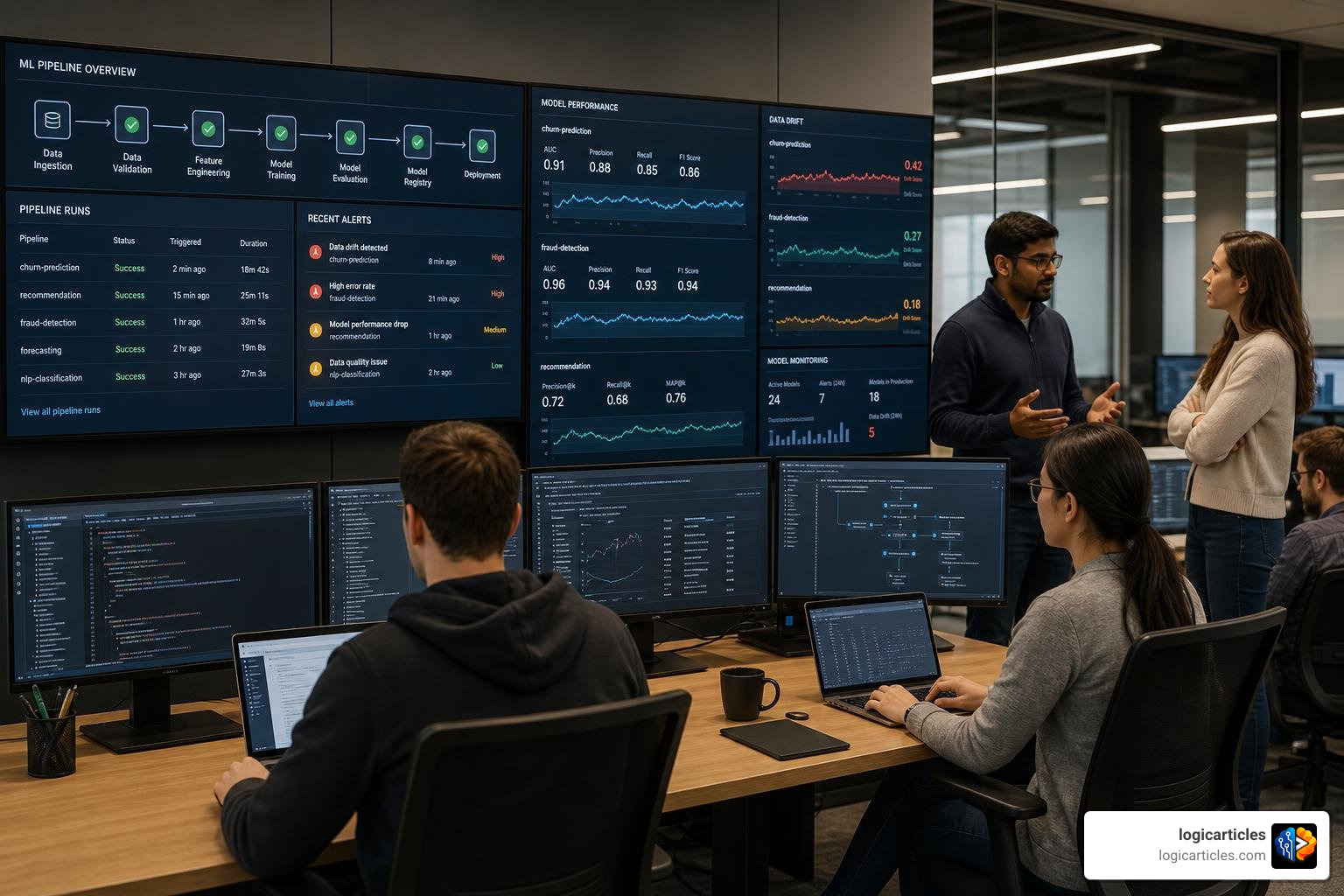
MLOps provides the automated infrastructure required to manage the full lifecycle of a model. Key elements of a modern MLOps pipeline include:
- Continuous Deployment (CD): Automatically rolling out updated models when new training data becomes available, without disrupting the live application.
- Model Monitoring & Drift Detection: Real-world data is constantly changing. MLOps tools actively monitor model inputs and outputs to detect “concept drift” — when a model’s predictive accuracy begins to degrade because the real world no longer matches its training data.
- Version Control for Data and Models: Just as we track code changes in Git, we must track which dataset was used to train which version of a model to ensure reproducibility and meet regulatory audits.
Democratizing AI Through AutoML and Low-Code Tools
Historically, building custom machine learning models required a specialized team of data scientists and machine learning engineers. Today, AutoML (Automated Machine Learning) and low-code platforms have democratized access to these advanced technologies.
With AutoML, non-technical professionals can upload structured data, select their target goal, and let automated pipelines handle data cleaning, feature engineering, algorithm selection, and hyperparameter tuning.
To explore the wider landscape of these accessible technologies, take a look at our guide to the Ai Tools You Should Know In 2026. By lowering the barrier to entry, these tools allow business analysts, product managers, and small-business owners to prototype and deploy predictive models in hours instead of months.
Strategic Comparison: Modern vs Traditional Machine Learning
To truly appreciate where we are in 2026, it helps to compare the current generation of machine learning trends with the traditional approaches of the past decade.
| Feature | Traditional Machine Learning | Modern ML Trends (2026) |
|---|---|---|
| Primary Approach | Purely predictive (classification, regression, forecasting) | Hybrid (predictive ML combined with generative and agentic systems) |
| Data Requirements | Highly structured, clean tabular data | Unstructured multimodal data (text, images, audio, video) |
| Adaptability | Rigid; requires manual feature engineering and complete retraining | Highly adaptable; utilizes foundation models, transfer learning, and RAG |
| System Architecture | Standalone, isolated models | Connected agentic workflows with shared feature stores |
| Deployment Focus | Heavy cloud servers, slow iterations | Hybrid cloud/edge, real-time streaming, automated MLOps |
As organizations scale their data pipelines to support these modern architectures, selecting the right processing engines is vital. For a deeper look at the backend engines driving these systems, read our analysis of the Best Big Data Analytics Tools In 2026 Ranked By Performance.
Key Differences in Scalability and Adaptability
The biggest leap from traditional to modern machine learning lies in how models adapt to new information.
Under traditional setups, if you wanted a model to recognize a new category of data, you had to collect thousands of new samples, manually label them, retrain the entire model from scratch, and redeploy it.
Modern systems utilize foundation models and transfer learning. Because these models are pre-trained on vast, diverse datasets, they already understand the fundamental structures of language, vision, or patterns.
To adapt them to a specific business task, we only need to perform lightweight fine-tuning with a handful of examples. Combined with Retrieval-Augmented Generation (RAG), we can update the model’s active knowledge base in real-time simply by updating an connected document database, entirely bypassing the need for retraining.
Why Droven.io Machine Learning Trends Matter for Modern Businesses
For modern enterprises, keeping up with these trends isn’t about chasing buzzwords — it’s about survival. Platforms like Droven.io have gained massive traction because they serve as educational knowledge hubs rather than vendor-driven marketplaces. They provide neutral, practical decision support that helps teams understand the conceptual foundations of AI before they commit their budgets.
As discussed in Exploring AI Trends and Tools for 2026: The Future of Business with Droven.io, businesses that succeed in 2026 do not start by asking which model to buy. Instead, they start by identifying their core operational bottlenecks and mapping them to specific, scalable machine learning trends. This strategic alignment ensures that AI investments translate directly into measurable efficiency gains rather than expensive, abandoned pilots.
Practical Applications, Benefits, and Implementation Challenges
To see how these concepts translate into reality, we can look at the vibrant ecosystem of innovators deploying these technologies. For inspiration on the top players leading this charge, check out our curated list of the Droven Io Best Ai Startups In Usa 2026.
Industry-Specific Use Cases and Measurable Outcomes
Machine learning is no longer a theoretical science; it is actively driving value across diverse sectors:
- Healthcare: Multimodal models analyze medical imaging, patient history, and real-time wearable data to assist doctors in diagnosing rare conditions early.
- Finance: Hybrid models combine predictive analytics with generative summaries to detect complex, multi-layered fraud patterns in real-time, while instantly drafting compliance reports for auditors.
- Manufacturing: Edge AI and TinyML sensors placed directly on factory equipment run continuous predictive maintenance algorithms, forecasting machine failures before they cause costly downtime.
- E-Commerce & Marketing: Companies use real-time predictive ML to dynamically adjust pricing and personalize marketing campaigns, resulting in documented conversion rate increases.
As these technologies continue to transform the workplace, the demand for AI-literate professionals has skyrocketed. To understand how the educational landscape is shifting to meet this need, read the guide on Droven IO Tech Education Trends 2026: AI, Cloud, Automation and the Future of Learning – Any New Thing.
Pros, Cons, and Adoption Barriers in 2026
While the potential of modern machine learning is immense, we must look at the landscape with a balanced perspective.
According to Droven.io and the Future of AI: Key Trends & What Comes Next, adopting these advanced trends comes with distinct advantages and serious hurdles:
The Pros
- Massive Productivity Gains: Automating routine, data-heavy workflows frees up human teams to focus on strategy, creative design, and complex problem-solving.
- Faster Time-to-Market: Low-code tools and pre-trained models allow developers to deploy intelligent features in record time.
- Highly Personalized Experiences: Businesses can tailor products, services, and communications to individual user behaviors in real-time.
The Cons & Challenges
- The Skills Gap: There is still a major shortage of professionals who understand how to properly design, deploy, and monitor modern MLOps pipelines.
- Data Privacy & Security Risks: Training models on proprietary data requires robust encryption, secure cloud architectures, and strict compliance with global regulations like the EU AI Act.
- The Need for Rigorous Governance: Without proactive bias detection and human-in-the-loop validation, automated decision-making systems can easily propagate errors or biased outcomes at scale.
Frequently Asked Questions About Droven.io Machine Learning Trends
What are the most important Droven.io machine learning trends in 2026?
The most critical trends in 2026 are Agentic AI (autonomous workflow execution), Small Language Models (SLMs) optimized for edge devices, robust MLOps infrastructures for real-time model monitoring, and Multimodal Machine Learning systems that process text, audio, and visual data simultaneously.
How is Droven.io different from other AI and ML learning platforms?
Rather than acting as a software vendor or a promotional marketplace, Droven.io functions as an educational knowledge hub. It focuses on providing neutral, evergreen, and highly structured conceptual guides. This helps developers, students, and business leaders build a foundational understanding of emerging tech before making purchasing decisions.
Who should use these machine learning insights?
These insights are designed for:
- Business Leaders & Decision-Makers who need to align AI capabilities with corporate strategy and ROI.
- IT Professionals & Developers looking to transition from traditional software engineering to modern, agentic AI development.
- Tech Enthusiasts & Beginners who want to build a clear, non-technical conceptual foundation of how artificial intelligence is reshaping the modern world.
Conclusion
At logicarticles, we believe that the true power of machine learning lies in sustainable, strategic transformation. As we look ahead through the remainder of 2026 and beyond, the organizations that thrive will not be those that deploy the largest, most expensive AI models just for the sake of innovation.
Instead, the future belongs to those who build highly efficient, well-governed, and operationally sound intelligent systems. By focusing on foundational concepts, prioritizing data quality, and implementing disciplined MLOps, we can unlock the true potential of these remarkable technologies.
Ready to take your tech stack to the next level? Explore the latest AI tools and resources on our platform today!