Why Big Data Analytics Tools Matter More Than Ever in 2026

Big data analytics tools are software platforms and frameworks that collect, process, and analyze massive datasets to help organizations make faster, smarter decisions.
Here are the most widely used big data analytics tools in 2026:
| Tool | Best For | Deployment |
|---|---|---|
| Apache Spark | Large-scale batch & stream processing | Open-source / Cloud |
| Apache Hadoop | Distributed storage & processing | Open-source |
| Google BigQuery | Serverless cloud analytics | Cloud (Google) |
| Amazon EMR | Managed big data clusters | Cloud (AWS) |
| Apache Hive | SQL queries on big data | Open-source |
| Ververica | Real-time stream processing | Cloud / On-premise |
| Power BI | Business intelligence & visualization | Cloud (Microsoft) |
| Tableau | Interactive data visualization | Cloud / On-premise |
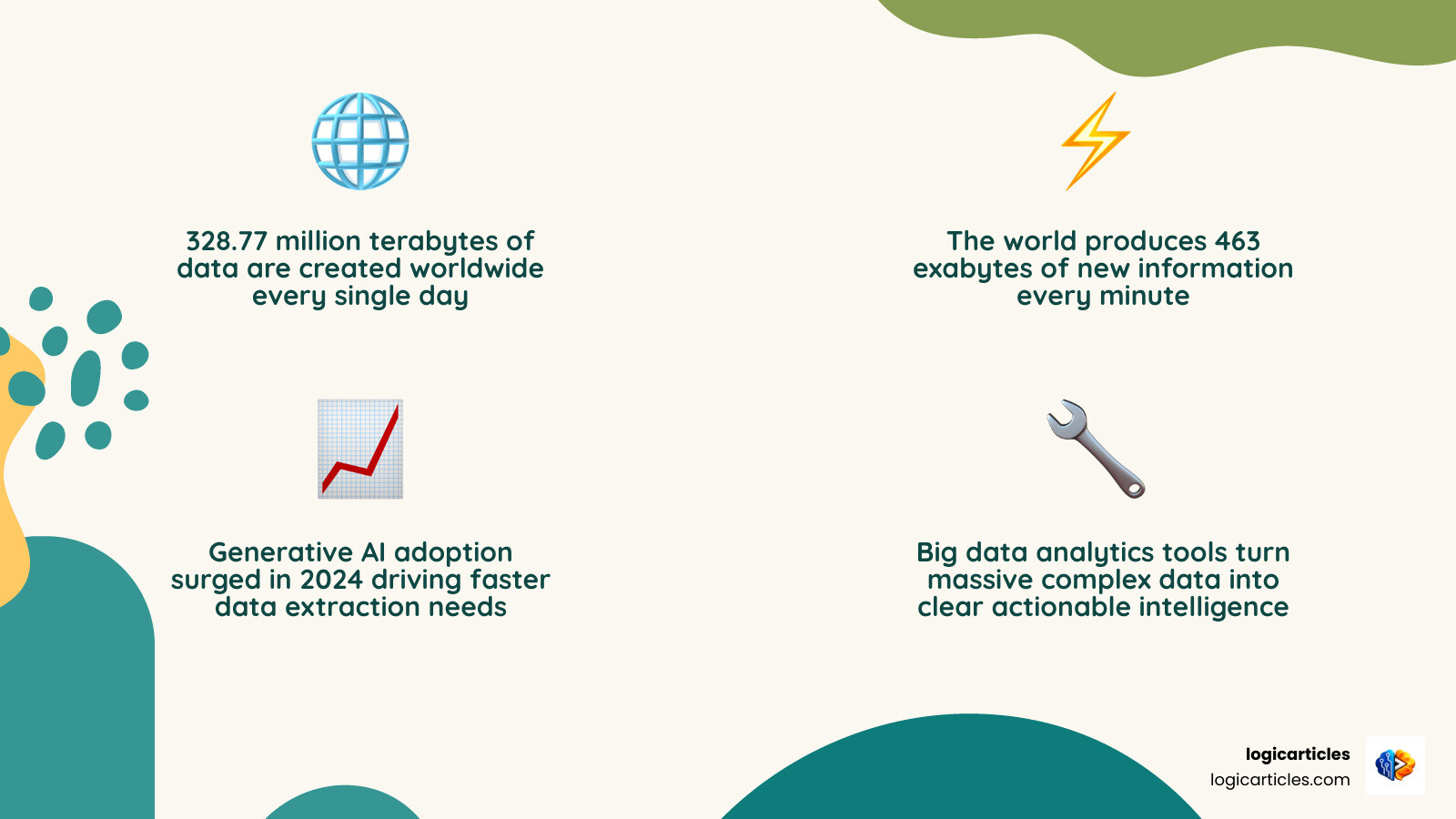
The scale of data being generated today is almost impossible to picture. Every single day, 328.77 million terabytes of data are created worldwide. Every minute, the world produces 463 exabytes of new information.
And that number keeps climbing.
On top of that, generative AI adoption surged in 2024 — meaning more organizations than ever are trying to extract real value from their data, faster than before.
But raw data alone is worthless. The ability to analyze it is where the competitive advantage lives.
That’s exactly what big data analytics tools are built for — turning overwhelming volumes of messy, complex data into clear, actionable intelligence. Whether you’re in healthcare, finance, retail, or manufacturing, the right tool can mean the difference between reacting to problems and predicting them before they happen.
This guide breaks down everything you need to know: what these tools do, how they compare, and how to choose the right one for your needs.
Understanding Big Data Analytics and the 5 V’s
To understand big data analytics tools, we first need to define what big data analytics actually is. At its core, it is the systematic processing of massive, complex datasets to uncover hidden patterns, correlations, and trends.
In the “old days” (which, in tech terms, was just a few years ago), traditional data analytics mostly dealt with structured data tucked away in tidy relational databases. You’d use SQL to ask a question, and the database would give you an answer. But big data is a different beast. It involves multi-format data that is often too large for a single computer to handle. Instead of just SQL, we now use machine learning, data mining, and deep learning to make sense of the chaos.
According to the experts at IBM, the framework for understanding this field revolves around the “Five V’s.” If you can master these, you understand why specialized big data analytics tools are necessary:
- Volume: The sheer amount of data. We aren’t talking gigabytes; we’re talking petabytes and exabytes.
- Velocity: The speed at which data is generated and needs to be processed. Think of credit card fraud detection—it has to happen in milliseconds.
- Variety: Data comes in all shapes—text, video, sensor readings, and stock tickers.
- Veracity: This refers to the quality and accuracy of the data. Is the information “clean,” or is it full of noise?
- Value: The most important V. There is no point in collecting data if it doesn’t lead to a business benefit or a better decision.
Types of Data in Modern Analytics
Not all data is created equal. When we use big data analytics tools, we are usually dealing with three distinct flavors:
- Structured Data: This is the highly organized stuff. Think of customer names, addresses, and transaction amounts in CRM systems. It fits perfectly into rows and columns.
- Unstructured Data: This makes up the vast majority of data generated today. It includes social media posts, emails, videos, and audio files. It doesn’t have a pre-defined model, making it much harder to analyze without AI.
- Semi-structured Data: This is the middle ground. It doesn’t live in a rigid database but contains tags or markers to separate data elements. Common examples include JSON and XML files, often used in web development and task management software.
The Four Essential Analysis Methods
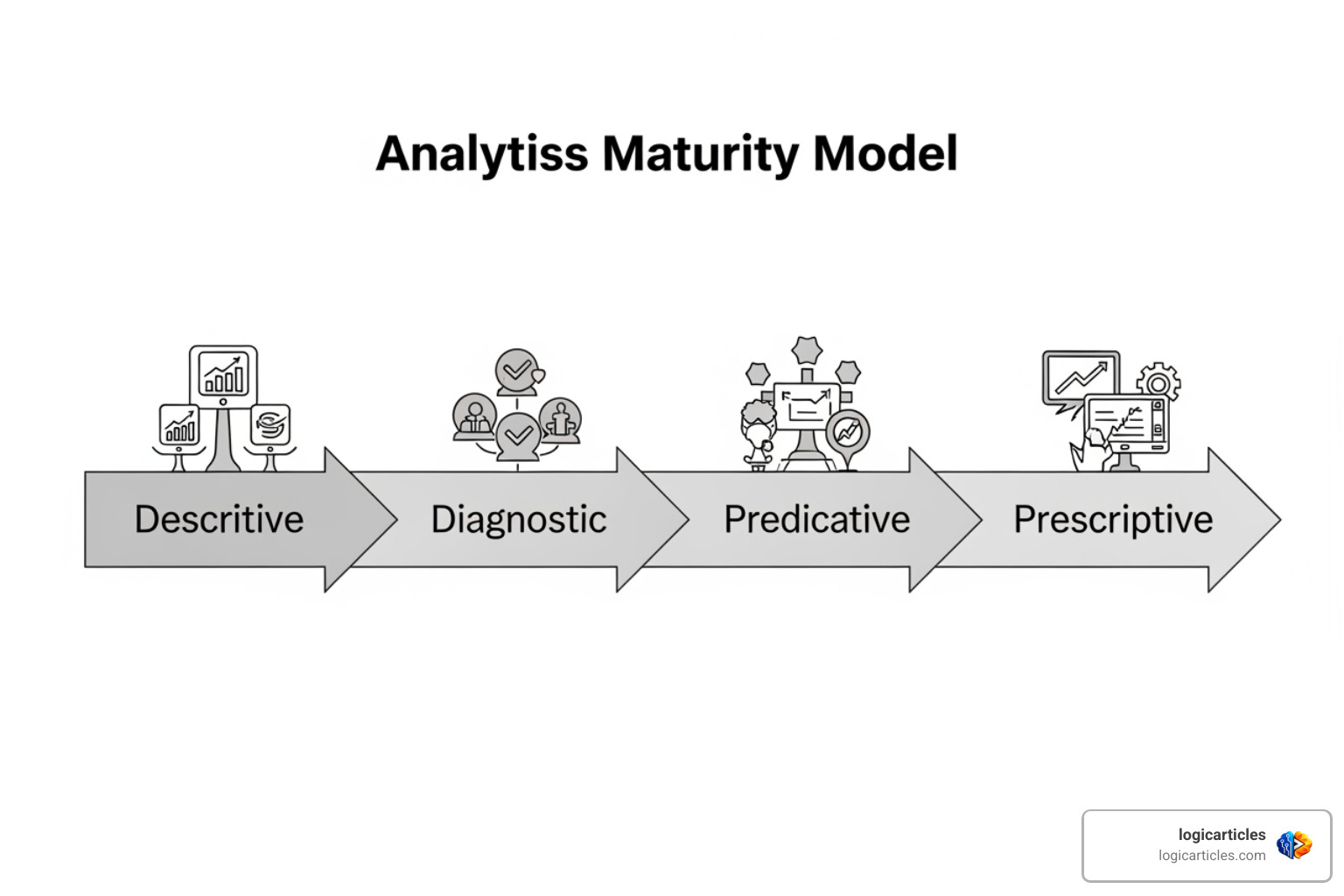
How we look at data depends on what we want to achieve. Most organizations move through these four stages of maturity:
- Descriptive Analytics: What happened? (e.g., “Our sales dropped 10% last month.”)
- Diagnostic Analytics: Why did it happen? (e.g., “Sales dropped because a key supplier was delayed.”)
- Predictive Analytics: What is likely to happen next? (e.g., “Based on current trends, we will run out of stock in three weeks.”)
- Prescriptive Analytics: What should we do about it? (e.g., “Order 500 units now to avoid a shortage.”)
The Big Data Analytics Workflow
Getting from raw data to a brilliant business insight isn’t magic; it’s a workflow. Most big data analytics tools are designed to handle one or more of these specific stages:
- Data Collection: Gathering information from IoT sensors, mobile apps, social media, and internal databases.
- Data Storage: Storing that information. This is where we see “Data Lakes” (for raw, unstructured data) and “Data Warehouses” (for structured, ready-to-analyze data).
- Data Processing: You have two choices here. Batch processing handles large chunks of data at once (great for end-of-month reports), while stream processing handles data in real-time as it arrives. Tools like Apache Spark are famous for being able to do both efficiently.
- Data Cleaning: This is the “scrubbing” phase. You remove duplicates, fix errors, and ensure everything is formatted correctly. Without this, you’re just analyzing “garbage.”
- Data Visualization: This is the final step where you turn numbers into charts and dashboards that humans can actually understand.
Ensuring Data Quality and Security
As we move toward more automated systems, data quality and security have become non-negotiable. If your data is wrong, your AI-driven decisions will be wrong too. Organizations are now using real-time monitoring and anomaly detection to catch statistical outliers before they cause issues.
Security is equally critical. With regulations like GDPR and DORA, protecting user privacy isn’t just a good idea—it’s the law. This involves encryption at rest and in transit, as well as strict access controls. For those in highly regulated sectors, working with a fintech software development company can help ensure that your analytics pipeline meets these rigorous security standards.
Top Big Data Analytics Tools for 2026
Choosing the right big data analytics tools can feel like being a kid in a very expensive, very confusing candy store. To help you navigate, we’ve put together a comparison of the heavy hitters currently dominating the market.
| Feature | Apache Hadoop | Amazon EMR | Google BigQuery | Ververica |
|---|---|---|---|---|
| Primary Strength | Cost-effective storage | Managed AWS ecosystem | Serverless AI integration | Real-time streaming |
| Processing Speed | Moderate (Batch) | High (Optimized Spark) | Very High (Dremel) | Sub-millisecond |
| Cost Model | Free (Open-source) | Pay-as-you-go | Query-based pricing | Enterprise licensing |
| Best For | Archiving & Batch | Hybrid cloud workloads | Predictive AI & BI | Fraud & Real-time AI |
Open-Source Big Data Analytics Tools
Open-source tools remain the backbone of the industry because they offer flexibility and avoid “vendor lock-in.”
- Apache Hadoop: The granddaddy of big data. It uses the Hadoop Distributed File System (HDFS) to store data across clusters of computers and MapReduce to process it in parallel. It’s perfect for organizations that need to store massive amounts of data cheaply.
- Apache Hive: Built on top of Hadoop, Hive allows people who know SQL to query data stored in HDFS. It’s essentially a data warehouse for the big data world. It is highly valued by organizations like nonprofits that need to manage large donor databases without massive proprietary software costs.
- Apache Spark: Currently the most popular engine for large-scale data. It’s significantly faster than Hadoop’s MapReduce because it processes data in-memory rather than writing back to the disk every time.
Cloud-Native Big Data Analytics Tools
In 2026, many companies are moving away from managing their own servers and toward “Serverless” architectures.
- Google BigQuery: This is Google’s fully managed, AI-ready data warehouse. It’s “serverless,” meaning you don’t have to worry about managing infrastructure—you just upload your data and start querying. It even has built-in machine learning (BigQuery ML).
- Amazon EMR: For those already in the AWS ecosystem, Amazon EMR is the go-to. it lets you run Spark, Hive, and Presto on managed clusters. It’s incredibly scalable; you can start small and grow to thousands of machines in minutes.
- Ververica: If your business lives or dies by the second—like high-frequency trading or real-time logistics—Ververica is a top-tier choice. It is built by the creators of Apache Flink and specializes in enterprise-grade stream processing.
How AI and Industry Trends are Transforming Analytics
We can’t talk about big data analytics tools in 2026 without talking about Artificial Intelligence. AI isn’t just a “feature” anymore; it’s the engine.
One of the biggest shifts we’ve seen is the rise of Agentic Data Engineering. Instead of a human writing every single line of code for a data pipeline, we now use multi-agent AI systems. These “agents” can autonomously clean data, detect anomalies, and even suggest the best visualization for a specific dataset.
Real-world industries are already reaping the rewards:
- Healthcare: AI-driven analytics are being used for real-time patient monitoring and diagnostic assistance, identifying potential health risks before they become emergencies.
- Finance: Banks use real-time stream processing to detect fraudulent transactions in less than a millisecond. Modern CFO software now integrates these insights to provide real-time cash flow forecasting.
- Retail: Companies like Amazon use recommendation engines driven by big data to generate a massive portion of their revenue.

Career Roles and Essential Skills
With the explosion of big data analytics tools, the demand for skilled professionals has never been higher. If you’re looking to enter this field, here are the roles that matter:
- Data Engineer: The “plumber” of the data world. They build the pipelines that move data from point A to point B.
- Data Scientist: The “detective.” They use statistics and machine learning to find the “why” behind the data.
- Machine Learning Engineer: The “architect.” They build and deploy the AI models that make predictions.
- BI Analyst: The “storyteller.” They turn complex data into reports that executives can use to make decisions. This role is particularly vital for managing family office accounting or complex corporate portfolios.
Key skills for 2026 include proficiency in Python, SQL, and R, along with a deep understanding of cloud platforms like AWS and Google Cloud.
Frequently Asked Questions about Big Data
What is the difference between big data and traditional data analytics?
Traditional analytics usually deals with structured data in small to medium volumes, often using a single server. Big data analytics handles the “5 V’s”—Volume, Velocity, Variety, Veracity, and Value—requiring distributed systems (like Hadoop or Spark) to process multi-format data across many computers simultaneously.
Which big data analytics tool is best for beginners in 2026?
For those just starting, Microsoft Excel remains a great way to learn basic data manipulation. However, if you want to step into “true” big data, Google BigQuery is excellent because its sandbox mode allows you to experiment with massive datasets using standard SQL without needing to manage any servers.
How does AI improve the accuracy of big data insights?
AI, specifically machine learning and deep learning, can identify complex patterns that humans might miss. It also automates the “cleaning” process, reducing human error. Furthermore, AI can process unstructured data (like text and images), which traditional tools simply cannot “read” on their own.
Conclusion
The world of big data analytics tools is moving fast. By 2026, the gap between companies that use their data and those that just “store” it has become a canyon. Whether you are using open-source giants like Apache Spark or cloud-native powerhouses like BigQuery, the goal remains the same: turning raw information into a competitive edge.
At logicarticles, we believe that the best decisions are driven by logic and data, not just intuition. As you begin your journey into big data, the “best” tool is the one that aligns with your specific business goals, whether that’s reducing infrastructure costs or launching a real-time AI recommendation engine.
For more insights on the latest tools and digital marketing trends, visit us at https://logicarticles.com/. Check out our guide on the best envelope budgeting apps to see how data-driven tools are even changing the way we handle personal finances.