Why Every Startup Needs the Right Tools to Scale

Growth navigate startup tools are software platforms designed to help early-stage companies scale faster, cut costs, and make smarter decisions with limited resources.
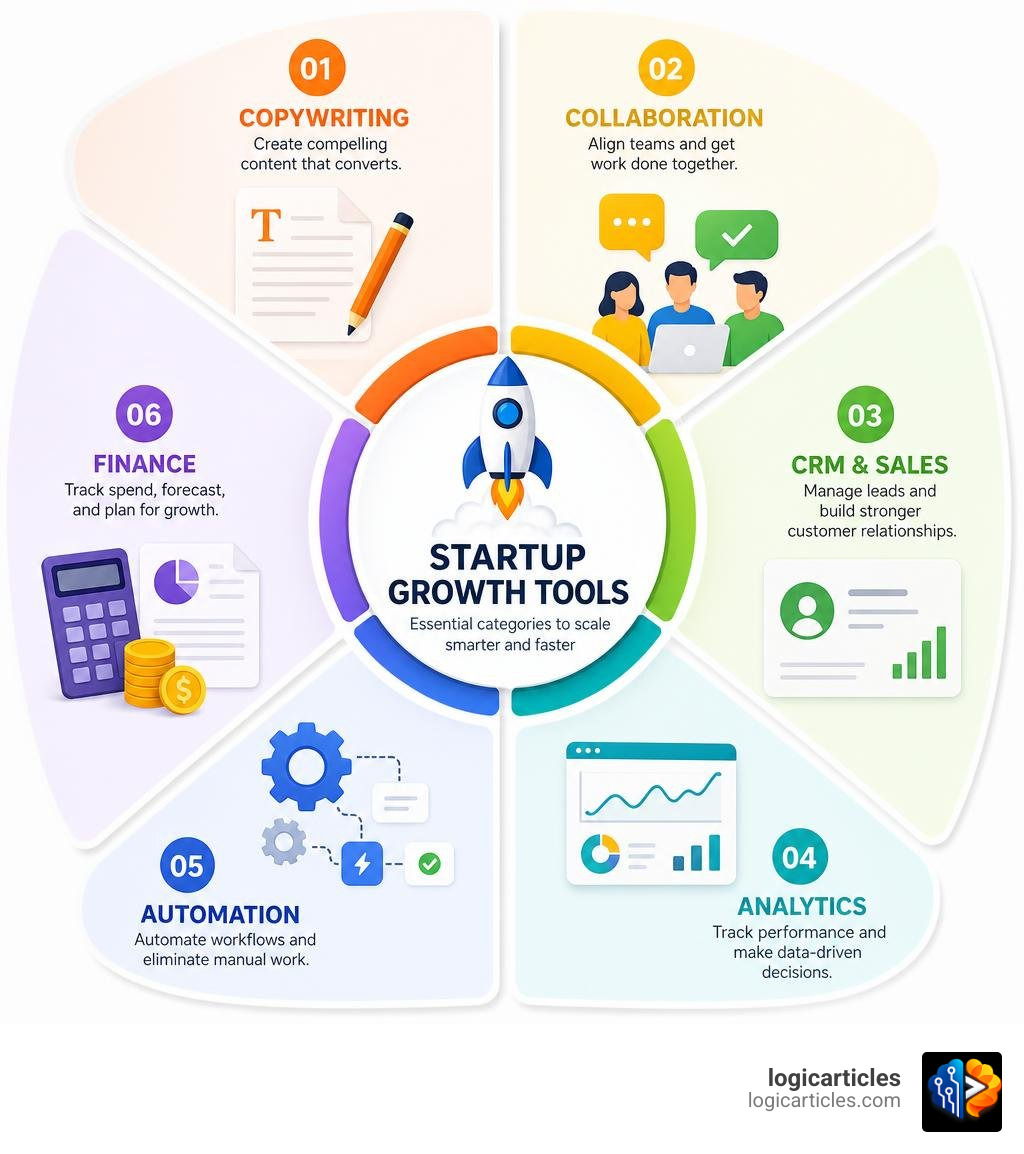
Here’s a quick overview of the most essential categories:
| Category | Purpose | Example Tools |
|---|---|---|
| AI Copywriting | Speed up content creation | Jasper, Copy.ai, Grammarly |
| Team Collaboration | Align remote and hybrid teams | Slack, Notion, Asana, Miro |
| CRM and Sales | Manage leads and automate follow-up | HubSpot, Salesforce, Pipedrive |
| Analytics | Understand user behavior and growth | Google Analytics 4, Tableau |
| Automation | Connect tools and eliminate manual work | Zapier, MuleSoft |
| Financial Management | Track spend, forecast, and plan scenarios | Xero, FreshBooks |
Running a startup in 2026 is a different game than it was just a few years ago. The landscape is crowded, budgets are tight, and the margin for error is razor-thin.
Most founders don’t fail because they have a bad idea. They fail because they can’t execute fast enough — or they waste precious runway on the wrong tools, in the wrong order, for the wrong reasons.
The numbers back this up. Startups using purpose-built platforms reach profitability around 8 months sooner and acquire customers at 40% lower cost than those relying on generic software. Yet 80% of teams still misdiagnose their growth stage when choosing tools.
The result? Tool chaos. Overlapping subscriptions. Fragmented data. A team that spends more time switching between apps than actually growing the business.
This guide cuts through the noise. You’ll find out which tool categories actually matter, which specific tools are worth your budget, and how to build a lean, integrated stack that scales with you — not against you.
What Are Growth Navigate Startup Tools and Why Do They Matter?
When we talk about growth navigate startup tools, we are referring to the underlying digital infrastructure that allows an early-stage venture to function like a much larger enterprise. These are not merely administrative applications; they are execution engines. They handle customer relationship management (CRM), analytics, marketing automation, strategic finance, and cross-functional project management.
In 2026, the baseline expectation for any software implementation is speed and agility. Cloud-based solutions accounted for 78% of startup software deployments by 2025, and that number continues to climb. Startups no longer have the luxury of multi-month onboarding cycles or heavy on-premise setups. We need tools that deliver immediate value, integrate seamlessly with our existing workflows, and allow us to pivot as market conditions change.
The primary reason these platforms matter so much is resource leverage. If you are operating a bootstrapped or early-stage team, your biggest constraint is not necessarily money—it is human hours. By automating repetitive tasks, establishing automated lead-qualification funnels, and using predictive models, a lean team of five can achieve the output of a fifty-person organization.
Furthermore, having a dedicated system helps you manage your customer acquisition cost (CAC). Without structural tracking, you are essentially throwing marketing dollars at a wall and hoping something sticks. By using specialized tools, you can pinpoint exactly where your highest-value users are coming from, allowing you to scale with surgical precision. For a deeper look at the foundational software options available, explore our breakdown of the Best Startup Growth Tools For 2026.
Critical Categories of Growth Tools for Scaling in 2026
To scale a business without collapsing under operational complexity, you must establish a balanced tech stack. We like to think of this stack in terms of two main priorities: the operational core (how your team works together) and decision velocity (how quickly you can turn data into strategic action).
When these elements are in balance, resource optimization happens naturally. You stop wasting money on redundant subscriptions, and your team stops drowning in manual data entry. Let’s break down the critical software categories that every scaling startup needs to master in 2026.
AI-Powered Copywriting and Content Creation
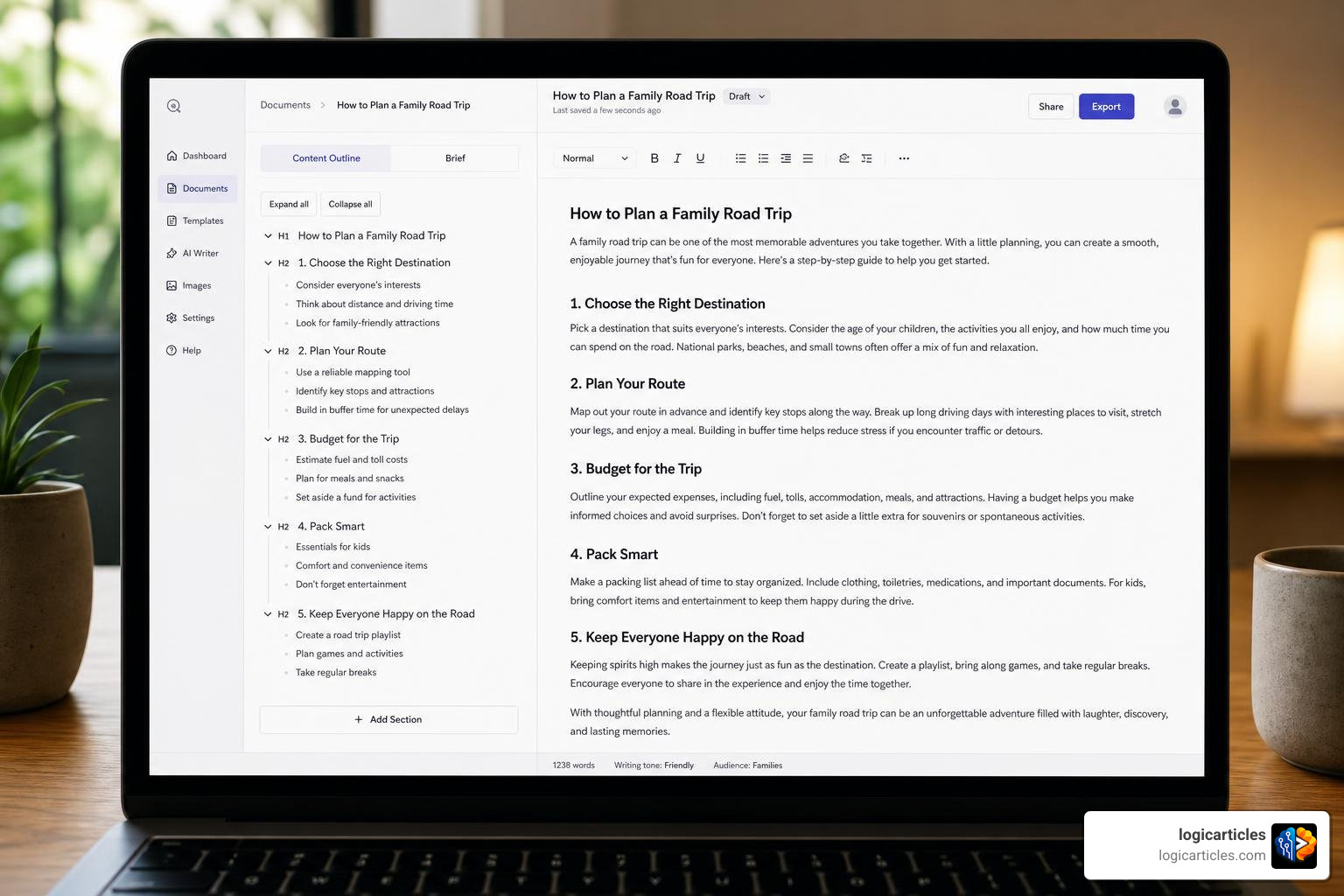
Content is the fuel for modern customer acquisition, but producing high-quality material consistently is incredibly time-consuming. This is where AI-driven writing tools step in. By leveraging specialized platforms, startups can reduce content production time by up to 80%, freeing up marketing teams to focus on strategy and distribution.
- Jasper: Best known for enterprise-grade content scaling, Jasper helps teams maintain a consistent brand voice across multiple channels. It features an “SEO Mode” and campaign acceleration capabilities that turn a single brief into blog posts, social media updates, and email sequences in minutes.
- Copy.ai: Excellent for rapid ad copywriting, product descriptions, and email marketing templates. It excels at breaking through writer’s block and generating dozens of creative angles for your campaigns.
- Grammarly: Beyond basic spellcheck, Grammarly acts as an real-time editor that ensures your brand’s tone remains professional, clear, and engaging across all internal and external communications.
Team Collaboration and Project Management
As teams scale, communication overhead grows exponentially. If you do not establish a structured workspace early on, institutional knowledge is lost, tasks slip through the cracks, and team alignment suffers.
- Slack: The undisputed hub for real-time team communication, used by over 750,000 organizations daily. With robust channels, huddles, and workflow builders, Slack keeps conversations organized and integrates with nearly every other tool in your stack.
- Notion: A highly flexible all-in-one workspace that combines wikis, databases, and project boards. It serves as an excellent internal knowledge base, ensuring that onboarding materials and product roadmaps are accessible to everyone.
- Asana: Ideal for managing complex, multi-step projects. It allows teams to visualize task dependencies, assign clear owners, and track progress against key deadlines. To compare Asana with other top-tier options, check out our review of the Best Task Management Software In 2026 Tested.
- Miro: An infinite visual whiteboard that is perfect for remote brainstorming sessions, wireframing user flows, and mapping out complex systems together.
Customer Relationship Management and Sales Automation
Your CRM is the single source of truth for your revenue engine. Without one, you are relying on messy spreadsheets, which leads to missed follow-ups and lost deals.
- HubSpot Sales Hub: Highly regarded for its all-in-one ecosystem, HubSpot combines contact management, email tracking, and automated sequences. It is exceptionally easy to adopt, making it a favorite for early-stage teams.
- Salesforce Starter Suite: Built for startups that want the power of Salesforce without the complex setup. Starting at $25 per user per month, it brings lead management, email marketing, and reporting into a unified, highly scalable platform.
- Zoho CRM: A highly customizable and budget-friendly alternative that offers robust automation features and integrates deeply with the broader Zoho ecosystem.
- Pipedrive: A pipeline-centric CRM designed specifically for sales teams who want a visual, no-nonsense way to track deals through various stages of the funnel.
When startups implement integrated CRM and analytics tools, they often see up to a 23% conversion lift in the very first sprint after deploying recommended experiments.
Financial Management and Scenario Simulation
You cannot build a sustainable business if you do not have absolute clarity on your numbers. Startups must move past basic bookkeeping and embrace strategic finance—modeling how different decisions will impact runway, burn rate, and margins.
- Xero: A powerful, cloud-based accounting platform that simplifies invoicing, bank reconciliation, and expense tracking. It integrates smoothly with hundreds of third-party financial apps.
- FreshBooks: An incredibly user-friendly invoicing and basic accounting tool designed for service-based startups and small teams who need to get paid quickly.
To ensure your pricing model supports your financial goals as you scale, we recommend looking into the Best Price Optimization Software to dynamically align your pricing with market demand.
Building a Cohesive Tech Stack Without Data Silos
One of the most dangerous traps a startup can fall into is creating data silos. This happens when different departments use isolated tools that do not communicate with one another. The marketing team is looking at one set of numbers in their email tool, the sales team is tracking different metrics in the CRM, and the product team is working off separate behavioral data.
To prevent this, you must design your tech stack around a single source of truth (SSOT). Every tool you select should feed data back into a central hub, ensuring that everyone on the team is making decisions based on the same information.

To achieve this level of cohesion, prioritize platforms that feature open APIs and native integrations. This allows you to connect your systems effortlessly. When native integrations are not available, workflow automation platforms like Zapier can act as the glue, connecting over 7,000 different applications to pass data back and forth automatically.
Key Selection Criteria for Growth Navigate Startup Tools
When evaluating new software for your stack, do not just look at the feature list. Run every tool through these five essential criteria:
- Scalability: Will this tool still serve your needs when your team doubles or triples in size? Avoid platforms that require painful, complex migrations later on.
- Integration Capabilities: Does it connect natively with your CRM and database, or will you have to build custom integrations to make it work?
- Ease of Use: If a tool is too complex, your team simply won’t use it. Prioritize low-code or no-code platforms that offer immediate time-to-value.
- Cost-to-Value: Software costs can spiral out of control quickly. Ensure the pricing model scales predictably with your usage or seat count. To keep your infrastructure costs in check, read our guide on the Best Cloud Cost Optimization Tools For 2026 Cut Cloud Bills Fast.
- AI-Readiness: Does the platform incorporate modern AI and machine learning features that can automate manual data entry and provide predictive insights?
Common Mistakes When Implementing Growth Navigate Startup Tools
Even with the best intentions, startups frequently stumble during software implementation. Here are the most common pitfalls to avoid:
- Tool Overload: Buying software just because it is trending on Product Hunt. If you do not have a clear strategy for a tool, do not buy it.
- Subscription Fatigue: Amassing dozens of micro-subscriptions that slowly drain your runway. Implement a strict “one-in, one-out” policy for software.
- Poor Integration: Leaving tools disconnected, which forces your team to manually copy and paste data between systems.
- Skipping Training: Assuming your team will figure out how to use a complex tool on their own. Without proper onboarding and documented ownership, adoption will fail.
Leveraging AI and Predictive Analytics for Startup Growth
The integration of artificial intelligence into growth tools has changed how startups operate. We have moved past simple automation; we are now in the era of autonomous growth agents and predictive growth engines. These systems do not just display data—they analyze it, run scenario simulations, perform goal gap analyses, and recommend specific, prioritized execution plans.
For instance, modern platforms can reverse-engineer your revenue targets. If you want to reach a specific ARR milestone, the system can audit your current metrics (such as CAC, LTV, and churn) and point out exactly what needs to change to get there. It can simulate what-if scenarios, showing you the exact financial impact of improving your activation rate by 15% versus reducing your churn by 2%.
Several innovative platforms are leading this AI-driven evolution:
- Growthmind: An AI-native growth operating system that acts as a diagnostic-first platform. Instead of accepting generic inputs, it interrogates your business assumptions, determines your precise growth stage, and builds a highly personalized, step-by-step action plan that updates dynamically.
- Pixie: A systematic scaling intelligence system that democratizes the high-impact strategic guidance typically reserved for elite startup accelerators. By connecting directly to your tools, it calculates an auditable “Scaleup Score” and maps out a clear, data-driven roadmap to keep you on track.
- Growth Navigator: An AI co-builder designed to act as a founder’s strategic partner. It constructs deep context artifacts about your unique offer, target customer profile (ICP), and brand voice before generating any assets, ensuring your marketing is highly specific and effective.
- Vyvra: A predictive growth engine built for scaling SaaS startups. Vyvra transforms your raw metrics into execution-ready sprint cards, allowing you to simulate growth scenarios and align your product and marketing teams in minutes.
- Norriva Growth Navigator: A unified platform that combines a real-time business performance cockpit with a forward-looking simulator. It allows you to model funding rounds, adjust revenue assumptions, and optimize your resource allocation side-by-side.
- GrowthPad: An autonomous growth platform that deploys specialized acquisition, retention, and monetization agents. These agents continuously scan your funnels to find hidden leaks, recommend experiments, and track performance lift without requiring you to hire additional headcount.
By utilizing these intelligent systems, startups can make proactive, evidence-based decisions rather than relying on gut feeling. To maximize your digital marketing return on investment alongside these platforms, check out our curated list of the Best Pay Per Click Software In 2026.
Frequently Asked Questions about Startup Growth Stack
How much of our budget should go toward software tools?
For bootstrapped and early-stage startups, software expenses typically account for 15% to 20% of the operational budget. Rather than viewing this as a fixed cost, we recommend evaluating software spend as a percentage of your revenue and overall efficiency.
Prioritize tools that directly drive revenue or save your team at least 10 hours of manual labor per week. If a piece of software does not clearly save you time or generate income, it is a luxury you cannot afford yet.
When is the right time to switch from free to paid plans?
The transition from a free tier to a paid plan should always be driven by a specific, operational bottleneck—never just for “nice-to-have” features.
| Trigger Type | Free Tier Behavior | Paid Upgrade Trigger |
|---|---|---|
| Contact/Lead Limits | CRM limits you to 500 contacts | Upgrade when active pipeline exceeds limits |
| Automation Volume | Basic multi-step zaps are locked | Upgrade when manual data entry takes >3 hours/week |
| Team Collaboration | Read-only access for guest users | Upgrade when multiple editors are needed for daily tasks |
| Data Retention | Analytics history limited to 30 days | Upgrade when year-over-year cohort analysis is required |
How do we avoid tool fatigue and ensure team adoption?
To keep your team from feeling overwhelmed by too many platforms, implement a one-in, one-out policy. Before adding a new subscription, challenge your team to find an existing tool in your stack that can solve the problem, or cancel an underutilized service to make room.
Additionally, assign a clear, documented “owner” to every tool in your stack. This person is responsible for setting up the workspace, onboarding new team members, and conducting quarterly audits to ensure the platform is still delivering clear value.
Conclusion
Building a successful startup in 2026 does not require a massive budget or a giant team. It requires leverage. By selecting the right growth navigate startup tools, you can eliminate operational friction, automate repetitive work, and make decisions based on real-world data rather than guesswork.
The goal is not to collect as many software subscriptions as possible. The goal is to build a cohesive, highly integrated system where your CRM, collaboration tools, and financial models work together to drive your business forward.
We at logicarticles are committed to helping you navigate this journey. By choosing your tools with intention, focusing on integration, and letting data guide your strategy, you can build a sustainable business that is built to scale. To discover more cutting-edge applications that can give your business a competitive edge, explore our dedicated AI Tools Category.