The AI Tools You Should Know in 2026 (Quick Answer)

The AI tools you should know in 2026 span several categories — from general-purpose assistants to specialized marketing, automation, and developer tools. Here are the top picks:
| Category | Top Tools |
|---|---|
| General AI Assistants | GPT-5.5, Claude Opus 4.8, Gemini Omni |
| Research & Search | Perplexity, NotebookLM, ChatGPT Deep Research |
| Content & Marketing | Jasper, Copy.ai, Surfer SEO, HeyGen, ElevenLabs |
| Automation & Workflows | Gumloop, n8n, Zapier, Lindy |
| Video Generation | Sora 2, Veo 3, Kling AI |
| Developer Tools | Cursor, Claude Sonnet 4.6, Gordon (Docker) |
| Image Generation | Midjourney, Nano Banana, Ideogram |
AI adoption in marketing alone has grown 184% since 2023. Today, 73% of marketing teams use at least one AI tool every single day.
That’s not a trend anymore. That’s the new baseline.
But here’s the problem: the number of AI tools has exploded. New ones launch every week. Some are genuinely useful. Many are not. And most “best of” lists are either outdated or quietly sponsored.
This guide cuts through the noise. It covers the tools that actually deliver — the ones brands like Shopify, Instacart, and Airbnb are using internally to move faster and work smarter.
Whether you’re a marketer, developer, founder, or just trying to stay relevant in your field, knowing which tools are worth your time right now matters more than ever.
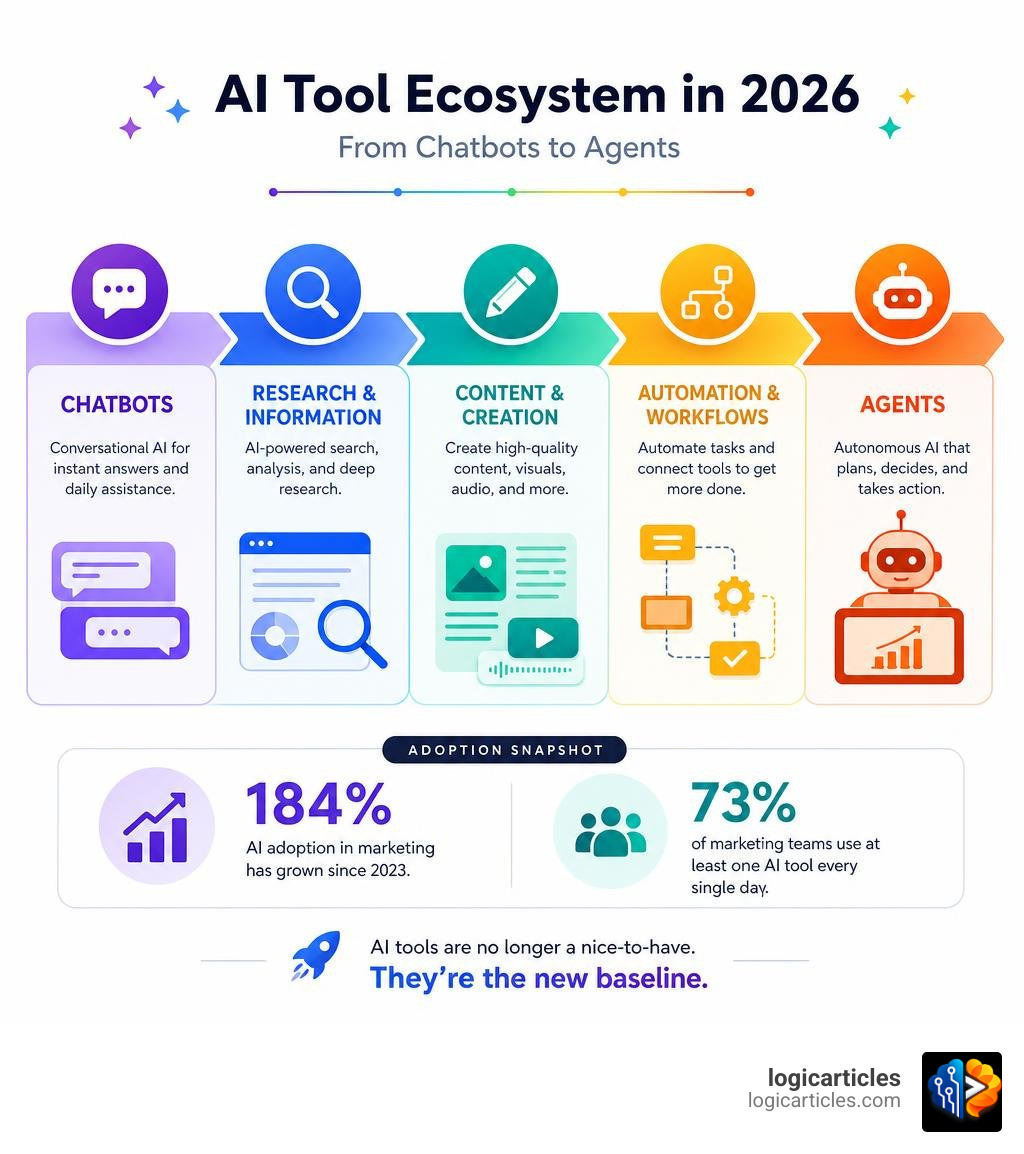
The Evolution of AI Tools You Should Know in 2026
Over the past few years, we have witnessed a massive paradigm shift in the software world. Testing every new tool on the market used to feel like trying to count glitter particles left over after a kindergarten art project. Today, the landscape is much clearer. AI is no longer just its own isolated category; it has become the core infrastructure of every great software product.
For businesses striving to stay ahead, choosing the right tools is the ultimate leverage. If you want to dive deeper into how early-stage companies are scaling their operations, check out our guide on the Best Startup Growth Tools For 2026.

From Simple Chatbots to Autonomous AI Agents
Remember when AI tools were just text boxes where you typed a prompt and hoped for a coherent paragraph? In 2026, we have moved far beyond simple chatbots. The industry has shifted toward autonomous AI agents, “vibe-coding” platforms, and highly sophisticated “grounding” techniques.
- Vibe-Coding: Platforms like Lovable, Bolt, and v0 have democratized software development. Non-developers can now build fully functional web applications, landing pages, and internal tools using natural language prompts. You focus on the “vibe” and design direction, while the AI handles the codebase.
- AI Grounding: To prevent the dreaded “hallucinations” of early models, modern systems connect directly to your workspace or “second brain.” Tools like NotebookLM and Mem ground their outputs strictly in your uploaded documents, ensuring that answers are accurate, factual, and highly customized to your company.
- Custom Agents: Rather than waiting for instructions, modern agents run in the background, proactively suggesting tasks, writing code, and orchestrating multi-step workflows. Many of these breakthroughs are being driven by the Droven Io Best Ai Startups In Usa 2026, which are redefining how we interact with software.
How Leading Brands Leverage AI Internally
Leading global brands aren’t just experimenting with AI—they have completely re-engineered their internal workflows around it.
- Shopify: Under the direction of CEO Tobi Lütke, Shopify implemented a company-wide initiative requiring all employees to leverage AI tools. Their teams use orchestration platforms to automate merchant support, write documentation, and optimize code.
- Instacart: Instacart uses advanced AI automation pipelines to manage their massive product catalogs, generate recipe ideas, and personalize search results for millions of users.
- Airbnb: By integrating custom AI reasoning models into their design and development workflows, Airbnb has drastically reduced the time it takes to prototype new features and analyze guest feedback.
These companies aren’t just saving time; they are seeing a 40% increase in marketing ROI and saving an average of 12.5 hours per week per employee on repetitive tasks.
S-Tier General Assistants and Reasoning Models
If you are going to learn or pay for any AI tool this year, it should be one of these S-Tier models. These are the foundational engines that power the rest of the software ecosystem.
| Model | Primary Strength | Context Window | Key Highlight |
|---|---|---|---|
| GPT-5.5 | Complex logic, agentic execution, and coding | 1M+ tokens | Co-designed on NVIDIA GB200 systems; incredible conceptual clarity |
| Claude 4.8 (Opus) | Long-context reasoning, writing, and self-correction | 1M tokens | Breaks 10% on the Legal Agent Benchmark; zero-shot reliability |
| Gemini Omni | Conversational, multi-turn video & multimodal editing | Multi-million tokens | Native physical and cultural world knowledge; SynthID watermarking |
GPT-5.5: Next-Generation Infrastructure for Real Work
OpenAI’s latest flagship, detailed in their announcement of Introducing GPT-5.5 | OpenAI , represents a major step forward for agentic AI. It is built to handle messy, multi-part tasks with minimal human oversight.
GPT-5.5 is co-designed and served on state-of-the-art NVIDIA GB200 NVL72 systems, which has boosted token generation speeds by over 20%. In professional benchmarks, it scores an impressive 82.7% on Terminal-Bench 2.0 (compared to 75.1% for GPT-5.4) and 78.7% on OSWorld-Verified.
In the real world, this means serious conceptual clarity. Developers are using it to merge branches with hundreds of complex frontend changes in under 20 minutes. Finance and tax professionals are using it to review tens of thousands of K-1 tax forms, compressing two weeks of dense analysis into a single afternoon.
Claude Sonnet 4.6 and Opus 4.8: The Writing and Coding Powerhouses
Anthropic continues to dominate the creative and analytical spheres with its dual-model strategy.
- Claude Sonnet 4.6: As outlined in the release of Claude Sonnet 4.6 \ Anthropic , this hybrid reasoning model offers an extraordinary performance-to-cost ratio ($3 per million input tokens, $15 per million output tokens). It features an extended thinking mode that makes it a powerhouse for production coding and customer-facing agents. It also boasts a 94% accuracy rate on complex insurance computer-use benchmarks.
- Claude Opus 4.8: For the most demanding enterprise tasks, Anthropic’s heavy hitter is Claude Opus 4.8 \ Anthropic . Opus 4.8 is the only model to complete every single case end-to-end on the rigorous Super-Agent benchmark. It features adaptive thinking, which automatically scales its reasoning depth based on the complexity of your prompt. It’s also the first model to break 10% on the Legal Agent Benchmark, making it the gold standard for dense contract analysis and legal drafting.
Gemini Omni: Conversational Multimodal Video and Image Creation
Google’s natively multimodal model has taken video editing and generation to a completely new level. According to Google’s post Introducing Gemini Omni , Gemini Omni allows users to edit video through natural, conversational language.
Rather than regenerating a video from scratch with a new prompt, Omni allows you to build edits conversationally. It maintains character consistency, physics, and scene memory across multiple turns. For safety and transparency, all videos generated by Gemini Omni include an imperceptible SynthID digital watermark for content verification.
Specialized AI Tools for Marketing, Automation, and Workflows
While general-purpose LLMs are incredibly powerful, forcing them to do highly specialized tasks can sometimes feel like using a Swiss Army knife to chop down a tree. That is where specialized tools come in.

If you are looking to analyze large datasets to fuel your marketing campaigns, take a look at our breakdown of the Best Big Data Analytics Tools In 2026 Ranked By Performance.
AI Marketing Tools You Should Know in 2026 for Content and SEO
In 2026, content creation and search engine optimization are highly automated, but they still require a human touch to ensure quality.
- Jasper: Still the premier choice for enterprise marketing teams. Jasper’s “Brand Voice” feature allows you to upload style guides and previous content to train the AI, ensuring that everything it writes sounds exactly like your brand.
- Copy.ai: Excellent for fast product messaging and high-volume marketing copy. Its workflow automation allows you to generate a 20-section blog post or dozens of ad variations in under 10 minutes.
- Surfer SEO & ContentShake AI: These tools analyze real-time search engine results pages (SERPs) to tell you exactly how to optimize your content. ContentShake AI is particularly impressive, regularly generating drafts that score at least 70% “human-written” on AI detectors.
- HeyGen & ElevenLabs: HeyGen can translate your marketing videos into over 175 languages and dialects while perfectly preserving the original speaker’s voice and lip-syncing. ElevenLabs, valued at over $1B, provides incredibly lifelike voice clones with as little as 10 seconds of reference audio.
- Suno: Need a catchy jingle or background track for an ad? Suno generates complete songs (including vocals, lyrics, and specific musical genres) from a simple text prompt.
AI Automation Tools You Should Know in 2026 for Orchestration
Connecting your AI models to your existing tech stack is where the real magic happens.
- Gumloop: A favorite among modern growth hackers. Gumloop offers a visual, node-based builder that combines Zapier-style automation with deep LLM integrations—without requiring you to manage API keys.
- n8n: The open-source, self-hostable alternative to traditional automation platforms. Because you can host it on your own servers, n8n gives enterprise teams complete control over their data, customization, and costs.
- Zapier & Make: The industry giants have evolved. Zapier now features “Zapier Agents” that can autonomously coordinate tasks across over 8,000 integrated applications, handling everything from customer feedback loops to lead routing.
- Lindy: Lindy excels at creating custom AI agents for complex business workflows. You can build a custom email scheduler, a CRM updater, or a lead generator in minutes using natural language.
Developer and Infrastructure Agents: Gordon and Cosmos 3
Even system infrastructure and physical AI have been transformed by agentic workflows.
For developers managing complex container setups, Docker recently introduced Gordon. As explained in Meet Gordon: AI Agent for Container Workflows | Docker , Gordon is a built-in assistant for Docker Desktop 4.74+. If a container exits unexpectedly, you can simply run docker ai in your terminal. Gordon will inspect the logs, identify the missing environment variable or misconfigured volume mount, and propose a direct fix.
On the physical computing front, NVIDIA Launches Cosmos 3, the Open Frontier Foundation Model for Physical AI | NVIDIA Newsroom . Cosmos 3 is an open-world foundation model built on a breakthrough mixture-of-transformers architecture. It acts as a “world model” for robotics, autonomous vehicles, and industrial AI, simulating physical environments and predicting future states to reduce physical AI training cycles from months to days.
How to Evaluate and Choose the Right AI Tools
With hundreds of platforms screaming for your attention (and your credit card), you need a structured framework to evaluate which tools actually deserve a spot in your workflow.
Key Criteria for AI Tool Selection
When we evaluate new software, we use four main pillars:
- Pricing and ROI: Does the tool offer a generous free tier to test its capabilities? If it’s a paid tool, does it save enough hours per week to justify the subscription? (Hint: an AI tool that saves you 5 hours a week is easily worth a $20/month subscription).
- Usability and Integration: Does the platform integrate cleanly with your existing tech stack (Slack, Gmail, Salesforce, etc.), or does it force you to constantly copy and paste data between tabs?
- Customization (Grounding): Can you train the tool on your own data, brand voice, and internal documentation? Or does it just give generic, out-of-the-box answers?
- API Access: For technical teams, having robust API access is critical for building custom, internal automations.
Limitations and Security Considerations
Before you upload your company’s entire database to a new AI tool, keep these critical safety guidelines in mind:
- Data Privacy & GDPR: Always check the tool’s privacy policy. Ensure they do not use your proprietary business data or customer information to train their public models.
- Usage Caps: Many “unlimited” free tools have strict throttle gates or message limits that reset every few hours.
- Hallucination Risk: Never publish AI-generated content or deploy code without a human-in-the-loop review. AI is an assistant, not a replacement for human judgment.
Frequently Asked Questions About AI Tools in 2026
What is the difference between AI platforms and standalone tools?
AI platforms (like Lindy, Copy.ai, or Zapier) are flexible ecosystems that let you customize inputs, chain multiple outputs together, and connect to hundreds of other apps. Standalone tools (like a basic background remover or a simple grammar checker) are built to do one narrow task exceptionally well, but they lack integration flexibility.
Which free AI tools offer the most value in 2026?
- NotebookLM: Grounded entirely in your uploaded files, making it incredible for summarizing PDFs and generating private, localized audio podcasts.
- Perplexity: The gold standard for real-time web research, offering direct citations for every claim.
- Humata: Excellent for analyzing long legal or technical documents, allowing you to ask questions and get answers anchored to specific pages.
How do AI search engines reduce hallucinations?
AI search engines use a technique called “grounding.” Instead of relying purely on their static training data, they perform real-time web searches, extract text from the top results, and use those verified sources to construct their answers—complete with clickable, inline citations.
Conclusion
The landscape of ai tools you should know in 2026 is no longer about novelty; it is about execution, integration, and scaling your business. Whether you are using S-Tier models like Claude Opus 4.8 and GPT-5.5 to write code, or using Gumloop and n8n to automate your marketing pipelines, the key is to start experimenting today.
Ready to build a smarter, AI-driven workflow for your business? Explore more AI resources on our platform to stay ahead of the curve.
What tool would you add to this list? Let us know in the comments below!