Why Most Software Companies Get SEO Keywords Wrong

The right seo keywords for software company can be the difference between a website that generates leads on autopilot and one that sits invisible on page 3 of Google.
Here are the most effective SEO keywords for software companies right now:
| Keyword | Monthly Searches | Keyword Difficulty |
|---|---|---|
| custom software development company | 2,900 | 80 |
| software development services | 600 | 65 |
| web application development company | 1,600 | 57 |
| healthcare software development company | 500 | 19 |
| software outsourcing company | 720 | 15 |
| fintech app development | 500 | 10 |
| HIPAA compliant software development | ~300 | 22-32 |
| cloud migration services | 890 | 36 |
The sweet spot for most software companies is keywords with a difficulty score between 20 and 40. These are competitive enough to drive real traffic, but achievable without a massive backlink budget.
Here’s the hard truth: most software companies chase the same 20 popular terms — keywords like “software development company” (27,100 searches/month) — while completely ignoring the long-tail phrases that actually convert buyers.
A broad keyword like “software engineers” gets 60,500 searches a month. But the majority of those searchers are job seekers and students, not people looking to hire a development firm. Meanwhile, a phrase like “custom software development for healthcare startups” gets almost no search volume — but every single visitor who finds you through it is a potential paying client.
That mismatch between traffic volume and buyer intent is exactly where most software company SEO strategies break down.
This guide will show you how to fix that — from picking the right keywords at every stage of the buyer journey, to structuring your content so Google (and AI search engines) actually rank it.
The Strategic Value of SEO Keywords for Software Company Growth
When we think about scaling a software business, paid advertising often feels like the easiest lever to pull. However, in June 2026, relying solely on paid channels is an expensive trap.
For software companies, organic search traffic drives over 1,000% more traffic than organic social media. To capture this traffic, we must understand the metrics that define the software keyword landscape: search volume, keyword difficulty (KD), commercial intent, and Cost Per Click (CPC).
These numbers tell a fascinating story. The high average CPC of $11.54 shows just how valuable these searchers are. If you are paying $11.50 every single time someone clicks on an ad for your software development services, your budget will dry up fast. This is why organic rankings are so critical. By ranking organically for high-intent keywords, you build a compounding asset that brings in qualified leads for free.
To find these high-value opportunities, we start by looking at what our target market is searching for. We then analyze the commercial intent behind those terms. High-intent transactional keywords might have lower search volumes, but they yield a much higher conversion rate than broad informational terms. For baseline search best practices, Google’s official SEO Starter Guide is also a useful reference when aligning keyword strategy with crawlability, content quality, and user experience.
To bridge the gap between organic strategies and paid search, many scaling companies use specialized tools. If you are also managing paid campaigns alongside your organic efforts, we recommend checking out the Best Pay Per Click Software In 2026 to maximize your overall search visibility.
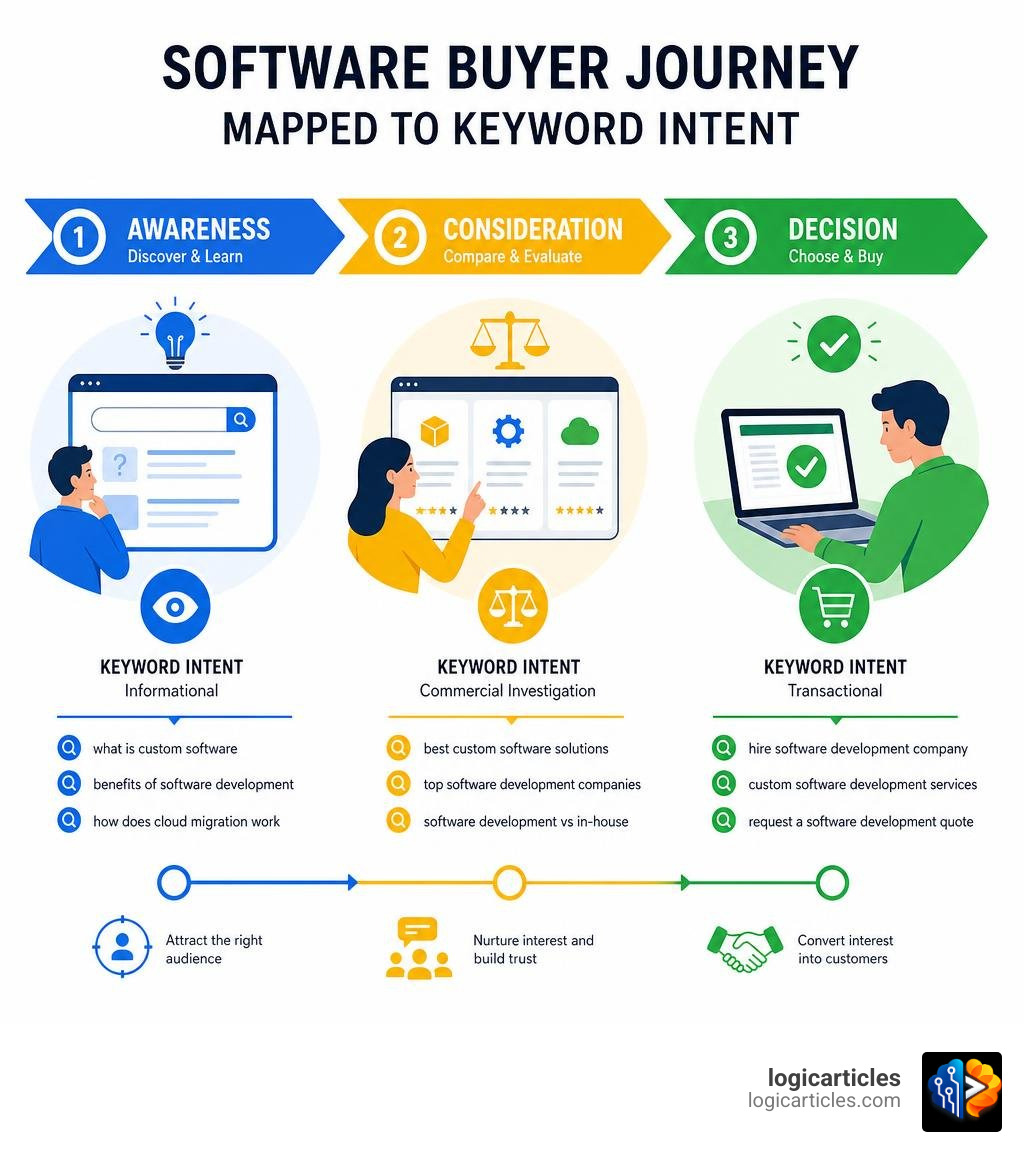
Mapping Keywords Across the Software Buyer’s Journey
A successful keyword strategy must address every stage of the marketing funnel. We cannot expect a user who has just realized they have a problem to immediately buy a custom enterprise software solution. They need to be nurtured through the buyer journey.
| Funnel Stage | Intent | Goal | Example Keyword | Average Conversion Rate |
|---|---|---|---|---|
| Top of Funnel (ToFU) | Informational | Educate & build trust | “how to migrate legacy database to cloud” | 1% – 2% |
| Middle of Funnel (MoFU) | Consideration | Compare options | “custom software vs off the shelf” | 3% – 5% |
| Bottom of Funnel (BoFu) | Transactional | Convert into lead | “healthcare software development company” | 8% – 15% |
By balancing our keyword targeting across this funnel, we ensure a steady stream of new prospects while simultaneously closing high-intent leads who are ready to sign a contract today.
Top-of-Funnel Informational Keywords
At the Top of the Funnel (ToFU), users are searching for solutions to specific pain points. They aren’t looking for your company name or even your specific service yet. They are asking “how-to” questions and looking for educational resources.
For instance, a CTO might search for “microservices vs monolith migration” or “how to secure a web application.” These keywords have high search volume but lower immediate conversion rates. However, they are essential for building brand authority and capturing early-stage leads.
By publishing detailed blog content, whitepapers, and guides that solve these problems, we position our company as the ultimate expert.
Middle-of-Funnel Comparison Keywords
Once prospects understand their problem, they move to the Middle of the Funnel (MoFU). Here, they are comparing different approaches, tech stacks, or software vendors.
Typical MoFU queries include comparison terms and alternative keywords like:
- “Flutter vs React Native 2026”
- “Salesforce alternatives” (1,900 monthly searches, 48 KD)
- “best project management software” (4,400 monthly searches, 54 KD)
At this stage, decision-makers are looking for unbiased, highly detailed technical breakdowns. Case studies, product feature comparisons, and expert roundups perform incredibly well here. To efficiently manage and scale the production of this comparison content, we recommend utilizing the Best Content Marketing Software to streamline your team’s editorial workflows.
Bottom-of-Funnel SEO Keywords for Software Company Lead Generation
The Bottom of the Funnel (BoFu) is where the magic happens. These are transactional, high-intent keywords searched by users who have a budget and are actively looking to hire a software firm.
Examples include:
- “custom web application development services” (590 searches/mo, 14 KD)
- “fintech app development” (500 searches/mo, 10 KD)
- “software outsourcing company” (720 searches/mo, 15 KD)
While these terms have lower monthly search volumes compared to broad informational keywords, their conversion rates are 4x to 8x higher. When someone searches for “custom software development services,” they aren’t browsing for fun—they have a project that needs to be built.
Technical SEO and Content Architecture for Software Sites
Excellent keyword research is useless if your website is too slow or poorly structured for search engines to crawl. Software websites often suffer from technical bloat, heavy JavaScript frameworks, and poor mobile responsiveness.
To ensure your keywords actually rank, we must prioritize technical SEO. This means optimizing page load speeds to under 3 seconds, ensuring perfect mobile rendering, and implementing structured schema markup (such as FAQPage, HowTo, and Service schema) to help search engines understand your pages.
Additionally, keeping your crawl paths clean is vital. Simple errors in your site configuration can completely block search engines from indexing your valuable keyword-optimized pages. To avoid these common technical traps, read our guide on how to Generate Robots Txt Files 7 Spellmistakes That Can Hurt Seo.
How to Structure Content Around SEO Keywords for Software Company Websites
To rank for highly competitive software terms, we must build “topical authority.” Search engines no longer rank isolated pages; they reward websites that demonstrate deep, comprehensive knowledge of a subject.
We achieve this by structuring our content into a Pillar-Cluster Architecture:
- Pillar Page: A comprehensive, high-level guide targeting a broad, high-volume keyword (e.g., “Custom Software Development Guide”).
- Topic Clusters: Supporting blog posts targeting specific, long-tail keywords (e.g., “Cost of Custom Software,” “How to Write a Software RFP,” “Agile vs Waterfall for Custom Dev”).
- Internal Linking: Hyperlinking the cluster content back to the pillar page using descriptive, keyword-rich anchor text. This passes “link equity” and signals to search engines that your pillar page is the ultimate resource.
Local SEO and Regional Targeting
If your software development company target clients in specific geographic locations, local SEO is a goldmine. Many enterprise clients prefer working with local partners or firms within their region.
To capture this demand, target geo-specific keywords like “software development company in Chicago” or “custom software developers near me.”
To win at local SEO:
- Claim and optimize your Google Business Profile.
- Maintain consistent Name, Address, and Phone number (NAP) details across the web.
- Build local citations by listing your business in authoritative directories.
To streamline this process, you can read our review of Zaubee Local Seo to see if it fits your local strategy. Additionally, to get started on building high-authority local citations manually, we have compiled a list of the Top Free Business Directories In The Usa to boost your local search presence.
Optimizing for AI Answer Engines and Community Search
By June 2026, search behavior has undergone a massive evolution. AI-powered answer engines (like ChatGPT Search, Perplexity, and Google’s AI Overviews) now answer a significant percentage of search queries directly.
At the same time, users are increasingly seeking human-first, authentic recommendations. This has led to an explosion of community-driven search queries. Reddit’s Daily Active Users have grown to 108.1 million (up 31% year-over-year), and Reddit threads now frequently rank in Google’s top 10 search results within minutes of posting.
To win in this modern search landscape, we must optimize for both traditional search and AI engine extraction simultaneously. This process is called Answer Engine Optimization (AEO).
To optimize for AEO and community search:
- Write short, direct answers: Place a “TL;DR” summary at the top of your technical articles. AI engines love extracting clear, 2-3 sentence answers.
- Format with structured headings: Use H2 and H3 tags phrased as direct questions (e.g., “What is the cost of custom software development?”).
- Target community keywords: Monitor and participate ethically in Reddit threads discussing your niche. A well-placed, helpful response can drive highly qualified referral traffic for years.
- Prioritize high-intent demos: Instead of chasing generic informational traffic, focus your core content on driving action.
By integrating these strategies, we ensure our software company remains visible whether a prospect is searching on Google, asking Perplexity, or browsing Reddit.
Frequently Asked Questions about Software SEO
Answering common questions clearly is not only great for our readers, but it also helps us target featured snippets in search results. Here are the answers to the most common questions software companies ask us.
To monitor how well your website is ranking for these questions and core keywords across different search engines, we recommend using the Best Enterprise Rank Tracking Software In 2026.
What is the ideal keyword difficulty score for a new software company?
For new software companies or websites with a low Domain Rating (DR), the keyword difficulty sweet spot sits between 20 and 40.
Keywords with a KD below 20 often have very low search volume or lack commercial intent. Keywords with a KD above 60 require significant backlink profiles and high domain authority to rank. By targeting the 20-40 range, you can rank relatively quickly by creating highly optimized, superior content without needing to spend thousands of dollars on link-building campaigns right out of the gate.
How long does it take to rank for competitive software keywords?
The timeline for ranking depends heavily on the keyword difficulty and your content velocity (how fast you publish high-quality content):
- Easy Keywords (KD 10-25): 1 to 3 months.
- Medium Keywords (KD 25-40): 3 to 6 months.
- Hard Keywords (KD 40+): 6 to 12+ months (and usually requires a strategic backlink acquisition campaign).
Consistency is key. A software company publishing 4 to 8 high-quality, strategically targeted articles per month will build topical authority and see ranking shifts much faster than a company publishing once a quarter.
How do you measure the ROI of software keyword optimization?
To measure the true ROI of your SEO efforts, we must look beyond vanity metrics like organic traffic volume and keyword rankings. Instead, track these business-focused KPIs:
- Organic Lead Conversion Rate: The percentage of organic visitors who request a demo, start a free trial, or submit a contact form.
- Customer Acquisition Cost (CAC) via SEO: Calculate your total monthly SEO spend (tools, content creation, optimization) divided by the number of closed customers acquired through organic search. For software companies, organic CAC is typically 3x to 5x lower than paid ads.
- Customer Lifetime Value (CLV) of Organic Traffic: Users who find you organically often have higher retention rates and lifetime value because they actively sought out your solution to solve their specific problem.
Conclusion
Building a successful keyword strategy is not about ranking for the highest-volume terms; it is about ranking for the right terms. By mapping your seo keywords for software company across the entire buyer journey, building topical authority through structured content clusters, and optimizing for both traditional Google search and AI answer engines, you can drive predictable, high-value leads to your business on autopilot.
At logicarticles, we specialize in helping technology and software businesses navigate the complex world of organic search. Ready to turn your website into a lead-generation machine? Get started with the best software strategies today and begin your journey toward compounding organic growth.