Why Finding the Best Content Marketing Software Changes Everything

The best content marketing software can mean the difference between a content team that’s constantly scrambling and one that ships great work on time, every time.
Here’s a quick look at the top options to help you decide fast:
| Software | Best For | Starting Price |
|---|---|---|
| HubSpot Content Hub | All-in-one teams, SMB to enterprise | Free / $20/month |
| Optimizely CMP | Enterprise content operations | Custom pricing |
| Contently | Freelancer-powered content at scale | Custom pricing |
| Jasper | AI-driven content creation | $49/month |
| Semrush Content Toolkit | SEO-focused content teams | $249.95/month |
| CoSchedule | Editorial calendar management | $29/user/month |
| Stackby | Small teams on a budget | $5/user/month |
| StoryChief | Multi-channel publishing | Custom pricing |
| Adobe GenStudio | Enterprise campaign content | Custom pricing |
Most content teams aren’t struggling because they lack ideas. They’re struggling because their tools are disconnected. One team might be juggling four to six separate apps — a spreadsheet for the calendar, a separate tool for approvals, another for publishing, and yet another for analytics. The result? Stale data, missed deadlines, and a lot of copy-pasting.
That’s the problem content marketing software is built to solve.
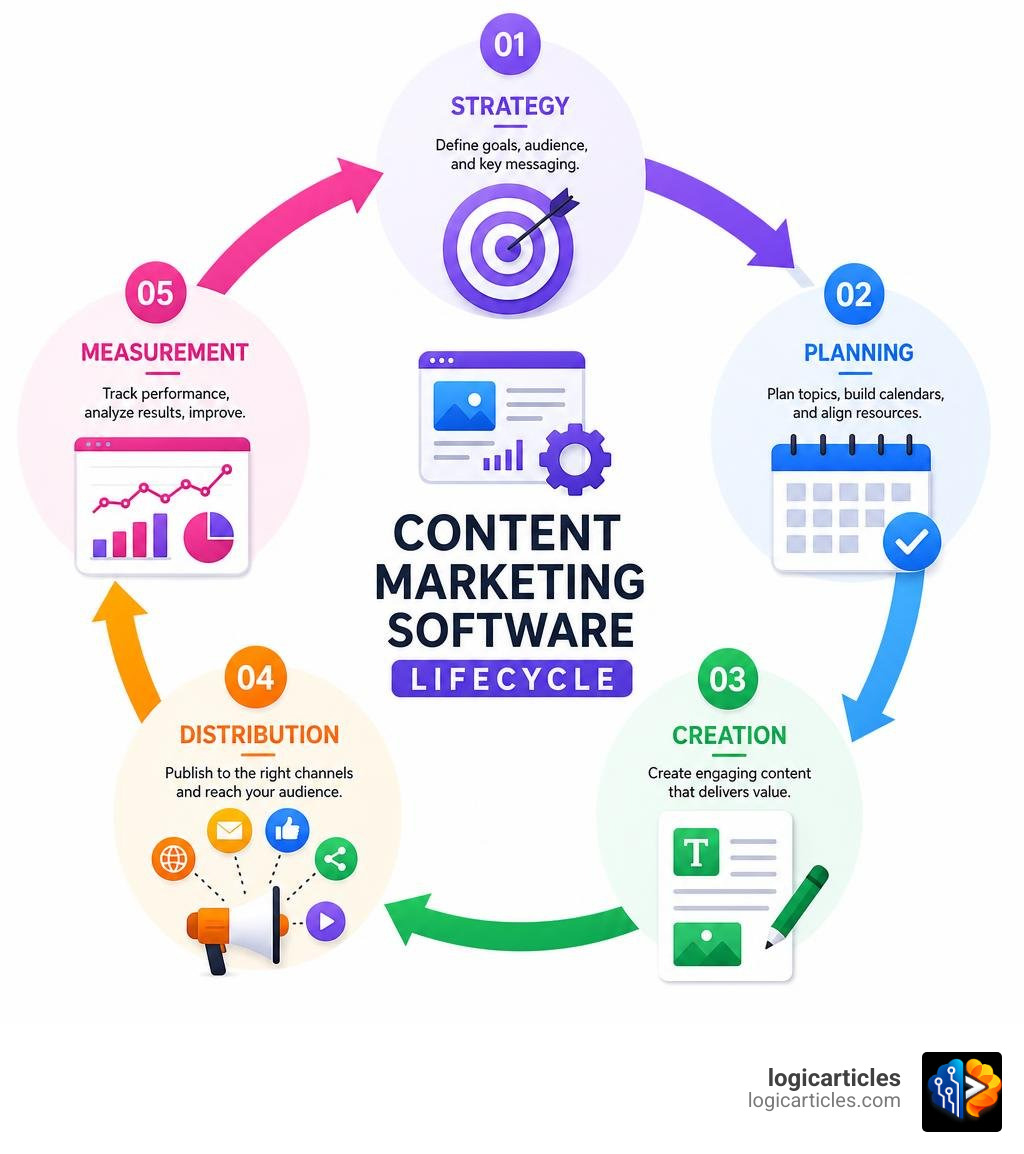
According to Gartner, these platforms support the entire content production process — from strategy and editorial planning all the way through to distribution and performance measurement. And the results can be significant: content marketing done well generates 3x more leads than traditional marketing at 62% lower cost.
This guide covers everything you need to pick the right platform — whether you’re a solo marketer, a growing team, or a large enterprise managing content across dozens of channels.
Core Capabilities of the Best Content Marketing Software
To understand why dedicated content tools are so transformative, we have to look under the hood. The best content marketing software doesn’t just give you a digital whiteboard to write on; it acts as the central nervous system for your entire marketing department.
When evaluating these platforms in 2026, we look for several core capabilities that bridge the gap between initial ideation and final conversion.
1. Unified Editorial Planning
The foundation of any successful strategy is a flexible, highly visible calendar. Without it, you are throwing spaghetti at the wall. The best platforms provide multi-view editorial calendars that let you filter by campaign, channel, content owner, or target persona. This ensures that every piece of content planned aligns directly with your broader business goals.
2. Structured Creative Workflows and Approvals
Content creation is rarely a solo act. A single blog post or video might need to pass through a copywriter, an SEO specialist, a graphic designer, a legal compliance checker, and a marketing director. Dedicated software automates this handoff.
When the writer finishes a draft, the system automatically alerts the editor. If legal rejects a claim, the draft is routed back with feedback. This eliminates the endless back-and-forth email chains that delay campaigns.
3. Metadata Management and Digital Asset Management (DAM)
As your content library grows, finding a specific image, video clip, or PDF becomes increasingly difficult. Advanced platforms feature built-in DAM systems with automated tagging. These systems use AI to scan your assets, apply relevant tags, and organize them into searchable repositories so your team can reuse and repurpose assets instantly.
4. Direct Multi-Channel Distribution
Why write a piece of content in one tool only to copy and paste it into five different publishing platforms? Leading systems integrate directly with your website’s CMS, email tools, and social media channels. You can write, optimize, format, and schedule your content to go live across all channels simultaneously with a single click.
5. Detailed Performance Measurement
To prove your ROI, you need to know exactly how your content performs. The best software links directly to your business analytics. It doesn’t just show you vanity metrics like page views; it tracks deep engagement, conversion rates, and even ties specific content assets to closed deals.
Platforms like the Optimizely CMP excel in this area by uniting the entire content lifecycle into a single operating system. This allows enterprise teams to map planning data directly to downstream performance metrics.
If you want to ensure your day-to-day workflow matches this level of operational excellence, pairing your content system with the Best Task Management Software In 2026 Tested can help keep your creative team perfectly aligned.

Key Differences: Content Marketing Software vs. General Project Management
A common mistake we see teams make is trying to force-fit a general project management tool (like Trello, Asana, or Monday) into a content marketing role. While these tools are fantastic for general task tracking, they fall short when it comes to managing the nuanced lifecycle of content production.
Here is a side-by-side comparison of how these two types of software handle content operations:
| Feature | General Project Management Tools | Dedicated Content Marketing Software |
|---|---|---|
| Primary Focus | General tasks, timelines, and broad team coordination | End-to-end content production and distribution |
| Calendar Views | Standard calendar or Gantt charts mapping generic deadlines | Interactive editorial calendars showing content status, channels, and campaigns |
| Content Creation | Basic text boxes or attachments with no built-in editor | Rich text editors with integrated SEO suggestions, readability scores, and brand voice guidelines |
| Publishing Pipelines | Manual updates; tasks must be marked “done” manually | Direct integrations with CMS platforms and social channels for automated publishing |
| SEO Integration | None; requires external tools and manual copy-pasting | Built-in keyword research, competitor analysis, and optimization checkers |
| Asset Management | Files attached to individual tasks, easily lost over time | Centralized Digital Asset Management (DAM) with AI-powered tagging and search |
General project management tools treat a blog post the same way they treat a software bug or an office relocation: as a task to be completed.
Content marketing software, on the other hand, understands that a blog post is a living asset. It needs to be researched for SEO, written, optimized, reviewed for compliance, published directly to a CMS, promoted on social media, and tracked for organic traffic.
Furthermore, content platforms help preserve institutional knowledge. When a key writer or designer leaves your team, their work, briefs, style guides, and templates remain organized inside your content platform.
If you are currently struggling to keep your internal processes and guidelines documented during these transitions, exploring the Best Knowledge Base Software In 2026 can provide a secure home for your team’s collective wisdom.
How AI and Automation Shape Modern Content Platforms
By mid-2026, artificial intelligence is no longer just a fancy add-on or a basic chatbot. It is deeply woven into the fabric of the best content marketing software, serving as an active assistant that saves teams hours of administrative and creative work every week.
Modern content platforms utilize AI to streamline three key areas:
Content Remixing and Atomization
Creating a single “hero” piece of content — like an in-depth whitepaper or industry report — takes a massive amount of effort. In the past, turning that report into a blog post, an email newsletter, and five social media updates was a tedious manual process.
Today, enterprise platforms like Adobe GenStudio use generative AI to analyze long-form assets and instantly atomize them into dozens of channel-ready, persona-adapted variations. You can convert a PDF report into a series of highly targeted LinkedIn updates or email sequences in minutes, keeping your brand voice perfectly consistent.

Automated Tagging and Asset Management
Instead of forcing human editors to manually tag every uploaded image or video, modern systems use computer vision to analyze assets upon upload. The software automatically applies descriptive keywords, identifies the faces or products shown, and formats the files for different device screens, drastically reducing administrative overhead.
Persona Adaptation and Brand Governance
Maintaining brand consistency across multiple regions, products, and target audiences is incredibly challenging. AI engines built into modern content software act as digital brand guardians. They scan every draft to ensure it aligns with your pre-defined brand guidelines, tone of voice, and regulatory compliance standards before it ever reaches an editor’s desk.
If you are eager to see how these intelligent assistants are reshaping the broader business landscape, check out our curated guide on the Ai Tools You Should Know In 2026 to stay ahead of the curve.
How to Choose the Best Content Marketing Software for Your Team Size
There is no “one-size-fits-all” solution in marketing. The software that powers a global enterprise with hundreds of contributors will overwhelm a three-person startup. To make the best choice, you must evaluate tools based on your team’s size, operational complexity, and growth goals.
Selecting the Best Content Marketing Software for Small Teams
For small teams, speed, simplicity, and low overhead are paramount. You don’t have the time to spend months configuring a complex platform or training your staff. You need a tool that offers rapid setup and immediate ease of use.
Small teams should focus on platforms that centralize their editorial calendars and basic workflows without enterprise price tags. Tools like Stackby (which starts at just $5 per user) or CoSchedule are excellent because they organize your pipeline visually and offer lightweight automation.
By keeping your tool stack simple, you free up your mental bandwidth to focus on what actually matters: writing great content and growing your business. For more tips on setting up a lean, highly efficient tech stack, read our breakdown of the Best Startup Growth Tools For 2026.
Evaluating the Best Content Marketing Software for Mid-Size and Enterprise Teams
As your organization grows, your challenges shift from “how do we write faster?” to “how do we maintain control, quality, and brand governance at scale?”
Enterprise and mid-size teams must manage multiple products, target personas, and publishing channels across different regions. For these teams, a simple shared calendar is no longer enough. You need robust digital asset management, advanced user permissions, and enterprise-grade security.
This is where headless architecture and unified content clouds shine. Platforms like the Contentstack Content Cloud solve the operational bottleneck of modern content teams by decoupling content creation from final delivery. This allows your writers to draft content in a secure, governed workspace while your developers deliver it seamlessly to any website, mobile app, or IoT device via APIs.
If your business is expanding rapidly and your current systems are starting to buckle under the pressure, you can explore the top Startup Tools To Scale Fast In 2026 to ensure your infrastructure is ready for enterprise-level demands.
Frequently Asked Questions about Content Platforms
Choosing a new software platform is a major decision that often brings up a lot of questions. Here are the answers to some of the most common queries we hear from content managers.
What is the difference between a CMS and content marketing software?
While they sound similar, they serve two fundamentally different parts of the content lifecycle:
- Content Management System (CMS): A CMS (like WordPress) is built primarily for content delivery. It is the database that hosts your live website, manages your page layouts, and displays your published posts to your audience.
- Content Marketing Software (CMP): A CMP is designed for the pre-publication workflow. It is where your team collaborates on ideas, writes briefs, manages editorial calendars, runs approval loops, and tracks internal production metrics.
Some modern tools successfully bridge this gap. For example, the HubSpot Content Hub offers both a scalable CMS and robust content marketing tools in one unified platform, allowing you to manage and publish your content from the same dashboard.
How do AI features improve content marketing ROI?
AI features improve ROI primarily by eliminating operational waste and scaling your output without requiring a matching increase in budget.
By using AI to automate repetitive tasks like keyword research, basic proofreading, and social media scheduling, your team can redirect their time toward high-level strategy and creative storytelling.
Furthermore, platforms like the StoryChief AI Platform allow you to quickly remix a single high-performing article into multiple platform-specific formats, helping you extract maximum value and reach from every single asset you create.
What are the mandatory features of a content marketing platform?
If you are building a shortlist of software options, ensure that every tool you evaluate includes these five non-negotiable features:
- An Interactive Editorial Calendar: A central source of truth that keeps your entire team aligned on deadlines and campaigns.
- Customizable Approval Workflows: The ability to set clear paths for draft reviews, legal checks, and final sign-offs.
- Direct Integrations: Seamless connections to your CMS, social channels, and email marketing platforms.
- Robust Analytics: Clear dashboards that track traffic, engagement, and conversion rates.
- A Shared Workspace: A collaborative environment where writers, editors, and designers can leave real-time feedback.
Platforms like the Jasper AI Platform combine these administrative workflows with enterprise-grade creative AI, giving teams a single workspace to plan, execute, and optimize their campaigns.
Conclusion
At logicarticles, we believe that content marketing shouldn’t feel like a constant uphill battle. Success doesn’t come from working longer hours or drowning your team in disconnected spreadsheets; it comes from establishing operational efficiency.
By investing in the best content marketing software for your team’s specific size and goals, you can centralize your planning, empower your creators with modern AI tools, and scale your production safely.
Are you ready to upgrade the rest of your business tools and build a highly efficient workflow? Explore our comprehensive reviews and guides in our Best Software Category to find the perfect solutions for your organization today!