Why AI Is the Great Equalizer for Brand Visibility on a Tight Budget

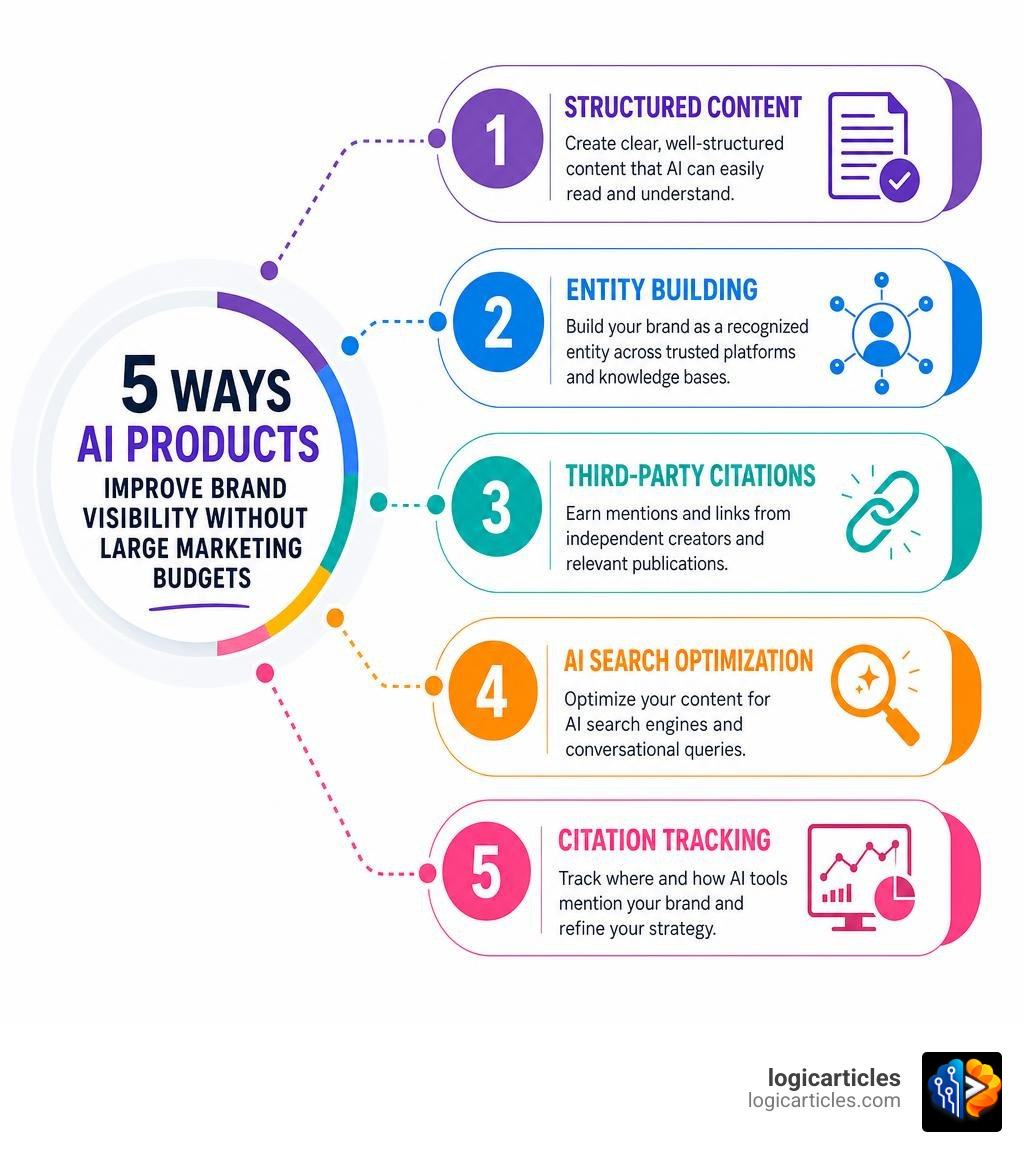
How AI products can improve brand visibility without large marketing budgets comes down to a few core tactics:
- Optimize for AI search engines (not just Google) by structuring your content so AI tools like ChatGPT, Gemini, and Perplexity can easily find and cite you
- Build entity authority through free platforms like LinkedIn, Wikidata, and Reddit before investing in owned content
- Use AI tools to automate content creation, email, and social scheduling — replacing thousands of dollars in specialist costs for under $100/month
- Earn third-party citations from independent creators and niche publications, which AI engines trust more than brand-owned pages
- Track your AI Share of Voice by regularly testing your brand name in AI tools and adjusting your strategy based on what surfaces
Not long ago, brand visibility was a game only big companies could win. A large ad budget meant more reach, more impressions, and more customers. Smaller brands were stuck playing catch-up.
That’s changing fast.
AI search tools now handle hundreds of millions of queries every week. And here’s the key shift: AI engines don’t care how much you spent on ads last quarter. They care about whether your content is clear, trustworthy, and easy to extract answers from.
One case study found a brand go from near-zero AI presence to appearing in 9% of tracked AI search results — in just 15 days — using creator-generated content across free platforms like Reddit, with no large ad spend involved.
The barrier to entry has dropped. The question now is whether you know how to play the new game.
How AI Products Can Improve Brand Visibility Without Large Marketing Budgets
As we navigate June 2026, the digital landscape is undergoing a massive shift. Traditional organic click-through rates are declining as Google AI Overviews and conversational answer engines handle a massive percentage of everyday queries. For small businesses and startups, this is actually incredibly good news. Why? Because the barrier to entry has shifted from capital to clarity.
AI-powered marketing tools can reduce digital advertising waste by up to 30% while improving ROI through precise audience targeting and predictive analytics. Instead of spending thousands on broad-scale paid campaigns, we can now use intelligent software to find exactly where our target audience hangs out, analyze competitor gaps, and optimize our organic presence.
This democratization of marketing means that a three-person startup can deploy the same level of sophisticated infrastructure that used to require a 10-person agency. By leveraging the right tools, companies using AI in marketing report a 3x improvement in campaign efficiency and customer engagement compared to traditional methods.
To help you choose the right stack for your business growth, check out our guide on the Best Startup Growth Tools for 2026 to see how you can start automating your operations today.
A 90-Day Roadmap to Build AI Visibility from Scratch
Building a robust AI presence doesn’t happen overnight, but you don’t need a massive budget to make it happen. We recommend a phased 90-day playbook that focuses on building trust and structured authority systematically.
Here is how we break down the 90-day cycle:
Phase 1: Days 1 to 30 – Entity Foundation
Before AI search engines can recommend your brand, they have to know you exist as a distinct entity. In this first month, focus on creating a digital paper trail that AI scrapers and models can easily verify.
- Claim your digital identity: Fill out your social profiles, verify your local listings, and ensure your Name, Address, and Phone number (NAP) are identical across the web.
- Build high-authority entity signals: Set up a comprehensive LinkedIn Company Page and post regularly. High-authority platforms are heavily indexed by large language models (LLMs).
- Audit your current visibility: Run manual audits by asking ChatGPT, Gemini, and Perplexity questions related to your niche. Note where you appear and where your competitors dominate.
For a deeper look at getting your brand recognized from day one, read this guide on How to Build AI Visibility for a Brand New Company | BabyPenguin.AI .
Phase 2: Days 31 to 60 – Third-Party Coverage
AI engines rarely trust what you say about yourself on your own website without outside validation. Month two is all about getting external validation.
- Secure third-party mentions: Focus on getting mentioned in niche publications, industry blogs, and podcasts.
- Leverage community platforms: Engage in discussions on Reddit and Quora. These platforms are highly indexed and frequently cited by search engines like Google and ChatGPT.
- Encourage reviews: Get your customers to leave detailed, keyword-rich reviews on third-party platforms like G2, Capterra, or Google Business.
Phase 3: Days 61 to 90 – Owned Content Optimization & Measurement
Now that the foundation is laid and external sources are talking about you, optimize your own website to make it easily readable by AI crawlers.
- Format for extraction: Rewrite your core pages to use an “answer-first” structure. Put direct answers to common customer questions in the first paragraph of your articles.
- Track performance: Use tools to monitor your AI Share of Voice and track how often your brand is cited in conversational search results.
To dive deeper into this structured roadmap, check out The AI search Visibility Playbook: What Marketers Should Do in 90 Days and explore the Startup Tools to Scale Fast in 2026 to accelerate your deployment.
Optimizing for AI Search Engines and Answer Engine Optimization (AEO)

Traditional SEO was about ranking in the top 10 blue links on Google. Today, we must optimize for Answer Engine Optimization (AEO) and Generative Engine Optimization (GEO).
When users ask conversational search engines for recommendations, these systems use Retrieval-Augmented Generation (RAG) to dynamically search the web, pull the most relevant facts, and synthesize a unique answer. If your brand isn’t structured to be easily retrieved, you simply won’t exist in the output.
To succeed in this environment, your digital footprint must align with how LLMs process information. This means shifting your focus from keyword stuffing to building topical authority, ensuring technical legibility, and utilizing the Best AI Website Builders that automatically output clean, crawlable code.
Let’s look at how traditional search optimization compares to modern AI visibility:
| Feature | Traditional SEO | AI Visibility (AEO / GEO) |
|---|---|---|
| Primary Goal | Rank on page one for specific keywords | Get cited as a trusted source in AI answers |
| User Experience | Click-through to website is required | Zero-click answers; user gets info directly |
| Content Structure | Long-form content, keyword density focus | Modular, answer-first, schema-heavy |
| Trust Signals | Backlink volume, Domain Authority | Third-party corroboration, structured facts |
| Traffic Quality | High volume, varying intent | Lower volume, but up to 4.4x higher conversion |
As highlighted in Production Is Cheap. Trust Is Scarce: Brand Survival in AI-First Discovery | SolCrys , producing massive amounts of generic content is no longer a viable strategy. Instead, the real bottleneck is building trust infrastructure that AI engines can rely on.
How AI Products Can Improve Brand Visibility Without Large Marketing Budgets Through Structured Data
One of the most effective, zero-cost ways to make your brand legible to AI engines is through structured data. By using JSON-LD schema markup, we tell search robots exactly what our content means, rather than letting them guess.
To optimize your site for entity recognition and knowledge graphs, you should implement the following schema types:
- Organization Schema: Define your brand name, official logo, social media profiles, and contact details.
- Product & Service Schema: Detail your offerings, pricing, and availability so AI agents can compare your product to competitors.
- FAQPage Schema: Use structured question-and-answer formats. This makes your answers highly extractable for conversational interfaces.
- Review Schema: Highlight third-party ratings to feed trust signals directly into the search engines’ data layers.
When your site uses clean, comprehensive schema, AI products can instantly identify your business as a validated solution for relevant user queries.
Building Trust and Authority in AI-First Discovery
AI search engines thrive on consensus. If ChatGPT or Gemini only finds your brand name on your own website, it is highly unlikely to recommend you. They look for third-party corroboration to verify your claims.
This is why community platforms have become the ultimate goldmine for budget-friendly brand visibility. For instance, Wikipedia and Reddit together account for more than 25% of all ChatGPT citations in the United States.
A single, deeply detailed Reddit thread comparing your product to industry giants can yield a far higher citation rate in AI engines than dozens of expensive, self-published blog posts.
A real-world example of this approach is detailed in How RocketX Went From Near-Zero to 9% AI Share of Voice in 15 Days | Scribble . By focusing on authentic creator content and community discussions rather than traditional paid ads, they built rapid, highly targeted organic authority in record time.
Low-Cost Content Creation and Social Media Automation
Another powerful aspect of how AI products can improve brand visibility without large marketing budgets is the ability to automate content workflows. Historically, maintaining a consistent content marketing presence required hiring writers, editors, and social media managers—a budget-breaker for small businesses.
Today, AI tools compress content drafting times by 60% to 70%. A high-quality blog post that used to take four hours to write can now be outlined, drafted, and optimized in under 90 minutes.
By building a standardized workflow, a solo founder can act as an entire marketing department. If you want to streamline your operations, utilizing Droven IO AI Automation Tools can help you connect your tools and automate your publishing schedule seamlessly.
For those operating on a tight budget, you can achieve enterprise-level marketing execution for less than the cost of a single software subscription. To see how small businesses are scaling their operations, read about AI Marketing for Small Business: Enterprise Results on a $99 Budget | Merlin .
How AI Products Can Improve Brand Visibility Without Large Marketing Budgets on Social Media
Social media is a fast-moving space where consistency is key. AI products allow us to stay active on multiple platforms without spending hours writing posts every day.
By using social automation, we can:
- Generate multi-format updates: Turn a single blog post into a LinkedIn article, a series of short posts, and an email newsletter draft with a single prompt.
- Optimize post timing: Use machine learning to analyze when your specific audience is most active and schedule posts accordingly.
- Analyze sentiment: Monitor conversations around your brand and industry in real-time, allowing you to jump on trending topics before they fade.
To build an efficient social media engine, explore our list of AI Tools You Should Know in 2026 and read the comprehensive AI for Marketing: The Complete 2026 Guide for Entrepreneurs and Solo Founders | itsdeep | itsdeep to refine your tactical execution.
Frequently Asked Questions about AI Brand Visibility
What is the difference between traditional SEO and AI visibility?
Traditional SEO focuses on optimizing your website to rank in the top blue links of search engine results pages (SERPs) to drive clicks. AI visibility, or Answer Engine Optimization (AEO), focuses on ensuring your brand is cited, mentioned, and recommended directly within the answers generated by conversational search engines. The goal shifts from earning clicks to becoming the trusted source that the AI presents to the user.
How long does it take to see results from AI visibility tactics?
While traditional SEO can take 4 to 6 months to show traction, AI visibility can yield quicker wins if you follow a structured approach. By building a strong entity foundation and earning third-party mentions on highly indexed sites like Reddit, some brands have seen measurable citation and share of voice improvements in as little as 2 to 4 weeks.
What are the risks of using AI for brand visibility?
The primary risks include algorithmic bias, potential data privacy issues, and the danger of generating low-quality “AI slop” that harms your brand’s reputation. To mitigate these risks, always keep a human in the loop. AI should be used as an execution assistant to draft and optimize, but human oversight is essential to ensure accuracy, maintain your unique brand voice, and verify that all claims are factual.
Conclusion
Building a recognizable brand no longer requires a million-dollar advertising budget. By focusing on strategic execution, technical clarity, and smart automation, small businesses can achieve incredible brand visibility at a fraction of the traditional cost.
The future belongs to the agile. By structuring your data for AI engines, building genuine trust through community platforms, and leveraging low-cost automation tools, you can compete directly with the biggest players in your industry.
Ready to take your marketing to the next level? Explore our comprehensive directory of AI tools to find the perfect solutions to scale your brand’s visibility today!