What is Considered a SBR Data Collection Method?

If you’re trying to answer which of the following is considered a sbr data collection method, here is the quick answer:
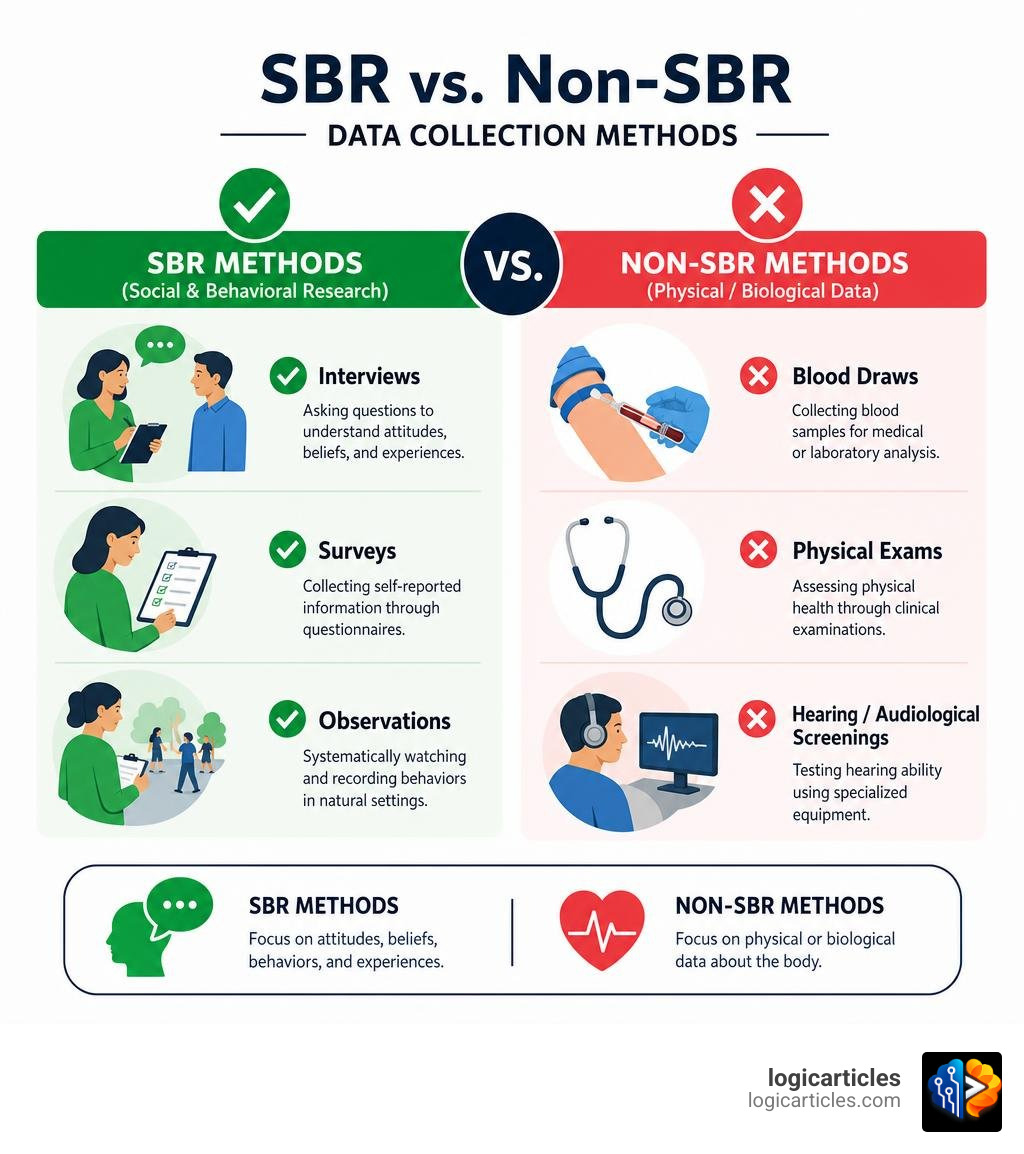
Interviews are the primary SBR (Social and Behavioral Research) data collection method. Surveys and observations also qualify. Physical methods like blood draws, hearing screenings, and physical exams do not.
| Method | SBR Data Collection Method? |
|---|---|
| Interviews | Yes |
| Surveys | Yes |
| Observations | Yes |
| Blood draws | No |
| Physical exams | No |
| Hearing/audiological screenings | No |
The reason is straightforward. SBR methods collect information about attitudes, beliefs, and behaviors — not biological or physiological data. Interviews, surveys, and observations do exactly that. Blood draws and physical exams collect body-level data, which puts them in a different category entirely.
Understanding this distinction matters whether you’re studying for a CITI Program exam, planning a research project, or just trying to get your ethics training right. The rest of this guide breaks it all down clearly.
Understanding SBR: Social & Behavioral Research vs. Statistical Business Registers
When we talk about “SBR,” context is everything. In academic, biomedical, and ethical research training, SBR stands for Social and Behavioral Research. However, in the realm of national statistics and economics, SBR can also stand for Statistical Business Registers. Because we want to make sure you are fully prepared no matter which type of research you are conducting in 2026, we will look at how data collection functions in both contexts.

In the context of national statistical offices, a Statistical Business Register (SBR) is a vital tool used to keep track of different statistical units, such as enterprises, local units, and legal entities. It plays a massive role in modernizing statistical production by integrating various administrative data sources with traditional survey data.
To maintain an accurate Statistical Business Register, agencies use structured administrative data (like tax records and business registration files) alongside targeted surveys. To explore how these technical systems classify and validate data, you can SBR Data Collection Methods: Which Techniques Qualify?.
For the remainder of this guide, we will focus primarily on the Social and Behavioral Research definition, as this is the focus of most academic and ethical training modules where the question “which of the following is considered a sbr data collection method?” is most frequently asked.
Which of the Following is Considered a SBR Data Collection Method?
In social and behavioral research, we focus on gathering non-invasive qualitative and quantitative data about how humans think, feel, interact, and behave. Unlike biomedical or clinical research, which relies on physical or physiological measurements, SBR relies on direct or indirect human reporting.

Because SBR studies human attitudes, beliefs, and actions, the ethical considerations are highly unique. The Belmont Report outlines three core ethical principles that we must always uphold in SBR:
- Respect for Persons: Treating participants as autonomous agents and protecting those with diminished autonomy. In practice, this means obtaining robust informed consent, ensuring participants understand they can withdraw at any time without penalty, and being extra cautious when researching vulnerable populations like children or prisoners.
- Beneficence: Maximizing potential benefits while minimizing potential risks of harm. Researchers must carefully weigh the psychological or social risks against the societal value of the knowledge gained.
- Justice: Ensuring a fair distribution of the burdens and benefits of research. This means selecting participants equitably and avoiding targeting convenient but vulnerable groups simply because they are easy to recruit.
In physical clinical trials, risks usually involve bodily harm or side effects. In SBR, the primary risks are non-physical, such as breaches of confidentiality, invasion of privacy, or emotional distress. This is why SBR data collection methods must prioritize participant comfort, privacy, and voluntary participation.
| Feature | SBR Methods (Interviews, Surveys) | Clinical Approaches (Blood Draws, Exams) |
|---|---|---|
| Primary Goal | Collect subjective experiences, attitudes, beliefs, and behaviors | Collect objective physiological, biological, or anatomical data |
| Invasiveness | Non-invasive (conversational or observational) | Invasive or physical |
| Primary Risk | Breach of confidentiality, social or psychological distress | Physical harm, side effects, physiological discomfort |
| Adaptability | High (questions can be adapted or skipped) | Low (requires strict physical protocols) |
Why Interviews are the Primary Answer to “Which of the Following is Considered a SBR Data Collection Method?”
If you encounter this question on an exam, the most common correct answer provided is interviews.
Interviews are considered the gold standard of qualitative SBR data collection because they facilitate direct, structured, or semi-structured interaction through questions and answers. They allow us to dive deep into a participant’s lived experiences, motivations, and personal beliefs.
Unlike physical exams or blood draws, which look at what is happening inside the body, an interview allows a researcher to understand how a participant interprets their world. This method is incredibly flexible; researchers can tailor their follow-up questions based on the participant’s unique responses to ensure a comfortable and safe environment. For instance, if a participant becomes emotional, a skilled interviewer can pause, offer a break, or pivot to less sensitive topics—a level of adaptability that is completely absent in rigid clinical procedures like blood draws. If you want to see how other students have tackled this specific exam question, you can check out this Brainly discussion on SBR methods.
Comparing Surveys and Observations: Which of the Following is Considered a SBR Data Collection Method in Social Science?
While interviews are highly interactive, they are not the only tools in the SBR toolkit. Surveys and observations are also widely recognized SBR data collection methods.
- Surveys: These are ideal for gathering quantitative data from larger groups. Surveys use structured, pre-determined questions to measure the prevalence of specific beliefs or behaviors. For example, a researcher might distribute an anonymous survey at a local mall to study community attitudes toward a new fitness program. Surveys are highly scalable and allow for statistical analysis, making them a powerful tool for identifying broad trends across diverse demographics.
- Observations: This method involves watching and recording behaviors in natural or controlled settings without actively manipulating the environment. It allows us to study how people behave in real-world scenarios rather than relying solely on what they self-report. This is particularly useful because people do not always behave the way they say they do in surveys or interviews.
To see more examples of how these options are presented in academic settings, you can explore more SBR solutions on Gauthmath or read through another Brainly Q&A on the topic.
Best Practices for Maintaining and Updating SBR Data
Whether we are managing qualitative interview transcripts or maintaining a massive database for a Statistical Business Register, data quality and participant protection must always go hand in hand.
To minimize risks and maintain high-quality data, we recommend implementing the following best practices:
- Prioritize Anonymization: Whenever possible, remove direct identifiers (like names, addresses, or social security numbers) from the dataset. Use random code numbers to link participant identities to their responses if longitudinal tracking is necessary. This process, often called de-identification, ensures that even if the dataset is compromised, individual participants cannot be easily identified.
- Establish Secure Storage: Store all digital data on encrypted, password-protected servers with restricted access. Physical documents, such as signed consent forms or paper surveys, should be kept in locked filing cabinets. Limit access to the decryption keys or master identity lists to only the primary investigators.
- Proactively Address Confidentiality Breaches: In SBR, a breach of confidentiality is often the most significant risk. Inform all subjects about how their data will be protected, especially in focus group situations where other participants are present and complete anonymity cannot be guaranteed by the researcher alone. Establish clear protocols for what to do if a breach does occur, including immediate notification procedures.
- Consider Certificates of Confidentiality: For highly sensitive topics (such as illegal behaviors, immigration status, or substance abuse), obtaining a Certificate of Confidentiality can protect your research records from forced legal disclosure, such as subpoenas from law enforcement or courts.
Frequently Asked Questions About SBR Data Collection
What is the main difference between SBR and clinical data collection?
SBR data collection methods are non-invasive and focus on collecting subjective experiences, attitudes, beliefs, and behaviors. Clinical data collection, on the other hand, relies on physical exams, blood draws, and audiological screenings to collect objective physiological and biological data.
What are the primary risks associated with SBR?
Unlike clinical trials where physical harm is a concern, the risks in SBR are primarily social, psychological, legal, or economic. These include invasion of privacy, emotional distress from sensitive questions, and breaches of confidentiality. Because human behavior is highly complex, these risks are often more variable and less predictable than physical harms.
How do researchers protect participant confidentiality in SBR?
Researchers protect confidentiality by obtaining informed consent, anonymizing datasets, using secure and encrypted storage solutions, and limiting access to sensitive identifying information.
Can a research project combine both SBR and clinical methods?
Yes, many modern studies use a mixed-methods approach. For example, a study on diabetes might collect clinical data (like blood glucose levels) alongside SBR data (like surveys about dietary habits and interviews about the psychological barriers to exercising). In these cases, the research team must apply the appropriate ethical and data protection standards to each respective type of data collected.
Conclusion
When asking which of the following is considered a sbr data collection method?, the key is to look for non-invasive techniques designed to capture human attitudes, beliefs, and behaviors. Interviews, surveys, and observations are all excellent examples of SBR methods, whereas physical exams, blood draws, and hearing screenings belong to the clinical and physiological research domain.
At logicarticles, we believe that modernizing your research workflows is the best way to ensure both data quality and ethical compliance. If you want to streamline your data analysis, write better research protocols, or find new ways to organize your findings, discover the best AI tools for research to elevate your work today!