Why So Many Startups Fail — and How the Right Tools Change That

Growth navigate startup tools are the systems, platforms, and frameworks that help early-stage companies plan smarter, operate leaner, and scale with intention rather than guesswork.
Here’s a quick look at the most essential categories:
| Category | What It Does | Example Tools |
|---|---|---|
| CRM & Acquisition | Tracks leads, pipeline, and customer journeys | HubSpot, Pipedrive, Zoho |
| Financial Planning | Monitors cash flow, runway, and burn rate | Puzzle, Xero, FreshBooks |
| Team Collaboration | Keeps remote and hybrid teams aligned | Slack, Notion, Asana |
| Analytics & Intelligence | Turns data into decisions | GA4, Tableau |
| AI Strategy & Automation | Automates growth tasks and planning | Jasper, Zapier, Growthmind |
| Content Creation | Speeds up marketing output | Copy.ai, Grammarly |
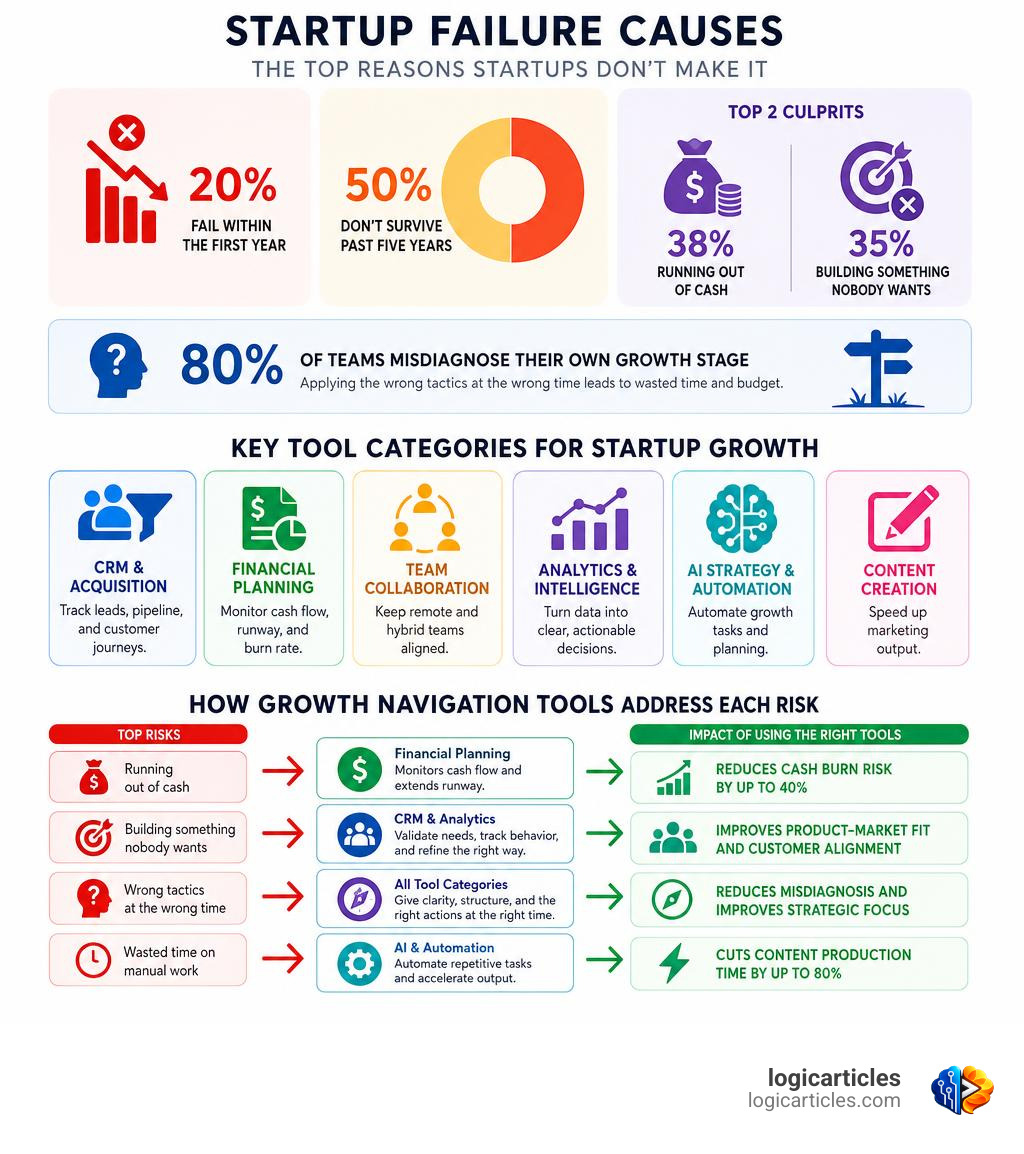
The numbers are hard to ignore. Around 20% of startups fail within their first year, and roughly 50% don’t survive past five years. The two biggest culprits? Running out of cash (38% of failures) and building something nobody wants (35%).
What makes this worse is that 80% of teams misdiagnose their own growth stage — meaning they’re applying the wrong tactics at the wrong time, burning budget on tools and strategies that don’t match where they actually are.
The good news: startups that use structured financial planning tools reduce cash burn risk by up to 40%. And AI-powered content tools can cut production time by as much as 80%.
The right tools don’t just save time. They replace guesswork with structure.
Understanding Growth Navigate Startup Tools and Why They Matter
When we talk about growth navigate startup tools, we aren’t just talking about a random collection of software subscriptions. We are talking about strategic systems and operational playbooks designed to guide a company through its most volatile growth stages.
In the chaotic early days of a business, founders often struggle to figure out what to focus on next. Should you hire more salespeople? Should you spend $10k on social ads? Or should you redesign your landing page? Without a structured growth navigation framework, you are essentially flying blind.
These tools function as a “digital co-founder.” They help you document your standard operating procedures (SOPs), map out your customer acquisition pipelines, and track your metrics in real-time. Instead of relying on gut feelings, you can use structured playbooks to turn your broad vision into daily, actionable tasks. If you want to dive deeper into how different software types can help your business structure its operations, you can Explore the best software categories for your startup.
How Growth Navigate Startup Tools Differ from Generic Software
It is easy to look at a list of business tools and think, “Why can’t I just use a standard spreadsheet and a basic chat app?”
The answer lies in the hidden costs of context switching and data fragmentation. When your team has to jump between ten different disconnected platforms to find a single customer update or financial metric, they lose hours of productive time every week.
Generic productivity or marketing software is often passive. It waits for you to input data, and it tracks tasks without understanding why you are doing them. It doesn’t know if your startup is in the pre-revenue validation stage or the rapid scaling stage.
In contrast, dedicated growth navigate startup tools are built around strategic alignment and execution tracking. They act as a single source of truth (SSOT). They connect your high-level business goals directly to your daily tasks. For instance, if your primary goal is to reduce customer churn by 2%, a true growth navigation system won’t just let you write down that goal — it will link your customer support tickets, product usage data, and email marketing campaigns directly to that metric so your entire team knows exactly what is moving the needle.
The Role of AI in Modern Growth Navigate Startup Tools
By June 2026, artificial intelligence has completely evolved past basic chat windows that generate generic text. Today, modern growth navigation software uses specialized AI agents that offer autonomous execution, diagnostic analysis, and predictive modeling.
Instead of you having to guess why your landing page isn’t converting, diagnostic AI systems can analyze your target market, review your competitor pricing, and pinpoint the exact friction points in your funnel. These systems don’t just accept your inputs; they actively interrogate your assumptions to make sure you aren’t building a product nobody wants.
Furthermore, these tools use persistent context. This means the AI understands your brand identity, your ideal customer profile (ICP), and your historical experiment data across every single interaction. You don’t have to keep re-explaining your business model to the software.
A great example of this shift is Growthmind | The AI-Native Growth Operating System, which leverages coordinated agent intelligence to diagnose, deploy, and scale marketing experiments without requiring you to hire an expensive agency. By using multiple specialized agents that pass structured data to one another, it acts as an autonomous growth team that works 24/7.
Essential Categories of Growth Navigation Software
To build a reliable software stack, we need to understand the core pillars of growth navigation. You don’t need to buy fifty different apps. Instead, you should focus on a few key categories that handle your most critical business functions.

When selecting these tools, you must ensure they integrate seamlessly so your data flows freely from sales to finance to product development. If your team is struggling to keep their daily tasks organized while building out these pillars, you can check out our review of the Best Task Management Software in 2026 Tested.
Customer Relationship and Acquisition Systems
At the heart of any scaling business is its customer data. A professional customer relationship management (CRM) platform is the foundation of growth. Moving your customer records from manual spreadsheets to a unified CRM eliminates errors and ensures that your sales, marketing, and support teams are looking at the exact same information.
Modern CRMs do much more than store email addresses. They provide:
- Lead Scoring: Automatically prioritizing prospects based on how they interact with your website or product.
- Pipeline Management: Giving you a visual, drag-and-drop view of your entire sales cycle so you can see where deals are getting stuck.
- Customer Journey Mapping: Tracking every touchpoint, from the first ad click to the final contract signature.
By centralizing these functions, you can automate repetitive follow-ups and ensure no valuable lead slips through the cracks.
Strategic Financial Planning and Cost Optimization
Since 38% of startups fail due to cash flow issues, having a clear view of your finances is non-negotiable. Financial planning tools help you build dynamic revenue models, track your monthly burn rate, and calculate your exact runway down to the day.
Instead of waiting for an accountant to send you static reports at the end of the quarter, modern financial tools let you run real-time “what-if” scenarios. For example, you can instantly see how hiring two new developers or dropping your pricing by 10% will impact your cash reserves six months from now.
Additionally, as you scale your digital infrastructure, cloud bills can quickly spiral out of control. To keep your operational margins healthy, it is wise to pair your financial planning systems with specialized cost management tools. Take a look at our guide on the Best Cloud Cost Optimization Tools for 2026 Cut Cloud Bills Fast to learn how to keep your hosting expenses lean.
Data Analytics and Scaling Intelligence
You cannot scale what you do not measure. However, many startups suffer from “data overload.” They track hundreds of vanity metrics (like social media likes or page views) while ignoring the core numbers that actually dictate business health.
Dedicated scaling intelligence platforms help you cut through the noise by calculating a unified benchmark score (often called a “Scaleup Score”) across multiple business domains. This score gives you a clear, objective view of your readiness to scale.
These platforms integrate with your live business data from sources like Stripe, HubSpot, and your accounting software to provide real-time decision support. Instead of guessing if your retention rate is good enough for your stage, you can benchmark your performance against thousands of other successful startups.
If you are dealing with massive volumes of user data and need heavy-duty processing power, you should explore the Best Big Data Analytics Tools in 2026 Ranked by Performance. For a dedicated, comprehensive platform designed specifically to guide early-stage companies through scaling milestones, we highly recommend checking out Pixie — So that more startups scale.
Top Recommended Growth Navigate Startup Tools for 2026
Choosing the right software can feel overwhelming when there are thousands of options on the market. To make things simple, we have curated a list of the top growth navigation tools for 2026 based on their integration capabilities, time-to-value, and scalability.

| Tool | Best Known For | Key Strengths | Starting Price |
|---|---|---|---|
| HubSpot | All-in-One CRM & Marketing | Massive ecosystem, seamless integrations, great for centralizing customer data | Free tier available; paid plans start around $15–$20/mo |
| Vyvra | Predictive SaaS Metrics | Reverse-engineers growth targets, simulates scenarios, generates sprint cards | Contact for pricing |
| cosmos™ | AI-Native Strategy | Connects brand positioning, ICP, and live KPIs into one dynamic system | Free tier available |
| Growth Navigator | Context-Driven Co-Building | Builds 20+ persistent business context artifacts for highly personalized assets | Free tier available; early access pricing at $97/mo |
| Zapier | Workflow Automation | Connects over 7,000 apps to automate manual data transfers | Free tier (100 tasks/mo); paid plans start at $19.99/mo |
| Puzzle | Strategic Finance | Real-time financial statements, runway tracking, and budgeting | Varies by startup size |
Let’s look at how some of these innovative platforms are changing the way founders work.
AI-Native Strategy and Execution Platforms
Traditional growth strategy often lives in static slide decks or text documents that are created during a weekend workshop and then forgotten. AI-native strategy platforms solve this by keeping your strategic foundation alive and connected to your daily metrics.
A standout in this category is Vyvra – Predictive Growth Engine for Scaling SaaS Startups. Vyvra allows you to input your current metrics (like MRR, churn, and CAC) and run predictive simulations. If you want to hit a specific ARR target, Vyvra will reverse-engineer that goal, show you exactly which metrics need to change, and translate those high-level goals into pre-prioritized sprint cards for your team.
Similarly, cosmos™ – the AI-native Growth Strategy Platform acts as a live strategic layer for your business. Instead of using generic AI that forgets your business model every time you close the tab, cosmos™ runs on your live brand positioning, target ICP, and key initiatives. This ensures that every strategic recommendation is perfectly tailored to your actual business reality, helping teams reduce alignment meetings by up to 50%.
Another fantastic option for teams wanting to run automated marketing campaigns and optimize conversion funnels is Your growth team. , which uses autonomous agents to scan your product metrics, identify leaks, and deploy targeted acquisition and retention experiments.
Context-Driven Co-Builders and Advisors
One of the biggest complaints founders have about generic AI tools is that they produce bland, generic content. This happens because the AI doesn’t understand your unique offer, your brand voice, or the specific pain points of your audience.
Context-driven co-builders solve this by focusing on “context first.” Before writing a single word of copy or designing an offer, these tools guide you through building a comprehensive digital profile of your business.
For example, Growth Navigator | Your AI Co-Builder | Founder’s Best Friend builds over 20 distinct “context artifacts” about your offer, your voice, and your ICP. Once this foundation is built, you can use it to design high-converting story pitches, messaging blueprints, and sales conversation flows that sound exactly like you — not like a generic chatbot.
For more classic recommendations on how to set up your core tech stack, you can read the curated lists found in resources like 9 Growth Navigate Startup Tools to Scale – The Marketing Agency , Top 10 Growth Tools for Startups: Overview and Benefits – Salesforce , and Growth Navigate Startup Tools: A Complete Guide – Biblical Toker .
How to Choose and Integrate Your Growth Stack
Building your software stack is like building a house: you need a solid foundation before you start adding fancy decorations. The goal is to create a streamlined, connected system where information flows automatically, preventing data silos and saving your team from manual copy-pasting.
Evaluating Tools Based on Startup Stage and Budget
When you are bootstrapped or in the very early stages of your business, every dollar counts. You should allocate roughly 10% to 15% of your operational budget for software tools, prioritizing platforms that either directly drive revenue or save you more than 10 hours of manual labor per week.
Here is a simple roadmap for scaling your tech stack:
- The Validation Stage (Pre-Revenue): Stick to free tiers or low-cost plans. Focus on basic communication (Slack), simple project management (Notion), and a free CRM tier (HubSpot) to track early conversations.
- The Traction Stage (Early Revenue): This is when you should upgrade to paid plans. The trigger to upgrade should always be a specific operational bottleneck — such as hitting contact limits in your CRM or needing advanced automation to handle incoming leads.
- The Scaling Stage (Consistent Growth): Invest in specialized analytics, predictive modeling, and advanced financial forecasting systems to optimize your margins.
By keeping a “one-in, one-out” policy for your software subscriptions, you can keep your budget lean and avoid paying for features you don’t use.
Measuring the ROI of Your Growth Software
Software is an investment, not just an expense. To make sure your tools are actually paying for themselves, you should evaluate them based on three core metrics:
- Capital Efficiency: Are these tools helping you reduce your cash burn rate? (Structured financial tools can reduce cash burn risk by up to 40%).
- Decision Cycles: How much faster can your team make critical decisions? Using predictive modeling software can reduce a three-day strategy meeting down to a 10-minute simulation.
- Alignment Time: Are your teams wasting hours in status meetings, or does your software keep everyone aligned automatically?
If a tool isn’t saving you time, bringing in revenue, or preventing costly mistakes, it’s time to cut it loose.
Frequently Asked Questions
How much of our operational budget should we allocate to software?
Early-stage startups should typically allocate 10% to 15% of their operational budget to software tools. Focus your spending on tools that directly automate manual work or help you acquire and retain customers.
When is the right time to upgrade from free to paid plans?
You should upgrade when you hit a hard limit that stops your business from growing (such as CRM contact limits) or when a paid feature will save your team enough hours to easily justify the monthly subscription cost. Never upgrade just for “nice-to-have” features.
How do we prevent tool fatigue and subscription bloat?
Assign a clear “owner” for every piece of software in your company. This person is responsible for training the team and making sure the tool is actually being used. Additionally, review your software subscriptions every quarter and cancel any tools that haven’t been used in the last 30 days.
Conclusion
Scaling a startup in 2026 is faster and more exciting than ever, but it also requires extreme operational discipline. By choosing the right growth navigate startup tools, you can turn your startup’s vision into a predictable, repeatable process.
Remember to start with the essentials: a solid CRM, structured financial planning, and a clear strategic framework. Let AI handle the repetitive heavy lifting so your human team can focus on what they do best — building great products and talking to your customers.
Ready to find the perfect software to support your business journey? Explore the best software categories for your startup and build a tech stack that helps you scale by design, not by chance.