What Software Engineers Actually Earn — and Why It Varies So Much

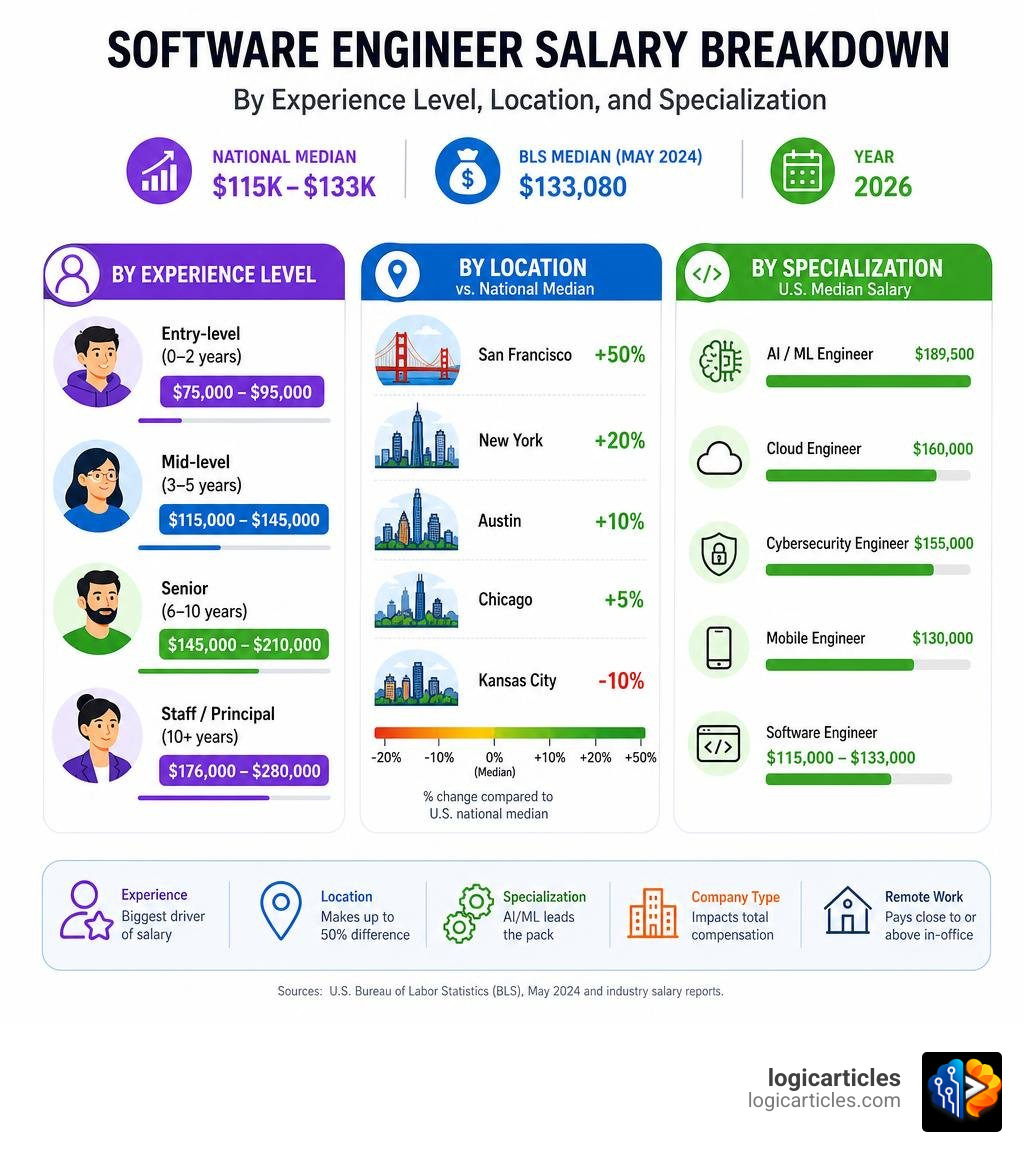
If you’re wondering how much does a software engineer make a year, here’s the short answer:
| Experience Level | Typical Annual Base Salary |
|---|---|
| Entry-level (0-2 years) | $75,000 – $95,000 |
| Mid-level (3-5 years) | $115,000 – $145,000 |
| Senior (6-10 years) | $145,000 – $210,000 |
| Staff / Principal (10+ years) | $176,000 – $280,000 |
The national median sits around $115,000 to $133,000 depending on the source. The U.S. Bureau of Labor Statistics (BLS) reported a median annual wage of $133,080 for software developers as of May 2024.
But that single number hides a massive range. An entry-level engineer in Kansas City might earn $75,000. A staff engineer at a top tech company in San Francisco could clear $400,000+ in total compensation. Same job title. Completely different world.
What drives that gap? A few big factors:
- Experience level — the single biggest driver
- Location — San Francisco pays roughly 50% more than the national median
- Company type — FAANG vs. a regional company vs. government work
- Specialization — AI/ML engineers now earn a U.S. median of $189,500, well above the average
- Remote vs. in-office — remote roles often pay close to or above in-office equivalents
This guide breaks all of it down with real numbers so you can benchmark where you stand — or where you’re headed.
How Much Does a Software Engineer Make a Year on Average?
When we look at the national average, the numbers can feel a bit like a moving target. That is because different salary aggregators and reporting agencies look at different slices of the tech industry.
Let’s break down what the most reliable sources report for the average base salary of a software engineer in 2026:
- U.S. Bureau of Labor Statistics (BLS): The BLS reported a median annual wage of $133,080 for software developers, with the top 10% earning more than $211,450.
- Indeed: Reports an average base salary of $134,240 per year, based on job postings across the country.
- Glassdoor: Places the average base salary slightly higher at $149,488.
- KORE1 Placed-Base Data: Real-world recruitment data shows a placed-base median of $148,900 across actual hiring contracts.
- PayScale: Reports a more conservative average base salary of $98,101, which typically reflects traditional IT departments and regional enterprises rather than pure tech companies.
Why are these numbers so different? It comes down to who is being surveyed. Platforms like Levels.fyi primarily capture self-reported data from high-paying Big Tech firms and AI labs. Meanwhile, the BLS captures everyone from a developer at a local credit union to a platform engineer at a major cloud provider.
To explore more comprehensive statistics on this spread, you can review the Software Engineer Salary Statistics 2026 – 50+ Key Data Points – Engineer Salary Data .
How Much Does a Software Engineer Make a Year at the Entry Level?
If you are just starting out, your first job in software engineering will still likely pay far above the national median for all occupations. Nationally, entry-level software engineers (0-2 years of experience) earn an average base salary of $95,000 per year, with most landing somewhere between $65,000 and $120,000.
Your educational path also plays a role in your starting offer:
- Computer Science Degree Holders: Usually start with a baseline of around $80,000. If you are looking to secure a formal education, you can check out our guide on the Online Best Software Engineering Degree In 2026.
- Coding Bootcamp Graduates: Typically see average first-year salaries of around $70,700, which often climbs to $80,900 by their second job.
While the entry-level market has stabilized after the hiring surges of the early 2020s, beginners who demonstrate strong building skills and a solid portfolio still command highly competitive starting wages.
Mid-Level, Senior, and Staff Engineer Compensation
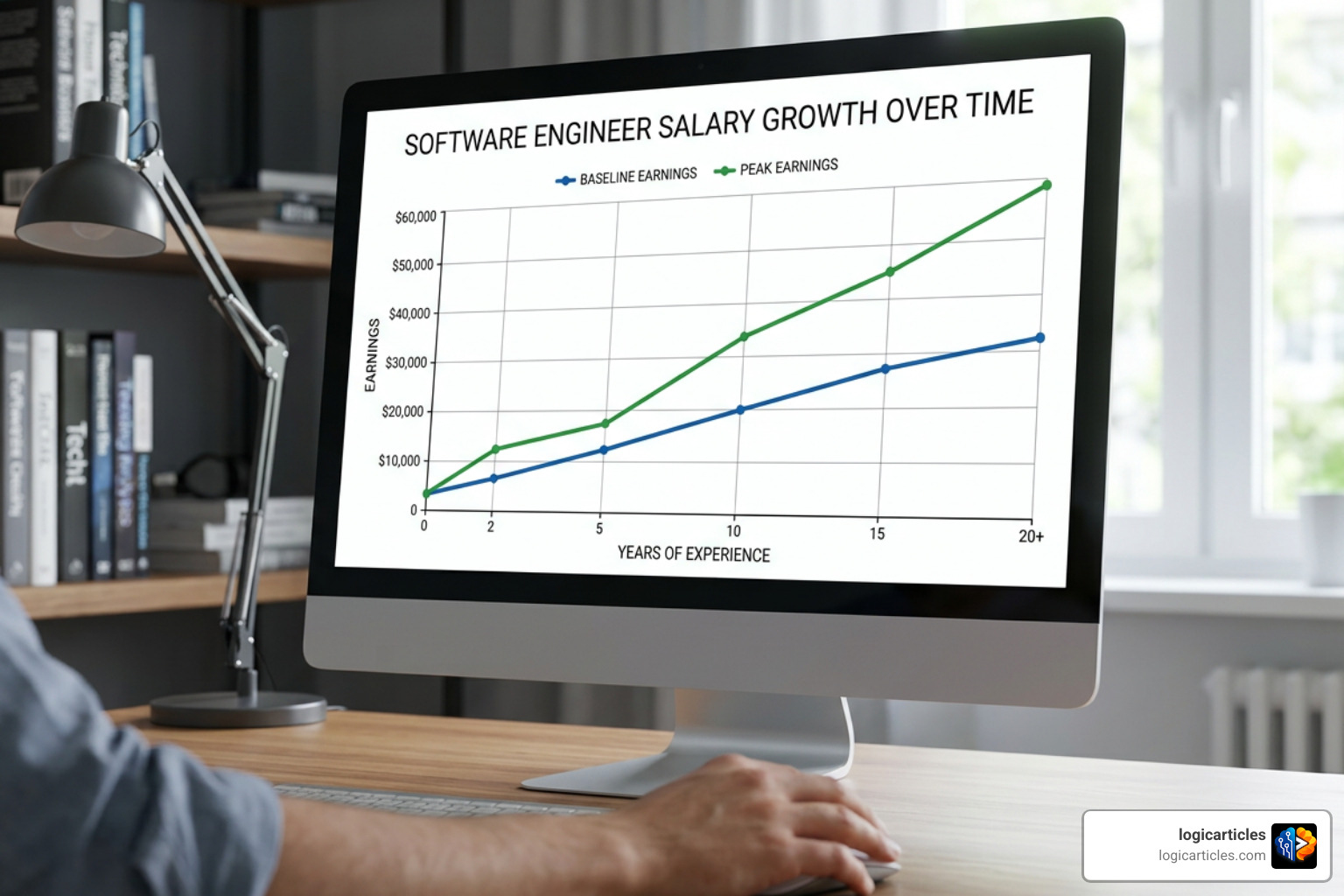
As you gain experience, your earning potential grows rapidly. In software engineering, promotions do not just mean a 3% cost-of-living bump; they often represent massive double-digit leaps in compensation.
Let’s look at how salaries progress across career levels:
- Mid-Level Software Engineer (3-5 years): Mid-level engineers are expected to own features end-to-end and work with minimal supervision. They earn an average base salary of $145,000, with total compensation packages often scaling up to $180,000 when bonuses and equity are included.
- Senior Software Engineer (6-10 years): Senior engineers do not just write code; they set technical direction, mentor junior team members, and design system architectures. They command an average base salary of $210,000, with total compensation frequently hitting $290,000+.
- Staff / Principal Engineer (11+ years): At this level, you are solving company-wide technical challenges and aligning engineering efforts with business goals. Staff and principal engineers earn an average base salary of $280,000, while their total compensation packages can easily exceed $420,000 due to heavy stock grants.
For a deeper dive into how these ranges shift across different corporate levels, take a look at the Software Engineer Salary 2026: Levels, Cities & Ranges | PayScope .
Key Factors Influencing Software Engineering Salaries

While experience sets the baseline, several other variables dictate where your offer lands within a given range. Understanding these factors can help you position yourself for maximum earning potential.
First, your technical stack and specialized skills are critical. However, technical talent alone is not enough to reach the top tier of engineering pay. Cultivating strong communication, project management, and leadership abilities is what allows you to transition into lucrative senior and lead roles. To learn more about this, read our article on Soft Skills For Software Engineers.
Additionally, mastering the art of negotiation can easily add 10% to 20% to your initial job offer. Many developers make the mistake of accepting the first number presented, but companies almost always leave room in their budgets for reasonable, data-backed counteroffers.
How Much Does a Software Engineer Make a Year in Top Tech Hubs?
Geography remains one of the strongest drivers of software engineering pay. Even with the rise of distributed teams, physical proximity to major tech ecosystems commands a premium.
Here is how average base salaries compare across the top U.S. tech hubs in 2026:
- San Francisco Bay Area: $205,000 (The highest nominal average in the world)
- Seattle, WA: $185,000
- New York City, NY: $175,000
- Austin, TX: $145,000
The Real Take-Home Pay: California vs. Washington
When comparing locations, it is vital to look beyond the gross salary and consider state taxes and the cost of living. For example, California has a top marginal state income tax rate of 13.3%. Washington state, on the other hand, has 0% state income tax.
This means a software engineer earning $200,000 in Seattle or Bellevue will often take home $12,000 to $15,000 more per year than an engineer earning the exact same gross salary in San Francisco or Los Angeles. When adjusted for the cost of living, Washington state frequently offers the highest real purchasing power in the country.
Remote vs. In-Office and Hybrid Pay Differentials
The remote work landscape has matured significantly. While the era of “work from anywhere with San Francisco wages” has largely ended, remote work remains incredibly lucrative.
- The Remote Discount: Many companies have implemented localized compensation bands. A remote software engineer living in a lower-cost area might see their salary set about 10% below the physical headquarters metro band.
- The Hybrid Premium: Interestingly, hybrid roles currently command an 8% salary premium over fully remote roles. Employers are willing to pay slightly more to secure talent that can collaborate in person a few days a week.
- The Productivity Reality: Despite localized adjustments, remote and hybrid engineers still earn highly competitive rates. Research from the Federal Reserve Bank of San Francisco indicates that remote/hybrid tech workers earn roughly 12% higher hourly rates on average than their fully in-person peers, largely because remote roles tend to attract highly experienced self-starters.
Company Type: FAANG vs. Startups and Traditional Industries
Where you work matters just as much as what you do. The tech industry is highly bifurcated, with different tiers of employers offering vastly different compensation philosophies.
- FAANG & Big Tech (Meta, Google, Apple, etc.): These companies offer the highest compensation ceilings. Total packages for mid-to-senior roles regularly range from $295,000 to $385,000+. They rely heavily on liquid stock grants (RSUs) to attract top talent.
- Growth-Stage Startups: Startups often cannot match Big Tech’s base salaries, but they offer equity in the form of stock options. While riskier, early-stage equity has the potential for massive payouts if the company goes public or is acquired.
- Traditional Industries (Finance, Healthcare, Insurance): These sectors have become highly competitive. Many insurance and healthcare firms pay 15% to 25% more than standard IT departments to secure modern cloud and security infrastructure talent. For more on this, explore our insights on Software Development Consulting In 2026.
Compensation Breakdown: Base Salary vs. Total Compensation
In software engineering, looking only at your base salary is a major mistake. The best compensation packages are structured like an iceberg—the base salary is just the visible tip, while the bulk of the value lies beneath the surface in the form of “Total Compensation” (TC).
Let’s break down the core components of a modern software engineering offer:
- Base Salary: This is your guaranteed cash flow paid out semi-monthly. It covers your day-to-day living expenses.
- Sign-On Bonus: A one-time cash payment given when you join. This can range from $5,000 for junior roles to over $100,000 for senior engineers at top-tier firms.
- Annual Performance Bonus: Usually calculated as a percentage of your base salary (typically 10% to 20%), tied to both your personal performance and the company’s financial success.
- Equity / Stock Grants (RSUs or Options): Restricted Stock Units (RSUs) are actual shares of company stock that vest over time (usually a 4-year schedule). At public tech companies, RSUs are as good as cash. At private startups, you receive stock options, which are the right to buy shares later at a set price.
- Benefits & Perks: This includes comprehensive medical, dental, and vision insurance (which 75% to 90% of software engineers receive), 401(k) matching, and wellness stipends.
To understand how recruitment agencies evaluate these complex packages to make competitive placements, you can read the Software Engineer Salary Guide 2026 – KORE1 .
Salary by Specialization: AI/ML, DevOps, and Full-Stack
Not all code is valued equally by the market. Specializing in high-demand domains can instantly elevate your salary band.
- AI and Machine Learning Engineers: This is currently the highest-paying developer specialty. AI/ML engineers command a median salary of $189,500, with top-tier talent clearing well over $250,000 in total compensation due to the rapid enterprise adoption of generative AI systems.
- DevOps and Cloud Infrastructure: Keeping systems stable, secure, and scalable is highly valued. If you want to see what these roles pay across the country, check out our guide on Devops Engineer Jobs In Usa.
- Full-Stack & Product Engineers: These versatile developers bridge the gap between frontend user experiences and backend databases. They remain the backbone of startup and enterprise development.
- Specialized Domain Development: Building software for highly regulated fields like healthcare or insurance requires niche knowledge that pays a premium. Learn more about these fields in our articles on Emr Software Development In 2026 and Insurance Software Development.
Gender Pay Gap and Diversity in Tech
While the tech industry has made strides toward salary transparency, equity gaps persist.
In 2026, female software engineers earn approximately 92 cents for every dollar earned by their male counterparts. While this represents a modest improvement from the 12% gap observed in 2024, progress remains slow, particularly as engineers advance into senior and executive roles.
The widespread adoption of pay transparency laws—requiring companies to post clear salary ranges on job descriptions—has helped narrow this gap by giving candidates more leverage during negotiations. To read more about how diversity and pay trends are evolving, see the Software Engineer Salary Statistics (2026): 35+ Data Points by Role, Level, State & Specialization | SkillFlow .
Comparing Software Engineers to Similar Tech Roles
If you are planning your career, it helps to see how software engineering salaries stack up against adjacent technical roles.
| Job Title | Median Annual Salary | Primary Focus |
|---|---|---|
| Software Engineer | $133,080 | System design, architecture, and writing core code |
| QA Analyst / Tester | $102,610 | Testing applications, writing test scripts, and finding bugs |
| DevOps / Cloud Engineer | $145,000 | Managing cloud infrastructure, CI/CD pipelines, and deployments |
| Systems / Embedded Engineer | $128,000 | Writing low-level code for hardware and physical devices |
While QA analysts and software testers earn highly competitive, comfortable salaries, software engineers command a premium because they are directly responsible for building the product’s core architecture.
To see how these roles are rated for job satisfaction and benefits, check out the Software Engineer Salary in 2026 | PayScale .
Job Outlook and Projected Growth Through 2034
Is software engineering still a safe bet for the future? Absolutely.
The BLS projects a 15% employment growth for software developers, quality assurance analysts, and testers from 2024 to 2034. This is much faster than the average for all occupations and will result in roughly 129,200 job openings each year.
The Impact of AI Automation
You might have heard concerns that AI will replace programmers. The reality is quite the opposite: AI is changing how we code, not if we code.
While basic, repetitive coding tasks are increasingly automated—contributing to a projected 6% decline in traditional “computer programmer” roles—the demand for skilled software engineers who can design complex systems, integrate AI tools, and manage cloud security is higher than ever.
Frequently Asked Questions About Software Engineer Salaries
Do all software engineers make over six figures?
No, but a vast majority do within their first few years. While some entry-level developers at small local businesses or non-profits might start in the $75,000 to $85,000 range, most engineers cross the six-figure threshold quickly. This is a stark contrast to general IT support roles, which typically top out around $60,000 to $75,000.
How much does a software engineer make per hour?
While most software engineers are salaried, contract and freelance developers are paid hourly. Contractor rates vary wildly:
- Junior / Mid-level Contractors: $50 to $100 per hour.
- Senior Specialized Consultants: $150 to $300+ per hour.
- Salaried Equivalent: A salaried software engineer making $130,000 a year earns the equivalent of roughly $62.50 per hour based on a standard 40-hour workweek.
What certifications increase a software engineer’s salary the most?
Certifications that validate specialized cloud and security skills yield the highest return on investment. According to the Tech Salary Guide 2026: Compensation Across All Tech Roles , upgrading to professional-level cloud credentials can boost your earnings significantly:
- AWS Certified Solutions Architect (Professional): Often commands average salaries of $155,000 to $221,000.
- AI/ML Specialized Certifications: Adding documented AI skills to an engineering profile yields an average 47% salary premium across various tech roles.
Conclusion
Determining how much does a software engineer make a year depends on your experience, location, specialization, and ability to negotiate. With a national median well over six figures and a highly favorable job outlook through 2034, software engineering remains one of the most financially rewarding and intellectually stimulating career paths available today.
Whether you are looking to optimize your current engineering salary, transition into a high-paying AI role, or build your first portfolio, we are here to help you navigate your tech career.
To stay ahead of the curve and master the latest technologies driving these premium salaries, Explore AI Tools on LogicArticles.