Why Insurance Policy Management Software Is Now Mission-Critical for Insurers

Insurance policy management software is a digital platform that automates and centralizes the full lifecycle of an insurance policy — from quoting and issuance through endorsements, renewals, and cancellations.
Quick answer: What does it do?
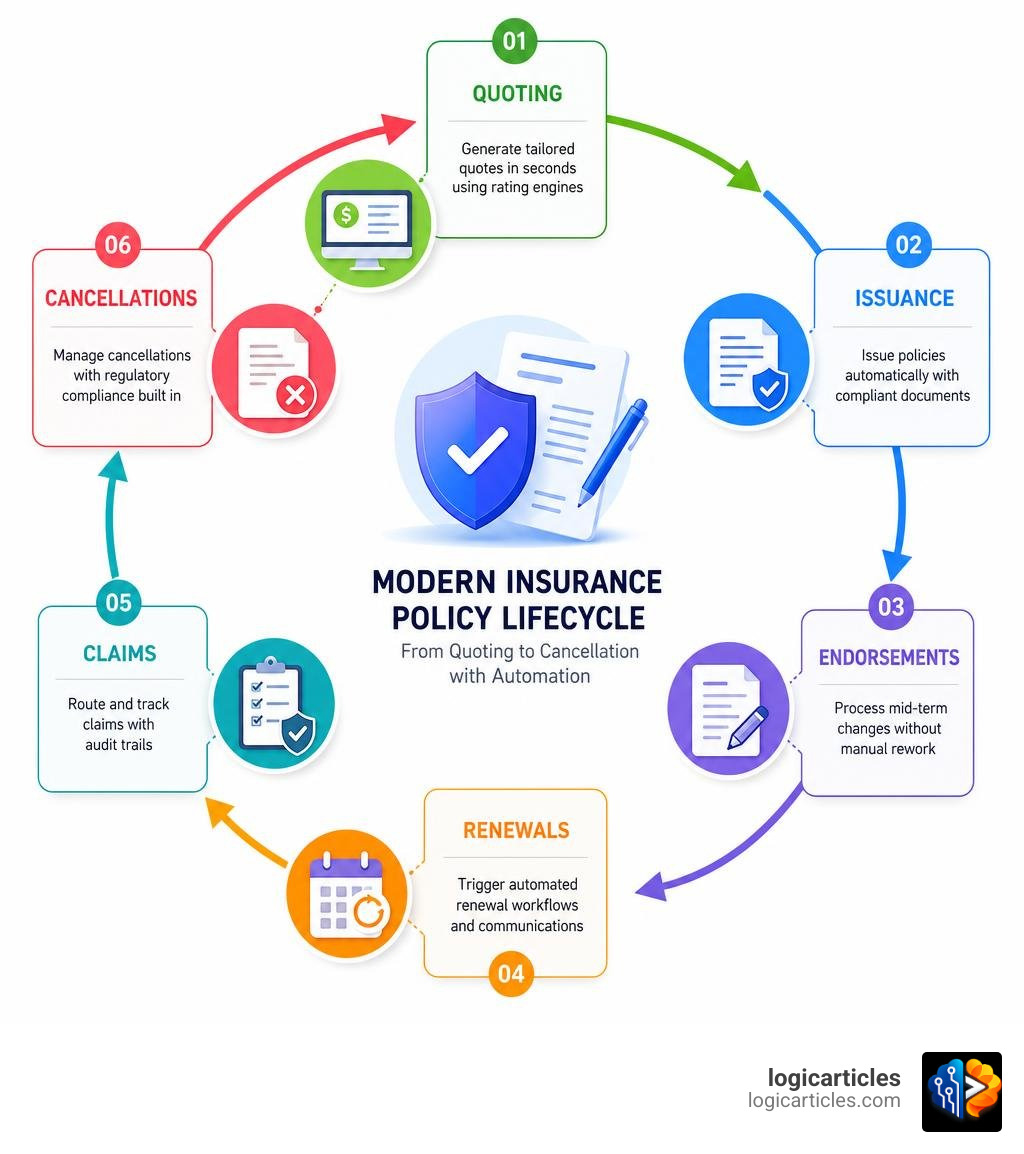
| Stage | What the software handles |
|---|---|
| Quoting | Generates tailored quotes in seconds using rating engines |
| Issuance | Issues policies automatically with compliant documents |
| Endorsements | Processes mid-term changes without manual rework |
| Renewals | Triggers automated renewal workflows and communications |
| Claims | Routes and tracks claims with audit trails |
| Cancellations | Manages cancellations with regulatory compliance built in |
For decades, insurers relied on manual processes, paper-based records, and disconnected spreadsheets. That approach was slow, error-prone, and expensive. As policies grew in volume and complexity, those cracks became costly.
The stakes are real. According to the Earnix 2024 Industry Trends report, 49% of insurers were fined or had to issue refunds in a single year due to compliance-related errors — the kind of errors that modern policy management platforms are specifically designed to prevent.
Today’s platforms go far beyond simple record-keeping. They serve as the digital core of an insurance operation — connecting underwriting, billing, claims, and customer service in one unified system.
Whether you’re a P&C carrier, a life insurer, or an MGA, the right policy management platform can mean the difference between scaling efficiently and being held back by outdated infrastructure.
Understanding Modern Insurance Policy Management Software
To truly appreciate the power of modern insurance policy management software, we must first look at what came before. Traditional systems—often called Policy Administration Systems (PAS)—were designed as rigid, back-office databases. They recorded policy details but did little to streamline operations.
Modern platforms, on the other hand, act as active, cloud-native engines. They don’t just store data; they orchestrate the entire insurance ecosystem.
| Feature | Legacy PAS | Modern Policy Management Software |
|---|---|---|
| Architecture | On-premise, monolithic, siloed | Cloud-native, SaaS, microservices-based |
| Customization | Requires heavy IT coding and months of development | Low-code/no-code visual editors for business users |
| Integration | Difficult, custom-built point-to-point connections | Open APIs, pre-built integrations, webhooks |
| Speed-to-Market | 6 to 18 months for new product launches | Weeks or even days via modular templates |
| User Experience | Clunky, green-screen terminal interfaces | Intuitive, responsive web/mobile dashboards |
A modern SaaS architecture ensures that software updates occur seamlessly in the background without disrupting daily operations. This cloud-native approach allows insurers to scale computing resources dynamically—such as handling a massive surge in quote requests during peak enrollment periods or processing high transaction volumes during major weather events.
For those looking to explore enterprise-grade policy administration platforms built on modern SaaS architecture, systems like the Insurance Policy Administration System – EIS PolicyCore demonstrate how a connected, event-driven core can simplify product modeling and scale operations.
The Shift from Legacy PAS to Agile Platforms
Why are insurers fleeing legacy systems in 2026? The short answer is IT dependency.
In the legacy era, if a product manager wanted to adjust a rating factor or introduce a new coverage rider, they had to submit an IT ticket. This ticket would sit in a queue for weeks, if not months, before a developer could manually rewrite the underlying COBOL or proprietary code. By the time the change went live, the market opportunity had often passed.
Modern platforms resolve this bottleneck through low-code agility. They utilize a “Product Factory” approach, where business users—such as underwriters, product managers, and compliance officers—can configure rules, modify rates, and launch products using drag-and-drop interfaces.
This shift dramatically compresses time-to-market. Instead of relying on multi-year development cycles, carriers can utilize agile Insurance Software Development methodologies to configure, test, and deploy new insurance products in a fraction of the time.
Core Features and Lifecycle Automation Capabilities
Modern policy management platforms are built to eliminate friction. By automating the touchpoints along the policy lifecycle, these platforms turn complex multi-day procedures into touchless, real-time events.

From the moment a prospect requests a quote to the final resolution of a policy renewal or cancellation, the entire workflow is governed by intelligent business rules. For instance, when a customer submits an application, the system can automatically retrieve third-party data, run risk-scoring algorithms, and bind the policy within minutes—a process known as Straight-Through Processing (STP).
Enterprise platforms like Duck Creek Policy – Duck Creek show how low-code configuration and automated workflows can handle high-volume STP for personal lines while maintaining robust governance for complex commercial packages.
Key Features of Insurance Policy Management Software
When evaluating an insurance policy management software solution, several core features are non-negotiable for achieving true operational efficiency:
- Centralized Repository: A single source of truth for all policyholder data, active coverages, historical endorsements, and billing schedules.
- Intelligent Document Management: Automated generation of declarations pages, policy binders, certificates of insurance, and cancellation notices, with built-in version control.
- Flexible Rating Engine: Hybrid rating engines that combine table-based and rule-based pricing models, allowing carriers to adjust rates dynamically based on real-time risk analytics.
- Seamless Billing and Payment Integration: Automated invoicing, direct-debit scheduling, and real-time payment gateway sync to prevent lapses in coverage.
- Role-Based Access Control (RBAC): Granular security permissions ensuring that agents, underwriters, claims adjusters, and customers only see the data relevant to their roles.
Integrating these core administrative capabilities with robust claims features is critical. Solutions like Insurance Policy Management Software & Claims Management Software highlight how unifying policy details with claims processing reduces claims leakage and ensures consistent data throughout the risk lifecycle.
The Role of AI, Automation, and Low-Code Tools
Artificial Intelligence is no longer a futuristic concept; in 2026, it is embedded directly into core policy software.
Agentic AI and GenAI have transformed document processing. Instead of manual data entry, GenAI tools automatically extract and interpret structured data from unstructured documents, such as medical records, loss runs, and property photos.
Furthermore, AI-driven natural language reporting allows managers to generate complex business intelligence reports simply by asking a question (e.g., “Show me our loss ratios by zip code for commercial property in Q1”).
The real-world operational impact of these technologies is staggering:
- 70% time savings achieved with Reporting AI tools that auto-generate SQL queries and dashboards.
- 65% faster delivery of custom features through low-code visual development pipelines, allowing business users to bypass traditional software development queues.
Key Benefits: Efficiency, Compliance, and Customer Experience
Transitioning to a modern policy management platform delivers measurable returns across every department of an insurance organization.

How Different Lines of Business Leverage Insurance Policy Management Software
The operational demands of an insurance carrier vary wildly depending on the products they write. A one-size-fits-all approach simply does not work. Modern policy software is highly modular, adapting to the unique requirements of different lines of business:
- Life Insurance and Annuities: Life policies can remain active for decades. Platforms like Life Insurance Policy Administration Software | Equisoft/manage specialize in managing long-term policy administration, complex beneficiary updates, premium schedules, and multi-generational rider configurations over time.
- Auto Insurance: Auto insurance requires high-velocity processing of mid-term changes (such as adding a driver or changing a vehicle). This line of business benefits heavily from real-time rating engines that can produce tailored quotes in under 5 seconds and issue active policies in 5 minutes. (If you’re looking to work with an independent agent to navigate these policies, consider reading about Questions To Ask Before Hiring A Car Insurance Agent In 2026).
- Property Insurance: Property underwriters must evaluate geographic and environmental risks. Modern policy software integrates with external GIS data and catastrophe modeling tools to automate risk assessment and speed up underwriting decisions.
- Commercial and Specialty Lines: Commercial packages involve complex, multi-layered risks across multiple locations. Modern platforms allow underwriters to customize coverages, manage reinsurance placements, and process complex multi-currency transactions on a single screen.
For carriers writing diverse or highly specialized lines, platforms like Insurance Policy Management Software | Damco Solutions provide the enterprise interoperability and AI-driven capabilities needed to manage complex workflows across multiple geographies and distribution channels.
Regulatory Compliance and Audit Trails
Insurance is one of the most heavily regulated industries in the world. With state, federal, and international laws constantly shifting, manual compliance tracking is a recipe for disaster.
As noted earlier, the Earnix 2024 report highlighted that 49% of insurers faced regulatory fines or refund mandates due to compliance errors. Modern policy software acts as an automated safety net. It runs real-time compliance checks during the quoting and binding process, ensuring that policy terms, limits, and disclosures match current local laws.
Furthermore, every action taken within the system—from an underwriter adjusting a rate to a customer updating an address—is recorded in an immutable audit trail. This end-to-end transparency simplifies compliance reporting for standards such as GDPR, HIPAA, CCPA, and SOC 2.
Using a platform like Policy Administration – Digital Insurance Platform | IBSuite Insurance Software | Modern Insurance System ensures that compliance is baked directly into the digital core, providing automated reporting and audit-ready data structures out of the box.
Integration, Migration, and Implementation Best Practices
No policy management software exists in a vacuum. To be effective, it must connect seamlessly with your entire technological ecosystem.
Modern solutions utilize an API-first design. This means they feature open, pre-built application programming interfaces (APIs) that allow them to communicate instantly with existing CRMs, payment gateways, document delivery networks, and specialized third-party databases.
Whether you are pulling credit scores, verifying vehicle history, or sending data to external claims systems, APIs eliminate the need for manual data duplication. If you are looking to optimize your claims workflow alongside your policy core, check out our guide to the Best Insurance Claims Software Vendors.
Step-by-Step Migration and Implementation Strategy
Migrating away from a legacy policy system can feel like performing open-heart surgery while running a marathon. However, by following a structured, phased approach, you can minimize operational disruption:
- Data Auditing and Clean-up: Before moving a single byte of data, audit your existing databases. Purge duplicate records, standardize formatting, and resolve data gaps. “Garbage in, garbage out” is the golden rule of software migration.
- Define Integration Standards Early: Identify all third-party systems that must connect to your new core. Map out API touchpoints and verify data-sharing protocols before starting development.
- Take a Phased Approach: Do not try to migrate all lines of business at once. Start with a single, less complex line of business or a specific geographic region. Gather feedback, refine workflows, and then scale the rollout.
- Invest in Change Management and Training: Technology is only as good as the people who use it. Provide hands-on training sessions, create user-friendly documentation, and appoint “internal champions” within different departments to ease the transition.
- Continuous Testing and Validation: Run parallel systems during the launch phase. Compare the outputs of your legacy system against the new software to ensure rating calculations, document generation, and billing schedules are 100% accurate.
Frequently Asked Questions about Policy Administration
How does modern software improve the policyholder’s digital experience?
Modern policy management systems connect directly to self-service customer portals and mobile applications. This allows policyholders to access their digital insurance cards, request mid-term endorsements (like adding a new vehicle), view billing schedules, and make payments in real time without needing to call an agent.
What is the typical cost and timeline for implementing a new system?
Implementation timelines and costs vary based on the size of the insurer and system complexity:
- Small to Mid-Sized Agencies: Often utilize pre-configured, out-of-the-box SaaS solutions with implementation costs ranging from $50,000 to $200,000, going live in 3 to 6 months.
- Enterprise Carriers: Complex, highly customized multi-line deployments can cost between $500,000 and $2,000,000+ and may take 12 to 18 months to complete a full phased rollout.
Can modern policy software integrate with existing legacy platforms?
Yes. Through custom APIs and middleware, modern platforms can run alongside legacy systems. This allows insurers to modernize their operations incrementally—such as deploying a modern digital front-end for quoting while slowly migrating back-end historical databases over several years.
Conclusion
As we navigate June 2026, the insurance landscape is moving faster than ever. Customers expect instant, personalized service, while regulators demand absolute precision and transparency. Relying on fragmented legacy systems is no longer just an operational headache—it is a significant business risk.
Adopting a modern, cloud-native insurance policy management software platform establishes a highly responsive digital core for your organization. By automating the policy lifecycle, empowering business users with low-code tools, and integrating advanced AI capabilities, you can launch products faster, eliminate manual errors, and deliver the seamless digital experiences your policyholders expect.
Ready to optimize your insurance operations and boost organizational productivity? Explore productivity solutions on LogicArticles to discover more strategies and software insights designed to scale your business.