Why HOA Management Software Reviews Matter Before You Buy

Reading HOA management software reviews carefully before committing to a platform can save your board hundreds of dollars — and dozens of hours — every single year.
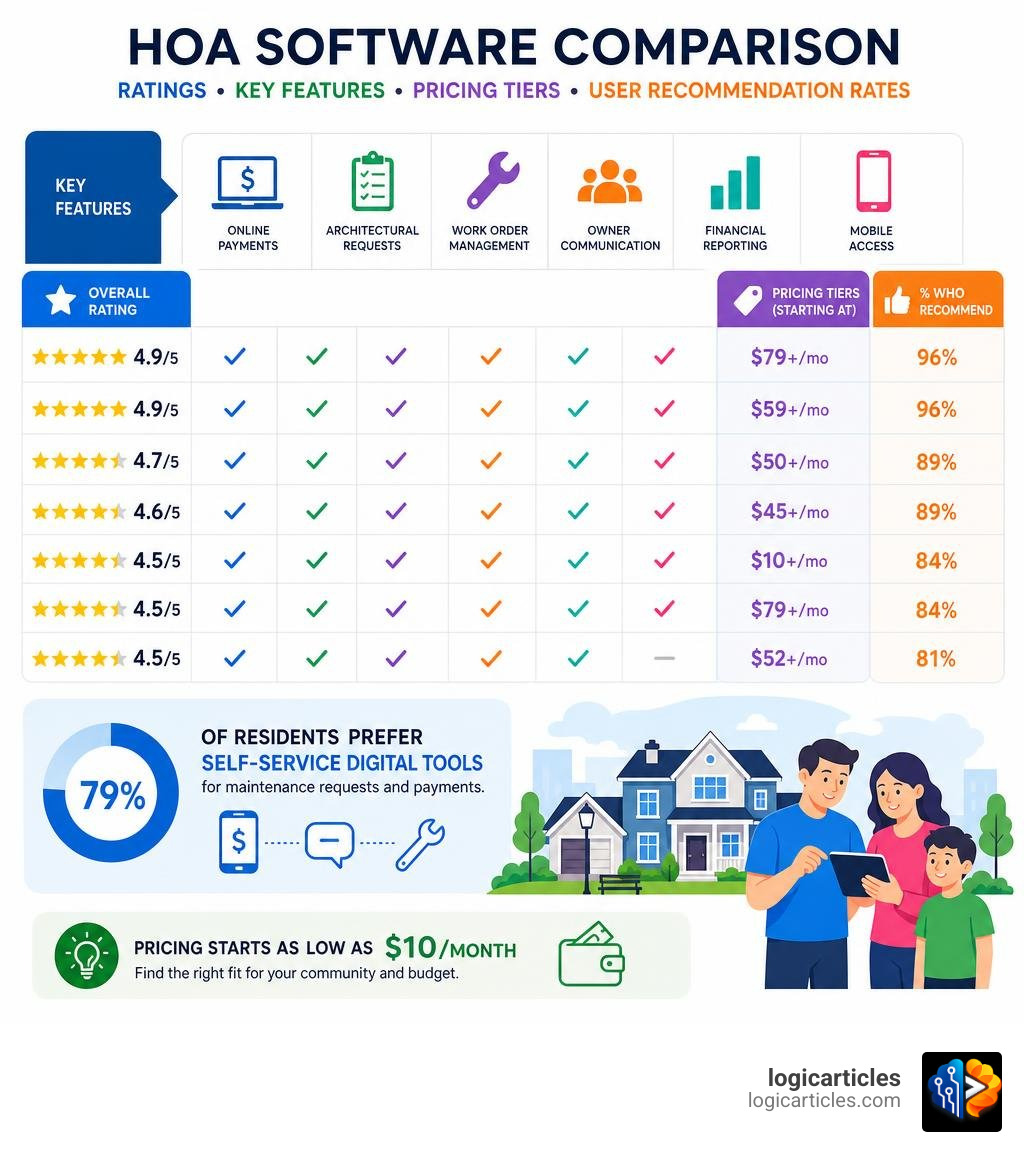
Here’s a quick look at how the top platforms compare based on verified user ratings:
| Software | Overall Rating | % Who Recommend |
|---|---|---|
| DoorLoop | 4.9/5 | 96% |
| Innago | 4.9/5 | 96% |
| Condo Control | 4.7/5 | 89% |
| Rentec Direct | 4.6/5 | 89% |
| PayHOA | 4.5/5 | 84% |
| AppFolio | 4.5/5 | 84% |
| Buildium | 4.5/5 | 81% |
Most HOA boards are run by volunteers — people with full-time jobs who didn’t sign up to become part-time accountants and admin staff. The right software changes that. The wrong one just adds more complexity.
Consider this: one person reportedly manages a 1,500-member HOA entirely on her own, part-time, because her software handles the heavy lifting. That’s the kind of difference the right platform makes.
And homeowners expect it too. 79% of residents prefer self-service digital tools for things like maintenance requests and payments — meaning software isn’t just a board convenience anymore. It’s a resident expectation.
Entry-level pricing starts as low as $10–$79+ per month, so there’s a solution for almost every budget. But price alone shouldn’t drive the decision. Features, ease of use, and how well the software fits your community’s size and needs matter just as much.
Essential Insights from HOA Management Software Reviews
When diving into the sea of hoa management software reviews, it is easy to get overwhelmed by flashy marketing terms. However, experienced board members and community managers know that a platform’s true value lies in its core functionality. To help us find the perfect match, let’s break down the essential features that keep a neighborhood running like clockwork.
Core Features to Look For
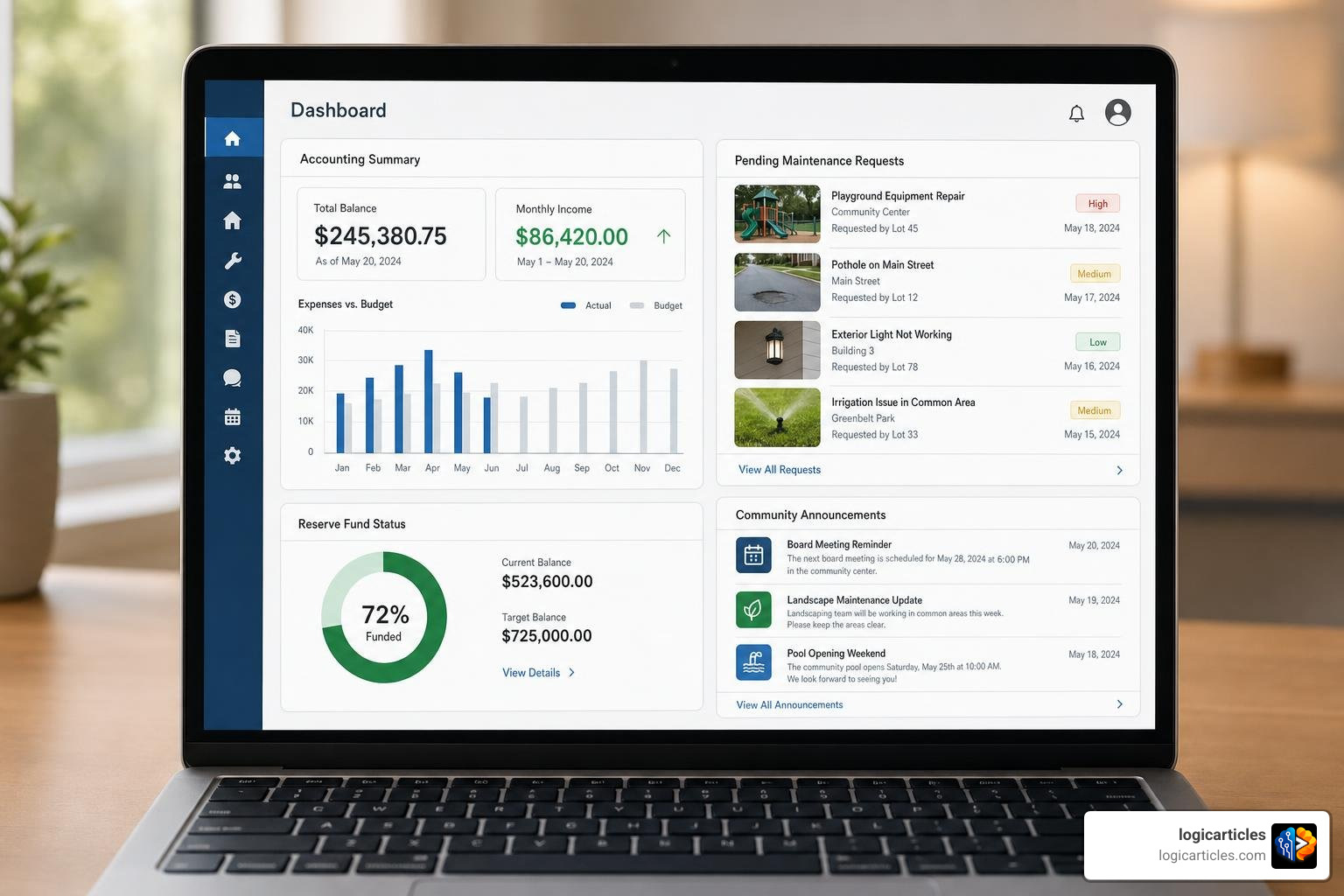
- Comprehensive Accounting Tools: Your software must handle more than just simple deposit tracking. It needs to manage accounts payable, accounts receivable, and general ledger reporting. If you are managing a condominium association, these tools become even more critical to track reserve funds and special assessments. For deeper insights into specialized condo accounting, check out our guide on the Best Condo Management Software.
- Centralized Communication Systems: A great platform allows us to send mass emails, text messages, and automated voice broadcasts. Instead of relying on fragmented personal email threads, boards can log all outbound communications in one centralized system.
- Automated Maintenance Tracking: When a common-area fence breaks or a pool pump fails, homeowners should be able to submit a work order online. The software should automatically route these requests to preferred vendors and update the board on progress.
- Secure Document Management: Governing documents, bylaws, and meeting minutes should be safely stored in the cloud. Homeowners need easy access to these files, while sensitive financial audits should remain restricted to board-level access permissions.
- On-Demand Resident Portals: A dedicated resident portal gives homeowners 24/7 access to their account balances, payment history, and community calendars. This self-service model drastically reduces the number of phone calls and emails board members have to answer.
Evaluating User Feedback and Ratings
While feature lists look great on paper, user reviews tell us what a platform is actually like to use day-to-day. When analyzing feedback, we must look beyond the raw star ratings.
Look for recurring comments regarding the software’s learning curve. If multiple reviews mention that non-technical board members struggle to navigate the interface, that is a red flag. Similarly, pay close attention to reviews discussing customer support response times. When a payment gateway fails or a financial report won’t generate before a major board meeting, you need a support team that responds in minutes, not days.
Understanding Self-Managed HOA Management Software Reviews
For volunteer-run, self-managed communities, the primary goal of adopting software is to reduce burnout. Volunteer board members usually have full-time jobs and families; they cannot afford to spend 15 hours a week chasing paper checks or manually writing violation notices.
According to verified PayHOA Reviews , self-managed communities thrive when a platform prioritizes ease of use and automated invoicing. Platforms like PayHOA, which currently serves over 5,000 communities, are specifically designed to meet these needs.
In a typical self-managed setup, automated billing and bank integration are the absolute lifesavers. Instead of manually cross-referencing bank statements, the software syncs with your bank account, automatically matching incoming payments with outstanding dues.
As highlighted in the PayHOA Review 2026: Features, Pricing & More , having intuitive budgeting tools allows non-accountant volunteers to generate clean, professional financial statements. However, self-managed boards should also weigh their options carefully. As discussed in the comparison of PayHOA Features vs ManageCasa HOA Software | ManageCasa , smaller HOAs operating on tight budgets might love the simplicity of basic platforms, but they should ensure the tool can scale if the community expands or if their accounting needs become more complex.
Deciphering Professional HOA Management Software Reviews
Professional property management companies operate on an entirely different scale than self-managed boards. They manage diverse portfolios containing thousands of units across multiple associations. For these users, software must be a powerhouse of automation, customization, and reporting.
Professional managers look for platforms like AppFolio or Buildium, which are built to handle massive data loads. Key requirements for professional-grade platforms include:
- Portfolio-Wide Reporting: The ability to generate consolidated financial reports across dozens of different properties simultaneously.
- Advanced Workflow Automation: Automated vendor procurement, invoice processing, and multi-tier approval workflows that reduce manual data entry.
- Customization and Branding: White-label resident portals and custom-branded mobile apps that present a professional image to clients.
If your management company oversees a mix of residential associations and commercial spaces, you will need a system capable of handling complex lease structures and common area maintenance (CAM) reconciliations. To explore how these platforms scale for larger operations, take a look at our analysis of the Best Real Estate Portfolio Management Software In 2026.
Pricing Models and What Boards Should Expect to Pay
One of the most common questions we hear is: “What should our board expect to pay for HOA software?” The answer depends largely on your community’s unit count and the complexity of your financial operations.
Generally, software pricing falls into three main categories: flat monthly fees, per-unit-per-month (PUPM) pricing, or custom enterprise plans. Let’s look at what boards should expect in 2026:
| Community Size | Average Monthly Cost | Common Pricing Model | Best Suited For |
|---|---|---|---|
| Small (1–50 units) | $10 – $79 | Flat Monthly Fee | Self-managed communities with basic accounting and communication needs. |
| Mid-Sized (51–250 units) | $100 – $300 | Per-Unit Pricing ($1.00 – $2.50/unit) | Growing communities requiring robust violation tracking and automated billing. |
| Large/Enterprise (250+ units) | $300 – $1,000+ | Custom Enterprise / High PUPM | Professional management firms or massive master-planned communities. |
Hidden Costs to Keep in Mind
While the base monthly subscription is easy to budget for, boards must look closely at the fine print to avoid unexpected expenses:
- Transaction Fees: Most platforms charge transaction fees for online payments. ACH (bank transfer) fees typically range from a flat $1.00 to $2.50 per transaction, while credit card processing fees usually hover around 3% to 3.5% plus a small per-transaction fee.
- Setup and Data Migration Fees: Moving years of historical financial data, homeowner directories, and open violations from spreadsheets into a new platform can be complex. Some companies include this onboarding service for free, while others charge a one-time fee ranging from $200 to over $1,000.
- Physical Mailing Costs: Even in our digital world, some homeowners still require physical mailings for legal notices. Many HOA platforms offer integrated print-to-mail services, charging around $1.05 to $1.25 per letter to print, stuff, and mail notices on your behalf.
Just as specialized operations require unique financial tools—such as those detailed in our reviews of the Best Commercial Property Management Software, the Best Construction Financial Management Software, the Best Nonprofit Financial Management Software, and the Best Family Office Accounting Software—HOA boards must ensure their chosen software’s pricing model aligns perfectly with their specific administrative budget.
Common Pain Points and Compliance Gaps in HOA Platforms
No software platform is perfect. Even the most highly rated systems have limitations that can frustrate volunteer boards and professional managers alike. By studying negative reviews, we can identify common pitfalls before signing a contract.

Usability and Support Issues
A frequent complaint in hoa management software reviews centers on user interfaces that feel outdated or non-intuitive. If the software’s layout is confusing, volunteer board members will struggle to adopt it, and homeowners will refuse to use the resident portal.
Customer support is another common friction point. Many lower-cost platforms rely strictly on email or chat-based support. When an urgent financial discrepancy arises, waiting 24 to 48 hours for an email response is simply unacceptable for an active board.
Navigating State-Specific Regulations and Compliance Gaps
Perhaps the most critical risk of using a generic, national HOA software platform is its potential failure to meet strict state-specific statutory requirements.
Take Florida’s complex condominium and HOA laws as a prime example. Under Florida Chapter 718 and recent legislative updates like HB 1021, associations face strict legal mandates that standard software platforms simply are not built to handle out of the box.
For instance, as detailed in the technical analysis of PayHOA for a Florida condo board — the honest review — HOA Rocket , many national platforms lack the built-in workflows required to comply with Florida’s strict 10-working-day records request clock (§718.111(12)(c)). If a homeowner submits an official records request through the software and the system does not calculate local holidays or generate automated compliance alerts, the board could face costly legal penalties.
Furthermore, Florida’s HB 1021 requires condominium associations with 25 or more units to maintain a statutory website containing secure, member-only portals with historical document versioning. Standard website builders provided by generic platforms often act as simple marketing pages, lacking the secure, compliant document-hosting structures required by law.
Other legislative changes, such as HB 913 milestone inspections, Structural Integrity Reserve Studies (SIRS), and mandatory director education tracking under §720.3033, require highly specialized record-keeping.
When choosing a platform, boards must evaluate whether they need a highly specialized tool or if they can successfully adapt a broader system. For instance, the TOPS [ONE] Reviews 2026: Real Pros, Cons & Expert Value Verdict | ITQlick highlights how legacy systems built specifically for community association management handle these rigorous compliance structures much better than generic property management tools.
Similarly, the RealManage HOA Software Review: Features, Uses, Comparisons demonstrates that while proprietary, management-company-backed systems offer incredible compliance stability, they often come with rigid workflows that can frustrate boards who prefer operational flexibility.
Frequently Asked Questions about HOA Software
What is the average cost of HOA management software in 2026?
In 2026, entry-level pricing for small associations ranges from $10 to $79 per month. For mid-sized communities, boards should expect to pay between $100 and $300 per month, often calculated on a per-unit basis (typically $1.00 to $2.50 per unit). Large or enterprise-level communities can expect monthly costs to exceed $500 to $1,000, depending on custom features and integration requirements.
How does HOA software improve resident communication?
HOA software centralizes communication by providing resident portals, automated email blasts, SMS text alerts, and push notifications. Instead of relying on physical newsletters or scattered email chains, boards can broadcast urgent community updates—such as pool closures or upcoming board meetings—instantly. It also provides homeowners with a transparent, self-service channel to view announcements and track their personal payment histories.
Can self-managed HOAs use professional property management software?
While it is technically possible, professional property management software is often too complex and expensive for volunteer-run boards. These systems are designed for professional managers overseeing massive portfolios and feature steep learning curves. Self-managed HOAs are generally much happier with lightweight, intuitive platforms that focus on automated dues collection, simple violation tracking, and user-friendly resident portals.
Conclusion
Selecting the right platform requires a careful balancing act between community size, operational budget, and specific compliance needs. There is no one-size-fits-all solution; a small, self-managed neighborhood in Ohio will have vastly different software requirements than a 500-unit high-rise condominium in Miami.
By taking the time to read verified hoa management software reviews, testing platforms through free trials, and keeping a close eye on hidden transaction fees and state compliance laws, your board can make a confident decision that protects your community’s finances and relieves volunteer burnout.
Ready to take your community’s operations to the next level with cutting-edge technology? Explore AI Tools for Property Management today to see how modern automation can streamline your daily workflows.