Why Address Standardization Tools Are Critical for Your Business Data

Address standardization tools are software solutions that automatically clean, format, and correct postal addresses to match official postal standards — so your mail reaches customers, your data stays accurate, and your operations run smoothly.
Here’s a quick look at the top address standardization tools and what they do:
| Tool | Best For | Key Feature |
|---|---|---|
| Melissa | Enterprise/Global | 250+ countries, CASS/SERP certified |
| Smarty | Developers | Sub-30ms API, 3.3B addresses/day |
| PostalUp | US-focused APIs | 50ms response, USPS Pub 28 compliant |
| Geoapify | Free/Small teams | No-code, free tier, geocoding included |
| PostGIS address_standardizer | Developers/DBAs | PostgreSQL extension, open-source |
Here’s a number that should stop you cold: approximately 20% of postal addresses entered online contain errors. Spelling mistakes. Wrong house numbers. Bad ZIP codes. Formatting that doesn’t match a country’s postal rules.
That’s one in five customer records — broken before they even hit your database.
The downstream damage adds up fast. According to USPS data, 4–5% of mail and 5–10% of packages are returned undeliverable. Every returned shipment costs money. Every bad address erodes customer trust.
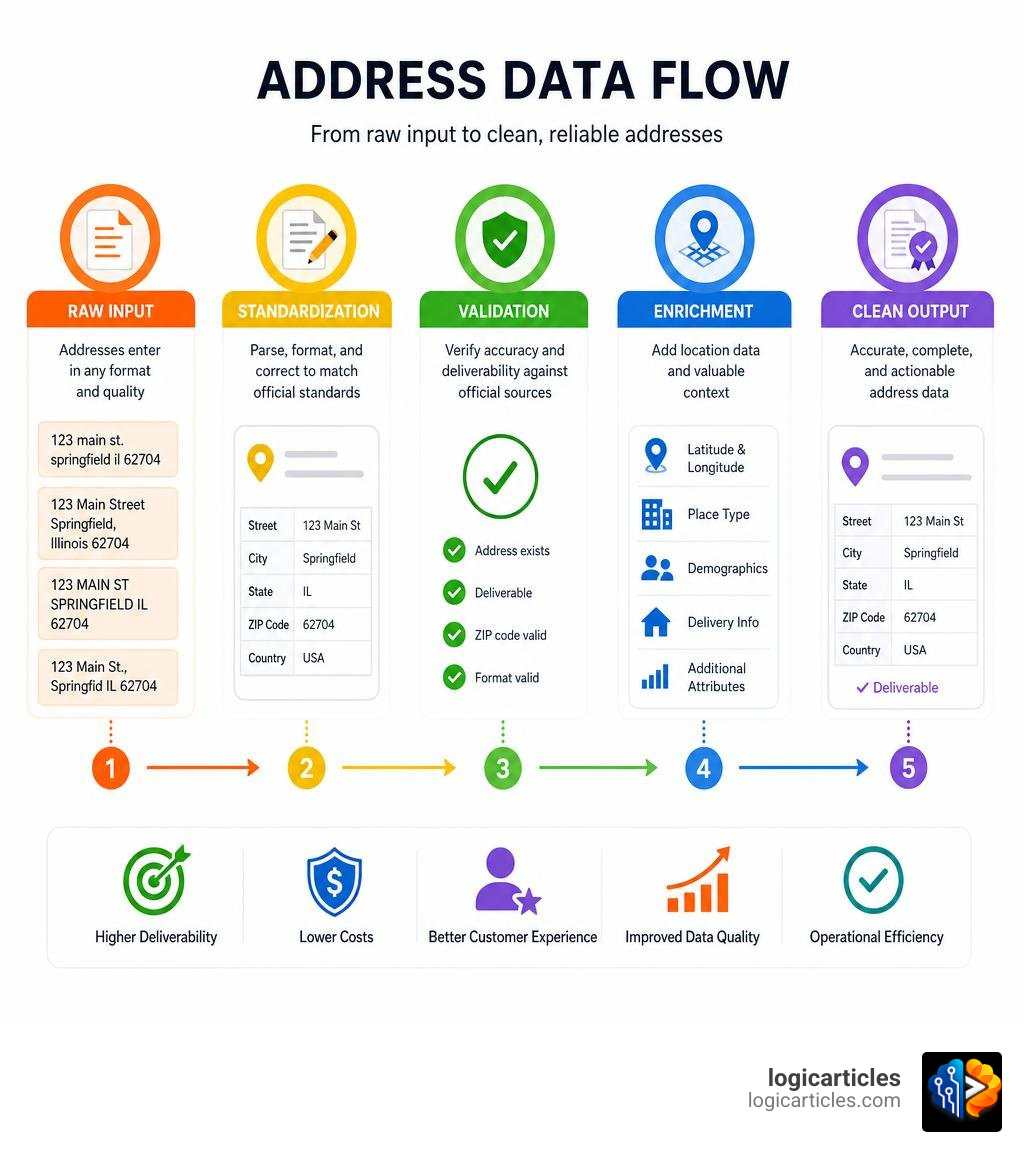
Address standardization tools fix this by automatically:
- Parsing addresses into structured components (street, city, state, ZIP)
- Correcting spelling errors and wrong abbreviations
- Reformatting to match postal authority standards (like USPS Pub 28)
- Verifying deliverability against official databases
- Enriching records with geocoordinates and supplemental data
This guide covers everything — how these tools work, what features matter, how to integrate them, and how to measure ROI. Whether you’re a developer building a checkout form, an ops manager cleaning a CRM, or a marketer running bulk mail campaigns, there’s a solution here for you.
Understanding Address Standardization, Validation, and Verification
To build a clean database, we first need to understand the distinct stages of address processing. While people often use these terms interchangeably, they refer to very different technical processes.
Address standardization is the foundational step. It takes raw, messy user input and reformats it to match the official guidelines of the local postal authority (such as USPS Publication 28 in the United States). This involves parsing the address string into distinct components—such as street number, street name, unit type, city, state, and postal code—and then applying uniform abbreviations and capitalization.
For developers working in JavaScript environments, lightweight libraries like us-address-normalization can perform this first layer of parsing and hashing offline without needing an external API call. This is incredibly useful for comparing user-entered addresses that may have minor formatting differences.
To see how these concepts differ, let’s compare them directly:
| Process | What It Does | Example Input | Example Output |
|---|---|---|---|
| Standardization | Parses and formats the address to match official postal guidelines. | 123 Main Street apt 4, New York, NY | 123 MAIN ST APT 4, NEW YORK, NY 10001 |
| Validation | Checks if the address actually exists in official databases. | 99999 Fake Rd, Beverly Hills, CA | “Invalid Address” (Does not exist in USPS database) |
| Verification | Confirms deliverability and matches the address to a live recipient or delivery point. | 123 Main St Apt 4 (where Apt 4 doesn’t exist) | Corrected to: 123 MAIN ST, NEW YORK, NY 10001 (noting Apt 4 is invalid) |
Common Postal Address Errors
Address standardization tools are built to handle a wide range of human errors. The most frequent issues we see include:
- Spelling Mistakes: “Smithe St” instead of “Smith St,” or misspelled city names.
- Inconsistent Abbreviations: Mixing “Street,” “St.”, “St,” “Avenue,” “Ave,” and “Av.”
- Missing Secondary Information: Leaving out apartment, suite, or unit numbers, which are critical for multi-tenant buildings.
- Incorrect ZIP Codes: Entering the wrong postal code for a city, or using an outdated code.
- Formatting Inconsistencies: Placing the apartment number before the street name or mixing up the city and state fields.
The Difference Between Validation and Verification
While standardization ensures your formatting is correct, validation and verification prove that the address is real.
Validation is a simple existence check. It asks: “Does this address exist in the official postal database?”
Verification goes a step further by checking deliverability. It determines if mail can actually be dropped off at that location. For instance, an address might be standard and valid, but if it is a new construction that has not yet been added to the carrier’s route, or if it is a commercial building that does not accept residential mail, verification will flag these issues.
Key Features to Look For in Address Standardization Tools
When evaluating software to clean your location data, you need to look beyond basic formatting features. Enterprise-grade tools rely on specific certifications and databases to ensure absolute accuracy.
Evaluating Modern Address Standardization Tools
For businesses operating in the United States, the gold standard is CASS (Coding Accuracy Support System) certification. Created by the USPS, CASS ensures that standardization software accurately matches addresses against the official USPS database.
A high-quality tool should include these essential features:
- Delivery Point Validation (DPV): Verifies whether an address is a deliverable physical location, down to the specific apartment or suite.
- LACSLink: Automatically updates rural route addresses that have been converted to standard street addresses (often due to local 911 emergency system upgrades).
- SuiteLink: Appends missing suite numbers to business addresses, improving sequencing and delivery speeds.
- ZIP+4 Coding: Adds the precise four-digit add-on code to the standard five-digit ZIP code, targeting specific delivery blocks.
If you are looking for a fast, developer-friendly option that handles these requirements seamlessly, the PostalUp US Address Validation API is an excellent choice. It is fully USPS Pub 28 compliant, offers sub-50ms response times, and easily processes batch validations.
Geocoding and Data Enrichment Capabilities
The best tools don’t just clean your addresses; they enrich them. Geocoding converts a physical address into precise latitude and longitude coordinates. This is crucial for logistics, mapping, and spatial analysis.
Advanced enrichment features can connect your standardized addresses to massive external datasets. For example, some platforms allow you to find parcel boundaries and attribute data for 155 million properties, or access data on 2.1 billion consumer records. This lets you append demographic, firmographic, and property-specific details directly to your customer profiles.
Implementation Methods: APIs, Batch Processing, and Integrations
Depending on your business workflow, you will need to standardize addresses in real time, in large batches, or directly within your database.
API Integration for Real-Time Validation
For e-commerce checkouts and customer registration forms, real-time API integration is the best approach. By standardizing addresses at the point of entry, you prevent bad data from ever entering your systems.
When choosing an API, speed and reliability are everything. Look for tools that offer sub-30ms response times (the industry average is around 50ms, whereas slower systems can take over 150ms) and guarantee a 99.95% uptime SLA. Modern APIs support multiple developer SDKs, including TypeScript, Python, Go, and Ruby.
For instance, the Poplar US Address Standardization API provides clear endpoints to standardize both single and multiple addresses with minimal development effort.
Batch Processing and Database Extensions
If you already have a database filled with millions of unstandardized records, real-time APIs aren’t enough. You need batch processing.
Many tools allow you to upload large CSV or Excel files, map your columns, and download the standardized results. For database administrators who prefer to keep their data in-house, open-source database extensions are highly efficient.
The PostgreSQL address_standardizer extension on GitHub is a powerful example. It runs directly inside your PostgreSQL database, parsing US street address strings into structured components without relying on external API calls. This is a game-changer for offline data warehousing and GIS mapping.
Business Benefits, ROI, and Industry Applications
Investing in address quality isn’t just about clean data; it has a massive impact on your bottom line.
Key Industries Benefiting from Standardized Data
- E-Commerce and Logistics: Standardizing addresses at checkout reduces cart abandonment, eliminates failed deliveries, and lowers shipping costs. Implementing autocomplete features can lead to a 15% conversion boost in international markets like Canada, Germany, Spain, and France.
- Insurance: Precise geocoding allows insurers to perform accurate catastrophe modeling, assessing risk down to the exact rooftop level of a property.
- Telecommunications: Standardized addresses help dispatch technicians to the correct locations, saving valuable travel time and reducing service delays.
- Healthcare and Finance: Clean address data ensures compliance with strict KYC (Know Your Customer) and KYB (Know Your Business) regulations while preventing billing fraud.
Measuring the ROI of Address Quality
The financial return on address standardization tools is easy to calculate. Consider these metrics:
- Reduced Shipping Penalties: Carriers like UPS and FedEx charge steep fees for address corrections. Standardizing addresses upfront completely eliminates these charges.
- Lower Resource Costs: Migrating your address verification from on-premise systems to cloud-based APIs can save your IT team an average of 15 to 20 person-hours per month.
- Postal Discounts: CASS-certified mailings qualify for significant bulk postage discounts, lowering marketing campaign costs.
Compliance, Data Privacy, and International Standards
Because address data is considered Personally Identifiable Information (PII), compliance and security must be top priorities.
When choosing a service, ensure they adhere to global data privacy standards, including:
- GDPR (General Data Protection Regulation) for European customers
- CCPA (California Consumer Privacy Act)
- HIPAA and HITRUST for healthcare data
- SOC 2 Type II certification for enterprise-grade security
How Address Standardization Tools Handle International Data
If your business operates globally, your tool must support international address formats. Formatting rules vary wildly across the globe; some countries place the postal code before the city, while others don’t use ZIP codes at all.
Enterprise tools support validation across 250 countries and territories in dozens of different languages. One of the most impressive features of modern international tools is transliteration. This process automatically converts addresses written in non-Latin scripts—such as Cyrillic, Arabic, Kanji, or Hebrew—into Latin characters, ensuring that international shipping carriers can read and deliver your packages successfully.
Frequently Asked Questions about Address Standardization
What is the difference between address standardization and address validation?
Address standardization reformats an address to meet official postal standards (correcting abbreviations and casing). Address validation checks if that formatted address actually exists in official databases and can receive physical mail.
Why do some valid addresses fail to standardize?
New construction properties often experience a database lag before they are added to official postal records. Additionally, rural routes, missing secondary information (like apartment numbers), or private roads can cause validation checks to fail even if the physical building exists.
How often do postal databases update?
Official postal databases, such as the USPS ZIP+4 registry, are updated monthly. In fact, approximately 4% of ZIP codes change every single month. To stay compliant with USPS Move Update standards, businesses must update their mailing lists against change-of-address databases (like NCOALink, which contains over 160 million permanent records) within 95 days before any bulk mailing.
Conclusion
Dirty data is an expensive liability. Whether it is a missed package, a frustrated customer, or hours of wasted IT development, unstandardized addresses quietly drain your company’s budget.
By implementing modern address standardization tools, you can protect your database, streamline your checkout process, and ensure your operations run at peak efficiency.
Ready to discover more ways to optimize your business workflows with cutting-edge technology? Explore AI Tools on LogicArticles to stay ahead of the curve.