What Is a BI Software Solutions Consultant — and Do You Need One?

A bi software solutions consultant is the professional who turns your raw, scattered data into clear, actionable business insights — bridging the gap between what your business needs and what your technology can deliver.
Quick answer: here’s what a BI software solutions consultant does for you:
- Audits your current data landscape and identifies gaps
- Recommends the right BI platform (Power BI, Tableau, etc.) for your needs
- Designs data models, pipelines, and dashboards tailored to your goals
- Implements the solution and integrates it with your existing systems
- Trains your team and hands off a self-sustaining, documented BI environment
Here’s a sobering fact: only 46% of organizations have a comprehensive data strategy in place. That means more than half of all businesses are making decisions without reliable, structured insight — leaving serious competitive advantage on the table.
The companies pulling ahead are the ones investing in BI. Those that do consistently report measurable gains across core business functions — from faster reporting to better forecasting to smarter resource allocation.
But choosing the wrong tools, skipping proper data modeling, or underestimating user adoption can sink even a well-funded BI project.
That’s exactly where an experienced BI software solutions consultant earns their value.
Why Your Business Needs a BI Software Solutions Consultant in 2026
In 2026, data is no longer a luxury or a passive record of what happened last quarter. It is the lifeblood of real-time strategy. Yet, many executive teams still find themselves drowning in a sea of disconnected Excel spreadsheets, manual data entry, and conflicting reports. If your sales team’s revenue numbers don’t match your finance team’s ledger, you are not alone—but you are operating at a massive disadvantage.
This is where a bi software solutions consultant comes in. Rather than simply installing a tool and walking away, an expert consultant builds the pipelines, architectures, and visual systems that turn operational chaos into boardroom clarity. Navigating this landscape requires more than just technical setup; it demands a strategic vision similar to what we discuss in our guide to Software Development Consulting In 2026.

Bridging the Gap Between Business and Tech
The biggest point of failure in most corporate data projects is communication. Business leaders speak in terms of customer acquisition costs, inventory turnover, and profit margins. On the other side of the hallway, database administrators speak in SQL queries, API endpoints, and JSON schemas.
A skilled bi software solutions consultant acts as the ultimate bilingual translator. They sit down with your stakeholders to uncover what decisions actually drive revenue, and then they engineer the underlying technical architecture to answer those questions.
For instance, elite specialists like BI Architect & Data Product Owner | Ondrej Thaisz emphasize a results-oriented approach that cuts through endless corporate discovery phases. By treating BI as a product rather than a never-ending IT project, they ensure that the technical delivery directly maps to cross-functional business alignment.
Essential Skills of a BI Software Solutions Consultant
What makes a consultant truly valuable? It is a rare combination of technical mastery, business acumen, and soft skills. If a consultant only knows how to write complex code but cannot explain what a chart means to a non-technical manager, the project will fail. Conversely, a consultant who only understands high-level business strategy won’t be able to optimize a slow-loading database.
When evaluating a consultant, look for:
- Technical Expertise: Mastery of data modeling, SQL optimization, ETL (Extract, Transform, Load) pipelines, and modern cloud platforms.
- Business Acumen: The ability to understand your industry’s specific KPIs, whether you are in healthcare, retail, finance, or logistics.
- Aesthetics and Accuracy: A great report must be both visually clear and mathematically flawless. As highlighted by BI Architect & Data Consultant | Maxim Anatsko, “data is not the goal”—transforming chaos into clarity is. A pretty dashboard that displays inaccurate data is a liability, not an asset.
- Change Management: The soft skills required to train teams, overcome user resistance, and ensure long-term tool adoption.
Selecting the Right Stack: Platforms and Architecture
One of the first major decisions a bi software solutions consultant will guide you through is selecting your technology stack. There is no “one-size-fits-all” answer here. The right choice depends on your existing infrastructure, budget, data volume, and internal team capabilities.
To help you understand the landscape, we have ranked some of the Best Big Data Analytics Tools In 2026 Ranked By Performance. When it comes to standard business intelligence and reporting, the primary battle is usually between Microsoft Power BI and Tableau, supported by classic SQL Server stacks (SSAS, SSIS, and SSRS).
| Feature | Microsoft Power BI | Tableau | SSAS / SSIS / SSRS (Legacy Stack) |
|---|---|---|---|
| Primary Use Case | Agile, decentralized analytics & Microsoft ecosystem integration | Deep exploratory visual analysis & interactive storytelling | Centralized enterprise data warehousing & paginated reporting |
| Licensing Cost | Generally lower; included in many Microsoft enterprise agreements | Higher per-user licensing costs | Tied to SQL Server licensing; can be cost-effective for legacy on-prem |
| Ease of Use | High for Excel users (uses Power Query and DAX) | Moderate to high; requires some specialized training | Low; requires dedicated database developers |
| Integration | Native with Teams, Excel, Azure, and Microsoft Fabric | Strong with Salesforce and diverse cloud databases | Native to Microsoft SQL Server environments |
According to reference customers, Microsoft Power BI is highly favored because of its versatility, with 61% of users leveraging it for decentralized analytics and 54% utilizing it for agile, centralized BI provisioning.
Modern Cloud Architectures and Microsoft Fabric
As we move deeper into 2026, modern cloud architectures are rapidly shifting toward unified data platforms like Microsoft Fabric. Instead of managing separate databases, data factories, and reporting servers, Fabric unifies everything into a single SaaS environment.
A key component of this modern approach is the Medallion Architecture, which organizes data into three distinct layers:
- Bronze (Raw): The landing zone for raw data directly from your source systems.
- Silver (Cleaned/Validated): Data that has been filtered, cleaned, and conformed to a standard structure.
- Gold (Curated): Business-ready data structured into star schemas, optimized for reporting.
With Microsoft Fabric’s Direct Lake mode, Power BI reports can query massive datasets in the Gold layer instantly, bypassing the slow import and refresh cycles of the past. Experienced consultants, such as Microsoft Fabric & Power BI Consultant | Michał Kulikowski, leverage this architecture to take organizations from zero to a production-ready cloud platform in record time, proving that proper governance and speed can co-exist.
Legacy Systems and Database Migration
Many established companies are held back by legacy databases, such as old on-premise SQL Servers or even Microsoft Access. These systems slow down reporting and create isolated data silos.
A major responsibility of a bi software solutions consultant is managing database migrations without disrupting daily business operations. By moving legacy data to optimized cloud data warehouses and implementing modern indexing strategies, consultants can achieve monumental performance boosts.
For example, Amir Khan — End-to-End BI Solutions Architect has demonstrated how migrating legacy setups to structured SQL databases and implementing optimized indexing can result in up to a 10x query performance improvement, turning painful 30-second report load times into near-instantaneous clicks.
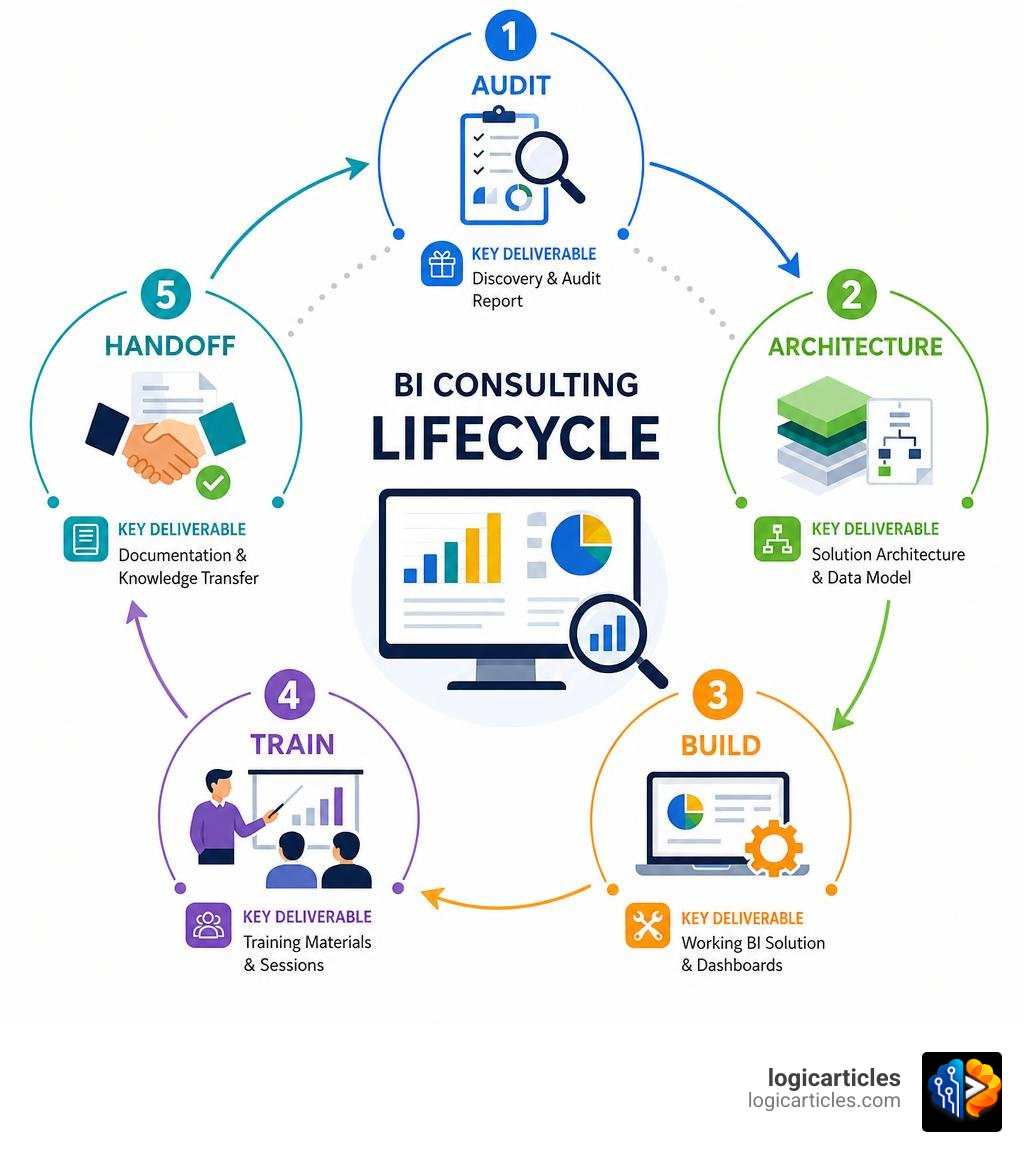
The BI Consulting Process: From Audit to Handoff
A successful BI implementation is not an accident; it is the result of a structured, disciplined process. If a consultant promises to build you a perfect dashboard in two days without auditing your underlying data first, run away. That is a recipe for a fragile, inaccurate system.

A professional BI engagement typically follows a four-phase blueprint:
The Blueprint: Requirements Gathering and Data Modeling
The foundation of any great BI system is data modeling. During this phase, the consultant gathers business requirements and designs the backend logic.
Most experienced consultants rely on the Kimball Methodology and Dimensional Modeling. This involves organizing your data into:
- Fact Tables: Contain the quantitative measurements or metrics of a business process (e.g., sales transaction amounts, units sold).
- Dimension Tables: Contain the descriptive attributes surrounding those business processes (e.g., customer names, store locations, product categories).
By structuring these tables into a Star Schema, the BI tool can run incredibly fast, making calculations simple and intuitive.
As showcased by Shehroz | Senior BI Consultant & Power BI Expert · GrowthWithShehroz, building a robust star schema data warehouse allows companies to replace hundreds of manual, fragile Excel formulas with clean, automated DAX (Data Analysis Expressions) measures. This ensures that every department is looking at a single, undisputed version of the truth.
Handoff, Training, and Driving User Adoption
The most beautiful dashboard in the world is completely useless if your team refuses to use it. User adoption is the ultimate metric of success for any BI project.
Because of this, the final phase of a consulting engagement must focus heavily on handoff and education. This includes:
- Role-Based Training: Teaching executives how to read high-level dashboards, while training operational analysts how to perform self-service data exploration.
- Comprehensive Documentation: Creating clear guides outlining data definitions, source-to-target mappings, and refresh schedules.
- Self-Sufficiency Enablement: Building a system that your internal team can manage long after the consultant leaves.
This focus on long-term sustainability is a hallmark of premium consulting. For instance, the services outlined on Work With Me | BI Consulting Services | Maxim Anatsko place a heavy emphasis on custom training programs designed to make internal teams fully self-sufficient, preventing ongoing dependency on external contractors.
Overcoming Implementation Challenges: Data Quality and Legacy Systems
Every BI project faces hurdles. The difference between success and failure lies in how your bi software solutions consultant anticipates and handles these bottlenecks.
The three most common roadblocks include:
- Dirty Data: Inconsistent formatting, missing values, and duplicate records. A consultant resolves this by building automated ETL validation pipelines that clean the data before it ever reaches your reports.
- Legacy Integration: Connecting to outdated, proprietary on-premise software. Consultants overcome this by utilizing modern APIs, custom connectors, or staging environments to safely extract data.
- User Adoption Barriers: Resistance from employees who are comfortable with their old ways of working. Consultants combat this by involving key users early in the design process, ensuring the new dashboards actually make their daily jobs easier.
For fast-growing companies looking to scale efficiently, integrating these data pipelines early is critical, often utilizing some of the Best Startup Growth Tools For 2026 to maintain agility.
Measuring Success: Metrics and Future Trends for a BI Software Solutions Consultant
How do you know if your investment in a bi software solutions consultant has paid off? We look at a combination of operational and business metrics:
- Time Savings: Reducing the time it takes to generate month-end reports from days to minutes.
- Report Accuracy: Eliminating calculation discrepancies across departments.
- Query Performance: Keeping dashboard load times under two seconds to ensure a smooth user experience.
- Business Impact: Identifying cost-saving opportunities, such as optimizing inventory to reduce waste or spotting high-performing sales channels.
Looking forward, the future of BI consulting is deeply tied to artificial intelligence. We are seeing consultants build AI-ready data architectures that optimize semantic models for Large Language Models (LLMs). This allows business leaders to ask natural language questions directly to their data via tools like Microsoft Copilot. To stay ahead of these developments, check out our breakdown of Ai Tools You Should Know In 2026.
Frequently Asked Questions about BI Consulting
What does a BI software solutions consultant do?
A bi software solutions consultant designs, builds, and maintains the systems that turn raw business data into interactive dashboards and reports. Their day-to-day work includes writing SQL queries, building ETL pipelines, structuring data warehouses, designing user-friendly dashboards, and training business teams to make data-driven decisions.
How much does a typical BI implementation cost?
The cost of a BI project depends on the size of your organization and the complexity of your data sources. While simple, single-source dashboard setups can be highly cost-effective, comprehensive enterprise solutions generally fall into three tiers:
- Simple BI Solution: $80,000 to $200,000 (ideal for ~5 data sources with standard reporting).
- Corporate-Scale BI Solution: $200,000 to $400,000 (covers multiple departments and complex data flows).
- Enterprise-Scale BI Solution: $400,000 to $1,000,000+ (for global operations with real-time processing and deep compliance requirements).
How long does it take to deploy a complete BI platform?
A basic proof-of-concept (POC) dashboard can often be built in two to three weeks. However, delivering a fully governed, production-grade enterprise data platform using a modern medallion architecture typically takes around three to six months depending on the quality of the underlying data.
Conclusion
At logicarticles, we believe that data shouldn’t be a source of stress or confusion. It should be your greatest competitive advantage. Investing in a professional bi software solutions consultant is the most reliable way to stop guessing and start leading with certainty.
By auditing your data, selecting the right modern architecture, and focusing heavily on user training, an expert consultant ensures your business is built to scale in 2026 and beyond.
If you are ready to streamline your workflows, eliminate manual reporting bottlenecks, and boost your team’s daily output, Explore Productivity Solutions with us today!What Is a BI Software Solutions Consultant — and Do You Need One?
A bi software solutions consultant is the professional who turns your raw, scattered data into clear, actionable business insights — bridging the gap between what your business needs and what your technology can deliver.
Quick answer: here’s what a BI software solutions consultant does for you:
- Audits your current data landscape and identifies gaps
- Recommends the right BI platform (Power BI, Tableau, etc.) for your needs
- Designs data models, pipelines, and dashboards tailored to your goals
- Implements the solution and integrates it with your existing systems
- Trains your team and hands off a self-sustaining, documented BI environment
Here’s a sobering fact: only 46% of organizations have a comprehensive data strategy in place. That means more than half of all businesses are making decisions without reliable, structured insight — leaving serious competitive advantage on the table.
The companies pulling ahead are the ones investing in BI. Those that do consistently report measurable gains across core business functions — from faster reporting to better forecasting to smarter resource allocation.
But choosing the wrong tools, skipping proper data modeling, or underestimating user adoption can sink even a well-funded BI project.
That’s exactly where an experienced BI software solutions consultant earns their value.
Why Your Business Needs a BI Software Solutions Consultant in 2026
In 2026, data is no longer a luxury or a passive record of what happened last quarter. It is the lifeblood of real-time strategy. Yet, many executive teams still find themselves drowning in a sea of disconnected Excel spreadsheets, manual data entry, and conflicting reports. If your sales team’s revenue numbers don’t match your finance team’s ledger, you are not alone—but you are operating at a massive disadvantage.
This is where a bi software solutions consultant comes in. Rather than simply installing a tool and walking away, an expert consultant builds the pipelines, architectures, and visual systems that turn operational chaos into boardroom clarity. Navigating this landscape requires more than just technical setup; it demands a strategic vision similar to what we discuss in our guide to Software Development Consulting In 2026.
Bridging the Gap Between Business and Tech
The biggest point of failure in most corporate data projects is communication. Business leaders speak in terms of customer acquisition costs, inventory turnover, and profit margins. On the other side of the hallway, database administrators speak in SQL queries, API endpoints, and JSON schemas.
A skilled bi software solutions consultant acts as the ultimate bilingual translator. They sit down with your stakeholders to uncover what decisions actually drive revenue, and then they engineer the underlying technical architecture to answer those questions.
For instance, elite specialists like BI Architect & Data Product Owner | Ondrej Thaisz emphasize a results-oriented approach that cuts through endless corporate discovery phases. By treating BI as a product rather than a never-ending IT project, they ensure that the technical delivery directly maps to cross-functional business alignment.
Essential Skills of a BI Software Solutions Consultant
What makes a consultant truly valuable? It is a rare combination of technical mastery, business acumen, and soft skills. If a consultant only knows how to write complex code but cannot explain what a chart means to a non-technical manager, the project will fail. Conversely, a consultant who only understands high-level business strategy won’t be able to optimize a slow-loading database.
When evaluating a consultant, look for:
- Technical Expertise: Mastery of data modeling, SQL optimization, ETL (Extract, Transform, Load) pipelines, and modern cloud platforms.
- Business Acumen: The ability to understand your industry’s specific KPIs, whether you are in healthcare, retail, finance, or logistics.
- Aesthetics and Accuracy: A great report must be both visually clear and mathematically flawless. As highlighted by BI Architect & Data Consultant | Maxim Anatsko, “data is not the goal”—transforming chaos into clarity is. A pretty dashboard that displays inaccurate data is a liability, not an asset.
- Change Management: The soft skills required to train teams, overcome user resistance, and ensure long-term tool adoption.
Selecting the Right Stack: Platforms and Architecture
One of the first major decisions a bi software solutions consultant will guide you through is selecting your technology stack. There is no “one-size-fits-all” answer here. The right choice depends on your existing infrastructure, budget, data volume, and internal team capabilities.
To help you understand the landscape, we have ranked some of the Best Big Data Analytics Tools In 2026 Ranked By Performance. When it comes to standard business intelligence and reporting, the primary battle is usually between Microsoft Power BI and Tableau, supported by classic SQL Server stacks (SSAS, SSIS, and SSRS).
| Feature | Microsoft Power BI | Tableau | SSAS / SSIS / SSRS (Legacy Stack) |
|---|---|---|---|
| Primary Use Case | Agile, decentralized analytics & Microsoft ecosystem integration | Deep exploratory visual analysis & interactive storytelling | Centralized enterprise data warehousing & paginated reporting |
| Licensing Cost | Generally lower; included in many Microsoft enterprise agreements | Higher per-user licensing costs | Tied to SQL Server licensing; can be cost-effective for legacy on-prem |
| Ease of Use | High for Excel users (uses Power Query and DAX) | Moderate to high; requires some specialized training | Low; requires dedicated database developers |
| Integration | Native with Teams, Excel, Azure, and Microsoft Fabric | Strong with Salesforce and diverse cloud databases | Native to Microsoft SQL Server environments |
According to reference customers, Microsoft Power BI is highly favored because of its versatility, with 61% of users leveraging it for decentralized analytics and 54% utilizing it for agile, centralized BI provisioning.
Modern Cloud Architectures and Microsoft Fabric
As we move deeper into 2026, modern cloud architectures are rapidly shifting toward unified data platforms like Microsoft Fabric. Instead of managing separate databases, data factories, and reporting servers, Fabric unifies everything into a single SaaS environment.
A key component of this modern approach is the Medallion Architecture, which organizes data into three distinct layers:
- Bronze (Raw): The landing zone for raw data directly from your source systems.
- Silver (Cleaned/Validated): Data that has been filtered, cleaned, and conformed to a standard structure.
- Gold (Curated): Business-ready data structured into star schemas, optimized for reporting.
With Microsoft Fabric’s Direct Lake mode, Power BI reports can query massive datasets in the Gold layer instantly, bypassing the slow import and refresh cycles of the past. Experienced consultants, such as Microsoft Fabric & Power BI Consultant | Michał Kulikowski, leverage this architecture to take organizations from zero to a production-ready cloud platform in record time, proving that proper governance and speed can co-exist.
Legacy Systems and Database Migration
Many established companies are held back by legacy databases, such as old on-premise SQL Servers or even Microsoft Access. These systems slow down reporting and create isolated data silos.
A major responsibility of a bi software solutions consultant is managing database migrations without disrupting daily business operations. By moving legacy data to optimized cloud data warehouses and implementing modern indexing strategies, consultants can achieve monumental performance boosts.
For example, Amir Khan — End-to-End BI Solutions Architect has demonstrated how migrating legacy setups to structured SQL databases and implementing optimized indexing can result in up to a 10x query performance improvement, turning painful 30-second report load times into near-instantaneous clicks.
The BI Consulting Process: From Audit to Handoff
A successful BI implementation is not an accident; it is the result of a structured, disciplined process. If a consultant promises to build you a perfect dashboard in two days without auditing your underlying data first, run away. That is a recipe for a fragile, inaccurate system.
A professional BI engagement typically follows a four-phase blueprint:
The Blueprint: Requirements Gathering and Data Modeling
The foundation of any great BI system is data modeling. During this phase, the consultant gathers business requirements and designs the backend logic.
Most experienced consultants rely on the Kimball Methodology and Dimensional Modeling. This involves organizing your data into:
- Fact Tables: Contain the quantitative measurements or metrics of a business process (e.g., sales transaction amounts, units sold).
- Dimension Tables: Contain the descriptive attributes surrounding those business processes (e.g., customer names, store locations, product categories).
By structuring these tables into a Star Schema, the BI tool can run incredibly fast, making calculations simple and intuitive.
As showcased by Shehroz | Senior BI Consultant & Power BI Expert · GrowthWithShehroz, building a robust star schema data warehouse allows companies to replace hundreds of manual, fragile Excel formulas with clean, automated DAX (Data Analysis Expressions) measures. This ensures that every department is looking at a single, undisputed version of the truth.
Handoff, Training, and Driving User Adoption
The most beautiful dashboard in the world is completely useless if your team refuses to use it. User adoption is the ultimate metric of success for any BI project.
Because of this, the final phase of a consulting engagement must focus heavily on handoff and education. This includes:
- Role-Based Training: Teaching executives how to read high-level dashboards, while training operational analysts how to perform self-service data exploration.
- Comprehensive Documentation: Creating clear guides outlining data definitions, source-to-target mappings, and refresh schedules.
- Self-Sufficiency Enablement: Building a system that your internal team can manage long after the consultant leaves.
This focus on long-term sustainability is a hallmark of premium consulting. For instance, the services outlined on Work With Me | BI Consulting Services | Maxim Anatsko place a heavy emphasis on custom training programs designed to make internal teams fully self-sufficient, preventing ongoing dependency on external contractors.
Overcoming Implementation Challenges: Data Quality and Legacy Systems
Every BI project faces hurdles. The difference between success and failure lies in how your bi software solutions consultant anticipates and handles these bottlenecks.
The three most common roadblocks include:
- Dirty Data: Inconsistent formatting, missing values, and duplicate records. A consultant resolves this by building automated ETL validation pipelines that clean the data before it ever reaches your reports.
- Legacy Integration: Connecting to outdated, proprietary on-premise software. Consultants overcome this by utilizing modern APIs, custom connectors, or staging environments to safely extract data.
- User Adoption Barriers: Resistance from employees who are comfortable with their old ways of working. Consultants combat this by involving key users early in the design process, ensuring the new dashboards actually make their daily jobs easier.
For fast-growing companies looking to scale efficiently, integrating these data pipelines early is critical, often utilizing some of the Best Startup Growth Tools For 2026 to maintain agility.
Measuring Success: Metrics and Future Trends for a BI Software Solutions Consultant
How do you know if your investment in a bi software solutions consultant has paid off? We look at a combination of operational and business metrics:
- Time Savings: Reducing the time it takes to generate month-end reports from days to minutes.
- Report Accuracy: Eliminating calculation discrepancies across departments.
- Query Performance: Keeping dashboard load times under two seconds to ensure a smooth user experience.
- Business Impact: Identifying cost-saving opportunities, such as optimizing inventory to reduce waste or spotting high-performing sales channels.
Looking forward, the future of BI consulting is deeply tied to artificial intelligence. We are seeing consultants build AI-ready data architectures that optimize semantic models for Large Language Models (LLMs). This allows business leaders to ask natural language questions directly to their data via tools like Microsoft Copilot. To stay ahead of these developments, check out our breakdown of Ai Tools You Should Know In 2026.
Frequently Asked Questions about BI Consulting
What does a BI software solutions consultant do?
A bi software solutions consultant designs, builds, and maintains the systems that turn raw business data into interactive dashboards and reports. Their day-to-day work includes writing SQL queries, building ETL pipelines, structuring data warehouses, designing user-friendly dashboards, and training business teams to make data-driven decisions.
How much does a typical BI implementation cost?
The cost of a BI project depends on the size of your organization and the complexity of your data sources. While simple, single-source dashboard setups can be highly cost-effective, comprehensive enterprise solutions generally fall into three tiers:
- Simple BI Solution: $80,000 to $200,000 (ideal for ~5 data sources with standard reporting).
- Corporate-Scale BI Solution: $200,000 to $400,000 (covers multiple departments and complex data flows).
- Enterprise-Scale BI Solution: $400,000 to $1,000,000+ (for global operations with real-time processing and deep compliance requirements).
How long does it take to deploy a complete BI platform?
A basic proof-of-concept (POC) dashboard can often be built in two to three weeks. However, delivering a fully governed, production-grade enterprise data platform using a modern medallion architecture typically takes around three to six months depending on the quality of the underlying data.
Conclusion
At logicarticles, we believe that data shouldn’t be a source of stress or confusion. It should be your greatest competitive advantage. Investing in a professional bi software solutions consultant is the most reliable way to stop guessing and start leading with certainty.
By auditing your data, selecting the right modern architecture, and focusing heavily on user training, an expert consultant ensures your business is built to scale in 2026 and beyond.
If you are ready to streamline your workflows, eliminate manual reporting bottlenecks, and boost your team’s daily output, Explore Productivity Solutions with us today!