The Best Spotify Alternatives in 2026: A Quick Answer

If you’re searching for Spotify alternatives, here are the top options ranked by what matters most:
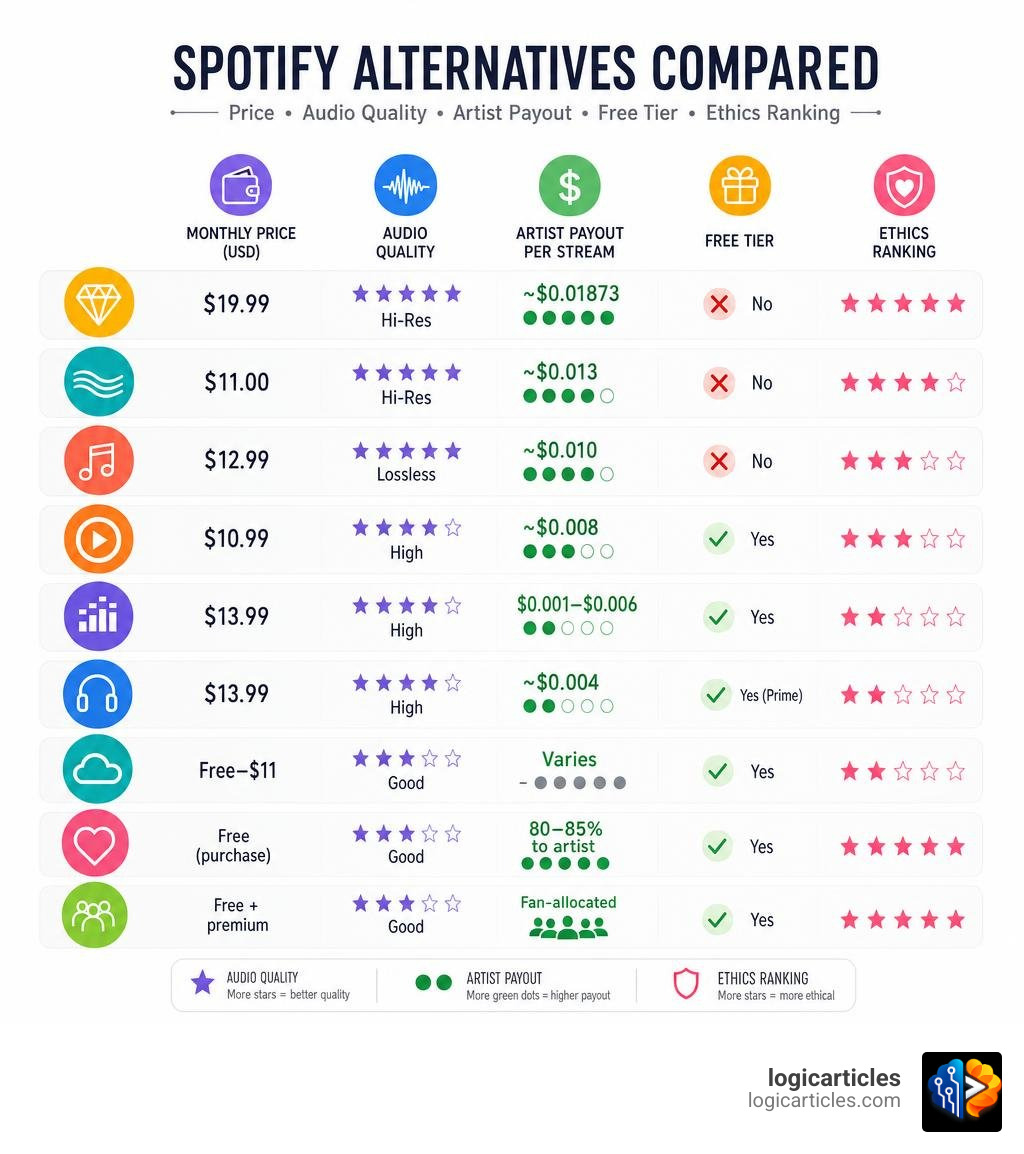
| Service | Best For | Monthly Price | Artist Payout/Stream | Free Tier |
|---|---|---|---|---|
| Qobuz | Audio quality + artist pay | $19.99 | ~$0.01873 | No |
| Tidal | Hi-res audio + ethics | $11.00 | ~$0.013 | No |
| Apple Music | iPhone users + lossless | $12.99 | ~$0.010 | No |
| YouTube Music | Android + video + catalog | $10.99 | ~$0.008 | Yes |
| Deezer | All-rounder + podcasts | $13.99 | $0.001–$0.006 | Yes |
| Amazon Music | Prime members + value | $13.99 | ~$0.004 | Yes (Prime) |
| SoundCloud | Indie discovery + free | Free–$11 | Varies | Yes |
| Bandcamp | Direct artist support | Free (purchase) | 80–85% to artist | Yes |
| Lissen | Fan-centric royalties | Free + premium | Fan-allocated | Yes |
Spotify is the world’s most dominant music platform — 675 million monthly active users and 263 million paying subscribers as of late 2024. That’s a staggering lead over every competitor.
But dominance doesn’t mean it’s the right choice for everyone.
More and more listeners are quietly questioning whether Spotify is actually worth it. The reasons vary. Some are frustrated by low audio quality. Others are troubled by how little artists earn — just $0.003 to $0.005 per stream, among the lowest rates in the industry. And some have been pushed over the edge by corporate decisions: Spotify donated $150,000 to Donald Trump’s 2025 inauguration, and CEO Daniel Ek invested €600 million in an AI military startup called Helsing.
As one commentator put it: “If you care about artists or ethics, then Spotify is bad news.”
Getting off Spotify used to feel like a hassle. But in 2026, the alternatives are better than ever — and switching is easier than most people realize.
This guide covers everything you need to make a confident decision: how the top services compare on price, audio quality, catalog size, and artist payouts; which platforms are most ethical; how to transfer your playlists without losing anything; and what to do about podcasts when you leave.
Why People Are Looking for spotify alternatives in 2026
Despite having hundreds of millions of users, Spotify is facing an unprecedented wave of user churn. In 2026, “subscription fatigue” is very real, and music fans are increasingly unwilling to overlook the platform’s drawbacks. From ethical compromises to compressed audio, the reasons to jump ship have piled up.
Rising Costs, Ads, and Missing Hi-Res Audio
Over the last few years, Spotify has steadily increased its subscription prices while delivering very little in return. Free-tier users are subjected to an onslaught of repetitive, unskippable ads, strict offline listening limits, and a highly restrictive shuffle-only experience.
For paying Premium subscribers, the frustration is different: the long-promised “Spotify HiFi” (lossless audio) has become the music industry’s ultimate vaporware. While almost every major competitor now includes CD-quality lossless audio and high-resolution streams at no extra cost, Spotify continues to stream highly compressed, lossy audio at a maximum of 320 kbps. For audiophiles and casual listeners with decent headphones alike, paying premium prices for sub-standard audio quality simply doesn’t make sense anymore.
Artist Payouts and Discovery Problems
If you want your subscription money to support the creators you love, Spotify is one of the worst places to spend it. Paying an average of just $0.003 to $0.005 per stream, an artist needs hundreds of thousands of plays just to pay rent. Worse, Spotify uses a “pro-rata” royalty model, meaning all subscription money is pooled together and distributed based on total market share—so your $11.99 monthly fee likely ends up funding massive pop stars you’ve never listened to.
At the same time, algorithmic discovery has hit a wall. With over 100,000 tracks uploaded to streaming platforms daily, Spotify’s recommendation engines have become highly predictable, often funneling users toward the same major-label-backed tracks. The joy of true organic discovery has been replaced by passive, “vibe-coded” background music.
Ethical and Corporate Concerns
For many, the breaking point isn’t the audio quality or the price—it’s where the money goes. Spotify’s corporate ethics have drawn heavy criticism. Beyond Daniel Ek’s €600 million investment in the military AI company Helsing and Spotify’s $150,000 donation to Trump’s 2025 inauguration, the company’s internal culture has raised eyebrows.
For instance, the incredibly popular “Spotify Wrapped” feature—which drives millions of shares every year—originally originated from an unpaid intern’s concept, for which they received neither credit nor compensation. Combined with aggressive data collection practices and platform lock-in tactics, it’s easy to see why listeners are seeking out more transparent, ethical homes for their music libraries.
Best Spotify Alternatives Compared by Price, Catalog, Audio Quality, and Payouts
Finding the right alternative means balancing what you want to pay with how you want to listen. Just as businesses use the Best Price Optimization Software to find the perfect value sweet spot, music lovers must weigh audio bitrates against monthly subscription fees.

Best spotify alternatives for Audio Quality
If sound quality is your absolute priority, two platforms stand far above the rest: Qobuz and Tidal.
- Qobuz: The undisputed king for audiophiles. It delivers pristine, high-resolution FLAC streams up to 24-bit/192 kHz. What makes Qobuz unique is that it doesn’t rely on proprietary compression formats or heavy DSP (digital signal processing); you get the exact studio master.
- Tidal: Tidal has recently phased out its controversial MQA format in favor of open-standard Hi-Res FLAC (up to 24-bit/192 kHz). With features like Tidal Connect, you can stream bit-perfect audio directly to compatible speakers and DACs (digital-to-analog converters) without relying on compressed Bluetooth.
- Apple Music & Amazon Music HD: Both offer lossless and high-resolution audio (up to 24-bit/192 kHz) as part of their standard subscriptions. They also feature robust spatial audio catalogs utilizing Dolby Atmos, though they lack some of the dedicated audiophile hardware integration found on Tidal and Qobuz.
Best spotify alternatives for Artist Payouts
How much does your stream actually value an artist? The numbers tell a stark story:
- Qobuz: Pays an average of $0.01873 per stream—nearly four times Spotify’s rate. Qobuz also publishes regular transparency reports and allows users to buy lossless digital downloads directly, with the majority of the purchase price going straight to the artist.
- Tidal: Pays roughly $0.013 per stream, more than double Spotify’s rate. They also run programs like Tidal Rising to actively fund and promote emerging independent artists.
- Apple Music: Maintains a flat rate of roughly $0.01 per stream (one penny per play), which is double Spotify’s payout.
- Lissen: If you want to bypass traditional streaming models entirely, Lissen | The fan platform artists actually want uses a fan-centric royalty model. Instead of pooling money, your subscription fee is split exclusively among the artists you actually stream that month.
Pricing, Catalog Size, and Core Features
When it comes to sheer variety, most platforms have caught up to—or surpassed—Spotify’s library size. While Spotify boasts around 100 million tracks, YouTube Music leads the pack with over 300 million tracks, largely because it indexes official releases alongside user-uploaded videos, live covers, and rare bootlegs. Deezer is another massive contender with a catalog of 120 million songs.
In terms of pricing, individual plans generally hover around $10.99 to $13.99 per month, with student discounts and family sharing plans widely available. Deezer even offers a unique “playlist quiz” feature that gamifies your library, while Tidal allows independent resume points per device rather than forcing a single unified queue across your phone and desktop.
Best Options by Ecosystem
Your current hardware setup should heavily influence your choice:
- The Apple Ecosystem: If you own an iPhone, Mac, Apple Watch, and HomePod, Apple Music is the most frictionless choice. It features deep Siri integration, seamless AirPlay 2 streaming, and native offline storage on Apple Watch.
- The Google & Android Ecosystem: YouTube Music is incredibly well-optimized for Android devices, offering seamless casting to Chromecast built-in speakers and smart TVs.
- Smart Homes & Alexa: Amazon Music is the logical choice if your home is filled with Echo devices. You can use Alexa voice commands to stream high-resolution audio effortlessly.
How to Choose the Right Service for Ethics, Indie Music, Podcasts, Free Listening, and Linux
Just as enterprises utilize the Best Big Data Analytics Tools In 2026 Ranked By Performance to sort through complex datasets, music listeners need to analyze their own habits to find their perfect platform match.

Best Ethical and Artist-Friendly Choices
If you want to completely wash your hands of big-tech corporate greed, the best approach is a hybrid one: use a highly ethical streaming platform like Qobuz or Lissen | The fan platform artists actually want for daily convenience, and buy physical media (vinyl, CDs) or digital files directly from your favorite independent artists. Purchasing records at local flea markets or thrift stores is a fantastic, budget-friendly way to build a physical connection to your music.
Best Platforms for Independent and Indie Artists
For true indie heads, nothing beats Bandcamp and SoundCloud.
On Bandcamp, artists typically keep 80% to 85% of all revenue from digital downloads, merchandise, and physical vinyl sales. It remains the absolute gold standard for supporting underground music. SoundCloud, with its open-upload architecture, remains the birthplace of grassroots music scenes, offering fan-powered royalties that distribute your subscription money directly to the creators you play.
Best Free and Ad-Supported Alternatives
If you are on a tight budget and cannot commit to a monthly subscription, there are still excellent options:
- SoundCloud Free: Gives you access to a massive library of 200 million songs. The trade-off is a lower streaming bitrate (128 kbps), ads, and online-only playback.
- YouTube Music Free: Allows you to stream almost any song or music video, though you must keep your phone screen turned on unless you upgrade.
- Deezer Free: Offers a solid, ad-supported radio-style experience for desktop and mobile users.
Best Podcast Options After Leaving Spotify
One of Spotify’s biggest mistakes was force-bundling podcasts into the main music app, cluttering user interfaces and ruining music queues. If you leave Spotify, we highly recommend separating your music and podcast listening. It keeps your queues clean and improves your overall experience.
The best dedicated, privacy-friendly podcast apps include:
- Pocket Casts (Excellent cross-platform syncing and clean UI)
- Overcast (The gold standard for iOS users, featuring advanced voice-boosting audio engines)
- Podcast Addict (Highly customizable for Android power-users)
- CastBox (Great for podcast discovery and community comments)
Best Options for Linux and Open-Source Users
Linux users have historically been ignored by major streaming platforms. If you run a Linux desktop, official apps are non-existent, and web players are often limited to low-bitrate streams. Fortunately, the open-source community has stepped up with incredible, ad-free alternatives:
- Tidal (Unofficial Desktop Client): The community-maintained Linux client for Tidal is gorgeous, featuring custom CSS themes, keyboard shortcuts, and detailed artist credits.
- SoulSync: A fantastic open-source project. You can check out the code at itslokeshx/SoulSync. It is an ad-free, open-source platform that combines AI playlist generation, real-time shared listening rooms, and offline downloads without requiring a login.
- Parachord: An incredibly innovative multi-source player inspired by the legendary Tomahawk project. You can download the desktop app directly from Parachord. It aggregates your local audio files, YouTube links, SoundCloud uploads, and Bandcamp purchases into a single, unified library.
- muffon: A highly advanced multi-source desktop streaming and discovery client. You can read the documentation and download it at README.md at main · staniel359/muffon. It requires no login, features zero ads, and pulls metadata and audio from Last.fm, SoundCloud, Bandcamp, and YouTube.
How to Switch From Spotify Without Losing Playlists, History, or Convenience
The biggest hurdle keeping people locked into Spotify is the fear of losing years of curated playlists, liked songs, and personalized recommendations. Fortunately, migrating your library in 2026 takes less than five minutes.
Just as businesses use the Best Cloud Pos Software In 2026 to seamlessly migrate transaction data, music fans can use specialized tools to port their entire music history.
Playlist and Library Transfer Tools
Several highly reliable third-party services can log into your Spotify account, scan your library, and automatically rebuild it on your new platform of choice:
- Soundiiz: Excellent for bulk transfers, allowing you to move playlists, followed artists, and liked albums.
- Tune My Music: A fast, web-based tool that offers a generous free tier for transferring up to 500 tracks.
- FreeYourMusic: A dedicated desktop and mobile app that handles massive libraries (we’re talking tens of thousands of songs) with incredibly high matching accuracy.
Note: Because of licensing differences, a tiny percentage of songs might not match perfectly. These tools will generate a handy text report of any missing tracks so you can find alternative versions.
Listening History, Recommendations, and Discovery Reset
When you start on a new platform, the recommendation algorithm starts from scratch. If you want to fast-track this process:
- Scrobble with Last.fm: If you use Last.fm, keep it connected! Most alternatives (like Tidal, Deezer, and Qobuz) natively support Last.fm scrobbling, allowing you to keep your long-term listening history intact.
- Manual Training: Spend your first week actively “liking” your favorite albums and skipping tracks you dislike. This quickly trains the new service’s recommendation engine.
Testing Before You Cancel
Don’t cancel your Spotify Premium subscription immediately. Instead, take advantage of the 30-day or 90-day free trials offered by competitors like Tidal or Apple Music. Run them side-by-side for a couple of weeks. Test them in your car, check how well they integrate with your smart speakers, and ensure you can easily download music for offline use before cutting the cord with Spotify.
The Real Trade-Offs When Switching
Leaving Spotify is a compromise, and it’s important to be realistic. You will gain higher audio quality, superior artist payouts, and a cleaner conscience. However, you might lose some social features (like seeing what your friends are listening to in real-time) or the collaborative playlist ease that Spotify mastered.
If you want to bridge that gap, open-source projects like the Parachord/parachord repository allow you to maintain cross-platform social features, while apps like Apollo offer collaborative, shared queues where everyone can host a listening session regardless of their preferred streaming service.
Frequently Asked Questions About Spotify Alternatives
What is the best Spotify alternative overall?
For the average user, Tidal offers the best balance of price ($11/month), high-resolution audio quality, and fair artist payouts (~$0.013 per stream). If you are deeply integrated into the Apple ecosystem, Apple Music is a close second.
Can I transfer playlists from Spotify to another music app?
Yes! Tools like Soundiiz, Tune My Music, and FreeYourMusic can automatically transfer your playlists, albums, and liked songs to almost any other streaming platform in just a few clicks.
Which Spotify alternative supports artists the most?
Bandcamp is the absolute best platform for direct support, as artists keep 80% to 85% of their sales. Among major streaming services, Qobuz pays the highest per-stream rate (~$0.01873), while Lissen | The fan platform artists actually want offers a highly ethical, fan-centric royalty model.
Conclusion
Leaving Spotify doesn’t mean sacrificing your love of music—in fact, for many, it reinvigorates it.
If you are an audiophile, making the switch to Qobuz or Tidal will make your favorite records sound brand new. If you are an independent music supporter, buying directly on Bandcamp or streaming on Lissen ensures your hard-earned money actually reaches the creators who soundtrack your life. And if you are a Linux or open-source enthusiast, tools like SoulSync and Parachord offer an exciting, ad-free world of user-controlled playback.
Before you make the leap, we recommend reading our other software and productivity roundups, such as the Best Task Management Software In 2026 Tested and the Best Hr Software For Small Businesses.
Ready to build a more intentional, high-quality, and ethical music library? For more software comparisons and digital lifestyle tips, explore more productivity and software comparison guides on our site!