Why Most Content Never Gets Found (And What SEO Content Writing Services Actually Do)

SEO content writing services combine professional writing with search engine optimization — so your content ranks on Google and converts readers into customers.
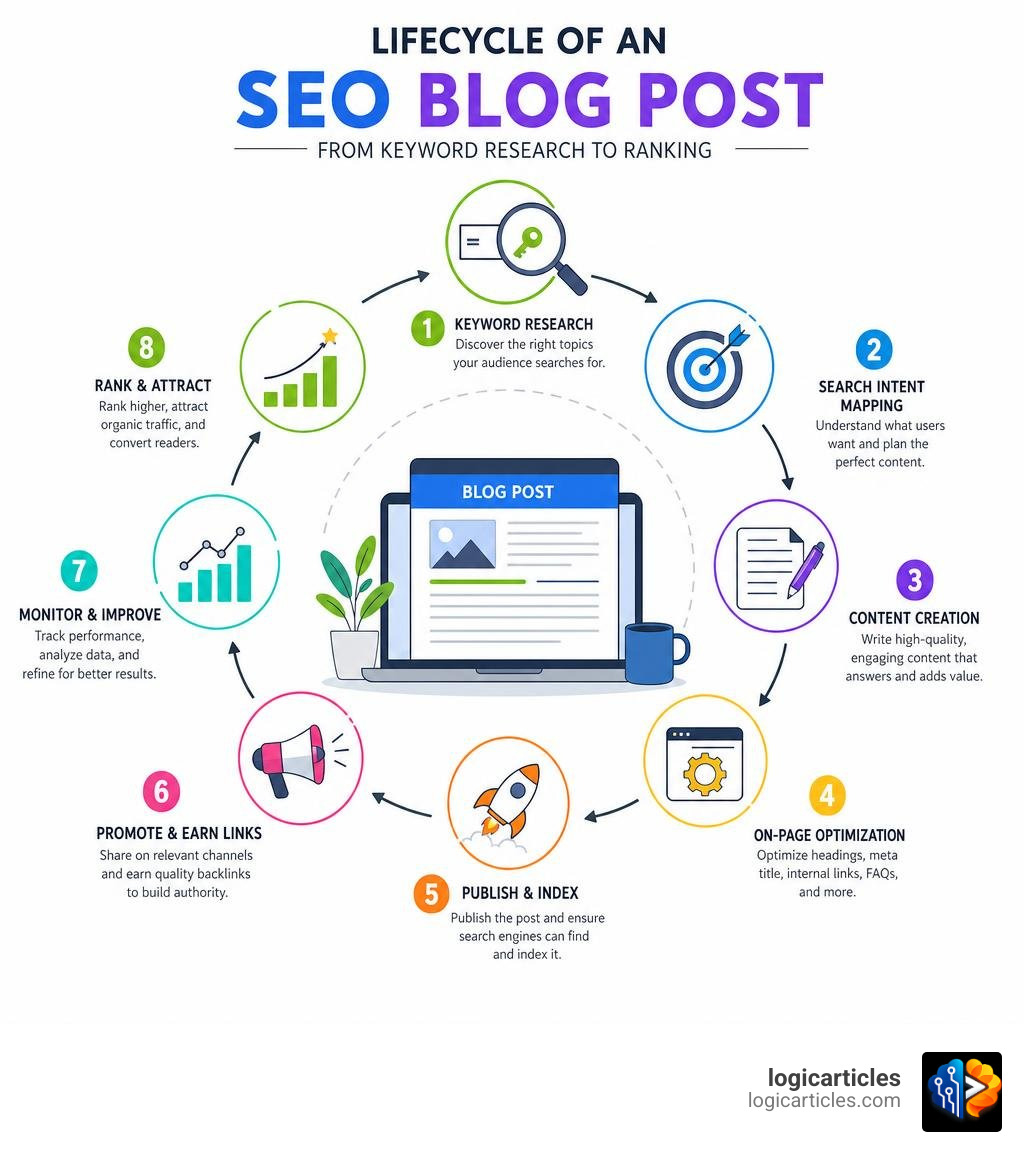
Here’s a quick breakdown of what they typically include:
- Keyword research — finding the terms your audience actually searches for
- Search intent mapping — matching content to what users want to find
- On-page optimization — headings, meta titles, internal links, and FAQ blocks
- Human-quality writing — clear, engaging copy that keeps readers on the page
- Editorial review — fact-checking, quality assurance, and brand voice alignment
These services differ from standard copywriting because ranking on Google requires more than good writing. It requires strategy.
Here’s the reality most businesses run into: they publish blog posts regularly, see little to no traffic growth, and assume content marketing doesn’t work. The problem usually isn’t the writing — it’s the absence of an SEO strategy behind it.
According to industry data, SEO drives over 1,000% more traffic than organic social media. Yet 61% of marketers say growing their organic presence is their top priority. The gap between those two facts is where SEO content writing services live.
Publishing content without SEO is, as one industry expert put it, “the most expensive habit in digital marketing.” You invest time and money creating content that search engines simply never surface.
That’s the core problem these services solve.
The Strategic Value of SEO Content Writing Services
To understand why professional seo content writing services are so valuable, we have to look past the act of putting words on a page. Anyone can write. But writing content that consistently climbs search engine rankings, satisfies user intent, and converts casual readers into paying customers requires a specialized blend of science and art.
When we invest in content, we aren’t just buying articles; we are building long-term digital assets. Unlike paid advertising, which stops delivering leads the moment you stop paying, optimized content continues to generate organic traffic month after month.
However, achieving this compounding growth requires a strategy-first approach. It involves deeply analyzing competitor SERPs (Search Engine Results Pages), understanding search intent, and executing precise keyword optimization without sacrificing editorial quality. For a closer look at how strategic execution looks in practice, you can explore Expert SEO Copywriting Services | Rank Higher & Convert Faster.
The Core Differences Between Standard Copywriting and SEO Content Writing Services
It is common to confuse standard copywriting with SEO content writing, but they serve different masters.
- Standard Copywriting: This is primarily focused on brand voice, persuasion, and immediate conversion. Think of landing pages, email sequences, or social media ads. The goal is to get a user who is already on your page to take action.
- SEO Content Writing: This focuses on both the reader and the search engine algorithm. It requires extensive keyword research, optimizing metadata (like meta titles and descriptions), structuring content with clear heading hierarchies, and covering semantic entities so search engine crawlers understand the page’s context.
Without the technical foundation of SEO, even the most beautifully written copy will sit in digital isolation. Conversely, content written purely for search engines—stuffed with keywords and lacking human warmth—will turn readers away instantly. High-quality seo content writing services bridge this gap, ensuring your copy ranks well and reads naturally. To manage these efforts effectively, businesses often pair these services with the Best Content Marketing Software to streamline their editorial pipelines.
How Professional SEO Content Writing Services Drive Organic Growth
The ultimate goal of any SEO campaign is organic growth. But how does optimized content actually achieve this?
First, it builds topical authority. Search engines like Google no longer look at keywords in isolation; they evaluate your website’s overall expertise on a subject. By publishing comprehensive topic clusters—a pillar page supported by closely related sub-topic articles—you signal to search engines that you are an authority in your niche.
Second, high-quality content naturally earns inbound links. Other websites want to link to comprehensive, well-researched guides. In fact, companies that blog consistently see an average of 97% more inbound links to their websites. This boost in backlink profile raises your overall domain authority, making it easier for all your pages to rank.
To track how these content assets perform over time and monitor your climb up the search results, using the Best Enterprise Rank Tracking Software in 2026 is essential for keeping an eye on your search visibility.
Key Elements of High-Ranking SEO Content
Creating high-ranking content isn’t a guessing game. It is a systematic process that aligns with search engine algorithms while prioritizing user experience.

When professional agencies build content, they follow a rigorous checklist to ensure every piece is primed to rank:
- Search Intent Alignment: Before writing a single word, we must identify why the user is searching. Are they looking to buy, to learn, or to find a specific website?
- On-Page Optimization: This includes placing the primary keyword in the H1, the first 100 words, and the meta tags, while structuring the rest of the draft with logical H2 and H3 tags.
- E-E-A-T (Experience, Expertise, Authoritativeness, Trustworthiness): Search engines prioritize content that shows real-world expertise. This means including credible sources, author bios, and proof-led copy.
To see how these elements come together in a professional workflow, check out SEO Content Writing Services | Content That Ranks & Converts.
Semantic Entity Coverage vs Keyword Density
Keyword density—the practice of repeating a target keyword a certain percentage of times—is a relic of the past. In fact, keyword density as a ranking factor died over a decade ago.
Today, modern search algorithms rely on NLP (Natural Language Processing) and semantic entity coverage. Search engines look for a network of related terms, concepts, and entities that naturally belong together. For example, if you are writing about “software development,” search engines expect to see related entities like “source code,” “agile methodology,” “debugging,” and “frameworks.”
By covering these semantic entities deeply, you fill competitor gaps and make your content much more robust. If you are in the tech space, you can see how this entity-mapping applies directly by reviewing SEO Keywords for Software Companies.
Structuring Content for Featured Snippets and AI Overviews
With the rise of AI-driven search experiences, winning featured snippets and citations in AI Overviews is more important than ever.
To do this, we must structure our content to make it incredibly easy for search engine crawlers to extract quick answers. This is often done by:
- Using direct H2 or H3 questions (e.g., “What is an SEO Content Writing Service?”).
- Providing a concise, 40-to-58-word answer directly below the heading.
- Using bulleted or numbered lists for step-by-step processes.
- Implementing schema markup (such as FAQ or Article schema) to give search engines explicit context about the page’s structure.
Having a clean, technically sound site architecture supports these efforts. Tools like a Sitemap Generator by Spellmistake can ensure search engines crawl and index these structured pages efficiently.
Comparing Human-Written, Hybrid AI, and Elite Content Tiers
The content landscape has changed dramatically. When looking for seo content writing services, you will generally run into three distinct tiers of content creation. Choosing the right one depends on your budget, your industry, and your organic growth goals.
| Content Tier | Description | AI Involvement | Price Range (per 100 words) | Best For |
|---|---|---|---|---|
| Hybrid AI Content | AI-generated drafts that are refined, fact-checked, and formatted by a human editor. | High (AI drafts, human edits) | $5 – $8 | High-volume publishing, basic informational topics, and scaling product descriptions. |
| Human-Written Content | Researched, structured, and drafted entirely by professional writers from scratch. | None (100% human) | $9 – $15 | Standard business blogs, service pages, and industries requiring authentic brand voice. |
| Elite / Senior Content | Written by subject-matter experts with deep niche experience. Highly strategic, entity-led, and authoritative. | None (100% expert human) | $20 – $70+ | Regulated niches (YMYL), highly technical SaaS, and competitive thought leadership. |
While AI tools have made content creation faster, search engines have also gotten smarter. Google rewards high engagement metrics—such as time on page, scroll depth, and interaction. This means that while an AI tool can help draft content quickly, human refinement is what keeps readers engaged. For those looking to explore how automated agents handle the initial heavy lifting, you can read more about Content Writer | AI SEO Agent | Optimatio.
The Role of Human Refinement in Modern SEO Writing
Regardless of the tier you choose, human refinement is non-negotiable. Pure AI-generated content often reads like it was “written by a robot in a hurry.” It lacks original insights, can contain factual inaccuracies (hallucinations), and often fails to capture a brand’s unique voice.
A professional editorial review process ensures that:
- Brand Voice is Consistent: The content sounds like your business, not a generic template.
- Quality Assurance is Met: The draft is free of grammatical errors, fluff, and awkward phrasing.
- Plagiarism and AI Checks are Performed: Ensuring the content is original and safe from automated spam penalties.
Just as a great website needs clean design to keep users engaged, great writing needs visual and structural polish. You can find inspiration on how to present your brand beautifully by checking out the 10 Best Graphic Design Inspiration Sites to Bookmark in 2026.
Pricing Models, Turnaround Times, and Measuring ROI
When hiring an SEO content writing agency, you will typically find three pricing models:
- Per-Word Rates: Best for one-off projects or variable monthly needs.
- Monthly Retainers: Ideal for ongoing campaigns where a set number of optimized articles are delivered each month to build compounding authority.
- Project-Based Pricing: Used for larger, comprehensive assets like pillar guides or complete website rewrites.
Turnaround times generally range from 3 to 6 business days for standard projects under 10,000 words.
To measure the ROI of your investment, you should focus on metrics that matter. While vanity metrics like impressions look nice in a report, true success is measured by organic traffic growth, keyword ranking improvements, lower bounce rates, and ultimately, conversion rates.
Before launching a massive content campaign, it is also wise to ensure your site’s technical foundation is solid. For example, making simple technical errors can prevent search engines from finding your new content in the first place. Learn how to avoid these pitfalls in our guide on how to Generate Robots.txt Files 7 Spellmistakes That Can Hurt SEO. For a comprehensive look at standard pricing packages and structured deliverables, you can also visit Content Writing Services | SEO Content Writing That Converts.
Frequently Asked Questions About SEO Content Writing

How long does it take for SEO content to rank?
For a newly published article, you can typically expect to see impressions appear in Google Search Console within 7 to 14 days as search engine crawlers discover and index the page. However, climbing to page one for competitive keywords takes time. Meaningful ranking movement and organic traffic growth generally occur within 30 to 90 days, depending on your site’s existing domain authority and the competition level of your target keywords.
Can SEO content writing services handle highly technical niches?
Yes, provided you work with agencies that employ specialized subject-matter experts. Complex fields like legal, medical, financial, or technical SaaS require writers who understand industry-specific terminology and compliance standards. Writing generic content in these spaces can damage your brand’s credibility and search rankings. For those looking to align their technical content with modern development standards, we recommend reviewing Web Development Best Practices 2026.
How do agencies ensure content is both SEO-friendly and engaging?
The secret lies in writing for humans first and search engine algorithms second. Professional writers use natural readability patterns—such as short paragraphs, bulleted lists, and clear subheadings—to improve the user experience. They strategically place keywords where they make sense contextually, rather than stuffing them into the text. This keeps readers on the page longer, signaling to search engines that your content is valuable and deserving of a higher rank.
Conclusion
In the competitive digital landscape of 2026, simply publishing words on a page is no longer enough to win the organic search game. To stand out, businesses need a strategy-first approach that satisfies search intent, covers semantic entities, and delivers genuine value to the reader.
Investing in professional seo content writing services is one of the most effective ways to build lasting topical authority, earn high-quality backlinks, and drive sustainable, compounding organic growth.
Ready to elevate your digital presence and find the right tools to power your brand’s growth? Explore the Best Software Solutions to streamline your marketing and SEO workflows today!