Why Most Software Engineers Hit a Career Wall (And How Soft Skills Break Through It)

Soft skills for software engineers are the non-technical abilities — like communication, empathy, time management, and collaboration — that determine how well you work with others and how far you advance in your career.
Here are the most important soft skills for software engineers:
- Communication — writing clearly, speaking confidently, and listening actively
- Emotional intelligence — managing your own reactions and understanding others
- Collaboration and teamwork — working effectively across functions and time zones
- Time management and prioritization — meeting deadlines and estimating accurately
- Problem-solving and critical thinking — navigating complexity with structure
- Adaptability — handling changing requirements without losing momentum
- Empathy — understanding users and teammates at a deeper level
- Feedback skills — giving and receiving criticism constructively
- Business acumen — translating technical work into real business value
- Leadership and mentoring — multiplying your impact by lifting others
You might be able to debug any system thrown at you. But can you explain why it broke to a non-technical stakeholder? Can you push back on an unrealistic deadline without burning a bridge? Can you mentor a junior developer without making them feel small?
These are the questions that separate engineers who plateau from engineers who grow into senior, staff, and principal roles.
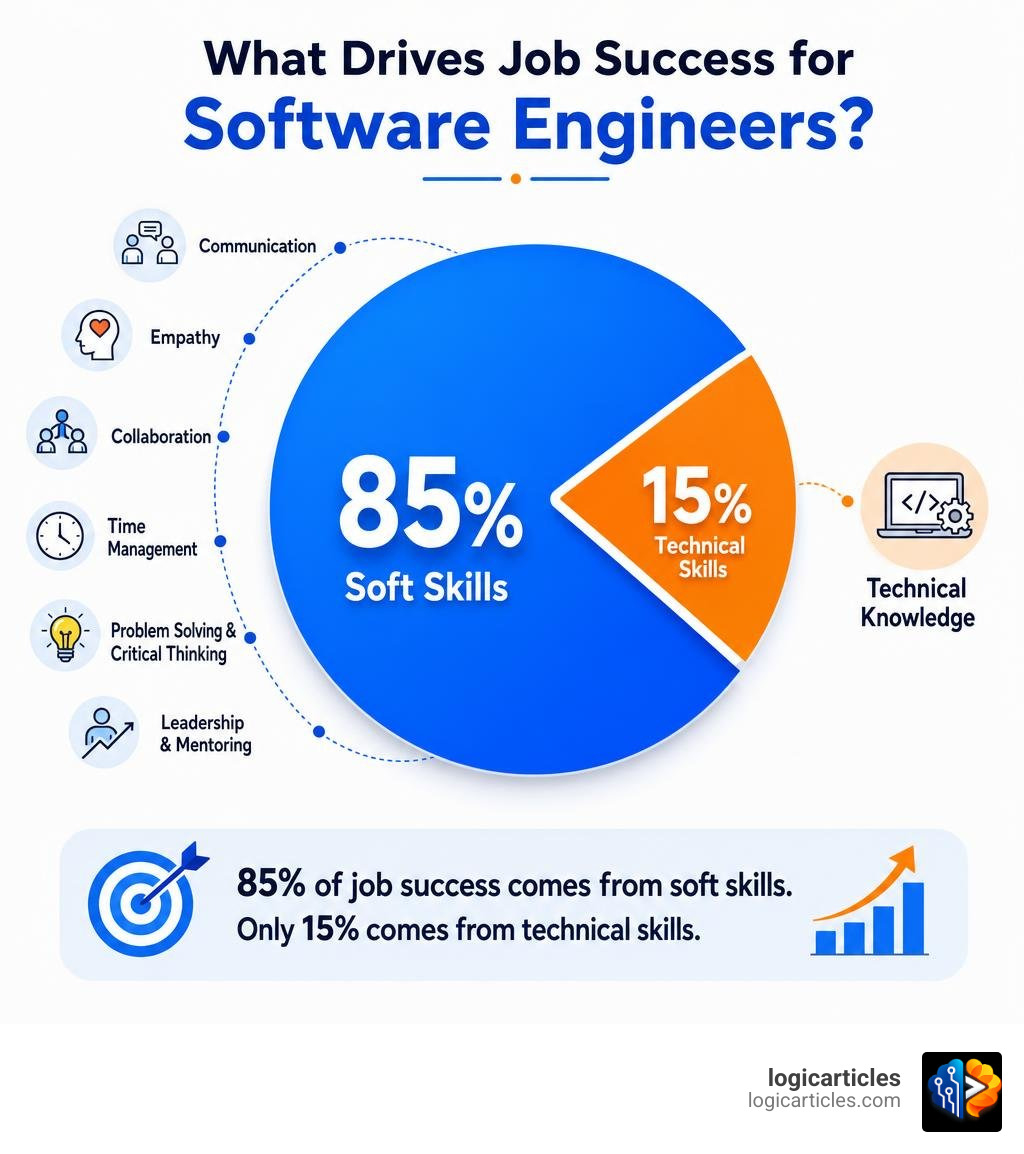
The numbers back this up. Research from Harvard, Carnegie Foundation, and Stanford found that 85% of job success comes from soft skills, while only 15% comes from technical knowledge. A separate National Academy study puts soft skills at up to 80% of overall job performance.
Yet most engineers spend nearly all their learning time on the technical 15%.
That gap is exactly where careers stall — and where this guide comes in.
Why Soft Skills for Software Engineers Matter More Than Ever in 2026
We live in a world where AI coding assistants can handle up to 80% of routine syntax generation, boilerplate writing, and basic debugging. In 2026, writing code is no longer the primary differentiator of an exceptional engineer. The true value has shifted from pure execution to system design, technical alignment, and strategic collaboration.

When anyone can generate a functional React component or a Python script with a well-crafted prompt, the engineers who stand out are those who can bridge the gap between technical possibilities and human needs.
If we only focus on our hard skills, we quickly hit what we call the “seniority ceiling.” This is the point in your career where being a coding genius is no longer enough to earn you a promotion. To move into staff, principal, or engineering management roles, you must scale your effectiveness through others. This means coordinating complex cross-functional efforts, mentoring teams, and aligning engineering outcomes with business goals.
To illustrate how the landscape has evolved, let’s look at how hard skills and soft skills compare in 2026:
| Hard Skills (The “What” and “How”) | Soft Skills (The “Who” and “Why”) |
|---|---|
| Writing clean, modular code | Translating complex technical constraints for non-technical stakeholders |
| Designing database schemas and system architectures | Aligning cross-functional teams on a unified engineering vision |
| Utilizing AI-assisted development tools and LLMs | Evaluating trade-offs, ethics, and user impact of technical decisions |
| Optimizing performance and writing unit tests | Mentoring junior developers and building a culture of psychological safety |
Mapping Soft Skills for Software Engineers Across Career Stages
The soft skills you need aren’t static; they evolve as you progress through your engineering journey.
- Junior Developers: At the start of your career, your primary soft skills are curiosity, active listening, and the ability to ask high-quality questions. Instead of trying to look like you know everything, focus on being coachable, taking constructive feedback without defensiveness, and communicating when you are stuck before wasting days on a single problem.
- Mid-Level Engineers: As you gain independence, your focus shifts to collaboration, time management, and dependability. You need to provide accurate estimates, manage your own workload, and actively contribute to code reviews and team discussions. If you are looking to formalize your technical foundation during this stage, pursuing an Online Best Software Engineering Degree in 2026 can provide both the theoretical depth and the structured group-work experience needed to transition to higher levels.
- Senior and Lead Engineers: At this stage, your job is about multiplying the output of those around you. This requires strategic career vision, mentorship, conflict resolution, and business acumen. You must learn how to say “no” constructively, negotiate technical debt with product managers, and lead without formal authority.
These dynamics look slightly different depending on your workspace. In a remote environment, asynchronous written communication, proactive status updates, and self-motivation are your lifelines. In an in-office environment, reading the room, spontaneous collaboration, and active listening during physical meetings take center stage.
Core Communication and Collaboration Frameworks for Developers
According to research from Atlassian, a staggering 96% of professionals believe that poor communication is the primary driver of project failures and workplace tension. In software development, communication is not just about being “nice”; it is about reducing ambiguity, aligning expectations, and ensuring that the systems we build actually solve the problems at hand.
One of the most frequent touchpoints for developer communication is the code review process. It is also a common breeding ground for friction. When we treat code reviews as a battlefield of egos, we alienate our teammates. Instead, we should treat code reviews as collaborative learning sessions.
An excellent way to build trust and maintain healthy team dynamics is to use the “I-Statement” framework and practice de-escalation techniques. When pointing out an issue, avoid accusatory language like, “You forgot to handle edge cases here.” Instead, frame it around the code and your perspective: “I’m concerned that this endpoint might time out if we receive a large payload. What do you think about adding a pagination limit?”
To dive deeper into why these human elements are so challenging yet vital, we highly recommend reading Soft Skills Aren’t Soft: The Hardest Skills for Developers to Learn. It highlights that learning to listen, manage frustration, and collaborate is often far more difficult than mastering a new framework.
To keep communication clear, we can adopt a few simple daily habits:
- Context-Content-Action: When writing a Slack message or an email, start with the context (why you are reaching out), provide the content (the core message or update), and end with a clear action item (what you need from the recipient and by when).
- Active Listening Cues: During meetings, don’t just wait for your turn to speak. Practice active listening by summarizing what the other person said before responding: “It sounds like your main concern is the latency of the payment gateway, is that correct?”
- The “One-Sentence Summary”: After a complex technical discussion, follow up with a brief written summary of the decisions made and the next steps to ensure everyone is on the same page.
Empathy and Emotional Intelligence in Team Dynamics
We often think of empathy as a warm, fuzzy concept, but in engineering, it is a highly practical tool. Empathy allows us to build better software because it forces us to put ourselves in our users’ shoes. It helps us ask: How will a non-technical user navigate this interface? What edge cases might cause them frustration?
When we combine user empathy with technical execution, we naturally align our development process with Web Development Best Practices 2026, creating accessible, responsive, and intuitive applications.
Empathy is also the foundation of psychological safety—the belief that you won’t be punished or humiliated for making a mistake, asking a question, or proposing a wild idea. Teams with high psychological safety ship better code faster because they don’t hide their mistakes; they discuss them, learn from them, and fix them.
To foster this environment, try implementing the “2+1” rule during code reviews or architectural feedback: for every critical piece of feedback or suggestion you make, balance it with two positive callouts. Acknowledge a clever optimization, a well-written test, or a clear variable name. This ensures your teammates feel valued and receptive to constructive critique.
Time Management, Estimation, and Navigating Ambiguity
One of the quickest ways to lose client trust and stakeholder confidence is to consistently miss deadlines. Yet, estimating software development timelines is notoriously difficult. Developers are natural optimists; we estimate based on a world where everything works perfectly on the first try, the APIs never go down, and we face zero interruptions.
To protect your credibility and build trust, we recommend using the Multiplication Method for estimation:
- Formulate your “gut” estimate of how long the actual coding will take.
- Multiply that number by 2.5.
- Round up to the nearest logical time block.
Why 2.5? Because writing code is only a fraction of the software development lifecycle. The rest of your time is spent clarifying ambiguous requirements, writing tests, navigating code reviews, resolving CI/CD pipeline failures, performing QA, and deploying the feature.
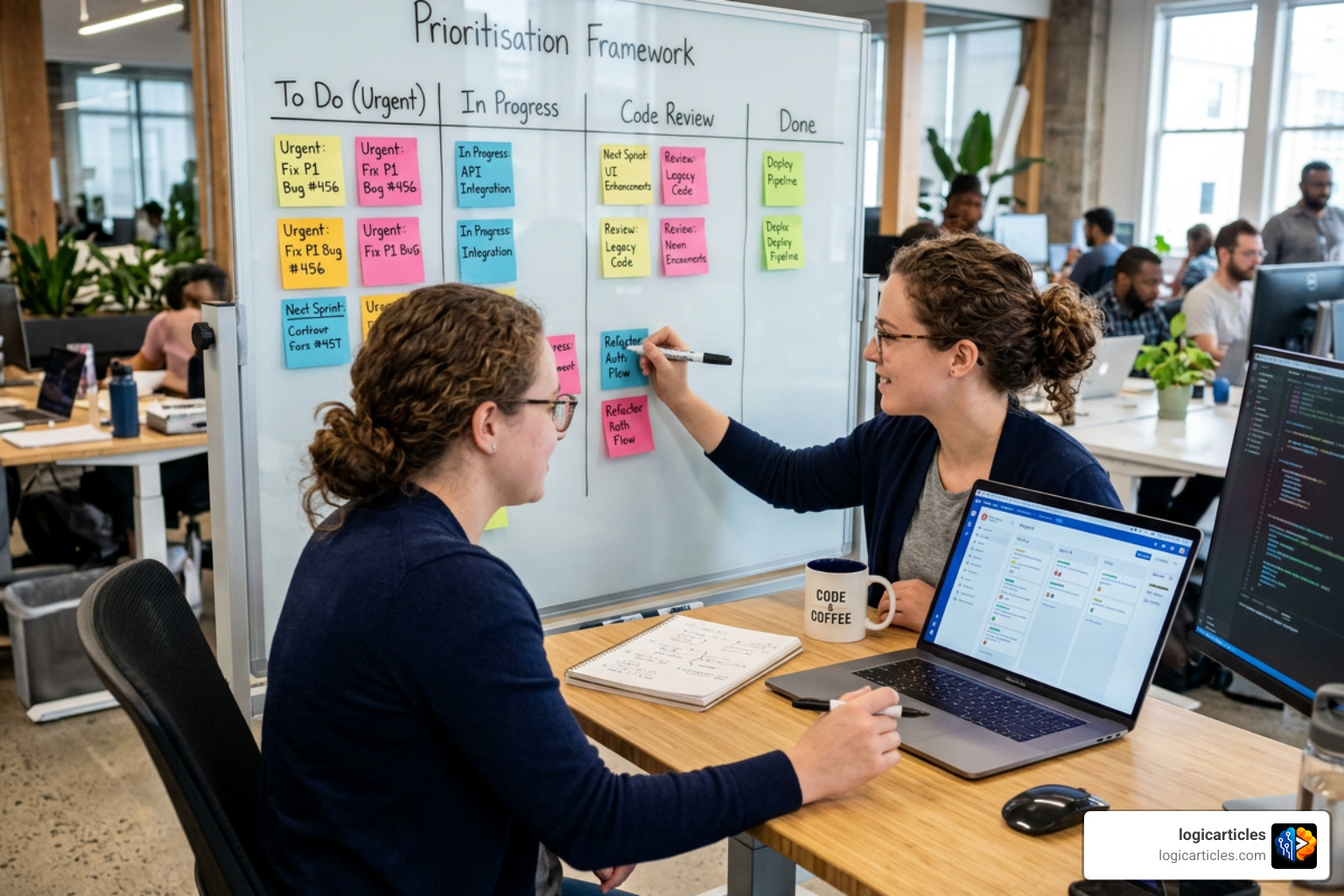
To manage your daily workload and avoid burnout, use the Eisenhower Matrix to sort your tasks:
- Urgent & Important: Critical production bugs, hotfixes, and tight project deadlines.
- Important but Not Urgent: Writing documentation, refactoring technical debt, system design planning, and skill development. (This is where high-performing engineers spend most of their time).
- Urgent but Not Important: Routine Slack pings, minor non-critical meetings, and administrative tasks.
- Not Urgent & Not Important: Doomscrolling tech forums or over-optimizing a local script that works perfectly fine.
If you want to read a comprehensive guide on how these non-technical skills impact career advancement and estimation, explore the insights on Soft Skills for JavaScript Developers in 2026.
Translating Technical Complexity into Business Value
As an engineer, you will often find yourself working with product managers, designers, sales teams, and executives. These stakeholders rarely care about the elegant design patterns of your codebase or the specific database indexing strategy you chose. They care about business outcomes: Does this reduce user churn? Does it speed up checkout? Does it lower server costs?
To collaborate effectively, you must practice bilingual communication—the ability to translate complex technical constraints into business value.
Instead of saying:
“We need to spend two weeks refactoring our legacy database queries because the SQL joins are highly unoptimized and causing database locks.”
Try saying:
“We need to invest two weeks in optimizing our database queries. Currently, the slow checkout page is causing a 15% user abandonment rate during peak hours. This update will speed up checkout by 3 seconds, directly improving our conversion rate and protecting revenue.”
This level of business acumen is particularly critical when acting as an external partner or consultant. If you are interested in how modern agencies navigate these high-stakes relationships, check out our insights on Software Development Consulting in 2026.
Problem-Solving, Adaptability, and Continuous Growth
At its core, software engineering is not about typing code; it is about solving problems. Excellent problem-solving requires critical thinking, structured analysis, and the ability to stay calm under pressure. When a system crashes in production, a great engineer doesn’t panic or start randomly changing lines of code. They systematically isolate variables, analyze logs, and formulate hypotheses.
This structured mindset is also what top-tier tech companies look for in system design interviews. They aren’t just testing whether you know how to configure a load balancer; they are evaluating how you think, how you handle changing constraints, and how you communicate trade-offs. To master this approach, read Soft Skills for Software Engineers: The Complete Guide, which details how to structure your thoughts and collaborate during complex design discussions.
Additionally, we must embrace the reality of fluid requirements. In the real world, product requirements change as market conditions shift. Instead of getting frustrated when a feature scope changes, view it as an opportunity to build adaptable, modular systems.
This adaptability is also learned when working on legacy codebases or maintenance projects. While everyone loves “green-field” projects where they can build from scratch, working on maintenance projects teaches you how real-world systems scale, where they break, and how to write code that is easy for the next developer to read.
Overcoming Imposter Syndrome and Accepting Feedback
If you have ever looked at a pull request with 20+ comments and felt a wave of panic or self-doubt wash over you, you are not alone. Imposter syndrome is incredibly common in the tech industry. The rapid pace of technological change means there is always something new to learn, which can make even seasoned professionals feel like they are falling behind.
The key to overcoming this is shifting from a fixed mindset to a growth mindset:
- Treat feedback like a bug report: Feedback on your code is not a reflection of your worth as a human being. It is simply data about system behavior from another perspective.
- Take outcome ownership: Instead of trying to write flawless code on the first try, focus on delivering reliable, maintainable software and owning the results. If a bug makes it to production, don’t look for someone to blame. Write a postmortem, document the prevention steps, and help the team learn from it.
- Pay it forward: One of the best ways to fight imposter syndrome is to mentor junior developers. Explaining concepts to others solidifies your own knowledge and reminds you of how far you have come.
How to Showcase and Develop Your Interpersonal Abilities
You can have the most polished soft skills in the world, but if you don’t know how to demonstrate them during the hiring process, you might miss out on your dream role.
When writing your resume, avoid generic bullet points like “Excellent communication skills” or “Great team player.” These are empty buzzwords. Instead, use the STAR format (Situation, Task, Action, Result) to show your soft skills in action:
- Weak: “Helped mentor junior developers on the team.”
- Strong (STAR): “Mentored 3 junior developers through weekly pair programming sessions, reducing their average onboarding time from 6 weeks to 4 weeks.”
- Weak: “Good at managing time and meeting deadlines.”
- Strong (STAR): “Led a cross-functional team of 4 to deliver a critical payment integration under a tight 3-week deadline, utilizing the Eisenhower matrix to prioritize tasks and launching 2 days ahead of schedule.”
During behavioral interviews, interviewers are looking for how you handle conflict, navigate ambiguity, and recover from failure. Be prepared with real-world stories where you had to disagree with a teammate, handle a difficult stakeholder, or manage a high-pressure production outage.
Here is a quick checklist of essential soft skills to weave into your resume and interview stories:
- Active listening (e.g., gathering requirements, incorporating feedback)
- Conflict resolution (e.g., navigating diverging technical opinions constructively)
- Cross-functional collaboration (e.g., working with product, design, and QA)
- Mentorship and coaching (e.g., pair programming, leading lunch-and-learns)
- Strategic prioritization (e.g., balancing technical debt with feature delivery)
Practical Exercises to Build Soft Skills for Software Engineers
Just like clean coding, soft skills are learnable behaviors that compound over time. Here are some actionable exercises you can start practicing this week:
- The EQ Habit Loop: Set a daily calendar reminder or run a simple local cron script to trigger a notification at the end of the day. Spend 2 minutes writing down one social interaction that went well, one that felt tense, and what you could do to improve the next one.
- The “Why” Exercise: Before starting any new ticket or feature, write down a single sentence explaining why this task matters to the end user or the business. If you can’t explain the “why,” reach out to your product manager for clarification.
- Active Documentation: Write internal documentation, API guides, or runbooks for your team. This forces you to practice clear, concise written communication and makes your team more resilient.
- Mock Interviews & Recording: Record yourself explaining a complex technical system or answering a behavioral question. Watch the playback to analyze your pacing, body language, and clarity of explanation.
For a deeper dive into establishing these daily habits, read Mastering Soft Skills for Software Engineers: A Practical Guide – DEV Community.
Frequently Asked Questions about Soft Skills in Tech
How can I showcase soft skills on my resume?
The best way to showcase soft skills on your resume is by using quantifiable, action-oriented bullet points that demonstrate the impact of those skills. Instead of listing “collaboration” as a skill, write about how you cooperated with cross-functional teams to deliver a feature that increased user engagement by 15%. Use the STAR method to structure your achievements.
Which soft skills are most important for remote software engineers?
For remote software engineers, the most critical soft skills are proactive asynchronous communication, self-motivation, and dependability. Because you don’t have spontaneous watercooler chats, you must document your progress clearly, write highly descriptive pull requests, over-communicate your status, and manage your time effectively without direct supervision.
How do I give constructive feedback in code reviews without sounding condescending?
To keep code reviews positive and constructive, focus your comments on the code rather than the person. Use the “I-Statement” framework to express concerns, ask open-ended questions to invite discussion (e.g., “What do you think about using a map here to improve lookup times?”), and apply the “2+1” rule to balance your critiques with genuine appreciation for their work.
Conclusion
At the end of the day, software engineering is a team sport. While your technical skills will get you through the door, your soft skills for software engineers are what will keep you in the room, earn you promotions, and allow you to build truly impactful technology.
As we navigate the landscape of 2026, let’s commit to treating our interpersonal habits with the same rigor we apply to our codebases. We should continuously deploy better communication habits, run self-reflection tests on our team interactions, and refactor our prioritization strategies.
If you are looking to leverage modern technology to streamline your workflows, automate routine tasks, and free up more time to focus on strategic communication and system design, Explore AI Tools on logicarticles. We regularly update our resources to help you stay ahead of the curve and accelerate your career.