Why You Need to Compare Different Software Testing Strategies, Outlining Their Applicability and Benefits

To compare different software testing strategies, outlining their applicability and benefits is one of the most valuable things any development team can do before writing a single test case. The strategy you choose shapes your release speed, defect rates, and long-term maintenance costs — often by a wider margin than the tools you pick.
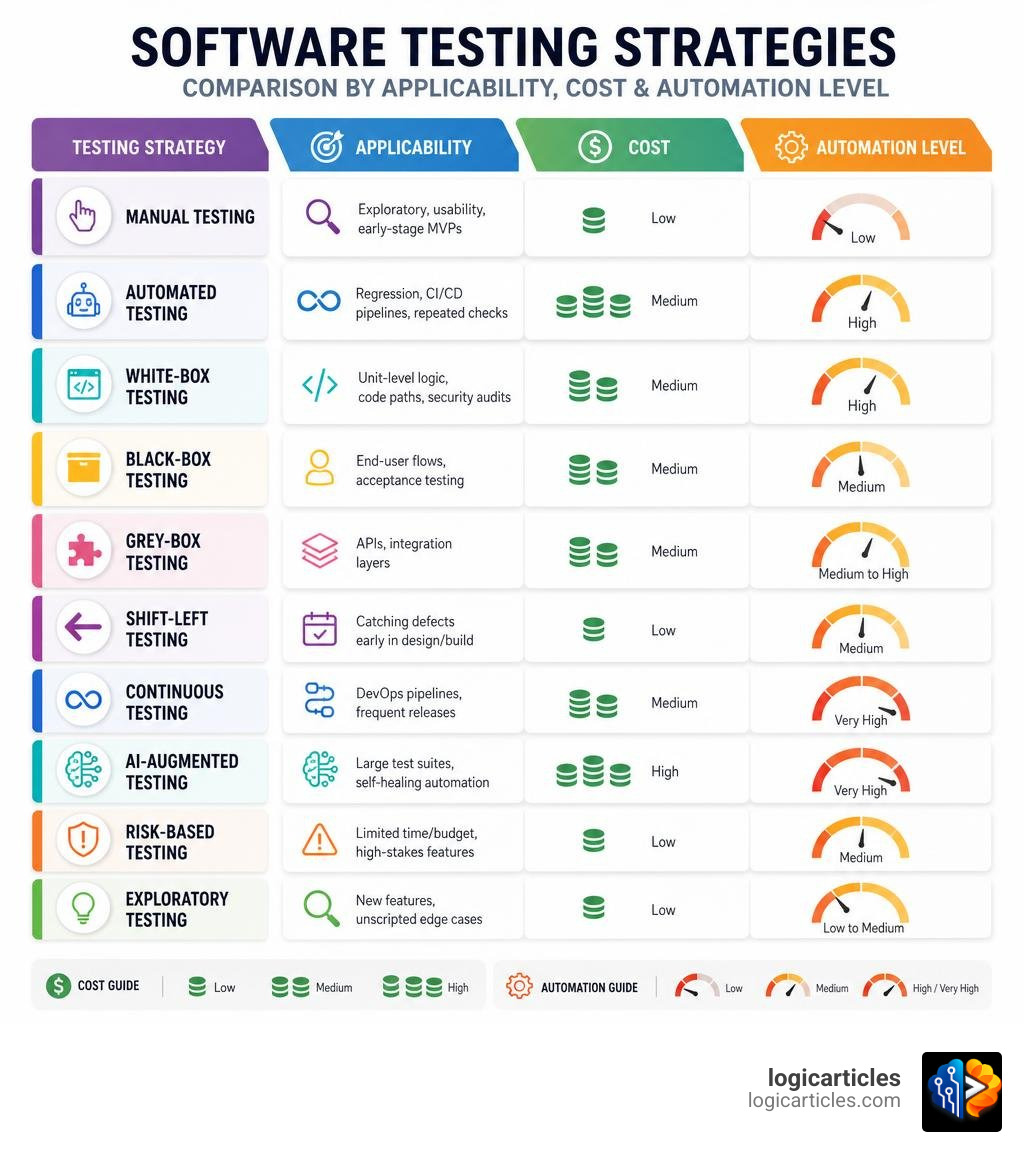
Here is a quick reference so you can find the right fit fast:
| Strategy | Best For | Key Benefit |
|---|---|---|
| Manual Testing | Exploratory, usability, early-stage MVPs | Flexible, no setup cost |
| Automated Testing | Regression, CI/CD pipelines, repeated checks | Fast, scalable, consistent |
| White-Box Testing | Unit-level logic, code paths, security audits | Deep code coverage |
| Black-Box Testing | End-user flows, acceptance testing | No code knowledge needed |
| Grey-Box Testing | APIs, integration layers | Balances depth and realism |
| Shift-Left Testing | Catching defects early in design/build | Up to 50% lower fix costs |
| Continuous Testing | DevOps pipelines, frequent releases | 60% fewer post-release failures |
| AI-Augmented Testing | Large test suites, self-healing automation | 30-50% better coverage |
| Risk-Based Testing | Limited time/budget, high-stakes features | Effort focused where it counts |
| Exploratory Testing | New features, unscripted edge cases | Surfaces unexpected defects |
Most teams in 2026 don’t rely on just one approach. They combine three or four strategies depending on their project type, team size, and risk tolerance.
The cost of getting this wrong is real. Poor software quality cost the US economy an estimated $2.41 trillion in 2022. And defects caught after shipping cost roughly 30 times more to fix than those caught during design.
This guide breaks down every major strategy — what it is, when to use it, and what you actually gain from it.
Core Categories of Software Testing Strategies
To build an effective quality assurance engine, we must first establish a shared vocabulary. The testing landscape is often divided into core execution methods, structural techniques, and primary quality objectives. Understanding these foundational classifications allows us to design a balanced approach that leaves no room for critical defects.
Manual vs. Automated Testing
The debate between manual and automated testing is not about which is superior, but rather about which is appropriate for the task at hand.
- Manual Testing remains indispensable for scenarios requiring human intuition, subjective evaluation, and visual aesthetics. Usability testing, ad-hoc exploratory sessions, and early-stage prototyping benefit immensely from a human perspective. However, manual testing is slow, prone to human error, and expensive to scale for repetitive tasks.
- Automated Testing shines in regression testing, load validation, and continuous integration pipelines. By automating repetitive checks, we can run thousands of test cases in minutes. Organizations that implement automated testing report up to 40% faster release cycles and 25% fewer production defects compared to manual-only approaches. The primary trade-off is the initial cost of test authoring and the ongoing burden of test maintenance.
White-Box, Black-Box, and Grey-Box Testing
These three techniques define how much visibility a tester has into the underlying codebase.
- White-Box Testing (Structural Testing): Testers have full access to the source code, architecture diagrams, and internal paths. This is highly effective for unit testing, path execution coverage, and mutation testing. It ensures that every logic branch, boundary condition, and data flow path behaves correctly.
- Black-Box Testing (Behavioral Testing): The internal code remains a mystery. Testers evaluate the system purely from an end-user perspective, verifying outputs against specific inputs. This is crucial for user acceptance testing (UAT), functional validation, and system integration.
- Grey-Box Testing: This hybrid approach grants testers partial knowledge of the internal workings, such as database schemas, API contracts, or architectural diagrams, while they execute tests at the functional level. It is exceptionally valuable for web service integration and system-level validation.
Functional vs. Non-Functional Testing
Every testing strategy must address both what the software does and how well it does it.
- Functional Testing validates specific business requirements and user actions. This includes unit, integration, sanity, smoke, and acceptance testing. It answers the question: “Does this feature work as intended?”
- Non-Functional Testing evaluates operational characteristics under specific conditions. It encompasses performance, load, stability, scalability, security, and compatibility testing. It answers the question: “How does the system behave under stress or when subjected to security threats?”
Static vs. Dynamic Testing
- Static Testing happens early in the software development lifecycle (SDLC) before any code is executed. It involves peer reviews, static code analysis, and walkthroughs of requirements and designs. Catching errors during this phase is highly cost-effective.
- Dynamic Testing requires code execution. It validates behavior, memory usage, and physical performance by interacting with a running software environment.
For a deeper dive into preventing downtime and structuring these core layers, see our What Is Testing In Zillexit Software 2026 Guide To Prevent Bugs Downtime Data Loss. To understand how engineering leaders structure these methodologies at the corporate level, check out Software Testing Methodologies Explained for Engineering Leaders.
Compare Different Software Testing Strategies, Outlining Their Applicability and Benefits
Selecting a testing strategy is not a one-size-fits-all decision. High-performing engineering teams analyze their project scope, risk tolerance, and delivery cycles to combine multiple approaches. Let us compare the five most widely used high-level testing strategies to understand their unique benefits and real-world applicability.

1. Risk-Based Testing
Risk-based testing prioritizes features and test cases based on the likelihood of failure and the business impact of that failure.
- Applicability: Ideal for legacy systems, enterprise migrations, and SaaS products with tight deadlines.
- Benefits: Optimizes resource allocation by focusing testing efforts on mission-critical features, such as payment gateways or user authentication, while deprioritizing low-risk areas like settings page copy.
2. Requirements-Based Testing
This strategy derives test cases directly from documented functional and non-functional requirements.
- Applicability: Standard practice in highly regulated industries, enterprise vendor engagements, and safety-critical environments.
- Benefits: Ensures absolute traceability between software requirements and test execution, leaving no feature unvalidated and providing clear compliance documentation for external audits.
3. Model-Based Testing
Model-based testing uses formal models of the software’s behavior (such as state transition diagrams or flowcharts) to automatically generate test cases.
- Applicability: Highly effective for complex workflows, multi-state systems, and telecom or automotive software.
- Benefits: Drastically reduces test design effort and ensures comprehensive coverage of complex state transitions that manual test design might miss.
4. Exploratory Testing
Exploratory testing is a highly disciplined, unscripted approach where testers simultaneously learn about the application, design the test cases, and execute them.
- Applicability: Crucial for new feature validation, complex user interfaces, and early-stage MVP testing.
- Benefits: Surfaces unexpected edge cases, visual defects, and usability issues that structured, scripted automation fails to catch.
5. Crowdsourced Testing
This strategy leverages a distributed network of real-world testers globally to evaluate software across diverse devices, networks, and locales.
- Applicability: Essential for mobile applications, consumer-facing e-commerce platforms, and global localization campaigns.
- Benefits: Provides rapid, multi-device compatibility feedback and uncovers localized usability issues before full-scale commercial launch.
For a detailed comparative breakdown of these and other emerging patterns, read Software Testing Strategies: 12 Approaches Compared (2026).
How to Compare Different Software Testing Strategies, Outlining Their Applicability and Benefits for Web Applications
When validating modern web applications, the testing strategy must adapt to rapid UI changes and complex state management. Front-end testing strategies have evolved significantly to balance execution speed with user-level confidence.
Historically, teams relied on the traditional Test Pyramid, which advocates for a large volume of unit tests, a moderate layer of integration tests, and a tiny sliver of end-to-end (E2E) tests. While this works well for isolated microservices, modern front-end Single Page Applications (SPAs) often benefit more from alternative models:
- The Testing Trophy: Proposed by Kent C. Dodds, this model places the heaviest emphasis on integration testing. It suggests that component integration tests offer the highest return on investment, while static analysis provides the baseline and E2E tests are reserved for critical user journeys.
- The Testing Diamond: Highly popular for backend APIs and web applications where database and external service integrations are critical to the user experience.
To implement these frameworks effectively, teams use tools like Playwright and Cypress for functional E2E testing, alongside React Testing Library for component testing. Furthermore, visual regression testing has become critical; it captures screenshots of components and compares them to approved baselines to detect unintended layout shifts.
To learn more about implementing these patterns in your codebase, read the Software Testing Strategies Complete Guide 2025.
Why You Must Compare Different Software Testing Strategies, Outlining Their Applicability and Benefits for Regulated Systems
In regulated industries — such as healthcare, aerospace, and financial services — software failure is not just a minor inconvenience; it can be life-threatening or financially catastrophic. For these systems, testing strategies are heavily governed by international standards like ISO/IEC/IEEE 29119.
In these environments, a requirements-based testing strategy paired with a rigorous Traceability Matrix is non-negotiable. Every line of code and every test case must map back to a specific system requirement to satisfy external auditors.
Furthermore, implementing shift-left testing practices is critical. By introducing testing activities during the initial requirement and design phases, organizations can reduce defect remediation costs by up to 50%. Identifying a design flaw early prevents the massive overhead of refactoring fully built, safety-critical code. For more on validating regulated platforms, explore our guide on Medical Device Software Testing.
Traditional vs. Modern Testing Methodologies in Agile and DevOps
The transition from traditional Waterfall models to Agile, DevOps, and continuous delivery has fundamentally altered when, how, and by whom software is tested.

In traditional models, testing was a distinct phase occurring late in the SDLC. While the V-Model provided structured validation levels — linking unit, integration, system, and acceptance testing to their respective development stages — it often created a bottleneck that delayed releases.
Modern software delivery demands continuous validation. Let us look at how these practices integrate across modern pipelines:
- Shift-Left Testing: Moving testing earlier in the lifecycle. Developers write unit tests alongside code, and QA professionals participate in requirements refining, ensuring that bugs are prevented rather than merely detected.
- Shift-Right Testing: Extending testing into post-release production. This involves synthetic monitoring, canary deployments, A/B testing, and chaos engineering to validate reliability under real-world conditions.
- Continuous Testing: Automatically executing automated tests throughout the CI/CD pipeline to provide rapid feedback on every code commit. This approach reduces post-release failures by 60% and accelerates feedback cycles by 70%.
For a practical look at setting up these continuous loops, read Software Testing Strategies: A Practical Guide.
The Role of AI and Automation in Modern Testing
As we operate in June 2026, artificial intelligence and machine learning are no longer experimental concepts in software testing; they are mainstream drivers of quality engineering efficiency.
AI-augmented testing tools improve test coverage by 30-50% and reduce test maintenance effort by 40%. The most impactful applications include:
- AI-Assisted Test Generation: Large Language Models (LLMs) analyze application code, user stories, and API specs to automatically generate robust test cases, unit tests, and E2E scripts.
- Self-Healing Tests: Traditional automation suites are notoriously fragile; a minor change in a CSS selector or element ID can break dozens of tests. AI-powered execution engines dynamically analyze DOM changes and self-heal element locators in real-time, preventing false failures.
- Agentic Testing: The newest strategic paradigm. Rather than merely assisting human testers, autonomous AI agents explore applications, author test suites from raw intent, run tests in virtual browsers, and self-heal across UI iterations. Human QA professionals shift their focus to defining high-level policies, training AI models, and managing complex edge cases.
Despite these advancements, teams must navigate challenges like AI explainability (understanding why an AI agent flagged a specific behavior as a bug) and test data management to ensure AI models are trained on safe, realistic, and compliant data sets.
Implementing Testing Strategies in Agile and DevOps Pipelines
Integrating a comprehensive testing strategy into a fast-moving DevOps pipeline requires careful orchestration. We cannot simply run our entire multi-hour test suite on every pull request without paralyzing development speed.
Instead, we must implement a tiered execution strategy:
- On Every Commit/PR: Run static code analysis, linting, and fast unit tests.
- On PR Merge (CI Gate): Execute a targeted smoke testing suite and critical API integration tests.
- Daily/Nightly Builds: Run full regression testing, visual regression suites, and basic security scans.
- Before Production Release: Run sanity testing on the final build, performance validation, and deep security checks.
To prevent test environments from becoming bottleneck points, modern teams utilize service virtualization to simulate unavailable APIs and databases. Furthermore, verifying that your pipeline meets strict security baselines is essential; read more about this in our article on Cybersecurity Software Requirements. For a step-by-step framework on writing and structuring these automated pipelines, review Software Testing Strategies: Types, Methods and Best Practices.
Aligning Testing with Software Maintenance and Consulting
A software testing strategy is not just about shipping the next release; it is a long-term investment in software maintainability. Without a robust, automated regression suite, a codebase quickly accumulates technical debt. As original developers move on, the knowledge of how different modules interact is lost, making future modifications highly risky.
This is where professional consulting and structured maintenance services become invaluable. Strategic test coverage ensures that future updates, security patches, and platform migrations can be executed with absolute confidence.
If your team is looking to modernize its QA processes or manage legacy systems, explore how we approach quality engineering in Software Development Consulting In 2026 and find the right service-level agreements in Best Software Maintenance Services 2026.
Frequently Asked Questions about Software Testing Strategies
What is the difference between a test strategy and a test plan?
A test strategy is a high-level, long-term operating model (often owned by QA or engineering leadership) that defines how an organization approaches quality assurance, which methodologies are used, and how coverage is measured. It changes infrequently (typically once or twice a year).
A test plan, on the other hand, is a tactical, project-specific document that outlines what is being tested in a specific release, who is executing the tests, the physical schedule, and resource allocation. It is highly dynamic and updated throughout each sprint.
How does shift-left testing reduce development costs?
According to studies by the IBM Systems Sciences Institute, a defect caught during the design or requirements phase costs 15 times less to remediate than one caught during beta testing, and up to 30 times less than a defect that escapes into production. Shift-left testing reduces costs by involving QA professionals early in the design process, catching conceptual errors and logical flaws before developers write a single line of code.
What is an agentic testing strategy?
An agentic testing strategy is an advanced modern approach where autonomous AI agents own the majority of the testing lifecycle. These agents can independently navigate an application, detect UI changes, generate and execute test scripts based on natural language requirements, and automatically repair broken locators. The human tester’s role evolves into defining high-level policies, reviewing edge cases, and supervising the AI’s learning loop.
Conclusion
To compare different software testing strategies, outlining their applicability and benefits, is the foundation of a mature software engineering organization. From traditional unit and integration testing to modern continuous and agentic testing strategies, the right combination of approaches ensures that your team can ship software rapidly without compromising on quality or security.
By shifting left, automating repetitive regression checks, and leveraging AI where appropriate, you can drastically reduce maintenance overhead and deliver exceptional user experiences.
If you are ready to evaluate and select the best tools to power your quality assurance engine, Explore the Best Software Categories on logicarticles today.