When a Bug Becomes a Safety Event: What Medical Device Software Testing Really Means

Medical device software testing is the process of systematically verifying and validating that software controlling or embedded in a medical device works correctly, safely, and in compliance with regulatory requirements — before it reaches patients.
If you’re looking for a quick overview:
- What it is: Structured testing of software in devices like infusion pumps, diagnostic tools, wearables, and remote monitoring systems
- Why it matters: A software defect can cause device malfunction, patient harm, or trigger a costly FDA recall
- Key standards: IEC 62304, ISO 13485, ISO 14971, FDA guidance documents
- Main test types: Functional, performance, security, usability, and interoperability testing
- Core process: Verification (built correctly?) + Validation (right product for users?)
- Who needs it: Any manufacturer developing software that is part of, or is itself, a medical device
Think about this for a moment: a brief pause in an infusion pump interface, a missed access-control check, or a broken connection between a home blood-pressure cuff and a hospital record system. In any other software context, these might be minor bugs. In a medical device, they can become safety events.
Healthcare software has shifted dramatically — from controlled hospital networks to wearables, home diagnostics, and AI-driven decision support tools. That shift has made rigorous testing not just a regulatory checkbox, but a genuine patient protection mechanism.
The stakes are real. The average healthcare data breach now costs an estimated $9.77 million — the highest of any industry. And software failures don’t just expose data; they can directly harm the people a device is meant to help.
According to the FDA, 79% of all software bugs occur during maintenance — not initial development. That means testing isn’t a one-time event. It’s a continuous discipline woven throughout the entire software lifecycle.
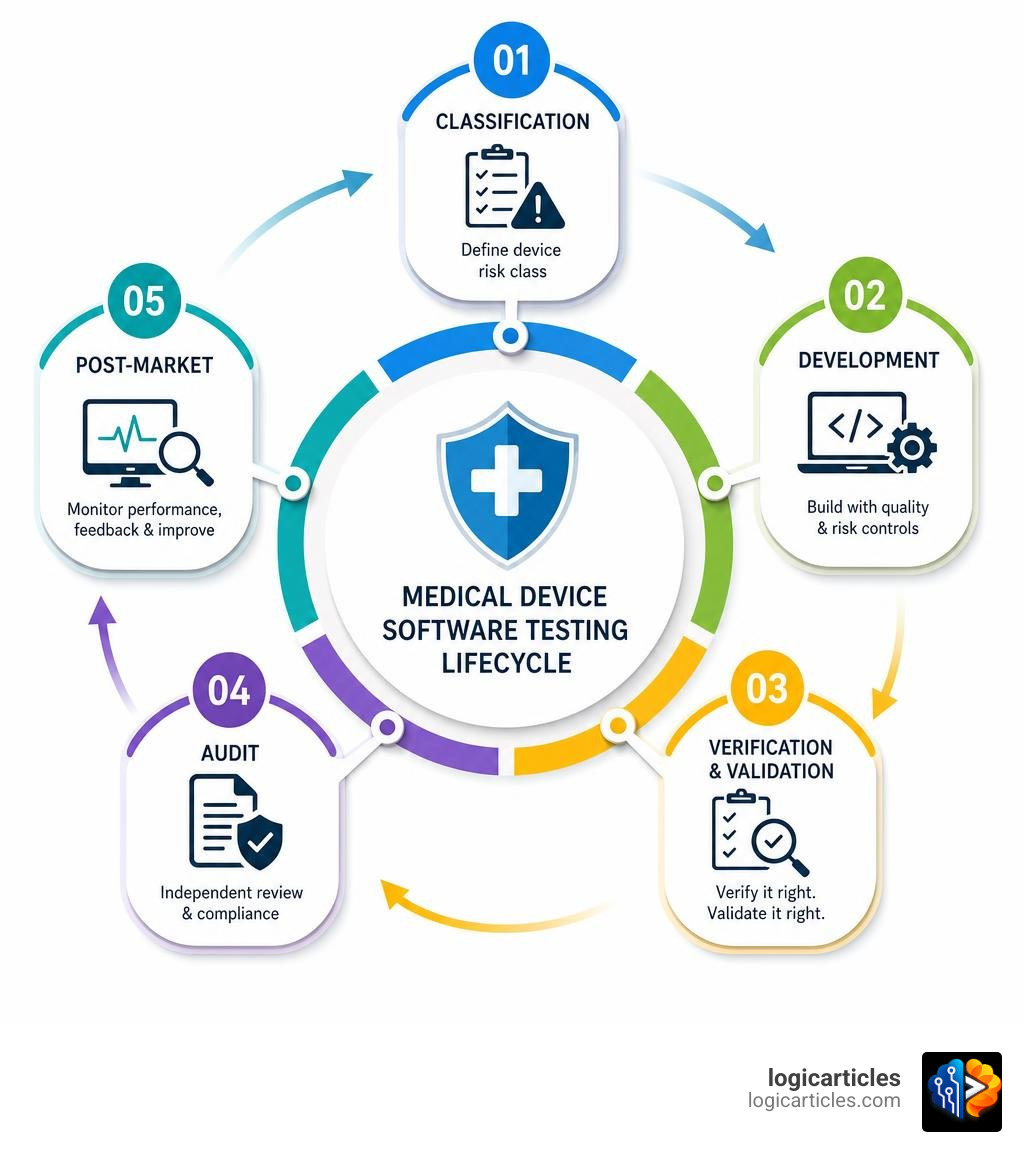
This guide walks through everything you need to know: the standards that govern the field, how risk classification shapes your testing requirements, the difference between verification and validation, and how to build a testing process that satisfies both regulators and patients.
The Regulatory Landscape of Medical Device Software Testing
Navigating the regulatory waters of medical device software can feel like trying to assemble flat-pack furniture in the dark. However, the international community has established a highly structured set of standards to ensure we are all building from the same blueprint.
At the heart of medical device software development is IEC 62304, which defines the life cycle requirements for medical device software. This standard applies whether the software is embedded directly inside a physical hardware device or is itself a standalone application—known as Software as a Medical Device (SaMD). If you want to dive deep into the specific lifecycle processes, the BS EN 62304 Standard provides the definitive, 88-page framework for maintaining compliance across both development and maintenance phases.
For broader quality management, we look to ISO 13485, which outlines the requirements for a comprehensive quality management system (QMS). In the United States, the regulatory landscape achieved a massive milestone on February 2, 2026, with the official implementation of the FDA’s Quality System Regulation (QSR) transition to the Quality Management System Regulation (QMSR). This convergence formally incorporates ISO 13485:2016 by reference, harmonizing U.S. federal requirements with global standards and streamlining international submissions.
For those submitting to the FDA, keeping up with Recognized Consensus Standards: Medical Devices is crucial. Standards like ISO/IEC/IEEE 29119-1 are recognized for their scientific and technical merit in software testing, giving engineering teams a validated roadmap for structuring their test suites. Meanwhile, in Europe, compliance requires strict adherence to the Medical Device Regulation (MDR) and In Vitro Diagnostic Regulation (IVDR), both of which mandate state-of-the-art software lifecycle processes to protect end-users.
Software Safety Classification and Risk Management
Under IEC 62304, before you write a single line of code or design your first test case, you must determine your software’s safety class. This gating decision dictates the entire scope and rigor of your testing activities. The classification is determined by the potential of the software to contribute to a hazardous situation:
- Class A: No injury or damage to health is possible.
- Class B: Non-serious injury is possible.
- Class C: Serious injury or death is possible.
This classification system directly dictates your testing obligations. For example, while unit testing is not strictly mandated for Class A software, it is a non-negotiable requirement for Class B and Class C software.

Crucially, risk management under ISO 14971 must be embedded within the software lifecycle. We cannot treat software risk as a separate silo. If your software implements a risk control measure (for example, an automatic cutoff when a laser gets too hot), the software implementing that control cannot be downgraded to a lower safety class. The logic is simple: if the safety net fails, the patient is still in danger. Therefore, testing must verify that these risk control measures perform flawlessly under fault conditions.
FDA eSTAR and Documentation Levels
When submitting your software to the FDA, the agency categorizes documentation requirements into two distinct levels based on the potential risk of the device: Basic Documentation and Enhanced Documentation. This risk-proportionate principle generally aligns with the IEC 62304 safety classes, where Class A software typically requires Basic documentation, and Class B or C software requires Enhanced documentation.
To streamline this process, the FDA utilizes the eSTAR (electronic Submission Template and Association Resource) PDF template. Preparing your submission requires assembling a comprehensive design history file (DHF) that leaves no room for ambiguity. Utilizing a structured Software Validation Procedure (SYS-044) ensures that your team is prepared to attach the nine specific types of software validation documentation required for a successful eSTAR submission, including a complete software risk management file containing plans, assessments, and final hazard reports.
Verification vs. Validation (V&V) in Medical Software
One of the most common technical errors in regulatory submissions is confusing software verification with software validation. While they sound similar, they serve two entirely different purposes in the eyes of auditors.
To keep it simple:
- Verification asks: “Did we build the product right?” It proves that the software meets its specified design inputs and technical requirements.
- Validation asks: “Did we build the right product?” It proves that the software meets the user’s needs and intended clinical use in a real-world environment.
Under the regulatory framework, IEC 62304 focuses almost exclusively on verification. It does not cover the validation of the medical device, even if the device consists entirely of software. To understand where these boundaries lie, reading up on IEC 62304 Software Verification and Validation clarifies that validation responsibilities actually reside within ISO 13485 (Clause 7.3.7), IEC 82304-1 (for healthcare software products), and IEC 62366-1 (usability engineering).
| Feature | Verification (V) | Validation (V) |
|---|---|---|
| Primary Question | Did we build the software according to its technical specs? | Does the software meet user needs and clinical intent? |
| Governing Standard | IEC 62304 (Clauses 5.5, 5.6, 5.7) | ISO 13485 (7.3.7), IEC 82304-1, IEC 62366-1 |
| Execution Phase | Performed continuously during development. | Performed at the end of the development lifecycle. |
| Methods | Static analysis, unit tests, integration tests, system tests. | Usability testing, clinical trials, simulated user environments. |
| Key Output | Verification reports, code coverage metrics, test logs. | Usability reports, validation summaries, clinical evaluations. |
Unit, Integration, and System Testing Under IEC 62304
To achieve compliant verification, your testing process must align with the specific clauses of IEC 62304:
- Unit Verification (Clause 5.5): Required for Class B and C. This involves testing individual software units to ensure they perform their designated tasks. Teams must establish clear acceptance criteria, which often include static analysis and code coverage thresholds.
- Software Integration and Integration Testing (Clause 5.6): This step verifies that different software units play nicely together. It is especially critical for verifying segregation between software items of different safety classes under fault conditions.
- Software System Testing (Clause 5.7): Following the 2015 amendment to IEC 62304, system testing is mandatory for all software classes, including Class A. System testing evaluates the fully integrated software against its system-level requirements.
To ensure your testing strategies meet these multi-layered requirements, following practical Software testing requirements helps structure your test cases by source, including functional, performance, interface, and risk-control requirements.
Traceability: The Spine of the Verification Record
If a regulator asks you to prove that a critical safety requirement was tested, and you cannot show them a direct line from the requirement to the test case, that requirement effectively does not exist.
Bidirectional traceability is the spine of your verification record. It requires establishing a living matrix that links:
$$\text{User Needs} \longleftrightarrow \text{System Requirements} \longleftrightarrow \text{Software Architecture} \longleftrightarrow \text{Detailed Design} \longleftrightarrow \text{Source Code} \longleftrightarrow \text{Test Cases} \longleftrightarrow \text{Test Results}$$
For Class C software, this traceability must extend all the way down to the unit level. Managing this manually is a recipe for disaster. We recommend using requirements management tools that automatically generate these matrices.
Furthermore, you must perform tool qualification on the software used to test your device. If you use an automated tool to generate test evidence, you must prove that the tool itself is reliable and outputs accurate data.
Key Testing Methodologies for Medical Devices
Building a resilient quality assurance strategy means deploying a diverse arsenal of testing methodologies. We cannot rely on functional testing alone to catch the complex edge cases that modern connected devices present.

- Functional Testing: Validates that the software functions exactly as specified, testing the basic usability and UI workflows.
- Performance Testing: Evaluates how the software handles stress, high loads, and resource constraints, ensuring the system remains stable under peak usage.
- Usability Testing: Focuses on human factors. If a clinician misinterprets an alarm due to poor UI design, it is a software safety failure.
- Interoperability Testing: Verifies that the device successfully exchanges data with other systems without corrupting or losing critical information.
Cybersecurity and Privacy-by-Design in 2026
In 2026, cyber resilience is no longer a separate discipline from software quality—it is software quality. Following massive security events like the 2024 Change Healthcare breach, which affected the data of 190 million Americans, security has become the highest priority for healthcare systems. In response, Gartner forecasts that by 2026, 40% of U.S. payers will allocate at least 15% of their IT spend to privacy-enhancing technologies (PETs) like anomaly detection and behavioral analytics.
To build secure medical devices, we must adopt a shift-left security approach, integrating threat modeling, static application security testing (SAST), and vulnerability scanning directly into the early stages of our development lifecycle. Security testing should also include penetration testing and the validation of data encryption protocols. For instance, if your device transmits patient health information, verifying the security of the communication channel is just as critical as testing a HIPAA Compliant Messaging App to prevent unauthorized access and protect electronic protected health information (ePHI).
Interoperability and EHR Integration
Modern medical devices do not live on isolated islands. They connect to hospital local networks, cloud databases, and Electronic Health Record (EHR) systems. This requires rigorous testing of communication protocols such as HL7 and DICOM.
When testing interoperability, we must validate:
- API Integrity: Ensuring APIs handle structured and unstructured data payloads without failing.
- Offline Behavior: How does the device behave when cloud connectivity is lost? Does it securely buffer patient data locally and sync accurately once reconnected?
- EHR Touchpoints: If you are developing software that feeds clinical data directly into hospital databases, aligning your validation strategy with modern Emr Software Development In 2026 practices ensures your data pipelines are robust, secure, and compliant with regional data standards.
Advanced Challenges: AI/ML, Connected Devices, and Legacy Code
As software capabilities evolve, testing teams face highly complex environments that traditional testing frameworks were never designed to handle.
Continuous Validation for AI/ML-Based Medical Device Software Testing
Artificial Intelligence (AI) and Machine Learning (ML) are transforming diagnostics and clinical decision support systems. However, testing an AI-based system introduces a unique challenge: non-deterministic behavior. Unlike traditional software, where a specific input always yields the exact same output, AI systems adapt and learn.
This requires continuous validation. Testing teams must monitor for algorithmic drift (where the model’s accuracy degrades over time as real-world clinical data changes). We must verify how these AI outputs are presented in user interfaces to ensure that clinicians are not misled by false positives or false negatives, and that safety-critical fallback systems are in place if the AI model fails to process an image or signal.
Managing Legacy Software and SOUP
Many medical devices rely on legacy code or SOUP (Software of Unknown Provenance)—which includes third-party libraries, open-source packages, or operating systems where the development process was not documented under medical device standards.
Under IEC 62304, you are fully responsible for the safety of any SOUP integrated into your device. To manage this safely:
- Identify and Document: Maintain a comprehensive inventory of all SOUP items, including their version numbers and known vulnerabilities.
- Risk Evaluation: Evaluate how a failure in a SOUP component could impact the overall system safety.
- Upgrade Validation: When upgrading a SOUP component, refer to the CONSOLIDATED standard guidelines to plan and execute regression testing, ensuring that the upgrade does not introduce unexpected side effects or break existing risk controls.
Best Practices to Accelerate Time-to-Market Safely
It is a common misconception that regulatory compliance must slow down your development process. By integrating modern testing practices, you can actually accelerate your time-to-market while maintaining absolute safety.
If you are expanding your healthcare ecosystem into related fields—such as building customer portals or claims processing systems—leveraging insights from Insurance Software Development can help you optimize data pipelines and secure backend integrations across your entire product line.
To optimize your core testing workflow, we recommend focusing on three key pillars:
- Shift-Left Testing: Start testing as early as possible. Finding a defect during architectural design or early unit testing is exponentially cheaper than finding it during system validation or, worse, after a product launch.
- Static Analysis: Use automated tools to analyze source code without executing it. This helps catch syntax errors, memory leaks, and compliance violations against coding standards (like MISRA) automatically.
- Quantified Code Coverage: For Class C software, aim for a statement coverage threshold above 95% and a branch coverage threshold above 90% for safety-critical functions. For Class B software, aim for a statement coverage above 80% with documented justifications for any uncovered code paths.
Optimizing Medical Device Software Testing with Automation
Manual testing cannot support the rapid deployment cycles required for modern software development. Automated testing is essential for achieving continuous delivery (CD) while maintaining an audit-ready state.
[Developer Code Push]
 │
 ▼
[Automated Build & Static Analysis] ────► (Fails if code standards are violated)
 │
 ▼
[Automated Unit Tests & Code Coverage] ──► (Fails if coverage falls below thresholds)
 │
 ▼
[Automated GUI & Integration Tests] ────► (Simulates clinician workflows)
 │
 ▼
[Audit-Ready Evidence Generated] ──────► (Automatic documentation of results)
By integrating your automated test suite into your CI/CD pipeline, every code push triggers an automatic build, runs static analysis, executes unit tests, and measures code coverage.
For user interface testing, utilize automated GUI testing tools that behave like a clinician (clicking buttons, entering patient data, and verifying screen changes) rather than relying on brittle coordinates. This ensures that safety-critical UI elements—such as alarm screens and confirmation dialogs—are verified rapidly across multiple screen resolutions and hardware configurations.
Frequently Asked Questions about Medical Device Software Testing
What are the three software safety classes under IEC 62304?
The three software safety classes are Class A, Class B, and Class C. They are assigned based on the potential injury risk to the patient, operator, or environment. Class A represents no possibility of injury, Class B represents possible non-serious injury, and Class C represents possible serious injury or death.
How does the FDA’s 2026 QMSR impact software validation?
The FDA’s Quality Management System Regulation (QMSR), which took full effect in February 2026, officially harmonizes U.S. design controls with ISO 13485:2016. For software validation, this means manufacturers must maintain a highly structured quality management system where design validation (ISO 13485 Clause 7.3.7) is clearly documented, and software risk management is thoroughly integrated from day one.
Why is automated GUI testing critical for medical devices?
Automated GUI testing is critical because user interface failures are a primary source of clinical safety risks. By automating GUI tests, you can simulate realistic clinician workflows, verify that critical warning alarms never freeze, and ensure error messages display correctly across various resolutions, drastically reducing human error and improving overall system reliability.
Conclusion
In the medical device industry, quality assurance is not just about finding bugs; it is about protecting human lives. By understanding the regulatory landscape, enforcing strict verification and validation boundaries, and leveraging modern test automation, your team can deliver life-saving software to market faster and with absolute confidence.
If you are looking to optimize your software quality processes or need expert guidance on structuring your development lifecycle, explore our comprehensive resources in the Best Software Category to ensure your systems are safe, compliant, and built for the future of digital health.