Why Getting Staffing Right Makes or Breaks Your Contact Center

Workforce management software for call centers is the technology that helps contact centers forecast call volume, build agent schedules, monitor real-time adherence, and optimize staffing — all in one place.
Here are the top workforce management software options for call centers right now:
| Platform | Best For | Key Strength |
|---|---|---|
| NICE IEX / CXone | Large enterprises | 45+ AI forecasting models, 20B+ interactions powered annually |
| Calabrio ONE | Mid-to-large contact centers | AI intraday optimization, agent self-service |
| Verint | Complex operations | Bot-led automation, conversational AI integration |
| Assembled | Growing teams | Simplicity, fast setup |
| Eleveo | Multi-deployment needs | On-prem, cloud, or hybrid with identical features |
Running a contact center without the right tools is genuinely painful.
Agents end up overscheduled or underutilized. Supervisors scramble to fill gaps. Customers wait too long. And the whole operation bleeds money and talent.
Here’s a number that puts it in perspective: 41.3% of contact centers still operate without any WFM technology — relying on spreadsheets, Erlang calculators, and manual processes that simply can’t keep up with modern contact volumes or multi-channel demand.
The problem isn’t just inefficiency. It’s a ripple effect. Poor scheduling drives agent burnout. Burnout drives attrition. Attrition drives higher costs and worse customer experiences.
The good news: modern WFM platforms have evolved dramatically. Today’s best tools use AI and machine learning to forecast demand weeks in advance, auto-adjust schedules in real time, and even let agents manage their own shifts — without creating chaos for operations teams.
This guide breaks down the leading options so you can find the right fit for your contact center’s size, structure, and goals.
What is a Workforce Management Software Call Center Platform?
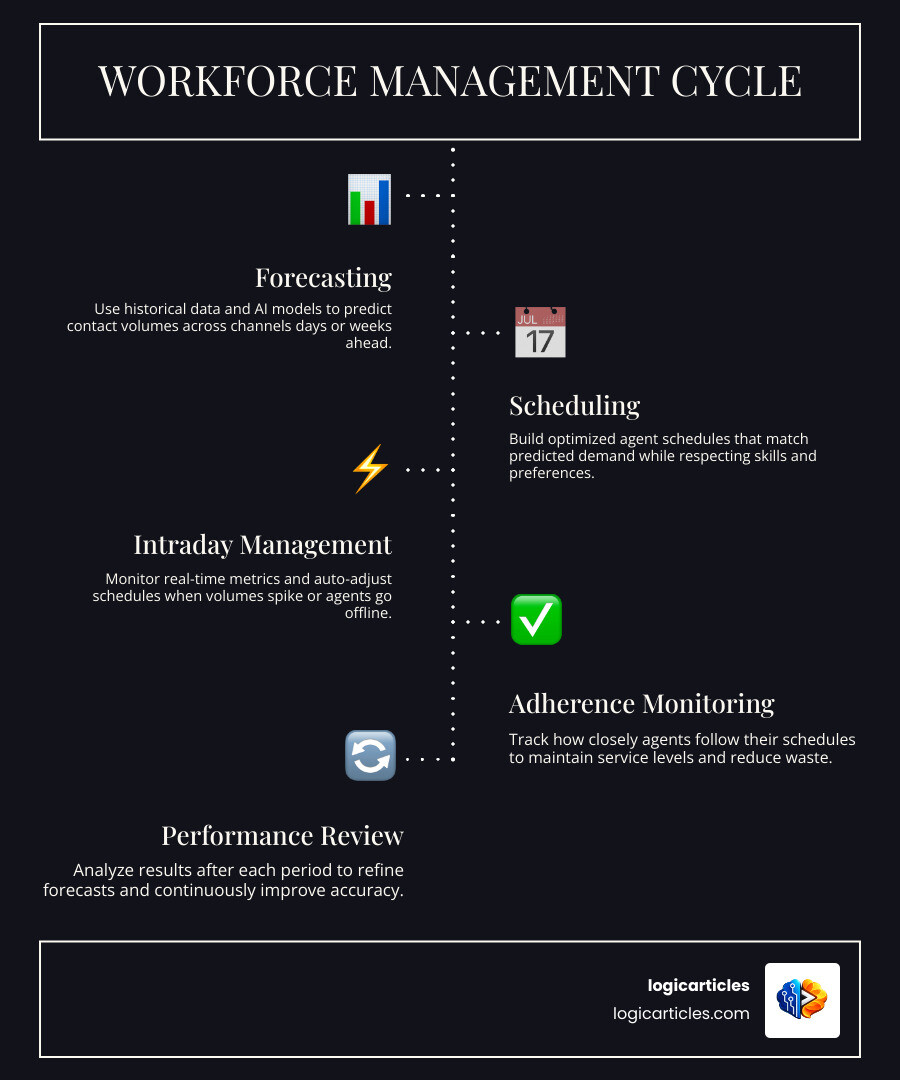
To truly understand what a workforce management software call center platform does, we have to look past the old-school definition of “making schedules.” In modern customer experience (CX) environments, workforce management (WFM) is a continuous, dynamic cycle. It is the strategic alignment of people, channels, and technology to ensure that the right agent with the right skill set is in the right seat at the exact moment a customer reaches out.
Historically, call centers only had to worry about one channel: inbound phone calls. If volume spiked, you threw more bodies at the phones. Today, the landscape is infinitely more complex. Agents are expected to handle a mix of synchronous channels (like live voice calls and web chats) and asynchronous channels (like email, SMS, and social media messaging) simultaneously.
Without a specialized WFM platform, trying to balance these channels is like trying to solve a Rubik’s cube while riding a unicycle. This is where dedicated Contact Center Workforce Management Software | Calabrio comes into play. It acts as the operational brain of your contact center, managing four core pillars:
- Forecasting: Predicting future interaction volumes and handle times based on historical data, seasonal trends, and upcoming business events.
- Scheduling: Building optimized shifts that align agent skills, availability, and preferences with your forecasted demand.
- Intraday Management: Monitoring real-time performance and adjusting staffing levels on the fly when unexpected call spikes or agent absences occur.
- Adherence Monitoring: Tracking whether agents are sticking to their scheduled activities (e.g., lunches, breaks, training) to protect service levels.
Furthermore, the rise of hybrid and remote work has permanently altered contact center operations. Managing a distributed workforce means managers can no longer look across a physical floor to see who is on a break or who needs assistance. Modern WFM tools bridge this gap by providing complete operational visibility, regardless of where your agents are physically located.
To explore how these cycles function in detail, you can read our comprehensive Guide to Call Center Workforce Management – Calabrio to understand how to move away from outdated spreadsheets and build a resilient workforce strategy.
Core Features of Workforce Management Software Call Center Platforms
When evaluating a workforce management software call center solution, it helps to look at the specific features that move the needle. The most robust platforms on the market go far beyond simple calendar creation. They provide a suite of tools designed to automate complex calculations and give both managers and agents more control over their daily work lives.
- Omnichannel Demand Forecasting: Modern customers expect seamless service across every touchpoint. A strong WFM tool doesn’t just forecast phone calls; it projects demand across chat, email, SMS, and social channels. It accounts for the varying average handle times (AHT) of different channels—for example, a chat conversation might take longer than a phone call but allow an agent to handle multiple sessions at once.
- Agent Self-Service and Shift Bidding: One of the quickest ways to improve agent satisfaction is to give them autonomy. Top-tier WFM platforms include mobile apps and agent portals where staff can view schedules, bid on preferred shifts, request time off, and swap shifts with qualified peers. The system automatically approves or denies these requests based on real-time staffing needs, removing the administrative burden from supervisors.
- Real-Time Adherence (RTA) Tracking: RTA tools compare what an agent is scheduled to do against what they are actually doing in real time. If an agent stays in “After Call Work” (ACW) status for too long or misses a scheduled break, the system flags this for supervisors. This isn’t about micromanagement; it’s about understanding operational bottlenecks and maintaining the service level agreements (SLAs) promised to customers.
- Capacity and Strategic Planning: Long-term planning is essential for budgeting and recruitment. WFM platforms offer “what-if” scenario modeling. For instance, if you plan to launch a new product line in six months, you can simulate how a 20% increase in contact volume will affect your staffing requirements, allowing you to hire and train agents well in advance.
Managing these moving parts is highly tactical. If you are looking for ways to keep your internal operations organized alongside your customer-facing teams, check out our review of the Best Task Management Software in 2026 Tested to streamline your administrative workflows.
How AI is Transforming Workforce Management Software Call Center Tools
Artificial Intelligence is no longer a futuristic buzzword; in 2026, it is the primary engine driving modern workforce management. Traditional WFM relied heavily on the Erlang C formula—a mathematical model developed in the early 20th century to calculate the number of telephone lines needed for a specific call volume. While Erlang C was for its time, it assumes a static environment and struggles with multi-skill, multi-channel routing.
AI-powered WFM tools have completely shattered these limitations. By leveraging machine learning and predictive analytics, AI can analyze thousands of variables simultaneously to produce highly accurate forecasts.
Traditional WFM (Erlang C) ────► Static, single-channel, assumes perfect conditions
AI-Powered WFM (Machine Learning) ─► Dynamic, omnichannel, learns from real-time data
Here is how AI is specifically changing the game:
- Advanced Machine Learning Forecasting: Leading platforms like AI-powered workforce management software for contact centers | NiCE utilize dozens of proprietary algorithms to analyze historical data. The system continuously runs simulations, testing different models against actual outcomes to automatically select the most accurate forecasting algorithm for any given day. It accounts for complex patterns like seasonal spikes, holidays, billing cycles, and marketing campaigns.
- True to Interval (TTI) Analytics: Historically, if an agent took a 30-minute call that started at 1:55 PM and ended at 2:25 PM, legacy systems would often log the entire interaction in the 2:00 PM to 2:30 PM interval. This distorted data and led to understaffing at the end of the hour. AI-driven TTI analytics logs interactions dynamically in the precise intervals they occur, dramatically reducing staffing mismatches.
- Agentic AI and Automated Bots: Modern systems employ specialized AI bots to handle real-time scheduling adjustments. For example, NICE’s TimeFlex bot allows agents to make unlimited, instantaneous schedule changes. The AI instantly calculates whether the change will harm operational efficiency; if the swap is neutral or beneficial, it is approved in seconds without human intervention.
- Cognitive Load Optimization: AI doesn’t just look at numbers; it looks at human impact. By analyzing interaction complexity, sentiment, and handle times, AI-driven scheduling can balance highly stressful interactions (like escalations) with simpler tasks (like back-office data entry) to prevent agent burnout.
To see how these AI models are deployed at scale, you can explore the AI Workforce Management for Contact Centers | NiCE platform, which highlights how machine learning can put complex scheduling and forecasting on complete autopilot.
Key Benefits of Implementing WFM in Contact Centers

Implementing a modern workforce management software call center solution yields massive, measurable returns across every area of your business. Because labor represents up to 70% of a contact center’s total operating budget, even minor improvements in scheduling efficiency can result in substantial financial savings.
Let’s look at the hard data and real-world outcomes associated with modern WFM implementation:
- Massive Cost Savings: Overstaffing wastes valuable budget, while understaffing leads to missed SLAs, abandoned calls, and lost revenue. By aligning staff precisely with demand, organizations achieve major financial breakthroughs. For example, payroll processing giant Paychex achieved over $500,000 in annual savings simply by optimizing their staffing levels and intraday activities using Calabrio ONE.
- Drastic Reductions in Agent Attrition: Contact centers are notorious for high turnover rates, often exceeding 45% annually. Much of this is driven by rigid schedules and burnout. WFM software directly combats this by offering agent autonomy. Calabrio ONE users, for instance, achieved a 25% decrease in agent attrition. Similarly, Five9 customers like The Ivy Collection and IAA saw agent attrition drop by 50% or more after deploying streamlined, agent-centric workflows.
- Improved Schedule Adherence: When agents understand the impact of their schedules and have a hand in creating them, adherence naturally rises. Calabrio WFM implementations have shown a 20% increase in adherence growth. For businesses like Wix, switching to Calabrio WFM resulted in 15% higher adherence and 10% greater scheduling accuracy, while simultaneously reducing the time managers spent on scheduling by 40%.
- Enhanced Customer Experiences (CX): At the end of the day, WFM is about serving the customer. When your contact center is staffed correctly, wait times drop, first-contact resolution (FCR) rates rise, and customer frustration evaporates. Even a modest 3% boost in Customer Satisfaction (CSAT) scores can dramatically improve customer lifetime value and brand loyalty.
If you are a growing business looking to support your agents through better overall company policies, benefits, and HR workflows, check out our guide on the Best HR Software for Small Businesses to build a strong operational foundation.
Choosing the Right Workforce Management Software Call Center Solution
Selecting the right workforce management software call center platform depends heavily on your organization’s size, technical maturity, and existing technology stack. What works perfectly for a global enterprise with 5,000 multi-lingual agents might completely overwhelm a 50-agent support team.
The table below outlines the core differences between Enterprise-grade and Mid-Market WFM solutions:
| Feature / Capability | Enterprise WFM (e.g., NICE, Calabrio, Verint) | Mid-Market WFM (e.g., Assembled, Eleveo) |
|---|---|---|
| Best Suited For | 500+ agents, complex multi-site operations | 50 to 500 agents, rapid growth teams |
| Forecasting Power | 45+ advanced machine learning algorithms | Simple historical trend analysis, regression models |
| Omnichannel Support | Deep, synchronous & asynchronous queue routing | Standard voice, chat, and email scheduling |
| Deployment Options | Cloud-native, on-premise, or hybrid | Primarily cloud-native |
| Setup & Implementation | 3 to 6 months, highly customizable | Weeks to a month, intuitive and fast |
| Integration Complexity | Custom API integrations, deep CRM/HRIS sync | Pre-built, out-of-the-box CCaaS connectors |
When choosing a solution, scalability and deployment flexibility are paramount. For organizations that operate in highly regulated industries (like healthcare or finance) or those transitioning slowly to the cloud, having deployment options is critical.
Platforms like Call Center Workforce Optimization Software | Eleveo shine here because they offer identical features, capabilities, and user experiences whether deployed on-premises, in the cloud, or in hybrid environments. This ensures you do not have to sacrifice advanced AI forecasting or real-time adherence tools just because your data security policies require on-premise data storage.
Furthermore, if your team utilizes a broader cloud-native setup, integrating your WFM directly with your cloud contact center platform (CCaaS) is essential. Platforms like Cloud Contact Center Software – Contact Center Experience Software | Five9 allow you to unify your telephony, digital engagement, and agent empowerment tools in one place, creating an intelligent CX ecosystem that feeds clean data directly into your WFM engine.
Best Practices for Software Selection and Implementation
Successfully deploying a workforce management software call center platform requires more than just signing a contract and turning on the software. It requires a thoughtful, structured approach to change management.
- Conduct a Thorough Needs Assessment: Before looking at vendors, document your current pain points. Are you struggling with forecasting accuracy? Is agent scheduling taking up too much of your supervisors’ time? Do you need to support digital channels like SMS and WhatsApp? Understanding your specific goals will prevent you from overpaying for features you don’t need.
- Secure Stakeholder Buy-In Early: WFM software affects everyone in the contact center. Involve your supervisors, IT team, and front-line agents in the selection process. Show agents how features like shift bidding and mobile self-service will give them more control over their schedules. If agents view the tool as an empowerment system rather than a tracking device, adoption rates will skyrocket.
- Invest in Continuous Training: WFM systems are incredibly powerful, but they have a steep learning curve. Do not skip out on vendor-led training. Ensure your workforce planners and supervisors are fully trained on how to interpret forecasting models, build schedules, and manage intraday adjustments.
- Clean and Integrate Your Data: Your WFM software is only as good as the data you feed it. Before implementation, ensure your Automatic Call Distributor (ACD), Customer Relationship Management (CRM), and HR systems are cleanly integrated. This ensures your historical contact volumes, handle times, and agent skills profiles flow into the WFM system without errors.
For organizations looking to align their technology stack across other areas of their business—such as retail locations or physical service centers—integrating your back-office systems is equally vital. You can read our analysis of the Best Cloud POS Software in 2026 to see how modern cloud platforms handle unified data across complex business models.
Frequently Asked Questions about Call Center WFM
What is the difference between workforce planning and workforce management?
While these terms are often used interchangeably, they represent different scopes of time and strategy.
Workforce planning is a long-term strategic process. It looks months or even years into the future to align hiring, training, and budgeting with the company’s growth plans. It answers questions like, “How many Spanish-speaking agents will we need to hire next quarter based on our projected expansion into Latin America?”
Workforce management (WFM), on the other hand, is highly tactical and operational. It focuses on the short-term—typically day-to-day and week-to-week scheduling, real-time intraday adjustments, and immediate adherence monitoring. WFM answers questions like, “Do we have enough agents staffed on the chat queue at 2:00 PM today to handle a sudden spike in website traffic?”
How does AI improve forecasting accuracy in call centers?
Traditional forecasting tools rely on historical averages, which can easily be skewed by a single anomalous event (like an unexpected server outage last year).
AI improves forecasting by using machine learning models that can evaluate thousands of variables simultaneously. It doesn’t just look at what happened on the same Tuesday last year; it looks at weather patterns, active marketing promotions, billing cycles, customer sentiment trends, and even macro-economic factors.
Furthermore, AI models continuously “learn.” If the system predicts 1,000 calls for a Monday morning but 1,200 come in, the machine learning algorithms immediately analyze the discrepancy and adjust future forecasts automatically. Platforms like AI workforce management software | NiCE run dozens of these algorithms simultaneously, automatically selecting the “best pick” model to ensure daily accuracy.
Can WFM software support hybrid and remote call center agents?
Yes, absolutely. In fact, managing a hybrid or remote workforce is nearly impossible without modern WFM software.
Advanced WFM tools provide cloud-based portals and mobile apps that allow remote agents to view their schedules, request time off, and swap shifts from anywhere. For managers, WFM software provides real-time adherence tracking and performance dashboards. This gives supervisors complete visibility into agent activities, ensuring remote staff are supported, engaged, and sticking to their scheduled activities without requiring physical oversight on a call center floor.
Additionally, to see how different tools stack up in the current market, you can consult the Best Call Center Workforce Management Software (2026 Guide) for a detailed breakdown of features designed specifically for distributed teams.
Conclusion

Implementing the right workforce management software call center platform is one of the most impactful decisions an organization can make. By moving away from rigid spreadsheets and embracing AI-driven forecasting, dynamic scheduling, and real-time intraday management, you unlock a powerful win-win-win scenario:
- Your business saves hundreds of thousands of dollars in labor waste and operational overhead.
- Your agents enjoy greater flexibility, less burnout, and a healthier work-life balance.
- Your customers receive faster, more personalized support across every communication channel.
At logicarticles, we believe in providing practical, logic-driven insights to help you navigate the complex world of modern business technology. Whether you are running a 50-agent support team or a global enterprise contact center, the right WFM solution is the key to achieving true operational excellence.
Ready to take your operations to the next level? Explore the Best Software Solutions to find more deep dives, comparisons, and expert recommendations on the tools driving business growth today.