Why Daycare Appointment Scheduling Software Is a Game-Changer for Childcare Centers

Daycare appointment scheduling software is a digital tool that helps childcare centers automate tour bookings, manage staff shifts, track enrollment, and communicate with parents — all from one platform.
Quick answer: What does it do?
- Lets parents book tours and recurring care slots online, 24/7
- Sends automated reminders to reduce no-shows
- Tracks staff-to-child ratios in real time
- Manages enrollment waitlists by age group
- Collects intake forms, allergies, and emergency contacts digitally
- Integrates billing, payments, and attendance tracking
Running a daycare is not like running a standard appointment business. Kids arrive late. Staff call in sick. Parents text questions at 9 a.m. while you’re in the middle of morning drop-off. Ratios shift every time a child checks in or out.
The administrative load is real. Directors can spend 10 or more hours every week just juggling schedules by phone, spreadsheet, and group text.
At the same time, parent expectations have shifted. Today, 62% of parents research childcare online before ever calling. They want to book a tour the same way they book everything else — instantly, from their phone, at whatever hour works for them.
Manual systems can’t keep up with that. A missed call at 7 p.m. from an interested parent often means a lost enrollment — not because your center wasn’t the right fit, but simply because nobody answered.
The gap between what childcare operations demand and what paper-based or phone-based systems deliver is exactly where scheduling software makes its biggest impact.
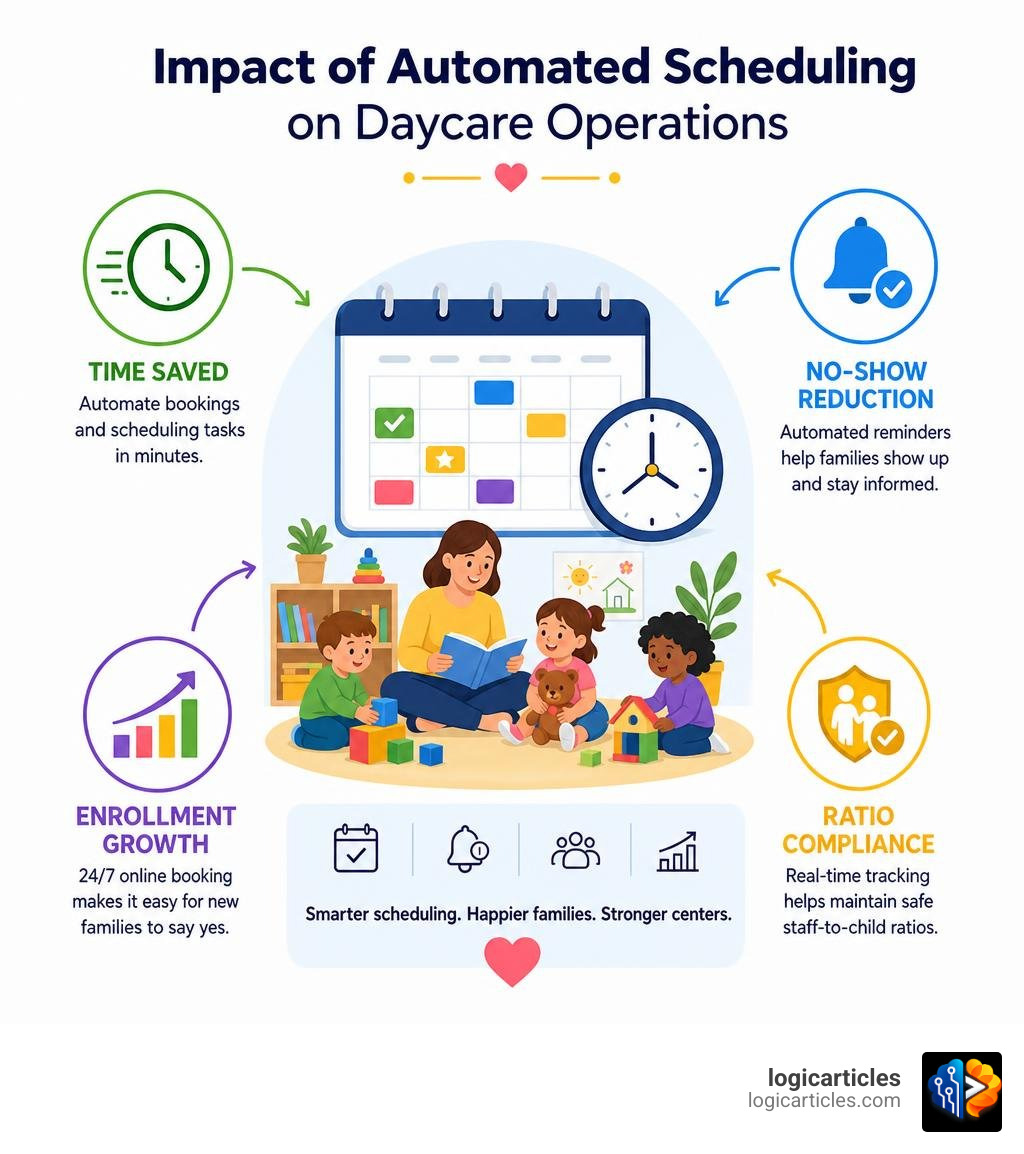
The Operational Challenges of Manual Daycare Scheduling
If you have ever run a daycare, you know that the morning rush feels like managing an airport terminal where half the flights are unscheduled, and the passengers can’t tie their own shoes. The operational reality of childcare is highly volatile, yet it is governed by incredibly strict state licensing laws.
One of the biggest hurdles daycare directors face today is the combination of persistent staffing shortages and strict ratio compliance. Unlike other service industries where a call-out simply means longer wait times, a single absent teacher in a childcare center can force an entire classroom to close. To keep classrooms legally compliant and safe, directors must constantly shuffle staff based on fluctuating daily attendance.
In addition, parents expect real-time, seamless communication. Juggling parent updates across scattered channels—such as WhatsApp, text messages, emails, and physical paper notes—creates an administrative nightmare.
Then comes the pipeline management. Managing tour bookings and waitlist chaos manually is incredibly inefficient. When parents call to book a tour, directors must pause their work, check paper calendars, and hope the parent actually shows up. Without automated follow-ups, tour no-shows skyrocket, leaving vacant enrollment slots that drain revenue.
Furthermore, waitlists are rarely straightforward. Because children age out of specific classrooms, waitlists must be managed by age-banded capacity rules. A manual spreadsheet simply cannot dynamically update when a spot opens up in the toddler room versus the infant room.
To see how specialized systems compare to general platforms, you can read our guide on the Best Child Care Software Management Programs. If you operate multiple locations, coordinating floating staff across classrooms requires robust coordination tools, which we detail in our analysis of the Best Employee Scheduling Software for Multi-Site 2026.
Essential Checklist for Daycare Appointment Scheduling Software
When you are ready to move away from paper calendars and chaotic spreadsheets, you need a clear framework to evaluate your options. The right daycare appointment scheduling software should act as the central nervous system of your building.

Here is your essential checklist of must-have parent-facing and back-office features:
- 24/7 Self-Service Tour Booking: Parents should be able to book facility tours directly from your website, Google Business profile, or social media pages. This captures interest the moment a parent is researching care, even if it is at 10 p.m. after their kids are asleep.
- Automated Multi-Channel Reminders: The platform must send automated SMS and email reminders to parents before scheduled tours or intake meetings. This simple feature has been shown to cut tour no-shows by up to 60%.
- Digital Intake Forms & Document Uploads: No more handing parents a thick packet of clipboards on day one. Parents should be able to securely upload immunization logs, emergency contacts, and allergy lists during the booking process.
- Two-Way Calendar Synchronization: The system must sync bidirectionally with personal calendars (Google, Outlook, iCloud) to prevent double-booking staff or rooms.
- Flexible Scheduling for Mixed Care Plans: Whether a family needs full-time care, part-time care, drop-in slots, or after-school programs, the scheduling calendar must allow you to set custom rules and recurring booking blocks.
For a deeper dive into platforms that excel at these parent-facing workflows, check out Daycare Scheduling Software | Childcare Booking System . To see how to eliminate administrative spreadsheets entirely, read more about Daycare Scheduling Software, Tours, Drop-offs & (2026) | SchedulingKit .
Core Features of Daycare Appointment Scheduling Software
Beyond simple appointment booking, daycare-specific software must handle the complex logistics of classroom management.
First and foremost is real-time ratio compliance tracking. The software should automatically link your staff rosters to classroom capacities. As children check in and out digitally, the system calculates the live staff-to-child ratio and triggers instant alerts if a room is approaching its legal limit.
Digital check-in and check-out kiosks serve as your single source of truth. Using tablets at the front door or in individual classrooms, parents sign their children in using secure PINs or QR codes. This digital timestamp not only keeps children safe but also feeds directly into your billing system, eliminating manual hourly calculations.
Finally, an automated, age-banded waitlist is crucial. When a space becomes available in your infant room, the software should automatically identify the next eligible family on the waitlist based on the child’s exact birthdate and notify them instantly.
For a platform that integrates these daily classroom operations with modern communication hubs, look at Dewx for Daycares – All-in-One Childcare Mgmt | Dewx . To see how these tools fit into a broader administrative ecosystem, check out our review of the Best Task Management Software in 2026 Tested.
Choosing the Right Daycare Appointment Scheduling Software for Your Budget
Selecting software requires balancing features against financial realities. The pricing landscape in 2026 generally falls into three models:
- Free-Forever Plans: Ideal for independent babysitters, nanny agencies, or very small home daycares. These plans usually offer unlimited basic bookings but limit advanced features like automated SMS reminders or custom branding.
- Per-User/Per-Child Monthly Fees: Common among large childcare management suites. While scalable, these costs can add up quickly as your enrollment grows.
- Flat-Rate Monthly Subscriptions: Often the most predictable choice for mid-to-large centers. You pay a set monthly fee regardless of how many children or staff members use the system.
To calculate your return on investment (ROI), use this simple formula:
$$\text{Monthly Savings} = (\text{Hours Spent on Scheduling per Week} \times \text{Hourly Administrative Rate} \times 4) – \text{Software Cost}$$
For example, saving 10 hours a week at an administrative cost of $25/hour equals $1,000 in saved labor costs per month. If the software costs $150 a month, your net monthly savings are $850—not to mention the added revenue from filling empty slots faster.
If you are a smaller provider looking for budget-friendly entry points, explore Free Childcare Scheduling Software | Koalendar . For international programs or centers catering to diverse student bodies, you can read our specialized guide on the Best Daycare Software USA for International Students 2026.
How Scheduling Automation Solves Ratio Compliance and Administrative Overhead
When we look at the day-to-day operations of modern childcare, manual coordination is a recipe for burn-out. Automation acts as a digital shield against licensing violations and administrative exhaustion.

State licensing agencies do not care if a teacher had a flat tire; they only care if your preschool room is out of compliance. By automating your scheduling, the system can instantly suggest qualified, available substitutes from your database the moment a teacher logs an absence, allowing you to resolve shift gaps in minutes.
Furthermore, the rise of conversational AI has transformed front-desk management. AI phone agents can answer parent inquiries after hours, answer basic questions about your curriculum, and schedule tours directly into your calendar while you sleep.
When scheduling is connected directly to billing, invoicing becomes effortless. The software tracks exactly when children are booked, automatically generates invoices, applies sibling discounts, and processes tuition payments securely.
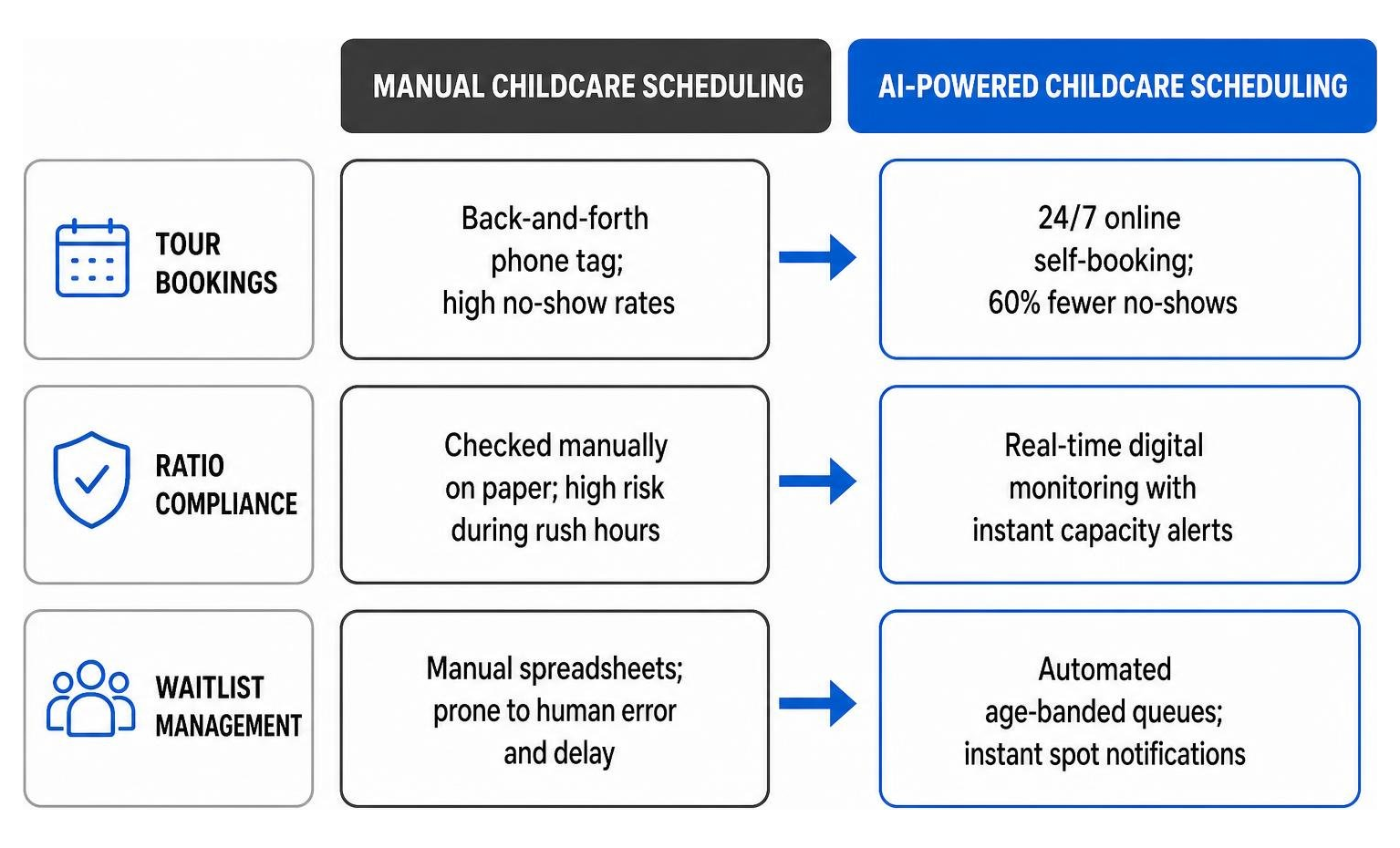
| Feature / Workflow | Manual Scheduling (Paper/Spreadsheets) | AI-Powered Automation |
|---|---|---|
| Tour Bookings | Back-and-forth phone tag; high no-show rates | 24/7 online self-booking; 60% fewer no-shows |
| Ratio Compliance | Checked manually on paper; high risk during rush hours | Real-time digital monitoring with instant capacity alerts |
| Waitlist Management | Manual spreadsheets; prone to human error and delay | Automated age-banded queues; instant spot notifications |
| Parent Communication | Scattered texts, emails, and paper notes | Unified inbox; AI-polished daily updates |
| Billing & Payments | Manual calculations; chasing late checks | Automated tuition invoicing and recurring card payments |
For centers looking to deploy AI-driven business tools and unified communication inboxes, explore Deelo for Daycare & Childcare — All-in-One AI Business Platform . If you are looking for an enterprise-grade ERP solution with advanced predictive analytics to forecast enrollment trends, check out AI-Powered Preschool / Daycare Software | Smart ERP for P… | Codeison .
Just as specialized platforms streamline other service sectors—such as the Best Software for Lawn Care Business or the Best Cloud POS Software in 2026—daycare scheduling software ensures that childcare directors can focus on education and safety rather than endless admin work.
Similar operational efficiencies can be seen in real estate management tools like the Best Software for Landlords, the Best Rental Property Software, the Best Apartment Management Software, and the Best Property Management CRM Software.
Frequently Asked Questions about Daycare Scheduling
How does scheduling software help with staff-to-child ratio compliance?
The software serves as an automated compliance monitor. By linking your staff roster directly to real-time classroom check-ins, the system dynamically calculates ratios throughout the day. If a classroom is about to exceed its legal limit because parents are dropping children off early, the software triggers an alert, allowing directors to dispatch a floating teacher before a licensing violation occurs.
Can parents book tours and enroll online?
Yes. Modern platforms allow you to embed a booking widget directly onto your website or social media pages. Parents can view real-time tour availability, choose a slot, complete state-compliant digital intake forms, and pay enrollment deposits online. If your classrooms are full, the system automatically places the family on an age-banded waitlist and notifies them the moment a spot opens up.
What is the typical cost and ROI of daycare scheduling platforms?
Pricing varies based on your center’s size and needs. Free plans are available for very small operations, while paid tiers range from $9 per user to flat rates of $50 to $200+ monthly. Most programs save an average of 10 to 20 hours per month on manual admin work. By automating reminders, centers typically see a 60% drop in tour no-shows, which directly translates to faster enrollment and increased revenue.
Conclusion
Running a successful childcare center in July 2026 requires balancing warm, high-quality care with modern, efficient business systems. Juggling paper schedules, manual waitlists, and scattered parent messages drains your energy and leaves your center vulnerable to costly ratio violations.
By implementing the right daycare appointment scheduling software, you reclaim valuable hours of your week, protect your state licensing status, and provide the seamless, digital-first experience that modern parents expect.
For more guides on streamlining your business operations and choosing the best digital tools, explore our comprehensive resource library at the logicarticles Productivity Hub.