You Ran Your AI Draft Through a Detector. Now What?

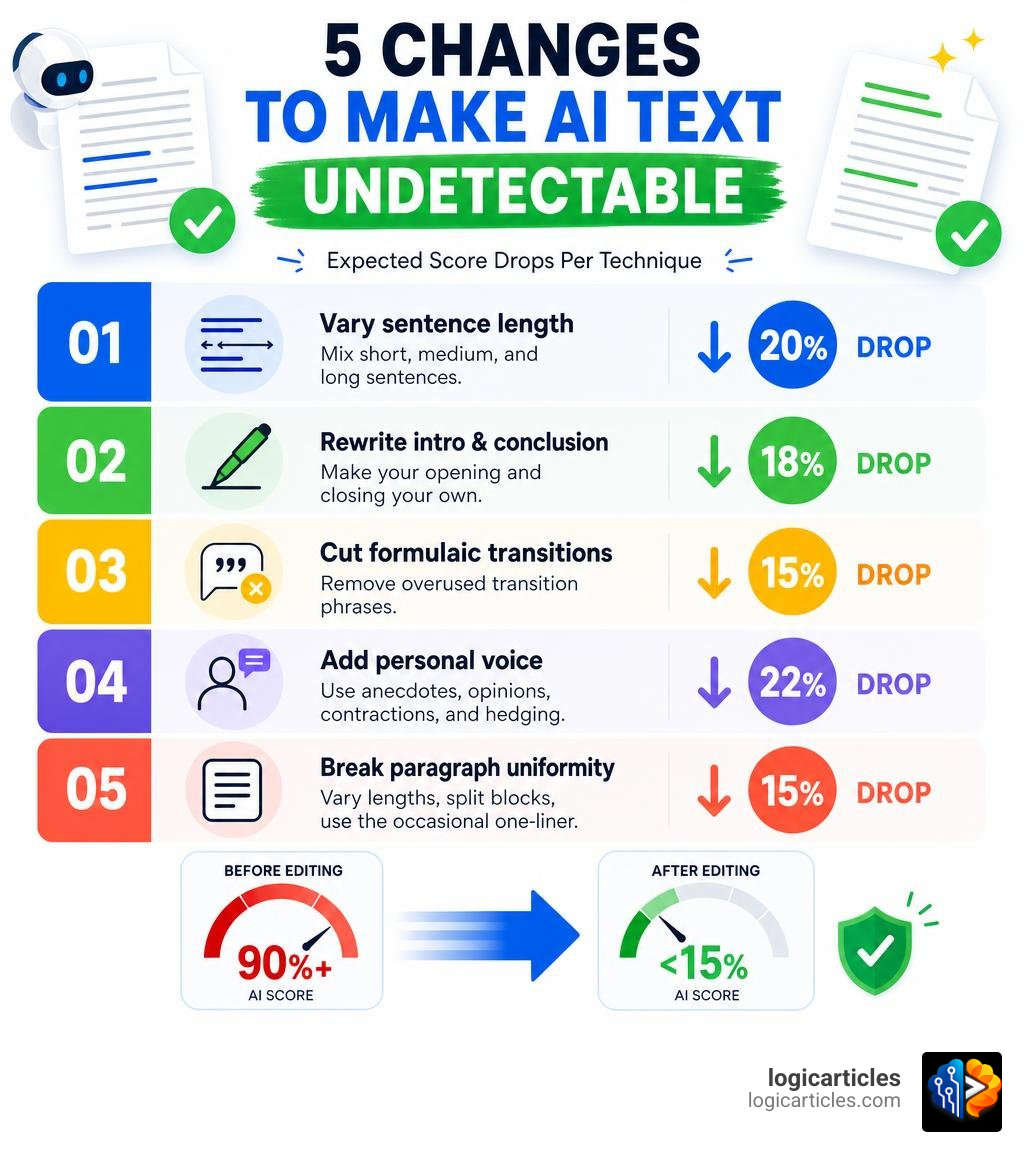
How to make AI text undetectable comes down to five structural changes that target what detectors actually measure — not surface-level word swaps.
Here’s the quick answer:
- Vary sentence length dramatically — mix very short sentences with longer, complex ones
- Rewrite the introduction and conclusion in your own voice
- Cut formulaic transitions like “furthermore,” “moreover,” and “it is important to note”
- Add personal anecdotes, opinions, and hedging language (contractions, “I think,” “in my experience”)
- Break paragraph uniformity — vary lengths, split long blocks, use the occasional one-liner
These five changes can bring a 90%+ AI score down to under 15% in a single editing pass.
You spent an hour on the perfect prompt. ChatGPT delivered a clean, well-structured draft. Then you ran it through a detector — 97% AI.
That number stings. And it’s increasingly common. Raw output from ChatGPT, Claude, or Gemini scores 95–99% AI across every major detector in 2026, including Turnitin, GPTZero, and Originality.ai.
The frustrating part? Most fixes people try — synonym swappers, basic paraphrasers, Unicode tricks — barely move the needle. That’s because detectors don’t look for specific words. They measure statistical patterns in how text is structured.
The good news: once you understand what’s actually being measured, fixing it is straightforward.
Why AI Content Gets Flagged: The Science of Detection
To bypass AI detection, we first have to understand how these tools think. AI detectors do not read your text like a human editor does. They do not look for “good” or “bad” writing. Instead, they run mathematical calculations to determine the probability that a machine generated the sequence of words on the page.
In fact, peer-reviewed research shows that detectors are far from infallible. A 2026 study found that detectors manage only 61–69% accuracy on clean text, and their accuracy collapses toward zero when analyzing hybrid human-AI writing. When basic adversarial techniques are applied, overall detector accuracy can plummet from a baseline of 39.5% down to just 17.4%.
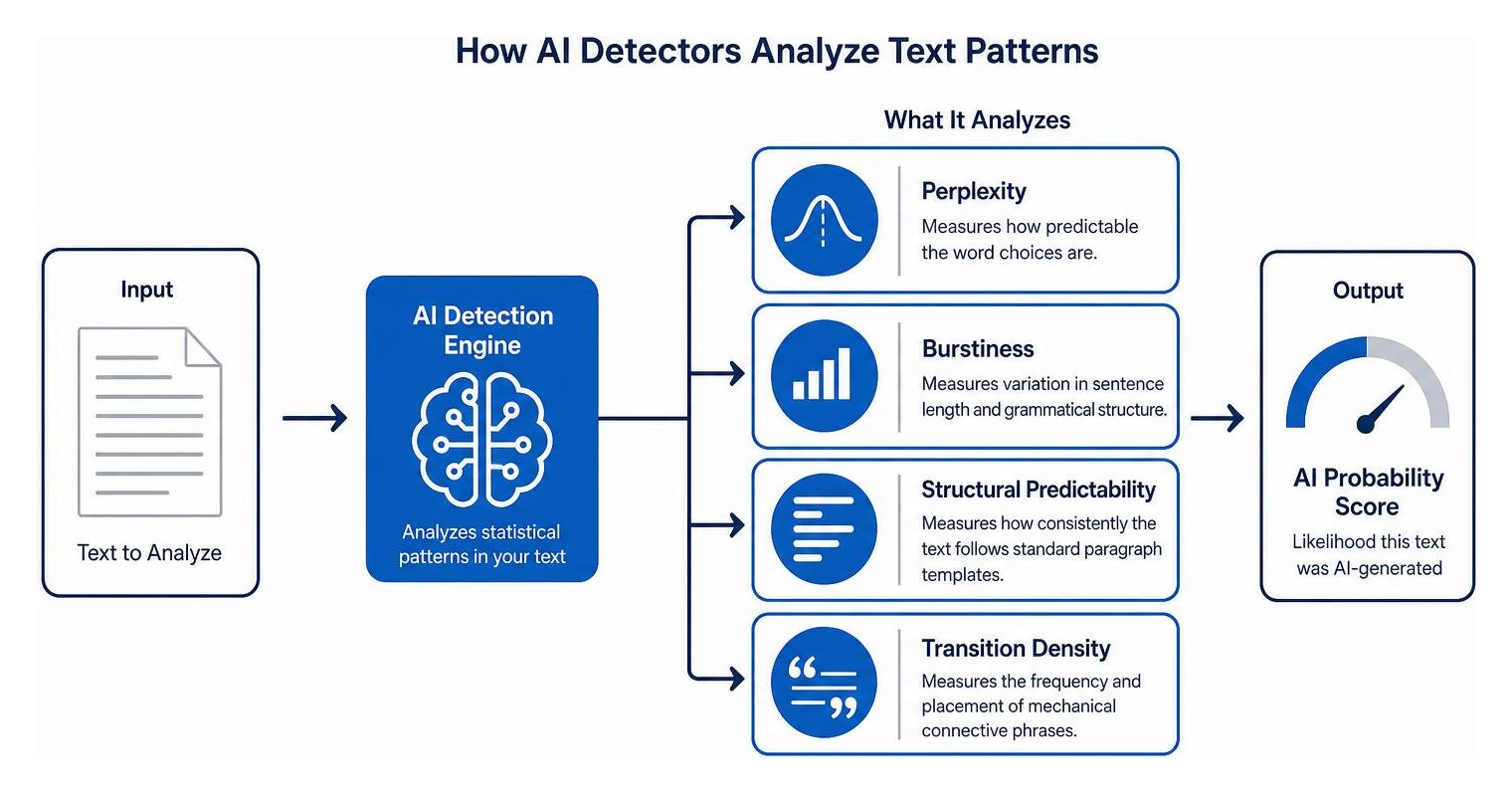
Detectors primarily look for statistical patterns, analyzing your text along four main vectors:
- Perplexity: The measure of how predictable the word choices are.
- Burstiness: The variation in sentence length and grammatical structure.
- Structural Predictability: How consistently the text follows standard paragraph templates.
- Transition Density: The frequency and placement of mechanical connective phrases.
If you want to dive deeper into the mechanics of these systems, you can Learn more about how detectors work.
Understanding Perplexity and Burstiness
Perplexity and burstiness are the two core metrics of modern AI detection.
Perplexity measures word predictability. Because Large Language Models (LLMs) operate by predicting the “safest” next token (word or syllable) based on probability distributions, they naturally select highly predictable word sequences. Human writers, on the other hand, use irregular, surprising, and highly specific vocabulary. When we write, we don’t choose the mathematically most probable next word; we select the word that best fits our unique style or emotional intent.
Burstiness refers to sentence-level variation. Humans write in bursts. We might write a short, punchy sentence. Then we might ramble on for forty words because we got excited about a tangent and forgot where we were going. Then we stop. Like this.
AI models do not do this. Because they are trained to be clear and helpful, they tend to cluster sentence lengths uniformly, usually averaging between 15 and 25 words per sentence. This creates a monotonous, rhythmic cadence that detectors flag instantly.
| Metric | Human Writing | AI-Generated Writing |
|---|---|---|
| Perplexity | High (unpredictable word choices, unique slang, specific jargon) | Low (statistically “safe” and highly predictable word choices) |
| Burstiness | High (dramatic variation in sentence length and structure) | Low (uniform sentence lengths, usually 15–25 words) |
| Transitions | Conversational, organic, or entirely absent | Formulaic, mechanical, and highly dense |
| Paragraph Rhythm | Irregular, highly visual, containing single-sentence callouts | Uniform, blocky, and strictly structured |
The ChatGPT Fingerprint and Model Differences
Different AI models leave distinct statistical fingerprints in their text, largely due to how they were trained.
- ChatGPT (GPT-4o / GPT-5): ChatGPT’s Reinforcement Learning from Human Feedback (RLHF) training optimizes for helpfulness and extreme politeness. This makes its writing systematically smoother and more organized than human prose. It relies heavily on safe structures, balanced “not only… but also” formulas, and a highly recognizable set of verbal tics.
- Claude (Anthropic): Claude is exceptionally thorough and intellectually nuanced. However, its fingerprint involves over-explaining concepts, utilizing complex academic transitions, and maintaining a highly formal, polite tone that can feel slightly detached.
- Gemini (Google): Gemini is brilliant for fast research, but its creative output is often generic. It tends to produce highly structured bullet points, predictable introductory hooks, and a flat, commercial copywriting style that detectors spot from a mile away.
To get the most out of these models before you even begin editing, it helps to understand the landscape of modern tools. Check out our guide on AI Tools You Should Know in 2026 to see how these models compare.
How to Make AI Text Undetectable: The 5 Core Changes
If you want to lower your AI detection scores consistently, you must transition from surface-level editing to structural editing.
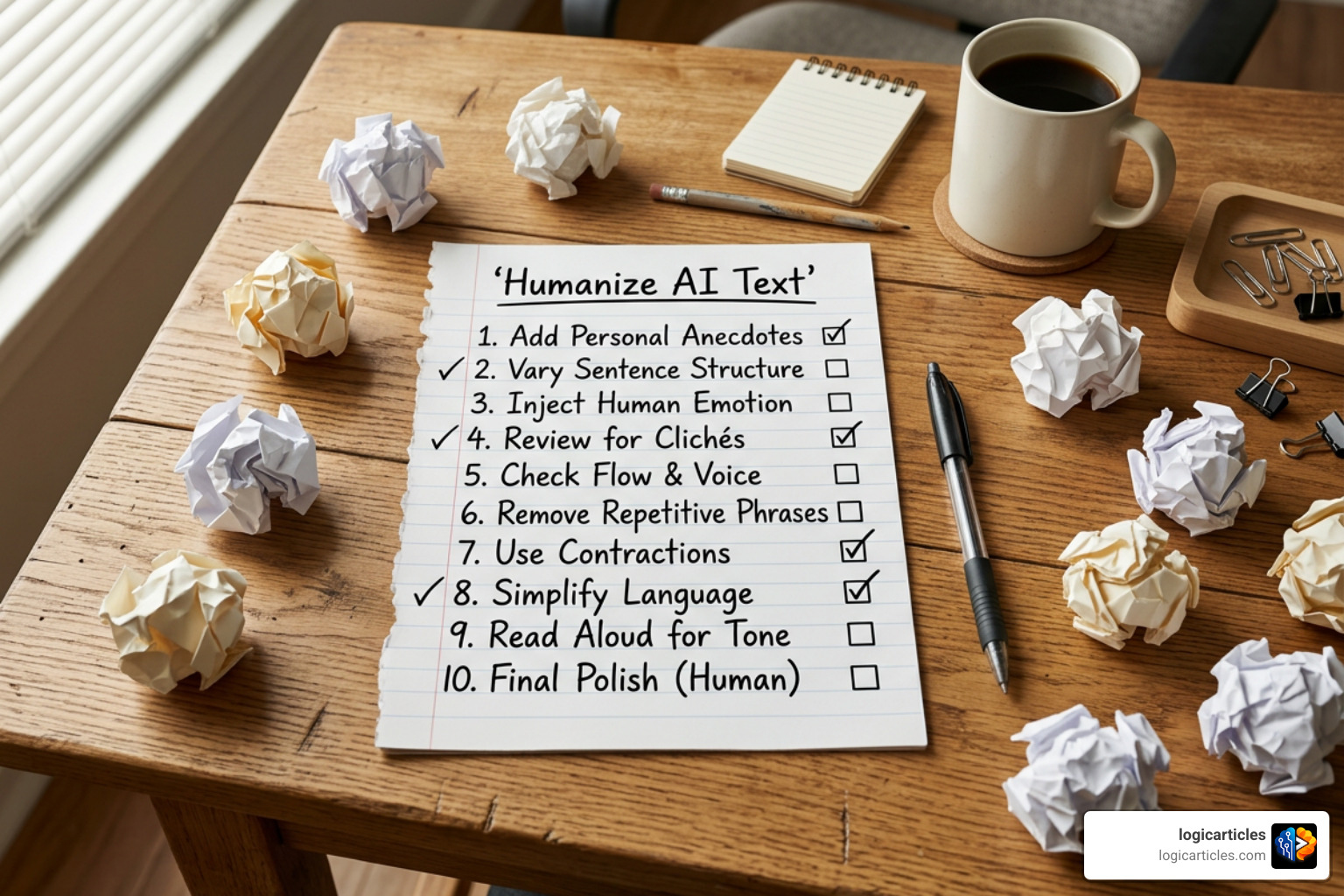
By focusing on the following five core changes, you can systematically dismantle the statistical patterns that detectors look for.
Change 1: Vary Sentence Length Dramatically
Varying your sentence length is the single highest-impact change you can make to bypass AI detectors. This single adjustment can drop AI detection scores by 20 to 35 percentage points.
To implement this, look at any paragraph in your draft. If every sentence is roughly the same length, break them up. Force yourself to include at least one ultra-short sentence (under 8 words) and one long, complex sentence (over 30 words) featuring subordinate clauses.
For example, instead of writing:
AI models are changing the landscape of digital marketing, and businesses must adapt quickly to stay competitive. (18 words)
Rewrite it to vary the rhythm:
Digital marketing is changing fast. If businesses don’t adapt to new AI systems immediately, they will simply get left behind. (2 words then 20 words)
Change 2: Rewrite the Introduction and Conclusion Completely
The opening and closing sections of a document are where AI detectors gain the most confidence. LLMs have incredibly predictable patterns for starting and ending articles. They love starting with broad generalizations (“In today’s world…”) and ending with neat summaries (“In conclusion, it is clear that…”).
Completely rewriting your introduction can move your AI detection score by 15 to 25 percentage points on its own, while a fresh conclusion can yield an additional 10 to 20 point drop.
When rewriting your introduction, skip the broad definitions. Open with a highly specific claim, a direct question, or a surprising statistic. When rewriting the conclusion, avoid summarizing what you just wrote. Instead, focus on a practical takeaway, an open question, or a future implication in plain, casual language.
Change 3: Eliminate Formulaic Transitions and AI Verbal Tics
AI models love mechanical transitions. They act as the “glue” that keeps machine-generated text cohesive, but they are also immediate red flags for detectors. Removing these predictable transitions can drop your score by 5 to 10 percentage points.
We must scrub our drafts of high-frequency AI verbal tics and transition phrases:
- Transitions to delete: Furthermore, Moreover, In conclusion, Additionally, It is important to note, Indeed, Consequently.
- Verbal tics to delete: Delve, Tapestry, Beacon, Testimonial, Not only… but also.
Instead of using a formal transition word, let your sentences stand on their own or use conversational connectors like But, So, Yet, or And.
Change 4: Inject Personal Anecdotes and Hedging Language
AI is trained to write with absolute, unbiased authority. Human writers, however, are beautifully biased, opinionated, and subjective. Injecting a personal touch immediately sky-rockets your text’s perplexity.
To do this:
- Add personal pronouns and opinions: Use “I think,” “in our experience,” or “we’ve found that.”
- Use hedging language: Instead of making definitive declarations, use words like might, probably, potentially, or sometimes.
- Use contractions naturally: AI often defaults to formal, uncontracted words (e.g., “do not,” “cannot,” “it is”). Convert these to “don’t,” “can’t,” and “it’s” to instantly soften the tone and mimic natural human speech.
Change 5: Break Paragraph Uniformity and Structure
AI text is visually uniform. It almost always generates paragraphs of equal length, usually containing 3 to 5 clean, balanced sentences.
To break this visual rhythm, we need to introduce irregularity. Try splitting a long paragraph mid-argument to create a single-sentence paragraph. Single-sentence callouts draw the reader’s eye and disrupt the uniform paragraph architecture that detectors are trained to identify. Breaking paragraph uniformity in this manner typically yields a 10 to 15 percentage point drop in AI scores.
Overall, applying all five of these structural changes in a single manual pass typically brings a 90%+ AI score down to a highly safe 15% to 40%.
Bypassing AI Detection: What No Longer Works in 2026
The arms race between AI detectors and bypass methods has accelerated. Many of the popular quick-fix tricks that worked in the early days of generative AI are completely ineffective today.

Why Synonym Swapping and Paraphrasing Tools Fail
In the past, writers relied heavily on basic paraphrasing tools to spin AI text. However, standard paraphrasers only swap individual words with synonyms while keeping the underlying sentence structure and paragraph architecture completely intact.
After basic paraphrasing (such as running text through a standard synonym-swapping tool), AI scores typically drop to only 62–85% — meaning the text is still flagged almost everywhere. This is because detectors measure statistical structure, not vocabulary.
Furthermore, major academic platforms updated their systems to include advanced “bypasser detection” specifically trained to catch text processed through basic humanizers and paraphrasing tools. You can Read about the limitations of paraphrasers to understand why structural manual editing is far more reliable.
The Failure of Unicode Tricks and Intentional Typos
Another common workaround involved “Unicode tricks,” such as replacing standard English letters with lookalike Cyrillic characters (homoglyphs), or deliberately inserting spelling errors to confuse the detector.
In 2026, these tricks are useless. Modern AI detectors normalize all input text before analyzing it. This means they strip out formatting anomalies, filter out Unicode tricks, and auto-correct minor typos before calculating perplexity and burstiness. Not only do these tricks fail to bypass detection, but they also ruin your content’s readability, break accessibility standards, and look highly suspicious to any human reviewer.
The Ultimate Hybrid Workflow for Content Creators
For high-volume content creators, pure manual editing can be incredibly time-consuming, taking 20 to 30 minutes per page. On the other hand, relying solely on automated humanizers can result in awkward, unpolished phrasing.
The solution is a hybrid workflow that combines the speed of AI, the precision of advanced humanization tools, and the authenticity of human editing. If you are looking to scale your content production while maintaining top-tier quality, utilizing professional SEO Content Writing Services can help you execute this workflow seamlessly.
Step-by-Step Guide to How to Make AI Text Undetectable
- Create a Human Outline: Don’t let the AI decide the structure of your article. Write a quick outline with your main arguments, unique angles, and primary sources first.
- Generate the AI Draft: Use ChatGPT, Claude, or Gemini to expand your outline into a full draft.
- Run a Baseline Scan: Paste the raw draft into an AI detector to identify which specific sections are flagging the highest.
- Apply the 5 Core Changes Manually: Spend 5 to 10 minutes applying our structural changes—focusing heavily on rewriting the introduction, varying sentence lengths, and removing obvious AI verbal tics.
- Use a Pattern-Level AI Humanizer: Run your manually edited draft through a high-quality, pattern-level AI humanizer tool to polish the remaining statistical markers.
- Final Verification and Audit Trail: Run a final scan to ensure your score is comfortably below 15%. If you are writing high-stakes content, keep a version history of your edits as proof of your human writing process.
Tailoring Your Strategy: Students vs. Bloggers vs. Professionals
Your humanization strategy should depend entirely on your target audience and the consequences of getting flagged.
- Students: Academic institutions use highly advanced detectors like Turnitin. Since only 5% of students fully understand their school’s AI policy, caution is vital. Students should focus on manual editing, processing essays paragraph-by-paragraph, and ensuring that humanization efforts are concentrated on the sentences between academic citations to preserve formatting.
- Bloggers: Bloggers must optimize for search engines. While search engines do not explicitly ban AI content, they heavily penalize unoriginal, low-quality text that lacks a unique perspective. Bloggers should focus on adding proprietary data, real-world images, and personal opinions to build E-E-A-T (Experience, Expertise, Authoritativeness, Trustworthiness).
- Professionals: In the corporate world, client trust is everything. Professionals should use a hybrid workflow to refine business reports, proposals, and emails so they sound natural, polished, and free of generic machine-like jargon.
If you want to scale your business content without risking your brand’s reputation, partnering with the Best Content Writing Agency in 2026 is an excellent way to ensure your content is both engaging and completely natural.
How to Handle False Positives and Ethical Considerations
AI detection is not a perfect science. As these tools become more aggressive, innocent writers are increasingly getting caught in the crosshairs.
What To Do When Your Human Writing Is Falsely Flagged
False positives are incredibly common, especially for certain demographics. A landmark Stanford study found that non-native English speakers face a massive 61.22% false positive rate with AI detectors. This happens because non-native writers often use highly formal, template-heavy prose with limited vocabulary, which mathematically mimics the low-perplexity style of AI models.
If your original, human-written work is falsely flagged, do not panic. Take these steps to build an appeal:
- Pull up your version history: Use Google Docs or Microsoft Word version history to show the step-by-step creation of your document over time. This is the strongest possible proof of authorship.
- Present your research notes: Show your initial outlines, brainstorms, and source materials.
- Explain the limitations of detectors: Point out that AI detectors are statistical estimation tools, not proof machines, and are highly prone to false positives in formal or technical writing.
Ethical Guidelines for How to Make AI Text Undetectable
While learning How to Make AI Text Undetectable is highly useful, we must always consider the ethical implications.
Using AI to assist, outline, and polish your writing is a standard productivity workflow in 2026. However, passing off entirely machine-generated work as original human thought—especially in academic environments with strict honor codes—can carry severe consequences. Always check your organization’s specific disclosure policies, verify every AI-generated claim against primary sources, and use these humanization techniques to enhance the quality and clarity of your voice, rather than to deceive.
Frequently Asked Questions about AI Detection
Can you make AI text 100% undetectable?
In practical terms, yes. While no tool or manual technique can guarantee universal, permanent invisibility across every single detector update, you can easily lower your scores below the standard flagging thresholds (typically 15–20%). By combining manual structural changes with pattern-level tools, you can consistently achieve scores under 10%.
Do AI humanizers work against Turnitin in 2026?
Turnitin uses highly sophisticated detection models that look for academic context and paraphrased AI patterns. Basic synonym-swapping tools will fail against Turnitin. However, pattern-level humanization that completely restructures the text’s perplexity and burstiness remains highly effective. For academic work, we always recommend a heavy manual editing pass on top of any tool-assisted humanization.
Why does my human writing get flagged as AI?
AI detectors flag text based on predictability. If you write in a highly formal, academic, or technical style, use standard template structures, or rely heavily on common transition words, a detector may mistake your structured writing for machine-generated text.
Conclusion
Making AI text undetectable isn’t about using sneaky tricks or finding a magic bypass button. It is about understanding the science of how detectors analyze text and systematically editing your content to look beautifully irregular, expressive, and human.
By focusing on our 5 core changes—varying sentence lengths, rewriting introductions, cutting formulaic transitions, adding personal anecdotes, and breaking paragraph uniformity—you can create high-quality content that engages your readers and easily clears AI detection hurdles.
Ready to take your content strategy to the next level? Explore our AI Tools category to discover the latest software, workflows, and guides to optimize your writing process in 2026.