Are Boldin Software Reviews Worth Your Attention?

Boldin software reviews consistently point to one of the most feature-rich retirement planning tools available to everyday investors — at a fraction of what a financial advisor would charge.
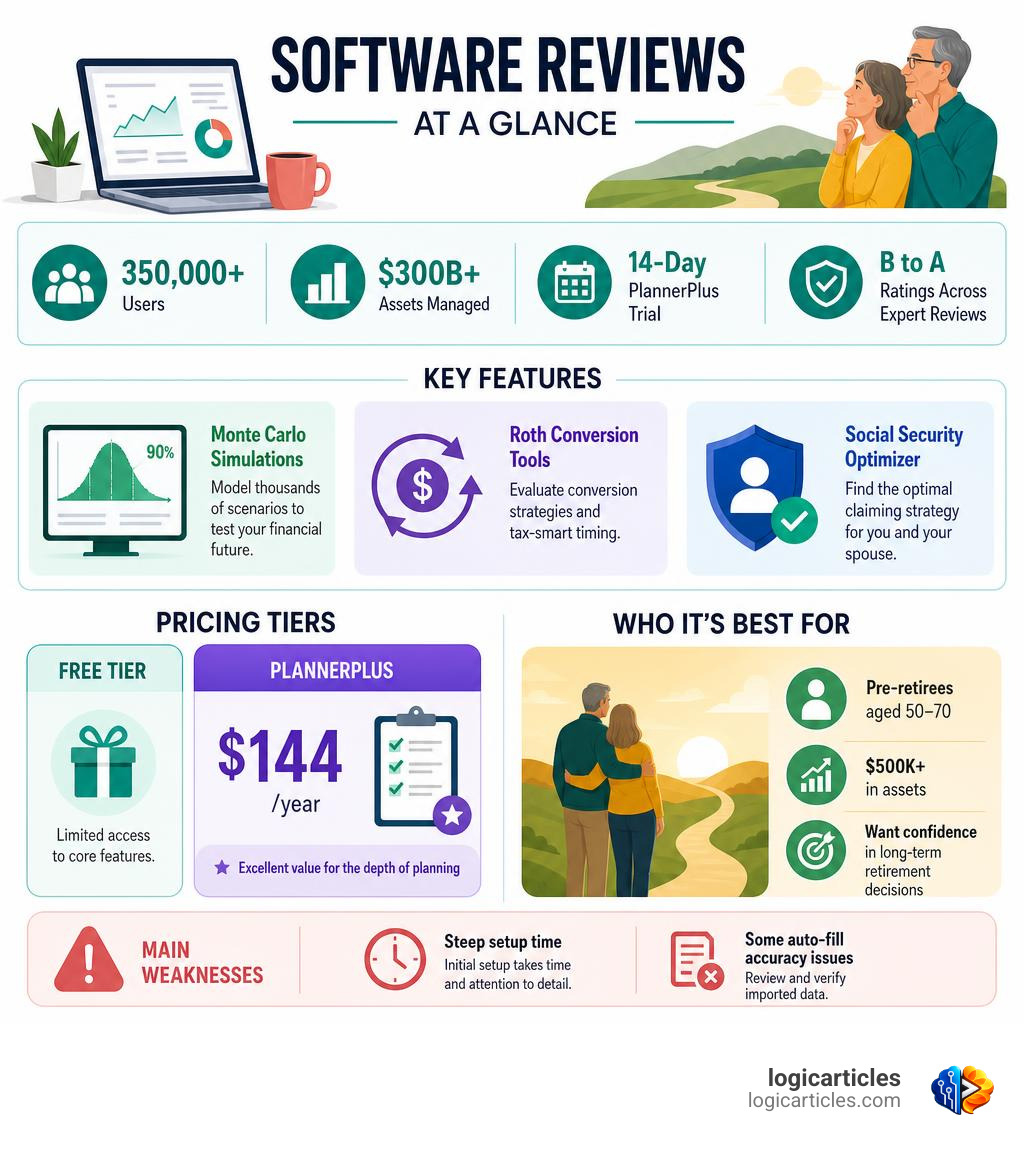
Here’s a quick summary of what reviewers say:
| Category | Verdict |
|---|---|
| Overall Quality | Strong — rated B to A range across expert reviews |
| Ease of Use | Moderate learning curve; not for beginners |
| Best Features | Monte Carlo simulations, Roth conversion tools, Social Security optimizer |
| Free Tier | Limited — best to start with the 14-day PlannerPlus trial |
| Paid Plan (PlannerPlus) | $144/year — widely considered excellent value |
| Best For | Pre-retirees aged 50-70 with $500K+ in assets |
| Main Weakness | Steep setup time; some auto-fill accuracy issues |
Boldin (formerly NewRetirement) has grown to serve over 350,000 users managing more than $300 billion in assets. That’s not a small niche product.
One user put it simply: “It’s because of Boldin that I actually retired.”
The tool helps people answer the questions that keep them up at night — Will I run out of money? When can I retire? Should I do a Roth conversion? — without paying thousands for a financial advisor.
But it’s not perfect for everyone. The depth that makes it powerful also makes it complex.
This guide breaks down what real users and expert reviewers say, how it compares to alternatives, and whether it’s the right fit for your situation.
What is Boldin and How Does It Work?
At its core, Boldin is a forward-looking financial engine rather than a traditional budgeting app. While popular tools like Monarch Money excel at tracking where your money went last month, Boldin is built to project where your money will go over the next 30 to 50 years.
Founded in 2015 by Steve Chen, the company was born out of a deeply personal mission: Chen wanted to help his own mother find affordable, comprehensive financial guidance that went beyond basic investment advice. In September 2024, the platform rebranded from NewRetirement to Boldin, reflecting its modern, expanded mission to empower users to take bold, confident steps into their financial futures.
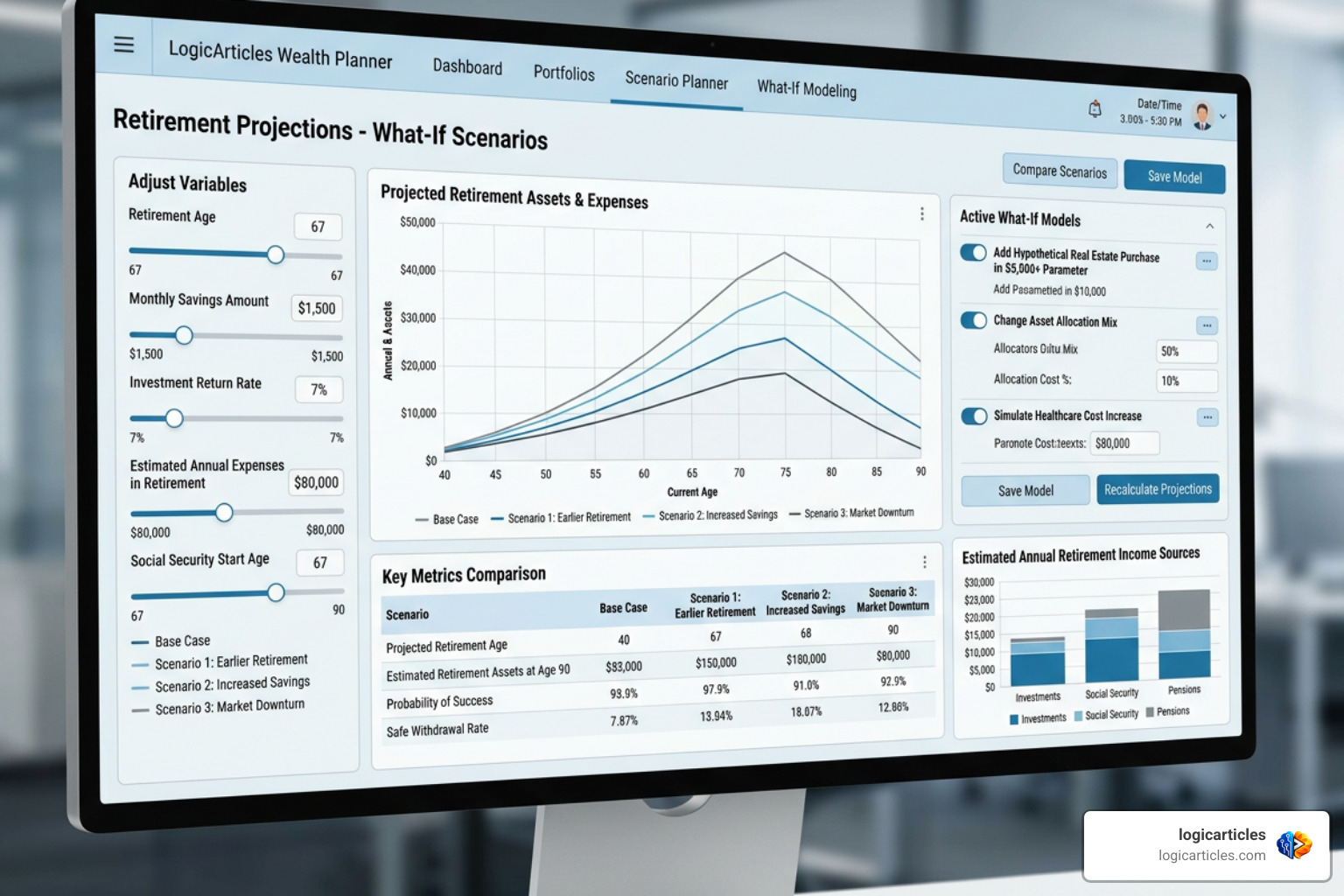
The software works by aggregating your complete financial life—including accounts, real estate, debts, income streams, and future expenses—and feeding them into a sophisticated projection calculator. Instead of relying on static, linear growth projections (which assume the market returns a perfect, unchanging percentage every year), Boldin runs your data through dynamic stress tests.
By mapping out your cash flow year by year, the platform helps you visualize your “Surplus-Gap” ratio. This shows you exactly when your expenses might exceed your passive income, giving you the foresight to adjust your strategy long before you actually stop working.
Core Features for Retirement Planning
What sets Boldin apart from basic online calculators is its specialized toolkit designed for complex, late-stage financial planning. Here are the heavy-hitting features that reviewers highlight:
- Monte Carlo Simulations: Considered the gold standard of financial stress-testing, Boldin’s Monte Carlo tool runs 1,000 randomized market scenarios to calculate your “Chance of Retirement Success.” In July 2025, Boldin updated its methodology to eliminate a geometric mean (CAGR) calculation error that previously double-counted market volatility, making its current projections highly accurate and reliable.
- Social Security Explorer: Deciding when to claim Social Security is a high-stakes decision. Claiming early can reduce your benefits by roughly 8% per year, while delaying until age 70 can increase your lifetime benefit by 8% annually. Boldin’s explorer calculates your maximum lifetime benefit based on customizable longevity assumptions for both you and your spouse.
- Roth Conversion Explorer: Tax planning is where Boldin truly shines. The Roth Explorer models the long-term tax savings of systematically moving traditional pre-tax funds into tax-free Roth IRAs. It estimates your future tax brackets, helps you avoid Medicare Premium surcharges (IRMAA), and models the five-year rule for withdrawals.
- Tax-Smart Drawdown Strategies: Instead of withdrawing randomly, Boldin automatically maps out optimized withdrawal sequences (e.g., taxable accounts first, then tax-deferred, then tax-free) to minimize your lifetime tax liability.
Boldin Software Reviews: User Interface and Ease of Use
When looking at User experiences on Boldin, the consensus is clear: the platform is incredibly powerful, but it requires a commitment.
This is not a “set-it-and-forget-it” app. The initial setup requires entering highly granular details—ranging from current investment allocations to future medical costs and real estate plans. Reviewers note that a proper setup takes anywhere from 30 to 45 minutes of focused attention, and some users report spending a few weeks tweaking variables before they felt entirely comfortable with the output.
The user interface prioritizes analytical depth over visual flash. While some younger users find the interface slightly “old school” compared to sleek, minimalist fintech apps, DIY investors and Bogleheads appreciate this layout. It puts the spreadsheets, charts, and mathematical assumptions front and center, giving you full transparency into how the software calculates your future wealth.
Analyzing Boldin Software Reviews: Pricing and Value Tiers
To understand whether the platform is right for you, we have to look closely at what you get for your money. Boldin operates on a freemium model with options to scale up to professional human advisory services.
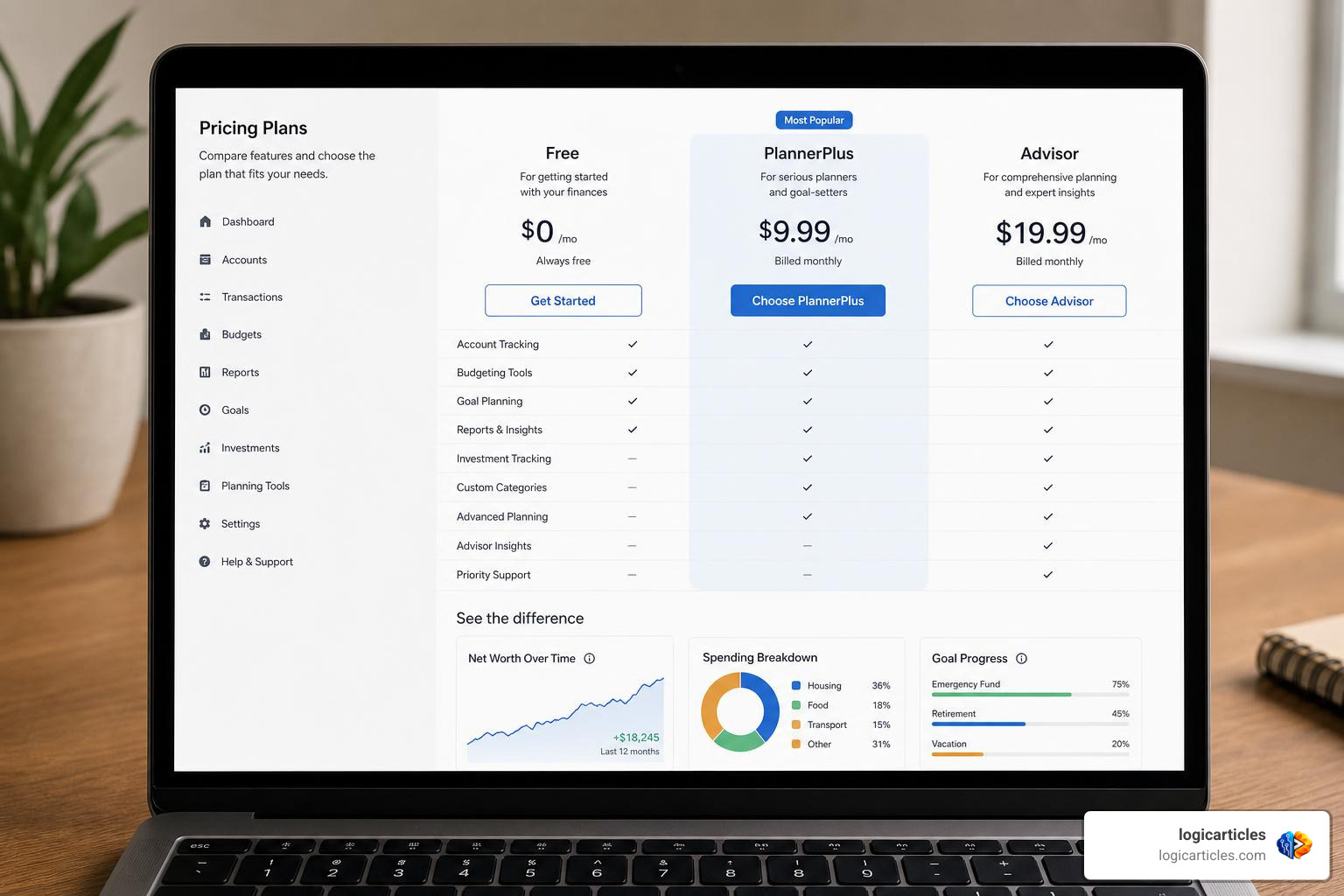
Free Basic Planner vs. PlannerPlus
While Boldin offers a free version, most expert reviews point out that the free tier is primarily a conversion tool rather than a fully functional planning suite.
The free tier uses highly conservative, static return assumptions and locks away advanced features like Monte Carlo simulations, automated account syncing, and the Roth Conversion Explorer. It also limits the number of custom input fields you can use.
Upgrading to PlannerPlus costs $144 per year (billed annually). This subscription unlocks the complete planning engine, including:
- Real-time account syncing via Plaid, MX, and Finicity.
- More than 250 manual input fields to customize your plan.
- Access to the Roth Conversion and Social Security Explorers.
- The ability to run side-by-side “What-If” scenario comparisons.
- Access to live weekly Q&A sessions and the PlannerPlus Academy.
As noted in a detailed Retirement Software Review: Boldin, the leap in value from the free tier to the paid subscription is massive. For anyone seriously planning their retirement, the PlannerPlus tier is practically mandatory.
Is the Paid Version Worth It?
Let’s look at the math. A traditional, human financial advisor typically charges an assets-under-management (AUM) fee of 1%, or a flat annual fee ranging from $1,500 to $30,000. At $144 a year, Boldin PlannerPlus costs less than a single hour of an advisor’s time.
In the DIY financial community, users often point out that a single mistake in retirement—such as a 2% withdrawal error on a $400,000 portfolio—can cost you $8,000 or more in unnecessary taxes and penalties. By using Boldin’s tax-smart withdrawal and Roth conversion tools to avoid that single mistake, you effectively save enough money to pay for your PlannerPlus subscription 56 times over.
For those who want a middle ground between pure DIY software and a traditional wealth manager, Boldin also offers one-on-one coaching sessions for $250, or full access to a fiduciary Certified Financial Planner (CFP) through the Boldin Advisors program for $2,800 per year.
Boldin Strengths, Weaknesses, and Expert Opinions
To paint an honest picture, we analyzed user discussions and expert reviews from highly critical financial communities, including the Bogleheads forum, White Coat Investor, and academic financial planners.
Key Strengths of the Platform
Experts and experienced DIY planners frequently highlight several major advantages of Boldin:
- Unmatched Scenario Modeling: The “What-If” tool is widely praised. Users love being able to instantly model complex life decisions: “What happens if we sell our home in California and relocate to Arizona at age 62?” or “Can we afford to buy a $100,000 lake house in five years without ruining our plan?”
- Granular Expense Categorization: Instead of assuming a flat inflation rate for all spending, Boldin allows you to separate your “Must Spend” (needs) from your “Like to Spend” (wants). It also integrates a built-in default model for long-term care costs (modeled around a national average of $117,992 in today’s dollars) and models dramatic healthcare cost increases as you age.
- State-Specific Tax Nuances: The software is smart enough to handle complex state tax rules, such as the unique tax treatment of Health Savings Accounts (HSAs) in California and New Jersey.
Limitations and Areas for Improvement
No software is perfect, and critical reviews point out a few notable limitations:
- Pessimistic Free Defaults: Some users complain that the free tier uses artificially pessimistic default assumptions, which can cause unnecessary panic and pressure users to upgrade.
- Data Auto-Fill and Correction Issues: A few negative reviews on trust platforms highlight frustrations with auto-filled data. In rare cases, users reported that auto-filled Social Security estimates or mortgage timelines were difficult to manually override, leading to temporary projection errors.
- Rigid Contribution Settings: Some advanced users note that the software struggles to model irregular, non-monthly savings—such as annual corporate profit-sharing or lump-sum business bonuses—because the system is optimized for monthly contribution intervals.
- Conventional Planning Bias: Academic critics, such as economics professor Laurence Kotlikoff (creator of competing tool MaxiFi), point out that conventional planning tools like Boldin focus on target spending goals rather than mathematical “consumption smoothing.” They argue this can sometimes encourage users to over-save or target unrealistic asset growth.
Who is Boldin Best Suited For?
Boldin is a specialized tool, and its value depends entirely on who is using it.
We have summarized how the different tiers align with various user profiles below:
| User Profile | Best Tier | Why? |
|---|---|---|
| Young Savers (Ages 20-35) | Free Basic / Alternatives | Focus is on accumulation and budgeting; advanced tax/withdrawal tools aren’t needed yet. |
| Mid-Career Builders (Ages 35-50) | PlannerPlus | Great for modeling college funding, real estate purchases, and early-retirement feasibility. |
| Pre-Retirees (Ages 50-65) | PlannerPlus | Critical window for optimizing Social Security, mapping Roth conversions, and stress-testing the plan. |
| Retirepreneurs & Business Owners | PlannerPlus / Advisor | Perfect for modeling how consulting or side-business income impacts Medicare (IRMAA) and Social Security taxes. |
| Hands-Off Investors | Boldin Advisors ($2,800/yr) | Best for those who want professional CFP validation without paying high AUM fees. |
How to Get Started with Boldin Software Reviews
If you want to put your retirement plans to the test, we recommend skipping the highly restricted free tier and signing up directly for the 14-day free trial of PlannerPlus.
Before you start, gather your basic financial documents:
- Current balances for all retirement, brokerage, and bank accounts.
- Estimated Social Security statements (from SSA.gov).
- Outstanding debt balances, interest rates, and payoff timelines (especially mortgages).
- A realistic estimate of your current annual spending, separated into essential and discretionary costs.
Set aside about 30 to 45 minutes on a desktop computer (the large-screen experience is far superior to mobile for inputting data). Follow the guided prompts, build your baseline plan, and then begin playing with the “What-If” scenario tool to see how different decisions affect your financial future.
Frequently Asked Questions About Boldin
Is Boldin safe to link with my bank accounts?
Yes. Boldin uses industry-standard financial aggregators—including Plaid, MX, and Finicity—to sync your account balances. These services establish secure, read-only connections. Boldin never stores your banking credentials, and they cannot access or move your funds.
Can Boldin handle complex tax situations like Roth conversions?
Yes, this is one of Boldin’s strongest features. The Roth Conversion Explorer allows you to model systematic conversions over multi-year periods. It projects how these conversions will affect your federal and state tax brackets, models the impact on your future Required Minimum Distributions (RMDs), and flags potential Medicare premium surcharges (IRMAA).
How does Boldin compare to traditional spreadsheets?
While spreadsheets are highly customizable, they require you to manually write formulas for complex tax brackets, Social Security rules, Medicare thresholds, and inflation adjustments. A single broken formula can ruin your entire projection. Boldin automates all of these calculations, updates them as tax laws change, and stress-tests your numbers against 1,000 Monte Carlo market scenarios in seconds.
Conclusion
The goal of retirement planning is not just to accumulate a pile of money—it is to gain the psychological freedom to enjoy it. Many users suffer from “One More Year” syndrome, working longer than they need to simply because they lack the data to prove they are safe to stop.
Boldin serves as a powerful, affordable bridge between basic online calculators and expensive financial advisors. It gives you the institutional-grade modeling tools to stress-test your assumptions, optimize your taxes, and build a concrete roadmap to financial freedom.
If you are ready to take control of your financial destiny, check out our resources and Start planning your future today!