Why an Online Software Engineering Degree Is Worth Your Time in 2026

An online software engineering degree is one of the most career-ready paths you can take right now — and you don’t need to quit your job or move to a campus to get one.
Quick answer: What is an online software engineering degree?
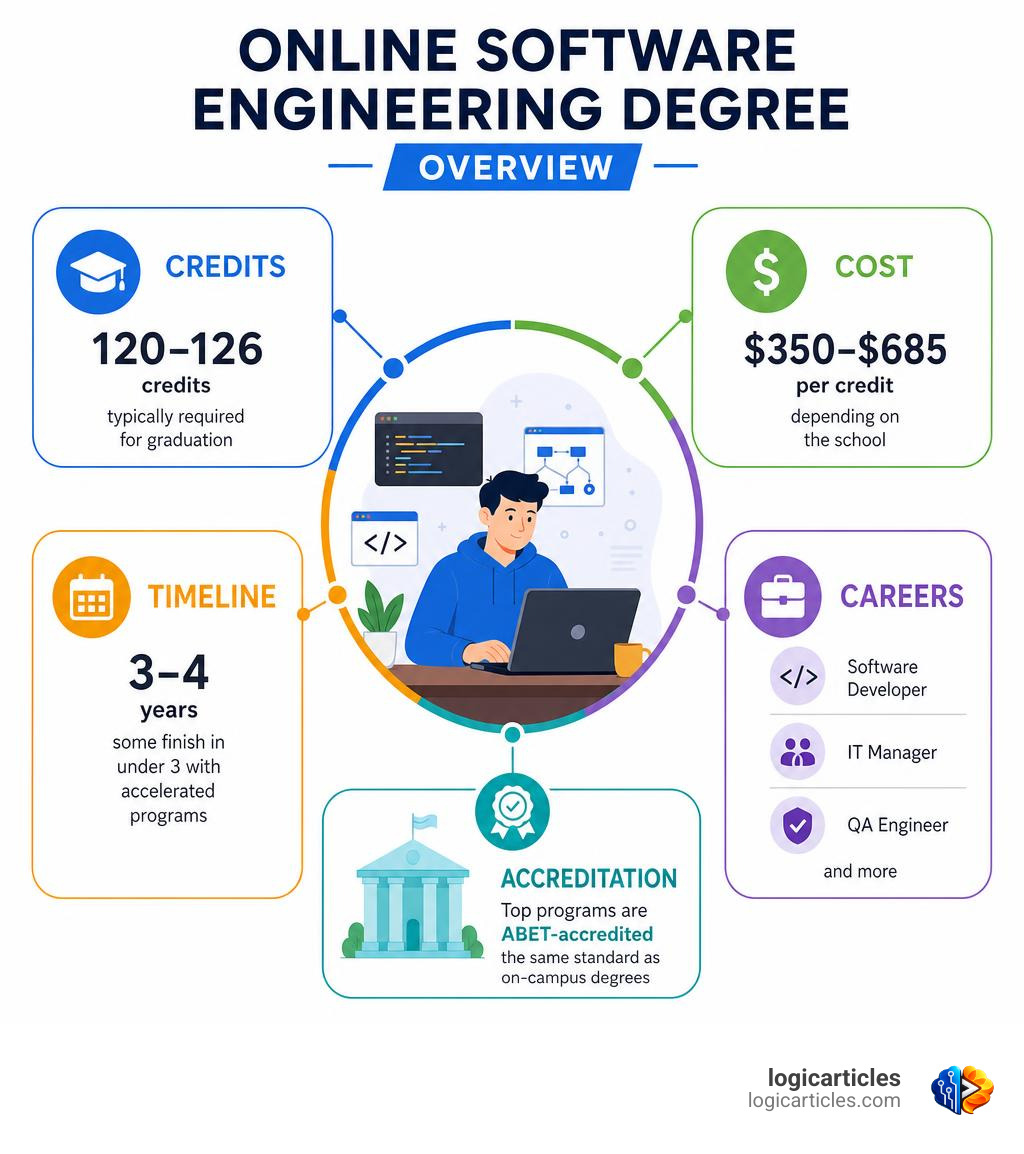
- A bachelor’s degree (typically 120–126 credits) earned fully online
- Covers software design, programming, testing, and systems development
- Takes about 3–4 years (some finish in under 3 with accelerated programs)
- Costs roughly $350–$685 per credit depending on the school
- Leads to roles like software developer, IT manager, or QA engineer
- Top programs are ABET-accredited — the same standard as on-campus degrees
The job market backs this up. Software developers are projected to see 17.9% employment growth over the next 10 years, with over 1.6 million people already working in the field. That’s not a niche career path — it’s one of the most in-demand professions in the economy.
The online format has matured too. Programs at major universities now offer the same diploma as their on-campus counterparts. No fine print. No “online” stamp on your degree.
Whether you’re a working professional looking to level up or someone starting fresh, this guide breaks down exactly what to expect — from costs and curriculum to career outcomes.
What to Expect from an Online Software Engineering Degree
If you have ever pictured yourself building the next viral mobile app, securing critical financial systems, or organizing complex cloud architectures, you are looking at the work of a software engineer. But what is it actually like to earn this degree online?
Historically, pursuing a technical field meant sitting in a physical computer lab for hours. In May 2026, the landscape has completely shifted. Online software engineering programs deliver the exact same rigorous curriculum as on-campus programs, but with the freedom to study whenever and wherever you work best.
Traditional vs. Online Programs
The primary difference is flexibility. Traditional programs require synchronous attendance—meaning you must show up to a physical classroom at a specific time. Online programs are typically asynchronous, allowing you to log in, watch lectures, and complete coding assignments around your existing schedule.
However, do not mistake flexibility for a shortcut. You will still face the same challenging calculus, physics, and complex programming courses. The difference is that you are in control of your study environment.
The Importance of ABET Accreditation
When evaluating online programs, programmatic accreditation is your golden ticket. You should prioritize programs accredited by the Engineering Accreditation Commission of ABET.
ABET accreditation ensures that the program meets strict industry standards for quality, safety, and modern engineering practices. Graduating from an ABET-accredited program signals to top-tier employers that your education was comprehensive and technically sound. For a detailed breakdown of how top programs stack up, check out ComputerScience.org’s guide to software engineering programs.
Typical Curriculum and Core Technical Skills
A common misconception is that software engineering is just “coding.” While programming is a massive component, software engineering is actually a broad discipline focused on the entire software development lifecycle (SDLC).
We design, architect, test, secure, and maintain systems. Our curriculum reflects this holistic approach.
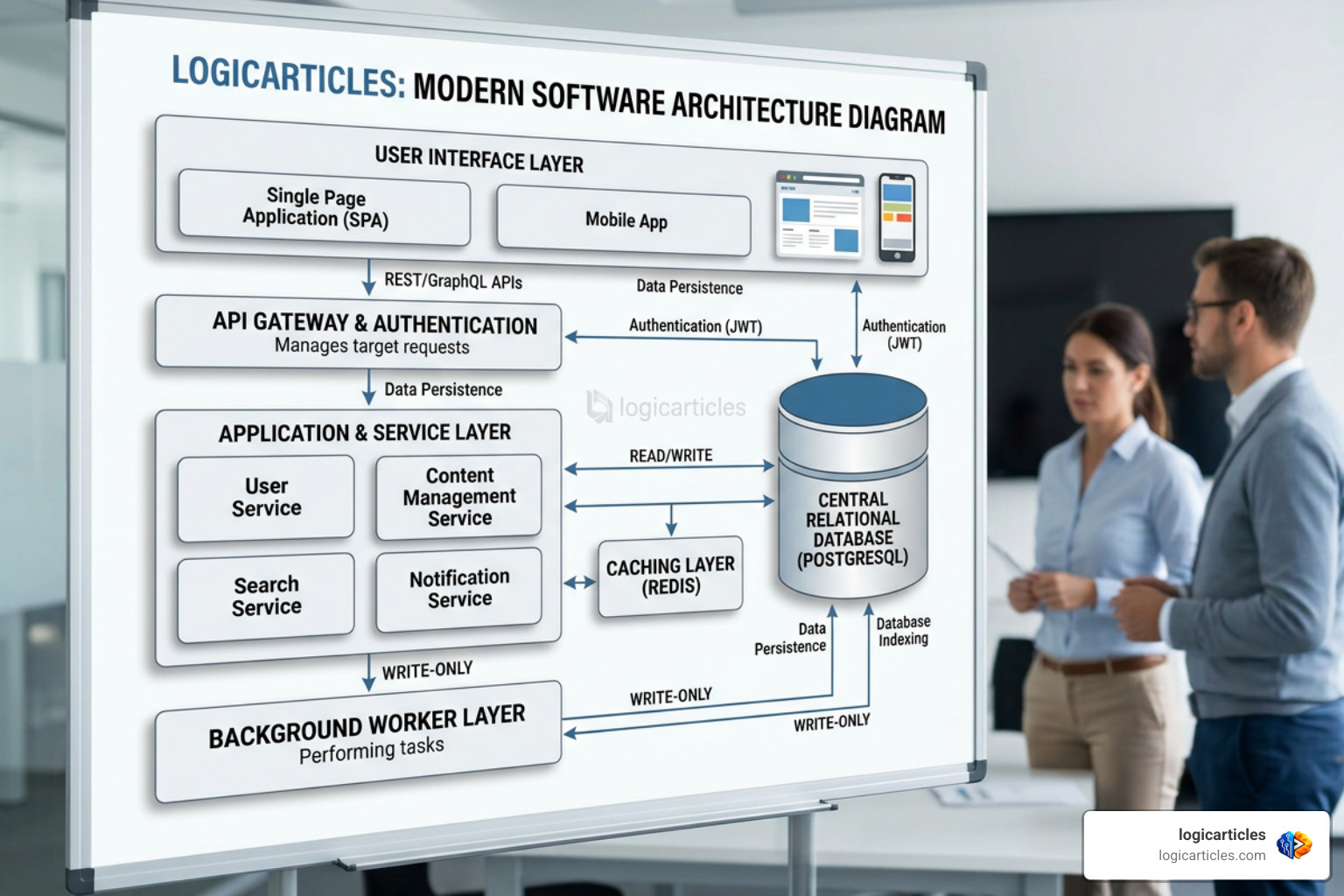
To succeed in the field, you will develop several core technical competencies:
- Software Design and Architecture: Learning how to structure complex, multi-file software systems so they are scalable, readable, and maintainable.
- Database Management: Designing, querying, and managing databases using SQL and modern data architectures to handle enterprise-level information.
- Secure Coding: Mitigating software and data risks by applying secure programming principles from day one, preventing common security vulnerabilities.
- Software Reverse Engineering: Analyzing existing legacy code to recreate missing documentation, enhance functionality, or find security loopholes.
Core Coursework Checklist
Most online software engineering programs require a combination of general education, mathematics, computer science, and specialized engineering courses. You can expect to take:
- Discrete Structures and Algorithms: The mathematical foundation of computer science and logic.
- User Interface (UI) / User Experience (UX) Design and Development: Conducting user testing to build accessible and user-friendly digital tools.
- Software Quality Assurance and Testing: Writing tests and applying validation practices to remove defects before software is deployed.
- Emerging Systems Architectures & Technologies: Exploring modern cloud-based and mobile environments.
Programming Languages in an Online Software Engineering Degree
While languages come and go, learning how to think like a programmer is a permanent skill. That said, you will spend a lot of time writing actual code.
Most online programs start you with a highly structured, object-oriented language like Java, and then branch out to other languages such as Python and C++.
Some universities even allow you to specialize by choosing a specific language track. For instance, in WGU’s Software Engineering Bachelor’s Program, students can choose between a Java track or a C# track:
- The Java Track: Ideal for building applications that run across diverse device ecosystems, including mobile platforms (Android), smart appliances, and connected vehicles.
- The C# Track: Frequently chosen by those targeting major tech hubs and large enterprises that rely heavily on Microsoft infrastructure.
Regardless of the language you choose, you will also master version control (such as Git). Version control is an essential industry best practice for any multi-file programming project, allowing you to track changes, collaborate with other developers, and manage code releases seamlessly.
Hands-On Projects and Capstone Requirements
You cannot learn software engineering solely by reading textbooks; you have to build things. Online programs integrate hands-on projects directly into their virtual environments.
Throughout your studies, you will build a professional portfolio of software systems, web applications, and databases that you can showcase to employers during job interviews.
The crown jewel of your degree is the senior capstone project. This is typically a one- or two-semester project where you work individually or in a multidisciplinary team to solve a real-world challenge.
For example, some universities partner with actual companies to sponsor capstone projects. You might collaborate with classmates to design, develop, and test a software system for a real business client. This experience teaches you how to apply Agile methodologies (like Scrum), communicate with stakeholders, and manage a complex project from initial requirements gathering to final deployment.
Admissions, Costs, and Timeline for Online Programs
Ready to apply? Let’s talk about the practical details: getting in, paying for it, and planning your schedule.
Typical Admission Requirements
Admission requirements vary depending on the institution and whether you are entering as a first-year student or a transfer student:
- Freshman Admission: Typically requires a high school diploma or GED, a minimum GPA (often between 2.25 and 2.75), and occasionally SAT/ACT scores.
- Prerequisite Math & Science: Because software engineering is a formal engineering discipline, some ABET-accredited programs require you to complete prerequisite courses like calculus, calculus-based physics, or chemistry with a lab before you can officially enter the major.
- Alternative Pathways: If you don’t meet standard admission requirements, some schools offer alternative options. For example, ASU Online provides an “Earned Admission” pathway where you can take online courses to prove your academic readiness and gain entry into the degree program.
Tuition and Transfer Credits
Tuition structures can work in a few different ways. Some schools charge a flat rate per six-month term, which is highly advantageous if you plan to study at an accelerated pace. Others charge a standard per-credit rate.
If you have already earned college credits or an associate degree, look for generous transfer policies. Many online programs allow you to transfer up to 90 credits (75% of the degree), drastically reducing both your time to graduation and your total cost.
To give you an idea of how these options compare, take a look at the tuition structures of several notable programs, including ASU’s Online Bachelor of Science in Software Engineering:
| University Program | Total Credit Hours | Tuition Pricing Model | Key Program Feature |
|---|---|---|---|
| ASU Online | 120 credits (41 classes) | Per-credit tuition | ABET-accredited, rigorous math/science foundations |
| Western Governors University (WGU) | 36–38 courses | ~$4,125 per 6-month term | Competency-based, flat-rate tuition, includes certifications |
| SNHU | 120 credits | ~$342 per credit ($250 for military) | Virtual computing tools, focus on portfolio building |
| St. Cloud State University | 122 credits | ~$350 per credit hour | 7-week course structure, accepts up to 90 transfer credits |
| Penn State World Campus | 126 credits | ~$638 to $685 per credit | ABET-accredited, industry-sponsored senior capstone |
How Long Does It Take to Earn an Online Software Engineering Degree?
For a traditional full-time student, a bachelor’s degree takes four years. However, the online format offers several ways to cross the finish line much faster:
- Competency-Based Learning: Rather than sitting through a semester-long class, competency-based programs allow you to take an assessment as soon as you master the material. If you already have coding experience, you can move through familiar topics quickly. At WGU, 60% of software engineering graduates finish their degree within 35 months.
- Accelerated Pathways: Many universities offer accelerated “BS-to-MS” bridge programs. These pathways allow you to take up to 12 credits of graduate-level coursework during your undergraduate studies at undergraduate tuition rates, putting you on track to earn both your bachelor’s and master’s degrees in about 5 years.
- Part-Time Flexibility: If you are balancing a full-time job and family commitments, you can choose to take one or two courses per term, extending your timeline but keeping your stress levels manageable.
Career Outcomes and Job Outlook for Graduates
The ultimate goal of earning your degree is to secure a fulfilling, high-paying career. The good news? The tech industry’s demand for qualified software professionals remains incredibly strong.
According to industry data, software developer positions are projected to grow by 17.9% over the next decade, while software quality assurance analyst and tester roles are expected to grow by 11.8%.
Graduating with a bachelor’s degree also has a significant financial impact. For example, WGU graduates report earning an average of $22,200 more per year just two years after graduation, and $30,300 more per year four years after graduation compared to their pre-enrollment earnings.
Common Job Titles for Graduates
When you start applying for jobs, you will be qualified for a wide range of roles across almost every industry—including healthcare, finance, gaming, aerospace, and defense:
- Software Developer / Programmer: Writing, testing, and maintaining code to build user-facing applications or backend services.
- Software Quality Assurance (QA) Engineer: Designing testing plans, writing automated test scripts, and identifying software bugs.
- Software Architect / Systems Analyst: Designing the high-level structure of complex software systems and choosing the right technologies to meet business needs.
- Information Technology (IT) Manager: Overseeing technical teams, managing development projects, and aligning tech strategies with business goals.
Frequently Asked Questions about Software Engineering Degrees
Choosing a degree is a big decision, and it is completely normal to have questions about the value of an online program. Let’s tackle some of the most common concerns.
Is an online software engineering degree respected by employers?
Absolutely. Today, employers care about what you know and what you can build, not whether you sat in a physical lecture hall.
Furthermore, your diploma and transcripts from major universities will look exactly the same as those of on-campus students; they do not include the word “online.” As long as you choose an accredited institution—ideally one with ABET programmatic accreditation—your degree will carry full weight in the job market.
What is the difference between software engineering and computer science?
Think of computer science as the “why” and software engineering as the “how.”
- Computer Science focuses heavily on the theoretical foundations of computation, algorithms, data structures, and computer theory.
- Software Engineering is a more structured engineering discipline. It focuses on the practical application of those theories to design, build, test, and manage large-scale software systems using standardized methodologies and project management techniques.
Are industry certifications included in online programs?
In some programs, yes! Earning certifications alongside your degree is a fantastic way to boost your resume before you even graduate.
For example, WGU embeds several highly valued, third-party industry certifications directly into their software engineering curriculum at no extra cost. These include:
- AWS Certified Cloud Practitioner (essential for cloud systems)
- CompTIA Project+ (critical for project management)
- ITIL (industry standard for IT service management and operations)
Conclusion
Embarking on an online software engineering degree is a powerful way to future-proof your career. The combination of high employment growth, flexible learning models, and strong salary outcomes makes it one of the most practical educational investments you can make in 2026.
At logicarticles, we are passionate about providing clear, logic-driven insights to help you navigate your educational and career journeys. If you are ready to take the next step, research the programs that align with your budget and learning style, reach out to an admissions counselor, and start building the digital tools of tomorrow!