Why Individual Investors Are Switching to Portfolio Management Software

Portfolio management software for individual investors has become one of the fastest-growing categories in personal finance tools — and for good reason.
If you’re looking for a quick answer, here are the top options in 2026:
| Software | Best For | Starting Price |
|---|---|---|
| Quicken Premier | Most comprehensive features | $8.49/month |
| Sharesight | DIY investors moving beyond spreadsheets | $9.33/month |
| Ziggma | Budget-conscious investors | $6.99/month |
| Kubera | Widest range of trackable assets | $249/year |
| Morningstar Investor | Investment research depth | $34.95/month |
| Fidelity Full View | Fidelity account holders | Free |
| Portfolio Visualizer | Backtesting and analysis | Free tier available |
| IBKR PortfolioAnalyst | Standalone free tracking tool | Free |
Most individual investors start with a spreadsheet. It feels simple, free, and under your control. But as your portfolio grows — more accounts, more asset types, more complexity — spreadsheets start to break down fast.
Manual data entry leads to errors. Prices go stale. You lose track of your real returns. Tax season becomes a nightmare.
Modern portfolio management software solves these problems by automatically syncing with brokers and banks, pulling in real-time prices, calculating your actual performance, and giving you a clear picture of your risk exposure — all in one place.
The difference isn’t just convenience. It’s clarity. And clarity leads to better investment decisions.
Portfolio Visualizer alone draws over 5.1 million annual visits from investors in more than 100 countries — a sign of just how hungry individual investors are for better tools.
Whether you’re tracking a simple stock-and-ETF portfolio or juggling crypto, real estate, and retirement accounts across multiple brokers, there’s a software option built for your needs and your budget.
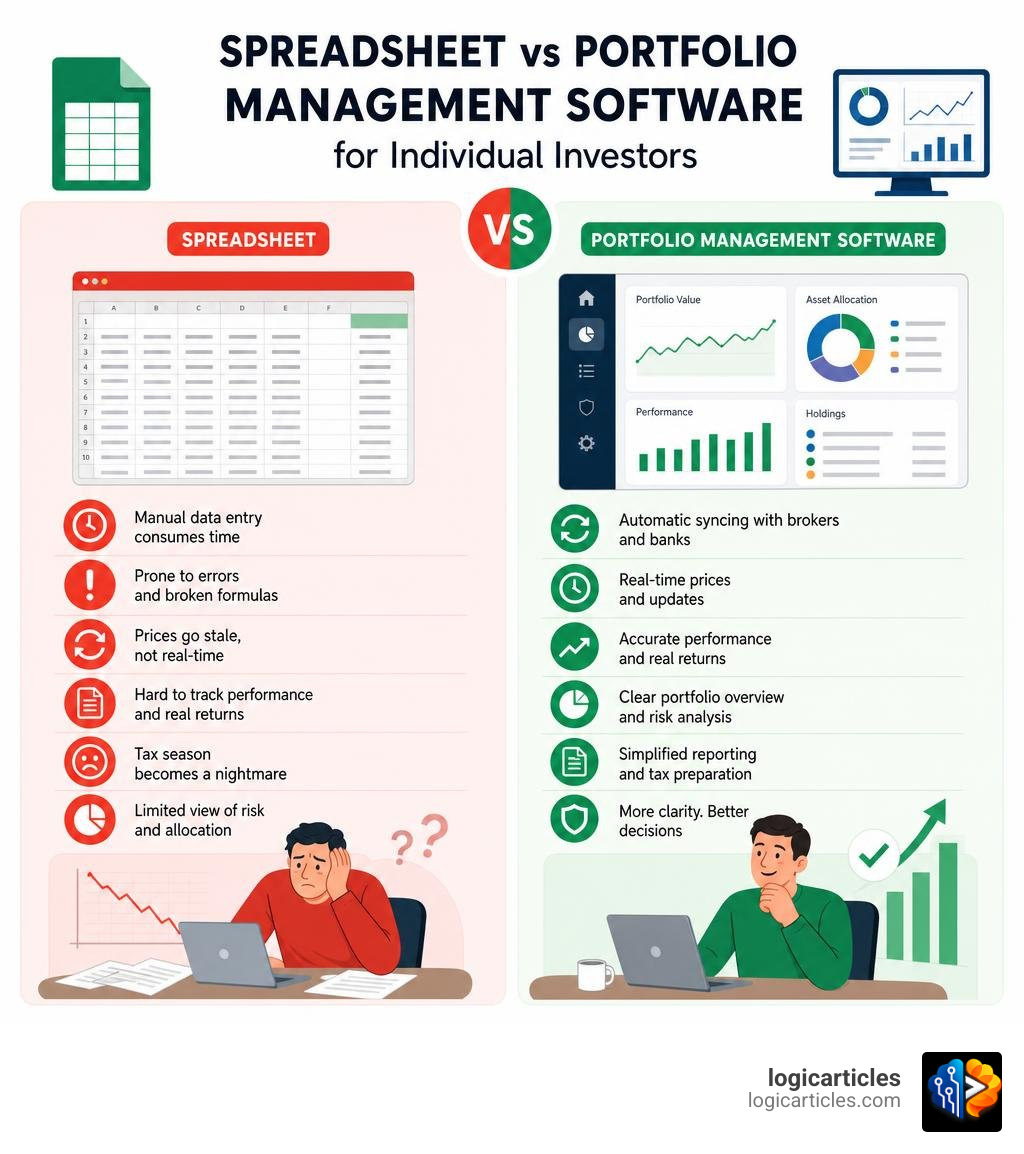
Why Move Beyond Spreadsheets to Portfolio Management Software for Individual Investors?
Let’s be honest: we all love a good spreadsheet. There is a certain satisfying feeling about designing your own rows, choosing your own pastel highlight colors, and writing custom formulas. But when it comes to managing your hard-earned wealth, relying on manual spreadsheets is like using a rotary phone in the era of smartphones.
First, manual data entry is notoriously prone to human error. A single misplaced decimal point or a broken formula can completely distort your perceived net worth or performance history. Second, spreadsheets do not update themselves in real time. If you want to know how your asset allocation looks on a volatile trading day, you have to manually copy and paste prices, which is both exhausting and inefficient.
By upgrading to dedicated portfolio management software for individual investors, you replace manual clutter with automated syncing. These modern tools connect securely to your financial institutions, pulling in transaction histories, stock splits, dividend payments, and cost basis calculations automatically. Just as we use specialized systems to keep our workflows organized—which you can read about in our guide to the Best Task Management Software In 2026 Tested—your investment portfolio deserves a dedicated platform built specifically to handle complex financial data without the risk of broken cells.
Key Features of Portfolio Management Software for Individual Investors
When shopping for the perfect platform, you shouldn’t just look for a pretty interface. A robust tool needs to do the heavy lifting for you. Here are the core pillars of a high-quality portfolio tracker:
- Automated Asset Allocation Mapping: The software should automatically categorize your holdings by asset class, sector, and geographical region, showing you exactly where your money is concentrated.
- Accurate Performance Tracking: It should calculate your true performance using advanced metrics like Time-Weighted Return (TWR) and Money-Weighted Return (MWR/XIRR), accounting for cash inflows and outflows.
- Risk Analysis and Stress Testing: You need to see how your portfolio might behave during a market downturn.
- Tax Optimization and Cost Basis Tracking: Features like tax-loss harvesting indicators and open-lot tracking help you minimize what you owe to Uncle Sam.
For investors seeking a highly professional suite of reporting features without a premium price tag, platforms like Interactive Brokers offer incredibly sophisticated tools. You can explore these capabilities in detail by checking out the PortfolioAnalyst Features | Interactive Brokers LLC , which provides deep-dive performance attribution and custom benchmarking across linked external accounts.
How to Choose Portfolio Management Software for Individual Investors
Finding the right fit depends heavily on your personal investing style, your technical comfort level, and the complexity of your assets.
If you are a buy-and-hold index fund investor, a simple, clean interface with basic broker syncing will work beautifully. However, if you are a hands-on DIY investor who enjoys building custom models, you will want a platform that offers advanced optimization algorithms. For instance, the tools hosted at pfolio: Portfolio Optimisation & Asset Allocation Tools for DIY Investors are designed specifically to help DIY investors apply Modern Portfolio Theory to construct and rebalance their own portfolios without paying exorbitant advisory fees.
When evaluating your options, consider:
- Broker Integration: Does the software seamlessly support the institutions where your assets live?
- Pricing Models: Are you comfortable with a monthly subscription, or do you prefer a free, ad-supported, or desktop-bound model?
- Security Standards: How does the platform protect your read-only financial data?
Advanced Capabilities: Performance, Risk, and Rebalancing
Once you move past basic tracking, the true magic of portfolio management software lies in its analytical power.
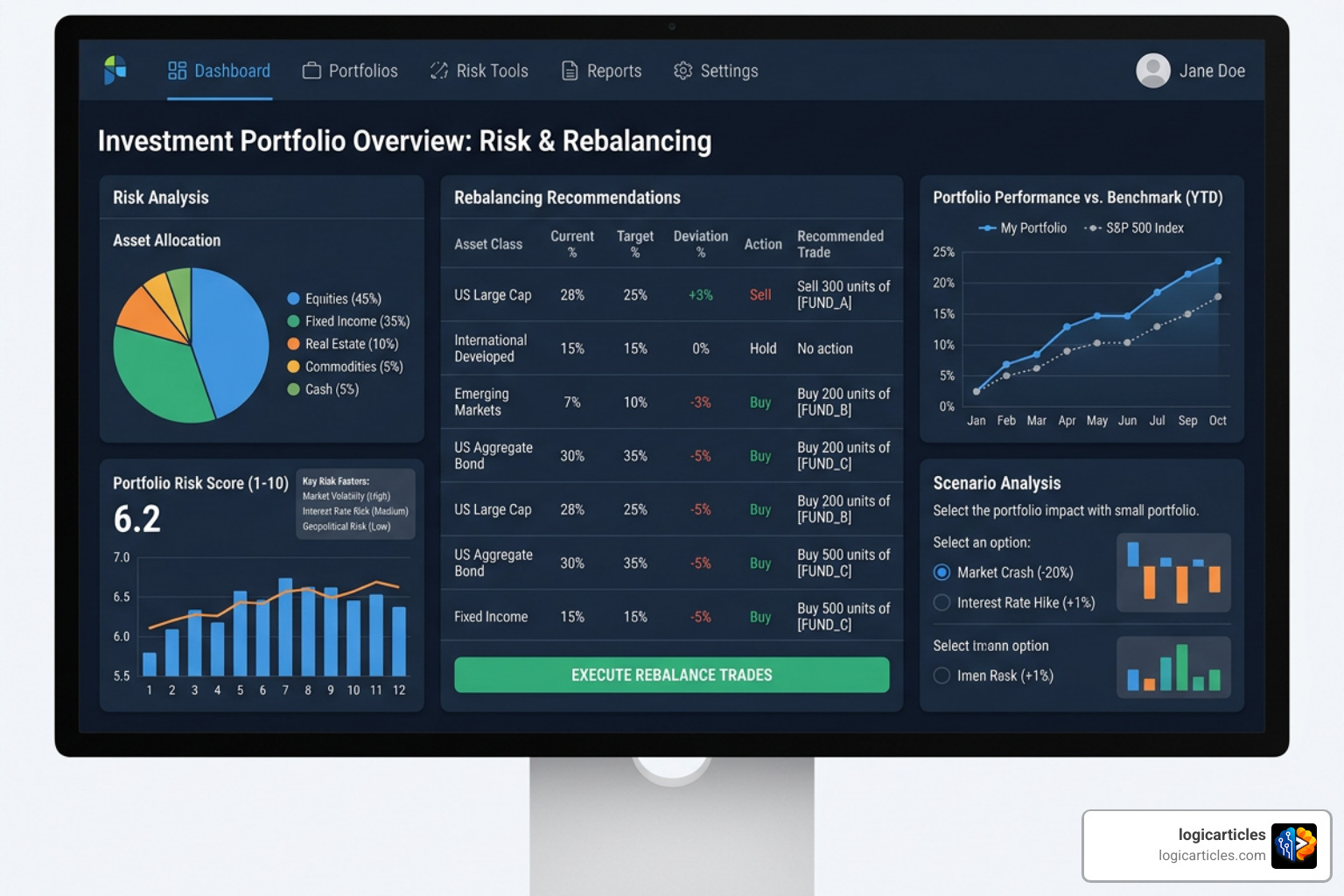
Understanding your portfolio’s risk-adjusted return is crucial. A portfolio that returned 15% last year might look great on paper, but if it took extreme, volatile risks to get there, you might be on thin ice. Advanced software calculates metrics like the Sharpe Ratio and Sortino Ratio to help you understand if your returns are due to smart asset allocation or simply taking on too much danger.
Many modern platforms also use Monte Carlo simulations to run thousands of virtual market scenarios, showing you the statistical probability of your portfolio lasting through retirement.
Furthermore, these tools make rebalancing painless. Instead of spending hours calculating how many shares of an ETF you need to sell or buy to get back to your target 60/40 allocation, the software generates exact trade instructions for you. While corporate finance teams use specialized tools to optimize their corporate earnings—as detailed in our review of the Best Revenue Management Software In 2026—individual investors can use retail portfolio software to optimize their personal returns and keep their risk levels perfectly balanced.
Tracking Diverse Asset Classes
In 2026, the modern investor’s portfolio is rarely limited to just US stocks and mutual funds. You might own international equities, cryptocurrencies, physical real estate, or even collectibles.
Tracking this diverse mix can be incredibly frustrating if your software only supports traditional brokerage accounts. This is where specialized tools shine. For example, Kubera is widely recognized for tracking the broadest range of assets, including foreign bank accounts, precious metals, and web domains.
If you are managing physical properties alongside your liquid investments, you might want to combine your general tracker with a dedicated real estate tool. To find the right fit for your physical holdings, check out our guide on the Best Real Estate Portfolio Management Software In 2026.
On the other hand, if you are a privacy-conscious developer or tech-savvy investor who prefers to keep your data completely off the cloud, you can look into open-source, local-first trackers. A fantastic example is the developer-friendly project Maermin/MAERMIN , which runs entirely in your browser using local storage and AES-256 encryption to track everything from stocks to alternative gaming assets without requiring a centralized server.
The Role of AI and Modern Integrations in 2026
Artificial intelligence has completely transformed how we manage our money. In 2026, AI features in portfolio software go far beyond simple chatbots; they act as proactive financial co-pilots.
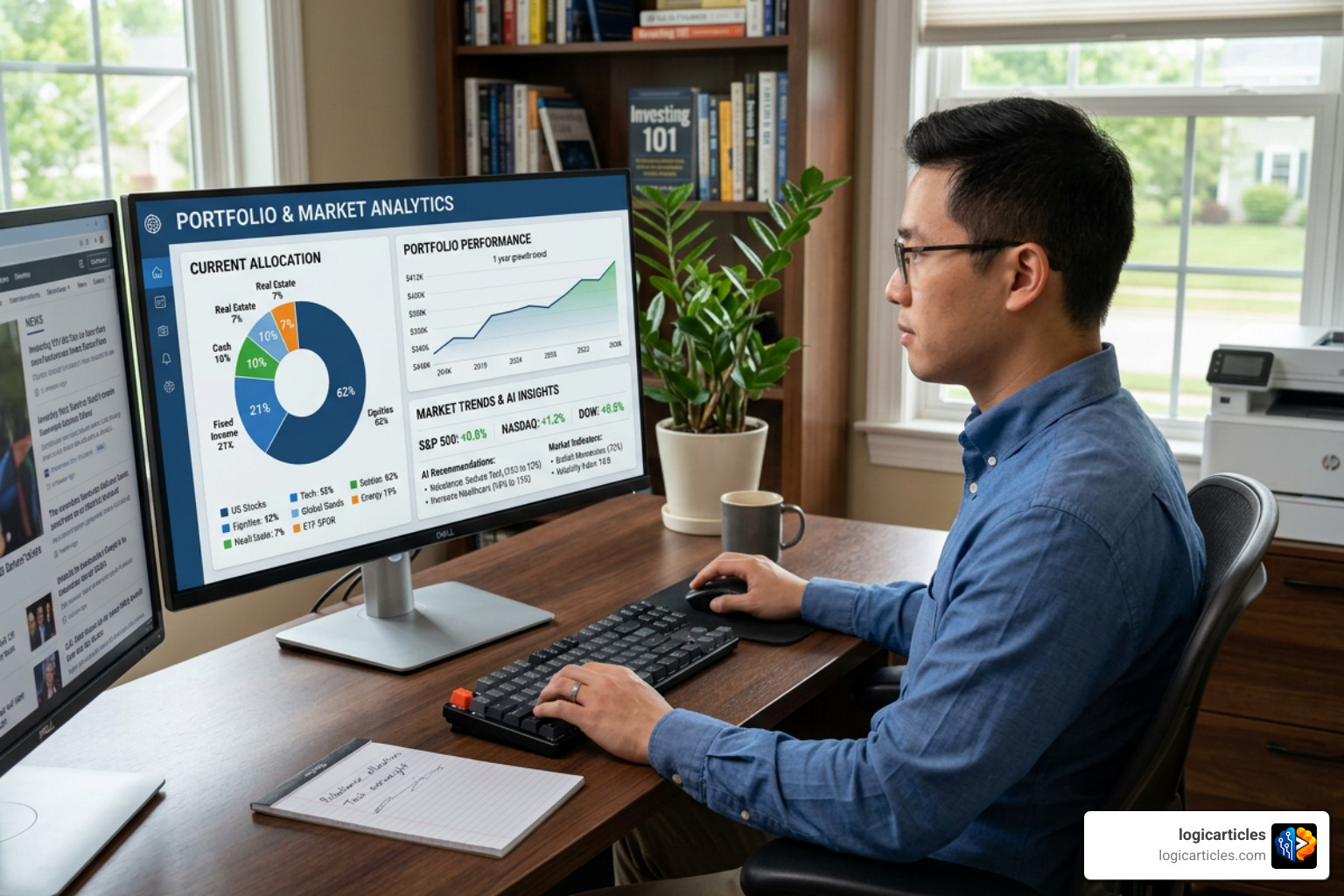
AI-driven platforms can now automatically parse PDF broker statements or tax documents, instantly extracting transaction histories and correcting formatting discrepancies without human intervention. These systems can also analyze your historical trading patterns to warn you of behavioral biases—like panic-selling during minor market dips—or highlight hidden fee overlaps where two different mutual funds are charging high expense ratios for holding the exact same underlying stocks.
A great example of this localized, next-generation innovation is Invesh — AI-Powered Portfolio Tracker for Indian Investors , which utilizes an AI wealth assistant to parse multi-account transactions from PDFs and CSVs, giving users a unified view of country-specific assets like PPF, EPF, and NPS alongside traditional stocks.
Security and Privacy Considerations
With great connectivity comes great responsibility. Linking your bank and brokerage accounts to a single platform requires absolute trust in the software’s security protocols.
When evaluating a platform, make sure it utilizes read-only access. This means that even if someone manages to compromise your portfolio software account, they cannot move, trade, or withdraw your actual funds. Most reputable platforms partner with secure data aggregators like Plaid or Yodlee, meaning the software itself never sees or stores your login credentials.
For institutional-grade security, you can look to major financial institutions that offer standalone tracking tools. For instance, the free tool PortfolioAnalyst | Interactive Brokers LLC utilizes highly rigorous security standards—including TLS 1.2 secure connections and strict multi-factor authentication—to safeguard consolidated external accounts.
Frequently Asked Questions about Portfolio Management
Navigating investment tools can raise plenty of questions. Here are some of the most common queries we receive from individual investors.
What is the difference between free and paid portfolio management tools?
Free portfolio management tools are excellent for beginners, but they usually come with limitations. Free tiers often restrict the number of external accounts you can link, limit the types of assets you can track (for example, excluding crypto or private equity), or display ads.
Paid tiers, which typically range from $6 to $35 per month, unlock unlimited account syncing, advanced risk metrics, automated rebalancing calculators, tax-loss harvesting tools, and priority customer support. The investment is usually well worth it if your portfolio size makes manual tracking too time-consuming.
Can I track alternative assets like real estate and crypto?
Yes, many modern portfolio trackers support alternative assets. Some platforms allow you to manually input real estate values using automatic valuation APIs (like Zillow), while others let you link directly to crypto exchanges or hardware wallets via public API keys.
If you are working with a professional financial advisor, they may use advanced, advisor-facing platforms to manage these complex asset classes. Platforms like the RIA Portfolio Management Software – Altruist allow wealth managers to build custom models, execute fractional share trades, and implement personalized indexing screens to seamlessly integrate alternative investments for their clients.
How does AI improve portfolio management for DIY investors?
AI helps DIY investors by turning complex financial data into plain-English insights. Instead of staring at a complicated spreadsheet of risk statistics, you can ask an AI assistant, “How will a 2% interest rate hike affect my portfolio?” The AI can instantly run a stress-test simulation and explain the potential impact on your specific bond and equity holdings.
Conclusion
The era of struggling with clunky, manual spreadsheets is officially over. Upgrading to the right portfolio management software for individual investors gives you the clarity, automation, and institutional-grade analysis you need to confidently take control of your financial future.
By choosing a tool that aligns with your specific asset mix, budget, and security preferences, you can stop spending your weekends fixing broken formulas and start spending your time optimizing your long-term wealth.
Ready to discover more tools to streamline your digital life? Head over to Explore the Best Software Categories to read our latest tested reviews and expert software recommendations!