Why the Best Investment Portfolio Management Software in US Matters More Than Ever

The best investment portfolio management software in US markets can mean the difference between scattered spreadsheets and a clear, confident view of your financial future.
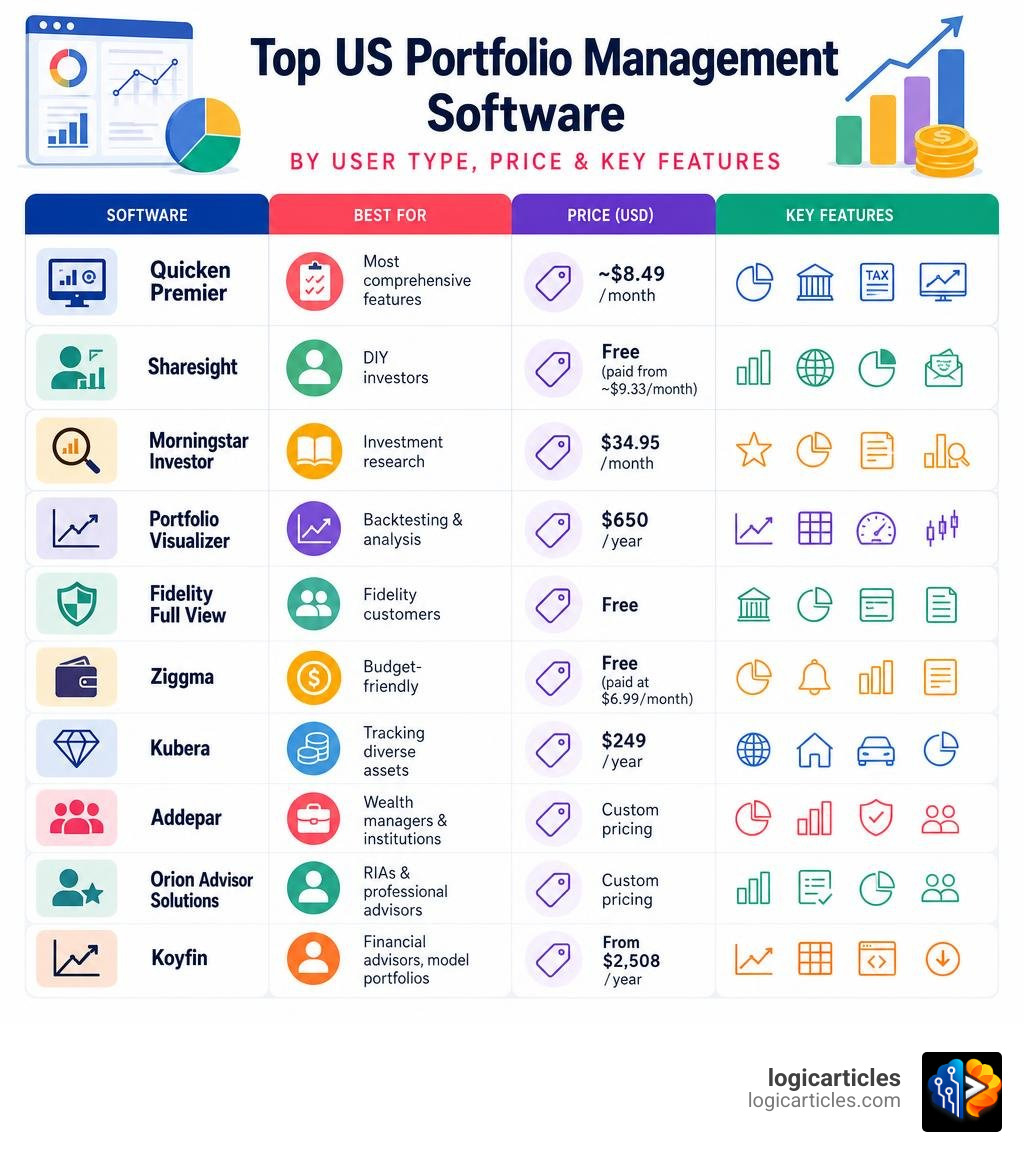
Here is a quick look at the top options to address what you are looking for right away:
| Software | Best For | Starting Price |
|---|---|---|
| Quicken Premier | Most comprehensive features | ~$8.49/month |
| Sharesight | DIY investors | Free (paid from ~$9.33/month) |
| Morningstar Investor | Investment research | $34.95/month |
| Portfolio Visualizer | Backtesting & analysis | $650/year |
| Fidelity Full View | Fidelity customers | Free |
| Ziggma | Budget-friendly | Free (paid at $6.99/month) |
| Kubera | Tracking diverse assets | $249/year |
| Addepar | Wealth managers & institutions | Custom pricing |
| Orion Advisor Solutions | RIAs & professional advisors | Custom pricing |
| Koyfin | Financial advisors, model portfolios | From $2,508/year |
Managing investments across multiple accounts, asset classes, and institutions is genuinely hard. Most people start with a spreadsheet. Eventually, that stops working.
Modern portfolio management software solves this by bringing everything into one place — tracking performance, flagging risk, and helping you make smarter allocation decisions.
The US market offers tools for every type of user:
- DIY individual investors who want simple tracking and tax reporting
- Financial advisors and RIAs who need model portfolios and client reporting
- Institutions and family offices managing complex, multi-asset portfolios
The stakes are real. Platforms like Addepar now manage over $7 trillion in assets across more than 50 countries. Orion Advisor Solutions holds the #1 market share for portfolio management and reporting tools among RIAs, with a 95% client retention rate. These numbers reflect just how central the right software has become to investment operations of all sizes.
The challenge is that not every tool fits every investor. A feature that is essential for a wealth manager — like real-time IBOR data or compliance automation — may be overkill for someone tracking a retirement account and a few ETFs.
This guide cuts through the noise and helps you find the right fit.
Choosing the Best Investment Portfolio Management Software in US
Selecting the right platform is not just about picking the tool with the most features or the flashiest dashboard. It is about understanding your workflows, your investment style, and your reporting requirements.
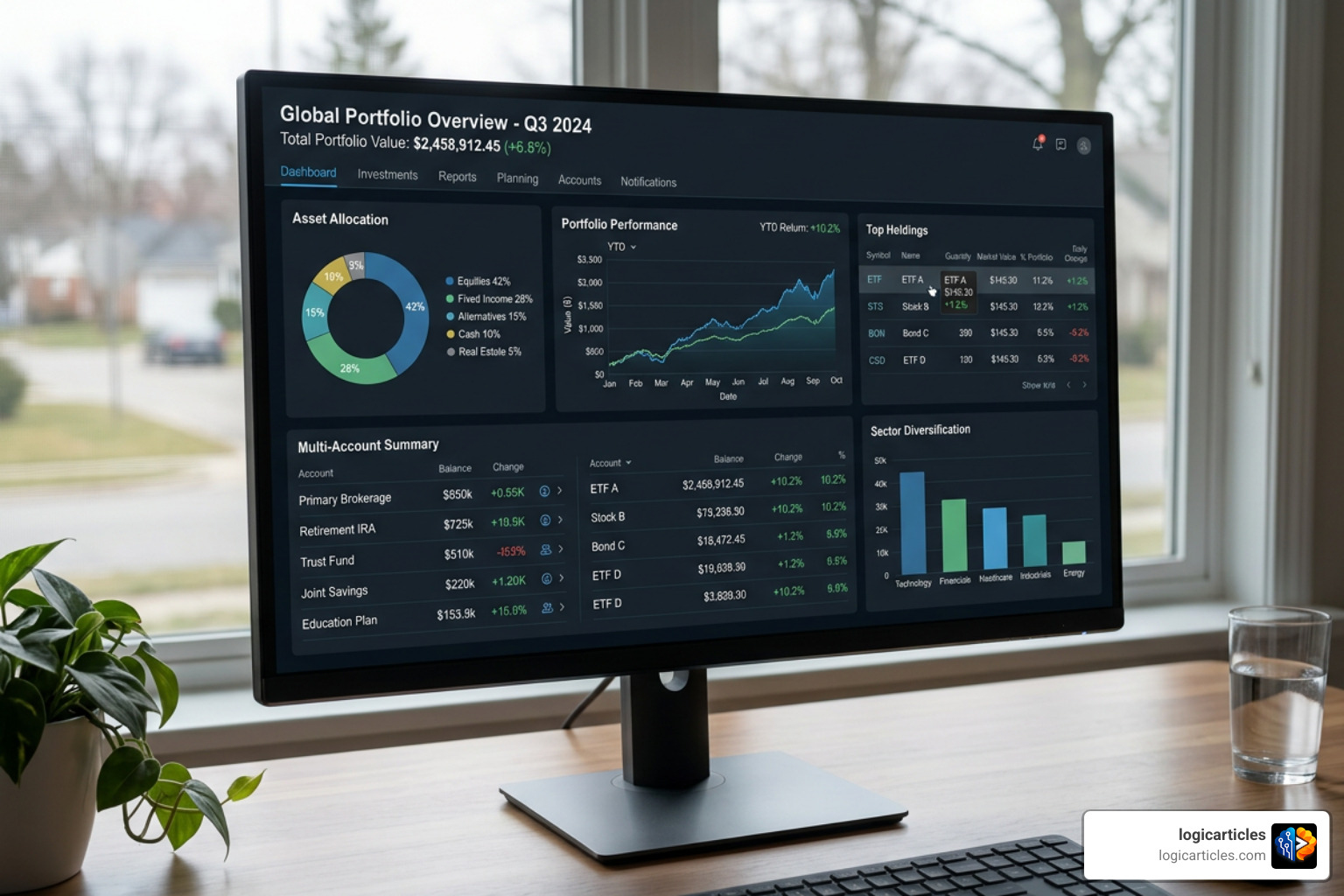
For individual investors, a great tool acts as a financial aggregator. It pulls data from your 401(k), your Roth IRA, and your taxable brokerage accounts to show you a single, unified net worth statement. For professional financial advisors, the requirements are far more robust. Advisors need institutional-grade performance reporting, billing automation, compliance auditing, and customizable model portfolios.
To help you understand the landscape, let us look at how free and premium portfolio tools stack up against each other:
| Feature Category | Free Tools (e.g., Fidelity Full View, Basic Trackers) | Premium Tools (e.g., Quicken, Sharesight, Koyfin) |
|---|---|---|
| Data Sync Frequency | Daily or manual refresh | Real-time or near-real-time API feeds |
| Asset Class Support | Standard US stocks, mutual funds, ETFs | Global markets, private equity, real estate, crypto |
| Tax Optimization | Basic cost basis tracking | Automated tax-loss harvesting, wash sale alerts |
| Performance Attribution | Simple rate of return (IRR or TWR) | Advanced attribution, risk-adjusted metrics (Sharpe, Beta) |
| Reporting Capabilities | Standard PDF exports, basic charts | White-labeled, highly customizable client reports |
| Scenario Modeling | None or very basic retirement calculators | Monte Carlo simulations, historical backtesting engines |
Regardless of where you sit on this spectrum, we believe that any tool you choose must pass three core tests: usability, data accuracy, and integration capability. Let us break down the specific components you should be evaluating under these categories.
Key Features of the Best Investment Portfolio Management Software in US
If you want to move past basic spreadsheets, your chosen software needs to do the heavy lifting for you. Here are the core features that define the top-tier systems in 2026:
- Comprehensive Asset Tracking: The software should seamlessly track standard equities, mutual funds, fixed income, and alternative assets. If you are managing complex corporate structures, you might also need specialized tools like Investment Accounting Software to handle the back-office general ledger requirements.
- Performance Monitoring & Attribution: Look for platforms that support both Time-Weighted Return (TWR) and Money-Weighted Return (MWR/IRR). Understanding why your portfolio performed the way it did is just as important as knowing the final return number.
- Risk Analysis & Metrics: Sophisticated tools calculate critical metrics such as Max Drawdown, Sharpe ratio, Sortino ratio, and Calmar ratio. Tools like Interactive Brokers’ PortfolioAnalyst excel here, providing GIPS-examined returns for professional-grade reporting. You can learn more about these capabilities directly on the PortfolioAnalyst Features | Interactive Brokers LLC page or review their broader services at PortfolioAnalyst | Interactive Brokers LLC.
- Automated Rebalancing: When market movements push your portfolio out of alignment, the software should automatically calculate the exact trades needed to return to your target allocation.
- Tax Optimization: Features like tax-loss harvesting and cost-basis tracking (FIFO, LIFO, Specific Share Identification) can save you thousands of dollars during tax season.
How to Select the Best Investment Portfolio Management Software in US for Your Goals
Your investment persona dictates your software requirements. Let us look at how different investor profiles should approach this choice:
1. The DIY Individual Investor
If you manage your own money, your primary goal is clarity and simplicity. You want a tool that automatically pulls data from your banks and brokers, tracks your dividend income, and monitors your asset allocation. Sharesight is an excellent choice for DIYers because of its powerful performance and tax reporting. If you want deep investment research alongside your tracking, Morningstar Investor provides access to professional-grade research covering over 54,000 publicly traded companies and 150,000 investment strategies.
2. The Model-Focused Financial Advisor
Advisors building customized models need platforms built for scale. Koyfin has quickly become a favorite in 2026 for building, tracking, and presenting model portfolios. It ranked first in G2’s Financial Analytics and Investment Portfolio Management categories, offering a fast, modern alternative to legacy systems like FactSet or YCharts. Koyfin allows you to group portfolios under households, analyze equity concentration risk, and export branded, client-ready reports.
For advisors looking for a highly modern custodial and portfolio management experience, Altruist offers a compelling solution. The RIA Portfolio Management Software – Altruist platform is built to replace expensive traditional TAMPs (which averages 0.45% to 0.50% of AUM) with a streamlined, low-cost model marketplace, fractional share trading, and automated rebalancing.
3. The Institutional Wealth Manager
Institutions managing complex, multi-family offices or registered investment advisor (RIA) firms require deep integrations and robust compliance tools. They often look to platforms like eMoney Advisor (which boasts a 94% user satisfaction rate among its 100,000+ financial professionals) or Orion Advisor Solutions. They also utilize advanced portfolio-building tools like the Streamlined, All-in-One Tool To Build Personalized Portfolios | Vise platform to construct hyper-personalized portfolios tailored to specific client tax constraints and values-based screens.
Categorizing Portfolio Management Solutions by Asset Class
Not all software handles all assets equally. A tool that is fantastic for tracking a portfolio of domestic US stocks might fail completely when asked to track a commercial real estate syndication or a private equity commitment.

Let us examine how different tools handle specific asset classes:
Traditional Equities, ETFs, and Mutual Funds
Almost every tool on our list tracks these flawlessly. However, if you want automated, hands-off management of these traditional assets, platforms like E*TRADE’s Core Portfolios offer a great solution. Their Core Portfolios: Automatic Investment Management | E*TRADE program uses algorithms to monitor your account daily, automatically rebalancing your portfolio if your asset drift exceeds 5%, while also leveraging tax-loss harvesting to offset capital gains.
Real Estate and Physical Property
Real estate investments require unique tracking metrics, such as net operating income (NOI), depreciation, and loan-to-value (LTV) ratios. Traditional portfolio trackers usually cannot handle these. If real estate makes up a significant portion of your net worth, you should look into dedicated Real Estate Investment Accounting Software or explore our comprehensive guide on the Best Real Estate Portfolio Management Software in 2026 to find tools that handle property depreciation, rent rolls, and mortgage balances alongside your liquid equities.
Multi-Asset and Exotic Assets
If you have a truly diverse portfolio containing a 401(k), physical real estate, crypto, and perhaps even alternative investments like art, you need a multi-asset aggregator. Kubera is highly regarded for tracking exotic assets, even supporting domain names and classic cars.
For a unified US-centric view, the Portfolio Tracker USA 2026 — 401k, Roth, Brokerage & Property | Richify platform offers an AI-powered personal finance engine designed to bridge the gaps between your Fidelity, Vanguard, Schwab, and physical property holdings in one clean interface.
Integration, Security, and Compliance Considerations
When you use portfolio management software, you are trusting a third-party platform with your most sensitive financial data. Therefore, security and compliance are non-negotiable.
Before linking your accounts, always check for the following standards:
- Bank-Grade Encryption: The software must use AES 256-bit encryption to protect your data both in transit and at rest.
- Read-Only Access: The integration with your brokerage accounts should be strictly read-only. The portfolio tracker should never have the authorization to initiate trades or withdraw funds.
- SOC 2 Type II Certification: This independent audit verifies that the software provider maintains strict security protocols over a prolonged period.
- Secure Aggregators: Ensure the platform uses secure, credential-free aggregators like Plaid or Yodlee rather than storing your direct bank login details on their own servers.
Compliance is equally critical for institutional users. If you are managing insurance-related investments or corporate real estate holdings, your software must comply with specific accounting and regulatory frameworks. For example, firms in the insurance space should look to specialized Insurance Investment Accounting Software to stay compliant with statutory accounting principles (SAP). Similarly, developers and builders require specialized Commercial Real Estate Development Software to track project costs, zoning, and construction draws alongside their capital stack.
Frequently Asked Questions about Portfolio Management
What is the difference between free and premium portfolio management tools?
Free tools typically rely on manual data entry or daily batch updates, and they often limit the number of accounts or asset classes you can track. Premium tools offer real-time API integrations, support for international markets and alternative assets, advanced risk analysis (like Sharpe and Sortino ratios), tax optimization tools, and automated rebalancing calculations.
How do portfolio management tools integrate with existing brokerage accounts?
Most modern tools use secure data aggregators like Plaid, Yodlee, or direct API connections provided by major brokerages (like Schwab, Fidelity, and Interactive Brokers). These integrations establish a secure, read-only connection that allows the software to pull transaction history and balance data without ever exposing your login credentials or allowing external trade execution.
Why is real-time data important for portfolio tracking?
While long-term buy-and-hold investors can easily manage with daily or weekly updates, real-time data is critical during periods of high market volatility. It allows you to monitor intraday asset drift, execute precise rebalancing trades, spot equity concentration risks as they happen, and make informed tactical allocation adjustments before the market closes.
Conclusion
Finding the best investment portfolio management software in US markets comes down to matching your specific financial goals with a platform built for your workflow. Whether you are a DIY investor looking to move past manual spreadsheets, an advisor designing sophisticated model portfolios, or an institutional manager overseeing billions in assets, there is a tool designed to make your financial life simpler and more efficient.
By consolidating your holdings, analyzing your risk exposure, and automating your tax strategies, the right software allows you to stop worrying about data entry and start focusing on long-term wealth creation.
Ready to explore more top-tier software recommendations? Explore the Best Software Categories on logicarticles to find the perfect tools to power your personal and professional financial operations.