Why the Magic Quadrant for Data Integration Tools 2026 Matters Right Now
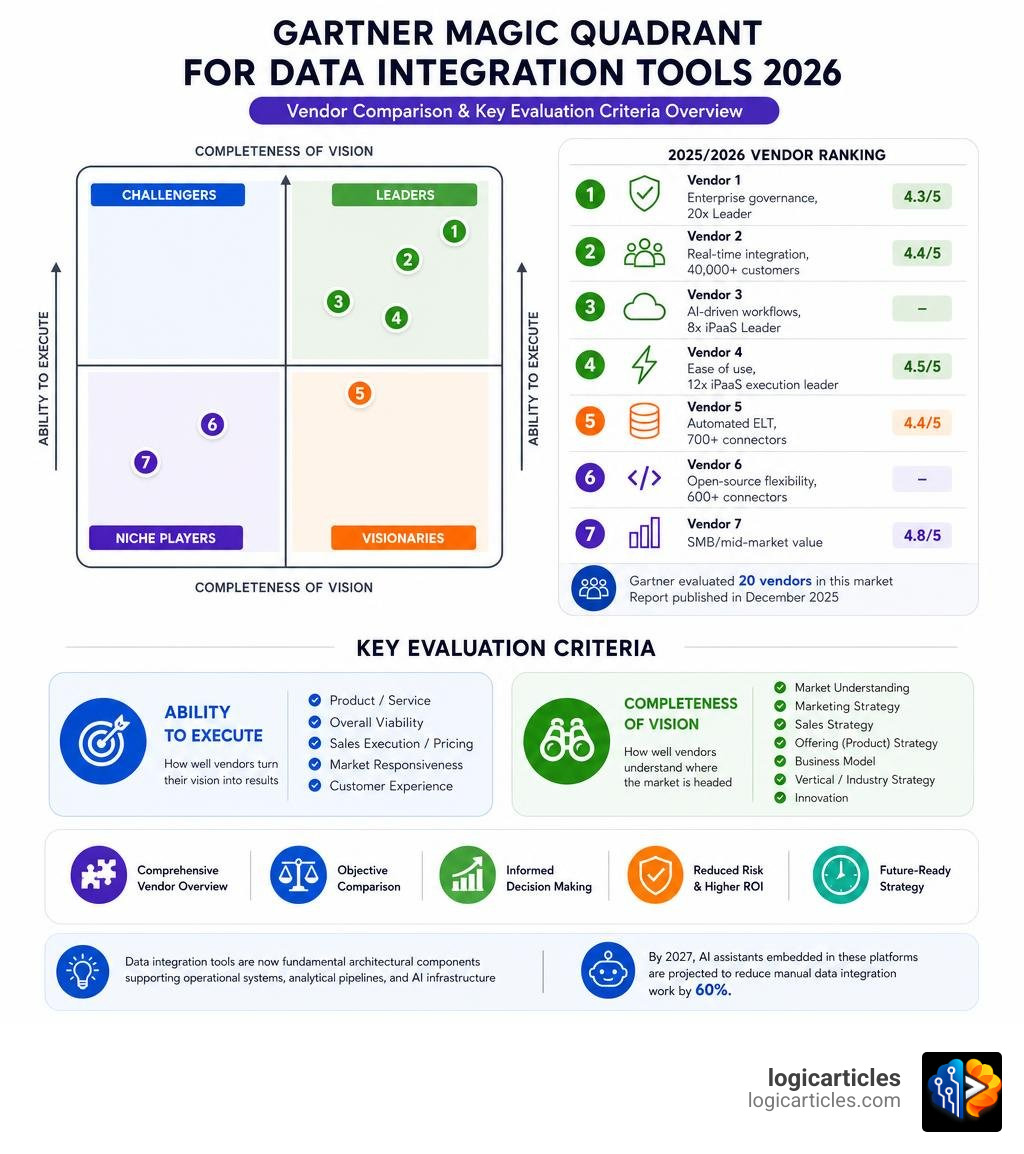
The magic quadrant for data integration tools 2026 is Gartner’s annual ranking of the vendors helping organizations move, transform, and manage data across modern cloud and hybrid environments. If you need a quick answer on who leads the pack, here it is:
Top Leaders in the 2025/2026 Gartner Magic Quadrant for Data Integration Tools:
| Vendor | Known For | G2 Rating |
|---|---|---|
| Informatica | Enterprise governance, 20x Leader | 4.3/5 |
| Qlik (Talend) | Real-time integration, 40,000+ customers | 4.4/5 |
| Microsoft Azure | AI-driven workflows, 8x iPaaS Leader | – |
| Boomi | Ease of use, 12x iPaaS execution leader | 4.5/5 |
| Fivetran | Automated ELT, 700+ connectors | 4.4/5 |
| Airbyte | Open-source flexibility, 600+ connectors | – |
| Skyvia | SMB/mid-market value | 4.8/5 |
Gartner evaluated 20 vendors in this market for the report published in December 2025. Each vendor is scored on two axes: Ability to Execute and Completeness of Vision.
Data integration tools are no longer just plumbing. As Gartner notes, they are now fundamental architectural components supporting operational systems, analytical pipelines, and AI infrastructure — all at once.
By 2027, AI assistants embedded in these platforms are projected to reduce manual data integration work by 60%. That makes choosing the right tool today a decision with serious long-term consequences.
This guide breaks down who the real leaders are, what separates them, and how to pick the right platform for your team’s needs and budget.
Understanding the Gartner Magic Quadrant for Data Integration Tools 2026
To understand how the magic quadrant for data integration tools 2026 shapes the industry, we must look at the strict methodology Gartner uses. Gartner does not just look at who has the flashiest features; they perform deep-dive technical evaluations, interview customers, and review vendor roadmaps.
The evaluation framework relies on two primary dimensions:
- Ability to Execute: This measures how well a vendor performs today. Gartner evaluates the product’s core capabilities, overall viability, sales execution, pricing flexibility, market responsiveness, and customer experience. If a platform is buggy or has a reputation for sudden, unpredictable price hikes, its score here will suffer.
- Completeness of Vision: This measures how well the vendor is positioned for the future. Gartner looks at the vendor’s market understanding, marketing and sales strategies, geographic reach, and product innovation. In 2026, this heavily weights how a vendor plans to integrate generative AI and automated metadata management into their pipelines.
To be included in the Gartner Data Integration Tools Report, platforms must support multiple integration styles. This means they cannot just do basic batch loading (ETL). They must also support real-time replication, streaming data, and data virtualization (querying data where it lives without moving it).
As we navigate through 2026, the market has shifted. Data integration is no longer just about feeding a static dashboard. It is about feeding live vector databases, orchestrating agentic AI workflows, and maintaining strict compliance across hybrid environments.
Top Vendors in the 2025/2026 Data Integration Landscape
The modern data stack has evolved, and the vendors in this year’s landscape reflect that maturity. No longer are organizations forced to choose between a rigid legacy system or a fragile custom-coded script. Instead, we have a highly specialized ecosystem of platforms designed for different scales, budgets, and technical skill levels.
Below is a breakdown of how the top contenders position themselves across the four classic Gartner categories:
- Leaders: Vendors with high execution capabilities and a clear, forward-looking vision. They support complex, multi-cloud architectures and are pioneer developers of AI-driven integration.
- Challengers: Strong executors with massive market share but perhaps a more conservative approach to cutting-edge features.
- Visionaries: Highly innovative platforms that might lack the massive global footprint or legacy enterprise support of the Leaders but are defining where the technology goes next.
- Niche Players: Specialized tools that excel in specific use cases, such as SMB-focused cloud syncs or specialized database replication.
| Vendor | Primary Strengths | Ideal For | Pricing Model |
|---|---|---|---|
| Informatica | Governance, Data Quality, MDM | Large enterprises | Consumption-based / Custom |
| Qlik (Talend) | Real-time streaming, CDC | Hybrid environments | Tiered subscription |
| Microsoft Azure | AI integration, Ecosystem | Azure-centric stacks | Pay-as-you-go (consumption) |
| Boomi | Low-code, API management | Hybrid cloud & iPaaS | Connection-based subscription |
| Fivetran | Fully managed pipelines | Modern cloud ELT | Active-row consumption |
| Airbyte | Open-source, Customization | Technical teams | Open source / Cloud credit |
| Skyvia | Ease of use, All-in-one | SMBs & Mid-market | Flat-rate monthly tiers |
Enterprise Leaders in the Magic Quadrant for Data Integration Tools 2026
When we look at the heavyweights of the enterprise tier, two names dominate the conversation: Informatica and Qlik (following its high-profile acquisition of Talend).
Informatica
Informatica has achieved a historic milestone, being named a Leader in the Gartner Magic Quadrant for Data Integration Tools for the 20th consecutive time. It remains the gold standard for global enterprises managing massive, highly regulated data estates.
The core of Informatica’s modern offering is its Intelligent Data Management Cloud (IDMC), powered by CLAIRE, its AI engine. Informatica does not just move data; it excels at making sure that data is clean, secure, and compliant. This is highlighted by its recognition in the Informatica Augmented Data Quality Solutions report, where it was named a Leader for the 18th time.
If you are running a multi-cloud environment with strict data residency laws, Informatica is incredibly hard to beat. However, smaller teams may find its pricing and sheer complexity overwhelming. For those looking to compare its performance against other high-end analytical engines, check out our guide on the Best Big Data Analytics Tools In 2026.
Qlik (Talend)
Following Qlik’s acquisition of Talend, the combined entity has solidified its spot as an absolute powerhouse. Qlik Talend Cloud serves over 40,000 customers globally and boasts an impressive 4.4/5 rating on Gartner Peer Insights.
Qlik’s traditional strength in real-time Change Data Capture (CDC) and streaming data blends beautifully with Talend’s robust data preparation and governance capabilities. The platform automates the entire pipeline: streaming, refining, cataloging, and publishing data in real time. It is an ideal fit for organizations that want an agnostic, real-time data integration solution that is not tied to a single cloud vendor.
Cloud and iPaaS Giants in the Magic Quadrant for Data Integration Tools 2026
As cloud adoption has become universal, the line between traditional data integration and Integration Platform as a Service (iPaaS) has blurred. In 2026, organizations do not just want to move database tables; they want to connect APIs and automate workflows.
Microsoft Azure
Microsoft continues to dominate the cloud landscape, having been named a Leader in the Gartner Magic Quadrant for iPaaS for the eighth consecutive year, according to the Microsoft 2026 iPaaS Leader Blog.
Azure Integration Services (including Azure Data Factory, Logic Apps, and API Management) is no longer just about moving data from point A to point B. Microsoft has reframed integration as the foundational infrastructure for AI. By utilizing “agentic workflows,” Azure allows organizations to build context-aware AI agents that can trigger business processes, query databases, and route information across fragmented systems securely. For teams already invested in the Microsoft ecosystem, it is a natural, highly scalable choice.
Boomi
Boomi has established itself as an integration pioneer, marking 12 consecutive years as a Leader. In the 2026 iPaaS evaluation, Boomi was positioned highest for its Ability to Execute, as noted in the Boomi 2026 iPaaS Execution Leader release.
Serving over 30,000 customers, Boomi has transitioned from a simple low-code connector tool to an enterprise-grade platform. Its Boomi Agentstudio has over 75,000 active AI agents deployed in production, helping businesses automate decision-making. Boomi is widely praised for its exceptional user experience (UX) and rapid deployment times, though complex, custom ETL transformations can sometimes push the platform to its limits.
SAP Integration Suite
For enterprises running on SAP, the SAP 2026 iPaaS Leader portal demonstrates how crucial native integration is. SAP Integration Suite is designed to connect SAP and non-SAP environments seamlessly. It helps businesses build event-driven architectures and manage APIs across hybrid and multi-cloud landscapes, ensuring that core financial and operational data remains synchronized.
If you are looking to combine these massive cloud suites with advanced automation, you might also want to explore how modern platforms handle workflows in our review of Droven Io AI Automation Tools.
Agile and Modern ELT/ETL Contenders
For cloud-first teams, modern data engineering is less about complex on-premise installations and more about speed, automation, and out-of-the-box connector ecosystems.
Fivetran
Fivetran has revolutionized the ELT (Extract, Load, Transform) space. Boasting a G2 rating of 4.4/5 and offering over 700 fully managed connectors, Fivetran is built for scalability.
Fivetran’s magic lies in its zero-maintenance pipelines. It automatically detects and handles “schema drift” (when a source database adds or changes a column, Fivetran updates the destination warehouse automatically without breaking the pipeline). It is highly efficient but uses a consumption-based pricing model based on “active rows,” which means your bill can scale rapidly if you are not careful about what you sync.
Airbyte
As the leading open-source alternative to Fivetran, Airbyte has quickly built a massive community of over 25,000 contributors. It supports over 600 connectors and is highly favored by technical teams who want to avoid vendor lock-in.
Airbyte allows you to run your pipelines on your own infrastructure for free, or use their hosted cloud service. It is highly customizable, though it requires more engineering resources to maintain and govern compared to fully managed SaaS options.
Skyvia
Skyvia is a cloud-native platform that has become a favorite for mid-market companies and SMBs, holding a spectacular G2 rating of 4.8/5. Starting at a highly affordable $79/month, Skyvia offers an all-in-one data platform that includes wizard-based ETL/ELT, cloud-to-cloud backup, and data integration via REST APIs. It is a fantastic option for teams that want zero-code simplicity without the steep enterprise price tag.
To see how these agile platforms fit into the broader ecosystem of smart productivity software, dive into our curated list of AI Tools You Should Know In 2026.
Key Technology Trends Shaping Data Integration in 2026
The data integration space is undergoing its most rapid evolution in a decade. We are moving away from rigid, scheduled batch jobs toward fluid, intelligent, and self-healing data networks.
Here are the major trends we are seeing in 2026:
- AI-Driven Integration & Agentic Workflows: We are transitioning from static automations to adaptive, context-aware processes. Instead of manually mapping source columns to destination columns, AI assistants now automatically suggest mappings and resolve schema conflicts. AI agents can now reason, look up missing data via APIs, and execute complex workflows without human intervention.
- Real-Time Change Data Capture (CDC): Waiting for a nightly batch job to run is no longer acceptable. CDC tracks changes at the database log level and streams updates instantly to your data warehouse. This keeps your operational dashboards and AI models updated with sub-second latency.
- The Dominance of ELT over ETL: Cloud data warehouses (like Snowflake, BigQuery, and Databricks) have become so powerful and cost-effective that it makes more sense to load raw data directly (ELT) and perform transformations inside the warehouse, rather than transforming it in transit (ETL).
- Reverse ETL: Data shouldn’t just sit in a warehouse for analysts to look at. Reverse ETL pushes cleaned, modeled data back out into operational tools like Salesforce, HubSpot, or Zendesk. This ensures your sales and support teams have customer health scores and usage metrics directly inside the tools they use daily.
- Governance by Design: With AI systems consuming massive amounts of enterprise data, governance cannot be an afterthought. Leading integration platforms now embed data quality checks, classification, and lineage tracking directly into the ingestion process.
For those looking to turn this integrated data into stunning, automated visual dashboards, check out our guide on AI Data Visualization Tools.
How to Choose the Right Data Integration Platform in 2026
With so many excellent options on the market, choosing the right platform can feel like a daunting task. We recommend using a structured evaluation framework based on your specific organizational profile.
- Identify Your Technical Persona: Ask yourself who will actually be building and maintaining these pipelines. If you have a team of dedicated data engineers who love SQL and Python, an open-source or code-heavy tool like Airbyte or custom dbt models is ideal. If ownership of the data flows belongs to business analysts or ops teams, a no-code/low-code platform like Skyvia or Boomi is a must for survival.
- Evaluate Your Connector Ecosystem: Do you need to connect to obscure, legacy on-premise databases, or a standard suite of modern SaaS tools? Look closely at a vendor’s native connector library. Ensure the connectors you need are fully maintained and not labeled “beta.”
- Model Your Pricing 12 Months Out: The cheapest tool today can easily become your loudest invoice tomorrow. Consumption-based models (based on rows synced or credits used) are incredibly easy to start with but can scale unpredictably as your data grows. Flat-rate or connector-based models offer much better budget predictability.
- Assess Real-Time Requirements: Do you actually need real-time data streaming, or is a 15-minute sync interval sufficient? True real-time CDC requires more expensive infrastructure and specialized tooling (like Qlik or native cloud services). Don’t pay a premium for sub-second latency if your business decisions are made weekly.
To read real, vetted peer reviews and see how these tools stack up across various industries, check out the Data Integration 2026 SoftwareReviews matrix.
Frequently Asked Questions about Data Integration Tools
What is the difference between ETL and ELT in 2026?
ETL (Extract, Transform, Load) transforms data on a separate integration server before loading it into the target system. This is useful for legacy on-premise databases with limited processing power. ELT (Extract, Load, Transform) loads raw data directly into a modern cloud data warehouse and uses the warehouse’s massive, scalable compute power to run transformations. In 2026, ELT is the preferred standard for cloud-first organizations because it is simpler, more flexible, and easier to debug.
How does AI impact data integration workflows?
AI has shifted integration from a manual engineering task to an automated, self-service process. AI-enhanced workflows can automatically map mismatched data schemas, detect anomalies in incoming data, and even write transformation SQL code. Furthermore, “agentic workflows” allow AI agents to securely interact with APIs, make decisions, and trigger business processes based on real-time data flows.
Why is real-time Change Data Capture (CDC) crucial now?
Traditional database syncing requires scanning entire tables, which strains source databases and API limits. CDC reads the database’s transaction logs to identify and extract only the rows that have changed. This allows for continuous, low-latency replication to your data warehouse without degrading the performance of your production applications.
Conclusion
The magic quadrant for data integration tools 2026 highlights a clear reality: data integration has evolved from a back-office utility into the vital nervous system of the modern, AI-driven enterprise. Whether you need the massive, governance-heavy capabilities of Informatica, the real-time agility of Qlik, the AI-native orchestration of Microsoft Azure, or the simple, cost-effective syncs of Skyvia, there is a tool designed specifically for your stack.
As we look toward a future dominated by real-time analytics and autonomous AI agents, the choices we make today about our data architecture will determine our agility tomorrow. Take the time to model your costs, evaluate your team’s technical capabilities, and choose a platform that can scale with your vision.
To stay ahead of the curve and discover more cutting-edge platforms, check out our comprehensive directory of Explore more AI Tools.